Automatic Door Guides and Articles
These automatic door guides are written from what we hold in writing, for the people who actually have to specify, budget for and live with an entrance. Where we do not hold a figure, we say so rather than estimating it.
How these automatic door guides are organised
Most questions about an automatic entrance belong to one of three stages: choosing one, running it, or dealing with the demands of a particular building. The library below is arranged that way.

Before you buy
Specification errors are expensive because they are discovered late. These automatic door guides cover the decisions that are hard to reverse once an operator is on the wall.
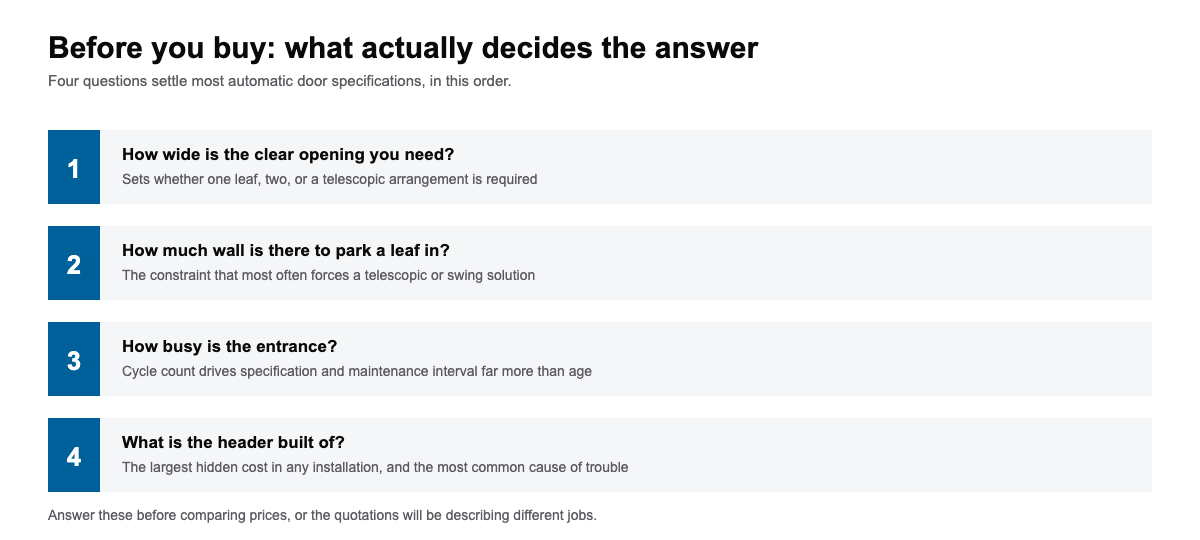
- Choosing the right automatic door operator size — How leaf weight, leaf width and clear opening constrain each other, and why the biggest operator is rarely the right answer.
- Automating a door you already have — When an existing hinged door can be automated, and when the hinges and frame make it a false economy.
- What an automatic door actually costs in South Africa — The cost drivers behind a quotation, including the builders work that is most often excluded from the cheapest price.
Once it is running
An entrance that has been installed well still needs to be understood. These automatic door guides deal with what changes after handover.
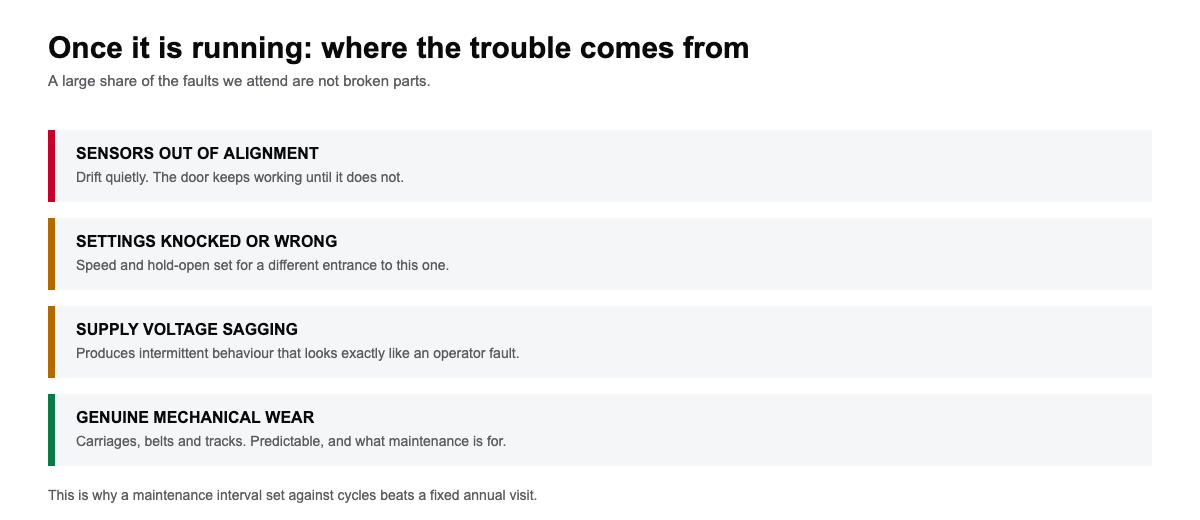
- Automatic door maintenance intervals — Why wear tracks cycles rather than the calendar, and what a service visit should actually cover.
- How automatic door sensors decide behaviour — The difference between activation and safety detection, and why most nuisance faults are a sensor rather than an operator.
- Automatic doors and load shedding — What happens to an entrance during an outage, what battery backup does and does not solve, and manual opening force.
By building type
The same operator behaves differently depending on what the building asks of it. These automatic door guides look at entrances in context.
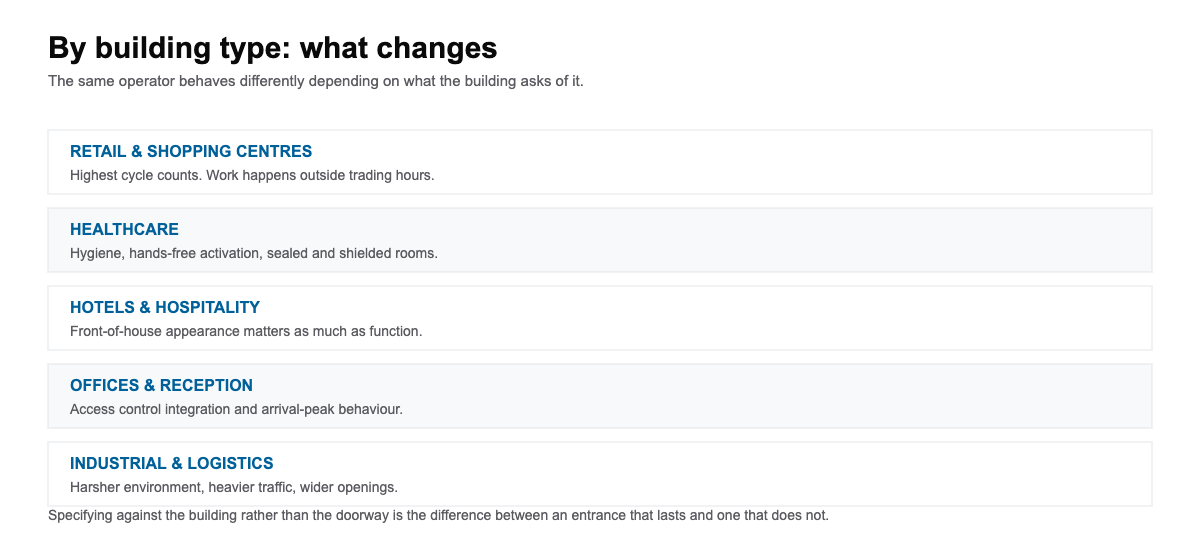
- Shopping centre automatic doors — The highest cycle counts of any sector, and what that means for specification, scheduling and maintenance intervals.
Product specifications rather than guides
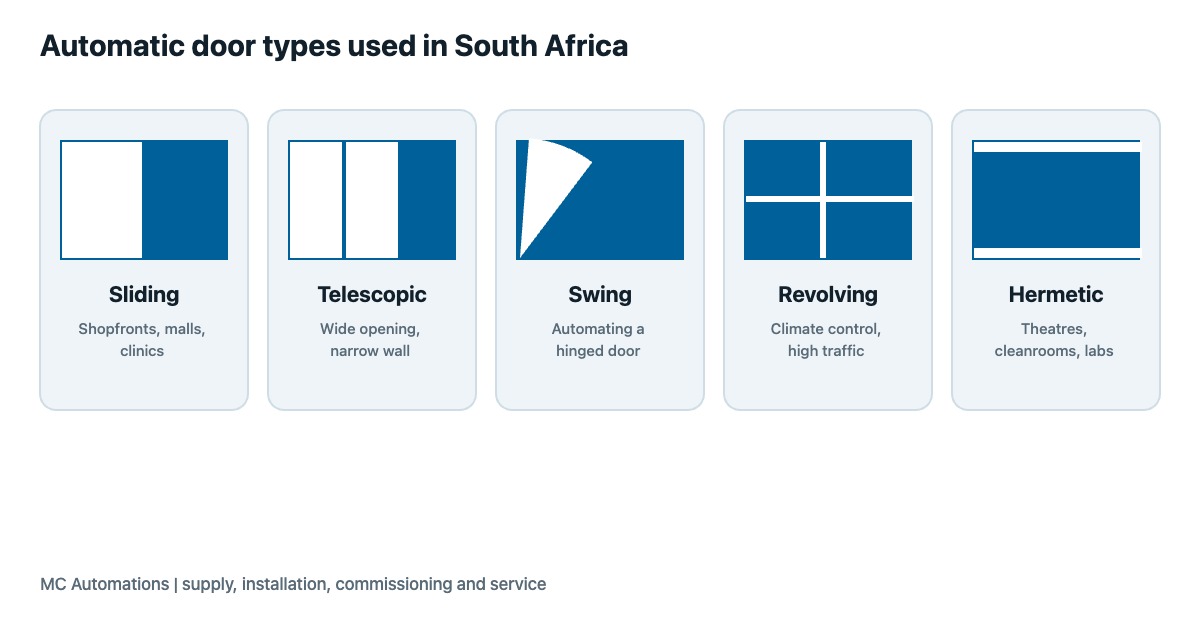
Where you need published figures rather than explanation, the brochures carry the full specification for each system: the MC-125 sliding door operator, the MCW-100 swing door operator, revolving entrances, telescopic sliding doors and hermetically sealing doors. Each is printable as a PDF for a tender.
For maintenance arrangements rather than products, our service level agreement page sets out the seven terms an agreement should define and how to compare one properly.
What these automatic door guides will not do
They will not give you a price for your entrance, because a price quoted without the opening is a guess. They will not claim certification we cannot evidence. And they will not convert a test result into a marketing promise — where an operator has been tested to a million cycles, these automatic door guides say exactly that and nothing more, because a service-life test result is not a maintenance-free period.
If a figure you need is missing from these automatic door guides, it is missing because we do not hold it in writing. Ask us and we will obtain it properly or tell you plainly that we cannot.
Quick answers from across the automatic door guides
If you only have a few minutes, these are the points the full articles keep coming back to. Each one is expanded in the relevant guide above.
Wear tracks cycles, not the calendar
This single idea explains more about automatic entrances than anything else in these automatic door guides. A shopping centre entrance can complete several thousand operating cycles a day; an office side door might manage a few dozen. Installed on the same date, they are years apart in real wear after twelve months. A maintenance contract specifying a fixed number of visits per year across every door on the estate therefore over-serves the quiet ones and under-serves the busy ones — and the busy ones are where a failure costs the most.
Most faults are not broken parts
A large share of breakdown attendance turns out to be sensors that have drifted out of alignment, settings that were knocked, or a supply voltage sagging at the bottom of its tolerance band and producing intermittent behaviour that looks exactly like an operator fault. This matters when you brief a contractor: describing the symptom accurately shortens the visit, because the technician arrives expecting the right problem rather than carrying parts on spec.
The header decides more than the operator does
Nearly every long-running complaint about an automatic entrance traces back to what it was mounted on. A header that flexes under a heavy leaf, or one that is out of level along its length, produces a door that binds at one end of travel and runs cleanly at the other. The operator compensates for a while by working harder, and that extra work lands on the belt and the carriages. A door needing its belt tensioned twice a year is usually telling you about the header rather than the operator.
Clear opening and leaf width constrain each other
People sizing an entrance often assume a wider opening can be solved by making one leaf bigger. It cannot, beyond a point. Each operator has a leaf width range as well as a leaf weight limit, and a wide opening usually has to be solved with a bi-parting arrangement or, where wall space is short, a telescopic one. These automatic door guides return to this because it is the constraint most frequently discovered late.
A test result is not a promise
Where an operator has been tested to one million cycles, that is a service-life test result obtained under test conditions. It is not a guarantee of a million trouble-free operations, not a maintenance-free period, and not a warranty term. We publish it as what it is. Any supplier converting a cycle test into a maintenance-free claim is telling you something the documentation does not support, and it is a useful thing to check when comparing offers.
What to read depending on why you are here
These automatic door guides serve three different readers, and the useful starting point differs for each.
- Specifying a new entrance. Start with operator sizing, then the cost guide. Between them they cover the decisions that are expensive to reverse.
- Running an existing estate. Start with maintenance intervals and sensors. Most avoidable cost on an existing estate sits in those two subjects.
- Dealing with a specific problem now. Sensors and load shedding cover the two most common causes of an entrance behaving oddly rather than failing outright.
Where these guides sit against the standards
Automatic entrances in South African buildings are designed against the SANS 10400 series supporting the National Building Regulations; copies are published by the South African Bureau of Standards. These automatic door guides are written to be practically useful rather than to restate regulation, and they do not claim compliance or certification on your behalf. Where a project needs evidence against a specific standard, ask us at enquiry stage and we will obtain it in writing or say plainly that we cannot.
Why we publish this at all
Buildings make better decisions when they understand the trade-offs, and a better-informed client is easier to work with, not harder. Most of what goes wrong with automatic entrances is decided before anybody orders an operator — in the header, the clear opening, the traffic assumption and the maintenance interval. These automatic door guides exist so those decisions get made deliberately rather than by default.
They also let you check us. Every figure quoted in these automatic door guides comes from documentation we hold, and where a number is absent it is because we do not hold it. That is a standard we would rather be measured against than a set of confident claims nobody can verify.
Glossary: the terms used across these automatic door guides
Entrance specifications use a small vocabulary precisely, and most misunderstandings between a building and a supplier come from two people using the same word differently. These are the definitions applied consistently throughout our automatic door guides.
- Clear opening — The gap actually available to walk or wheel through when the door is fully open. This is almost never the same as the structural opening, and quoting one when you mean the other is the most common source of error in an enquiry.
- Structural opening — The hole in the building. What the builder left. Everything else is fitted into it.
- Leaf — The moving panel itself. A single slide has one; a bi-parting arrangement has two that meet in the middle; a telescopic arrangement has two per side that nest as they open.
- Header — The structural member above the opening that carries the operator and the weight of the leaves. Surface-mounted operators transfer load into it on every cycle, which is why these automatic door guides return to it repeatedly.
- Stacking width — The wall space a leaf needs to park in when open. Where it does not exist, a telescopic or swing arrangement is usually the answer.
- Activation sensor — Detects somebody approaching and opens the door. Not a safety device.
- Safety sensor / presence detection — Detects somebody in the doorway and prevents the door closing on them. An entrance needs both this and activation; they do different jobs.
- Hold-open time — How long the door stays open after activation clears. Adjustable on both our operators, and the setting most often wrong for the people actually using the entrance.
- Manual opening force — The push needed to open the door by hand with no power. It matters most on escape routes and during outages.
- Service-life test — A test-condition result, such as one million cycles. It is not a maintenance-free period and not a warranty term, and these automatic door guides are careful never to present it as one.
- Cycle — One complete open-and-close. Cycle count, not age, is what drives wear and therefore the maintenance interval.
- Bi-parting — Two leaves opening away from each other from the centre. Clears a doorway faster than a single slide because each leaf travels half as far.
- Telescopic — Two leaves per side that nest as they open, fitting the same clear opening into roughly half the stacking width.
- Hermetically sealing — A door that seals against its frame when closed rather than merely closing to a running clearance. Specified where a room has to hold a condition.
- Push-and-go — A swing-operator behaviour where a light manual push starts the motor, which then completes the opening.
- Commissioning — Setting the entrance up on site: speeds, hold-open time and sensor coverage against how the door is actually used. Distinct from installation, and frequently where a job is let down.
Using these automatic door guides with a supplier
The most useful thing you can do with this material is to turn it into questions. A supplier who cannot say what the clear opening will be after installation, what the header will be fixed to, or what maintenance interval they are assuming has not looked at the job properly. None of those questions requires you to be technical — they simply require the vocabulary above.
The same applies when comparing quotations. Our automatic door guides on cost exist largely because buildings receive prices that are not describing the same job, and the difference usually sits in builders work, in the extent of the safety devices, or in whether commissioning was included at all. Asking those three questions consistently across three quotations does more to protect a budget than negotiating on the headline number.
Keeping this library honest
Two rules govern everything published in these automatic door guides. The first is that a figure appears only if we hold it in writing; where a specification is absent, it is absent because we do not have documentation for it, and we would rather say so than estimate. The second is that a test result is reported as a test result. Neither rule makes for punchy marketing, and both make the material more useful to somebody who has to sign off a decision.
If you find something in these automatic door guides that is unclear, out of date or contradicted by your own experience of an entrance, tell us. The material is written from installing and servicing these doors, and the feedback loop from buildings is what keeps it accurate.
Automatic door guides: frequently asked
Are these automatic door guides specific to your products?
No. They are written to be useful whoever supplied your entrance. Where a figure is product-specific we say which product it applies to, and the full specifications sit in the brochures rather than in the guides.
Do the guides give prices?
No. The cost guide explains what drives a price and what to check when comparing quotations, but a figure quoted without seeing the opening would be a guess.
How often are the guides updated?
When something changes or when a building tells us part of it is unclear. Where a specification changes, the brochures are the authoritative source.
Can I use this material in a specification document?
Yes. If you are quoting a product figure, take it from the relevant brochure rather than from a guide, because the brochures carry the published specification.
Do you cover doors from other manufacturers?
Yes. We service and repair automatic doors from other manufacturers, and these automatic door guides are written to apply across equipment rather than only to ours.
Five mistakes these automatic door guides exist to prevent
Almost every expensive problem we are called to could have been avoided at specification stage. These are the five that recur.
1. Narrowing the clear opening to make a standard door fit
Where wall space is short, the tempting shortcut is to reduce the opening until a conventional sliding leaf has somewhere to park. That works on a drawing and fails in a building the first time a bed, a pallet truck or two people with trolleys need to pass at once. If the required opening is genuinely wide and the facade is genuinely short, a telescopic arrangement exists precisely for that, and our automatic door guides on specification cover the trade-off.
2. Treating the header as somebody else’s problem
The operator is ordered, the builder forms an opening, and nobody owns the question of what the operator will actually be fixed to. This is the single most common cause of a door that never runs quite right, and it is almost impossible to correct afterwards without dismantling the installation.
3. Buying on headline price without comparing scope
Three quotations for the same doorway routinely describe three different jobs. Builders work included or excluded, commissioning included or not, the extent of the safety devices, and whether the clear opening is even the same. These automatic door guides push this point hard because it is where budgets are lost.
4. Fixed annual maintenance across an entire estate
Administratively neat and technically wrong. A busy entrance and a quiet side door do not wear at the same rate, and applying one interval to both guarantees that the door which matters most is the one being under-served.
5. Accepting a claim that the documentation does not support
A cycle test converted into a maintenance-free promise, a certification asserted rather than evidenced, a response time published as a headline. Each is easy to say and impossible to rely on. Our automatic door guides are written to be checkable, and we would encourage you to hold every supplier including us to that standard.
Where to go next
If you are early in a project, the specification guides above will save you the most. If you are managing an existing estate, start with maintenance intervals. And if you want published figures rather than explanation, the product brochures carry the specifications and print cleanly as PDFs for a tender pack. Whatever these automatic door guides do not answer, ask us directly — we will tell you what we hold in writing and what we do not.
In short
Automatic door guides at a glance
- Automatic door guides are quoted against the opening we measured, not a catalogue price.
- Ask about automatic door guides and we confirm the opening, the head and the power position first.
- Automatic door guides are installed and commissioned by our own technicians.
- Automatic door guides carry a 24-month warranty on the operator.