
Office park automatic doors for landlords and managing agents: who owns which entrance, the access states a working week needs, the morning peak that sizes the lobby, standardising across an estate, and why maintenance recovery changes the contract.
Automatic Doors for Schools, Colleges and Campuses
Automatic doors for schools are specified for the smallest and least predictable person who will use them, and that single constraint drives almost every decision. A sensor aimed for an adult can miss a six-year-old entirely. A hold-open time that works in an office is wrong when four hundred learners cross the same opening in ninety seconds because a bell has gone.
This guide covers what actually changes in a school or on a campus: the sensing, the peak loads, where automation genuinely helps and where the money is better spent elsewhere, and how the school holidays make this the easiest sector we work in to schedule.
Automatic doors for schools: children are not small adults
Everything about how learners use an entrance differs from how adults use one, and most specification mistakes in this sector come from forgetting that.
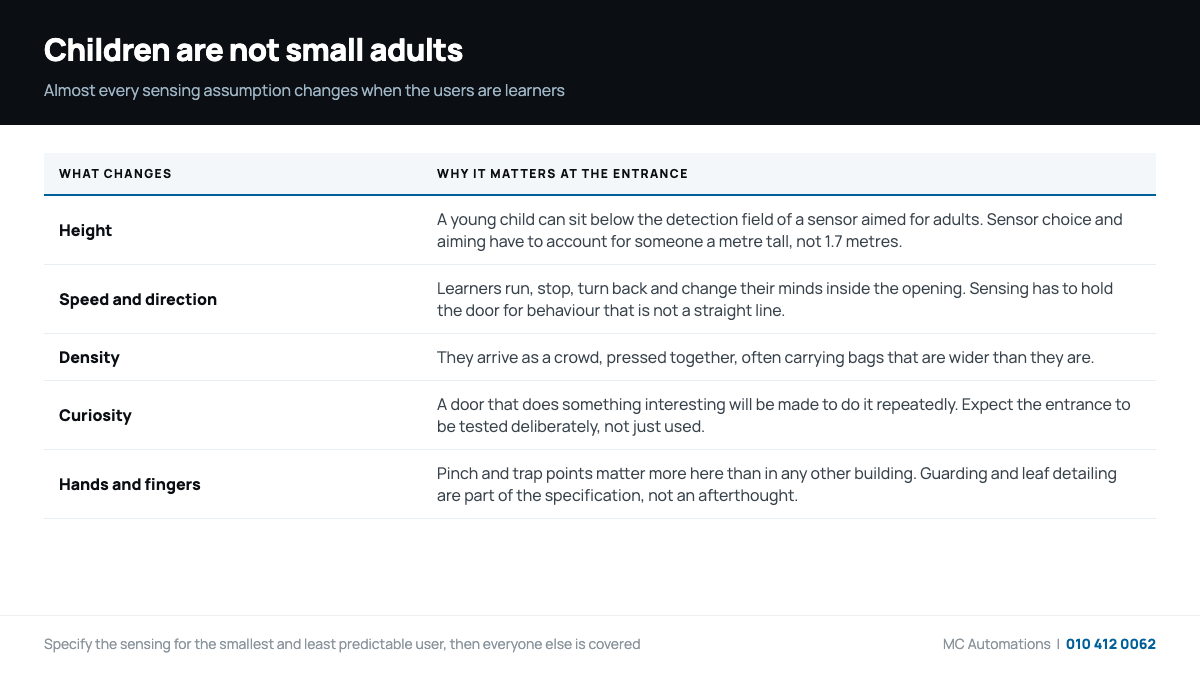
The height point is the one that matters most. Detection fields aimed for adult torsos can leave a gap at child height, and a child who is crouched, sitting or crawling is harder still. Sensor selection and aiming have to be set up for the smallest user on site and then checked, rather than set once from a standard installation drawing.
Pinch and trap points deserve the same attention. In a school the leaf edges, the gap at the jamb and anything a hand can reach into will be found, usually within a week of installation. That belongs in the specification conversation rather than being discovered later.
Bells create the sharpest peaks of any building type
Shopping centres have busy periods. Schools have a bell, and automatic doors for schools are loaded accordingly.
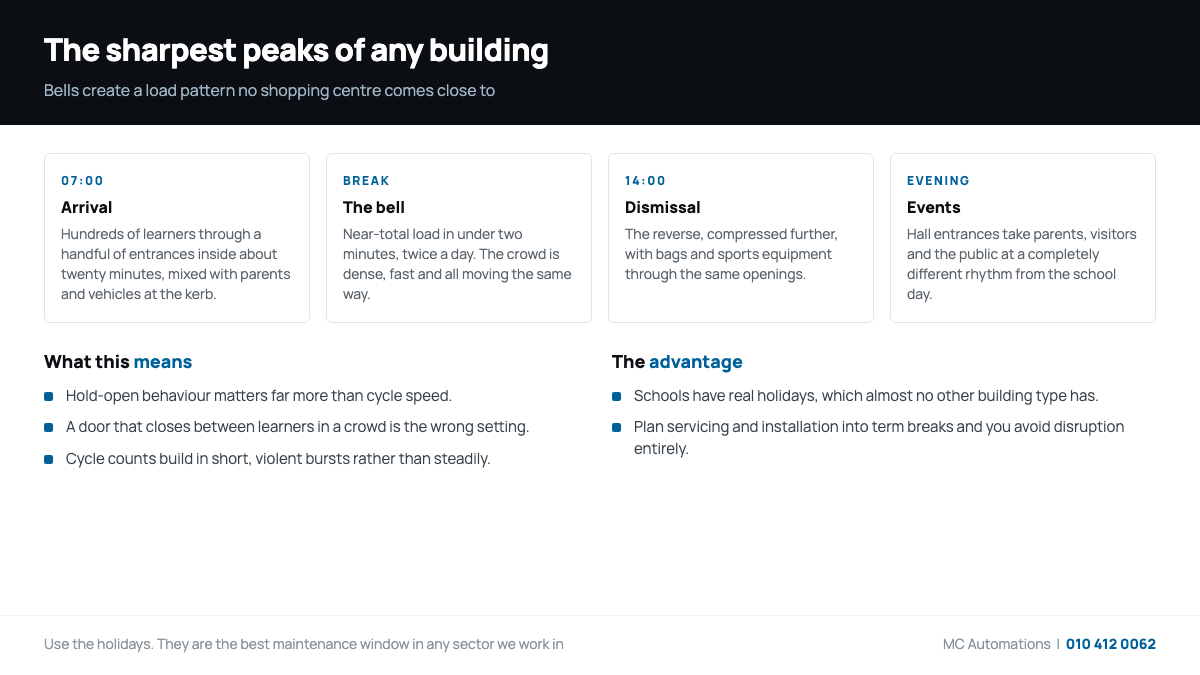
The practical consequence is that hold-open behaviour matters far more than cycle speed. During a break crowd you want a door that recognises a continuous flow and stays open for it, not one that closes briskly between learners and reopens thirty times. The second behaviour is both unpleasant and much harder on the mechanism.
Cycle counts also accumulate in short violent bursts rather than steadily, which is worth knowing when you set the service interval. A school entrance may be nearly idle for most of the day and still outlast its service interval on counted cycles before the calendar says so.
Where automatic doors for schools belong, and where they do not
We would rather talk a school out of the wrong door than take the order, because automatic doors for schools are often specified where something simpler would do. Not every opening benefits, and in a sector where budgets are tight the wrong choice is money that cannot be spent again.
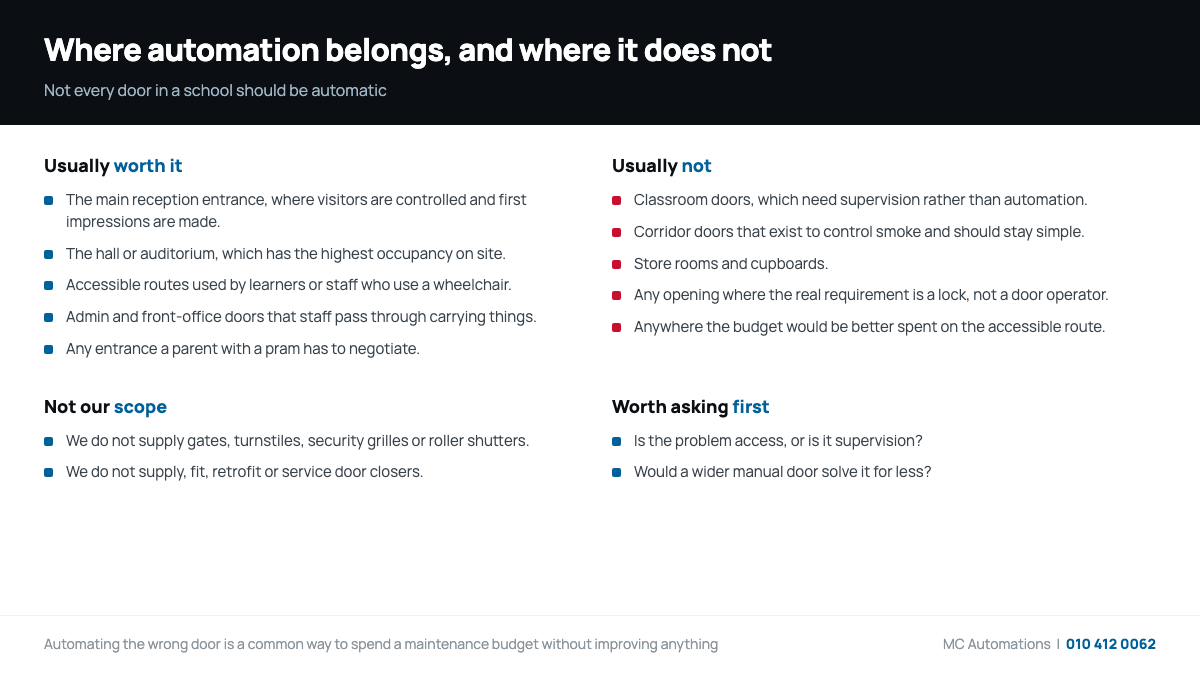
The honest test is whether the problem is access or supervision. A classroom door that children struggle with is usually a supervision question, or sometimes just a door that is too heavy and needs adjusting. An accessible route that a learner in a wheelchair cannot use independently is an access problem, and that is exactly what automation is for.
Being clear about scope: we supply, install and service pedestrian automatic entrances. We do not supply gates, turnstiles, security grilles or roller shutters, and we do not supply, fit, retrofit or service door closers. If what a school actually needs is a controlled gate at the perimeter, we are not the right call and will say so.
Security, and the direction that matters
Security is the dominant concern for most South African schools, and automatic doors for schools sit inside that conversation rather than solving it on their own.
The useful principle is that entry is controlled and exit is not. Visitors should be funnelled through a reception entrance where somebody sees them; learners and staff should never be prevented from getting out. On an escape route that is not merely good practice, it is a requirement: the route must be openable by hand, without power and without a key, while anybody is in the building.
Where a reception entrance carries access control, the interface between the reader and the operator needs specifying properly. Our automatic door access control page covers the options, and the physical side is in our guide to automatic door security, which is candid about what an entrance can and cannot be expected to resist.
Durability: automatic doors for schools take abuse
Automatic doors for schools are leaned on, kicked, hung off, held open with a bag and used as a meeting point. This is not misuse so much as a fact of the building, and it should be assumed in the specification rather than resented afterwards.
Two things follow. Choose the robust option at the opening rather than the elegant one, because an entrance that looks beautiful and marks easily will look worse within a term. And expect the floor track to collect grit, sand and whatever comes off a sports field, which makes the floor guide a routine service item rather than an occasional one.
Accessibility is usually the real reason
For many schools the trigger for installing automatic doors for schools is a specific learner or staff member, and that is the clearest case for the spend. An automatic door is often the difference between somebody moving through the building independently and needing help every time.
Where that is the driver, prioritise the accessible route end to end rather than automating one impressive entrance. A door that opens automatically into a passage with a step solves nothing. Our guide to automatic doors for disabled access covers how the route is assessed.
Halls, assembly and escape
Of all the automatic doors for schools on a site, those serving the hall carry the highest occupancy load, often by a wide margin, and that changes the entrance brief. Doors serving it are escape routes before they are anything else, which governs the opening width, the breakout behaviour and what happens when the alarm sounds.
Halls also have a second life as evening venues for parents and the public, with a completely different flow from the school day. Where a fire-resisting leaf is required, our fire-rated automatic doors page sets out exactly what we will and will not state on performance.
Standards, escape routes and who decides
Two sets of requirements govern automatic doors for schools, and they pull in opposite directions. Accessibility requirements push towards openings that anybody can use independently. Fire and escape requirements govern what those openings must do in an emergency. Where they appear to conflict, the fire strategy wins.
Both derive from the National Building Regulations and the supporting standards published by the South African Bureau of Standards, applied through the fire strategy prepared for your specific building. For a school hall in particular, occupancy loads are high enough that the escape provisions drive the opening width rather than the other way round.
What this means practically is that nobody should be specifying a school entrance from a catalogue. The requirement comes from the building, confirmed by whoever is competent to assess it, and the door is then selected against that. We will tell you plainly where something falls outside what we can confirm rather than guessing at a compliance position.
It also means the security arrangement has a hard limit. However strong the case for controlling who enters a school, an entrance on an escape route must remain openable by hand, without power and without a key, while anybody is inside the building. No access control configuration is permitted to override that.
Schools and campuses are not the same brief
Universities and colleges share much of the thinking behind automatic doors for schools, and differ in important ways.
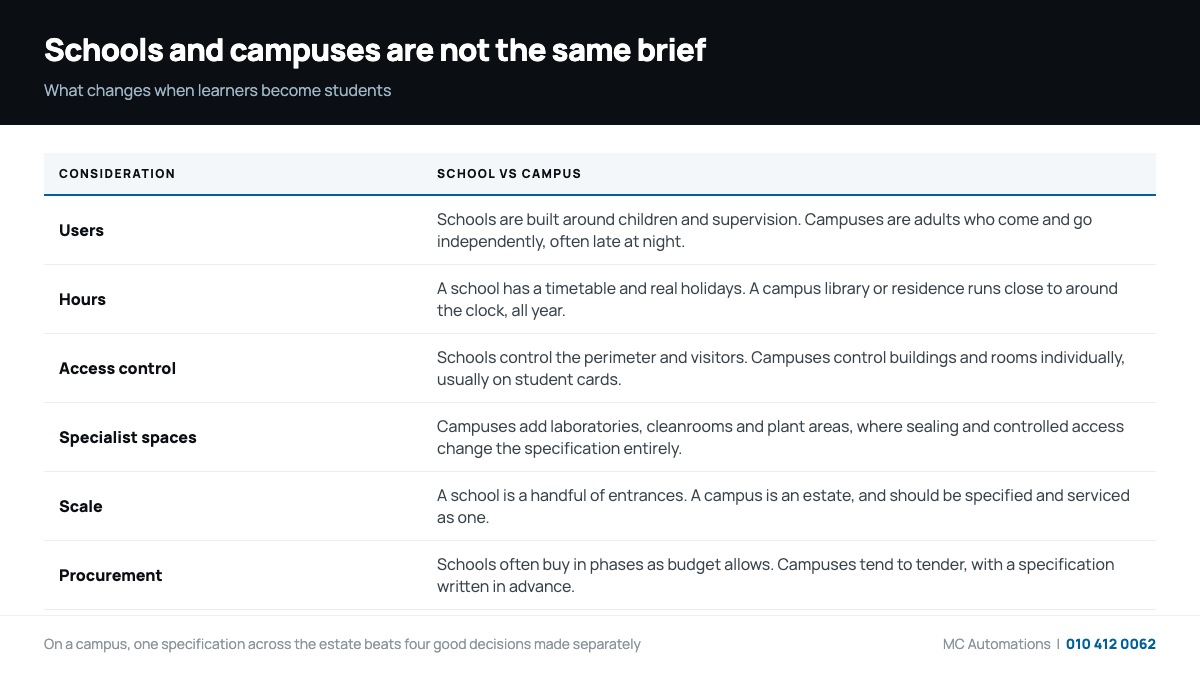
The biggest practical difference is scale and continuity. A school is a handful of entrances with real holidays; a campus is an estate where a library or residence runs close to around the clock all year. That removes the convenient maintenance window and pushes campuses towards planned, scheduled servicing on a counted-cycle basis rather than opportunistic work during breaks.
Service automatic doors for schools in the holidays
Schools have something almost no other building type we work in has: genuine, predictable periods with nobody in the building.
Installation that would be disruptive in term time is straightforward in a holiday. Servicing that needs an entrance out of use for an hour is a non-event. Planning this work into term breaks rather than around a timetable is the single easiest saving available in this sector, and it costs nothing but forward planning.
We service entrances on a six-month interval as standard, which for most schools maps neatly onto two holiday periods a year. Entrances serving halls and main gates may warrant more frequent attention given how the cycles concentrate.
Budget, phasing and getting it right
Most schools cannot fund all their automatic doors for schools at once, and that is fine provided the order is sensible. Start with the accessible route if there is a specific need, then the reception entrance where visitors are controlled, then the hall. Leave the openings that are merely convenient until last.
Specify once even if you buy in phases. Agreeing a single operator specification at the outset means spares fit every entrance, the maintenance team learns one system, and a technician attending the fourth door already knows what is on the wall. Phasing the purchase is sensible; phasing the specification is not.
If you are working to a published budget, our operators are supplied from R15 900 excluding VAT for the swing unit and R27 590 excluding VAT for the sliding unit. Those are supply figures for the drive; installation is quoted against the actual opening after a survey.
Retrofitting an existing school building
Very little of this work is new construction. Most enquiries about automatic doors for schools concern buildings put up decades ago, where an accessibility need has arisen or a reception has been reorganised for security reasons.
Retrofit is usually straightforward because the leaf, frame and glass normally stay and only the operator above the opening changes. Three things decide whether it is simple: headroom above the door for the header, a power supply nearby or a route for one, and whether the existing leaf is within the weight the operator handles. A survey settles all three in under an hour.
Older school buildings throw up two recurring complications. Power is often a long way from the opening, because nobody wiring a 1970s classroom block anticipated a door needing a supply. And original openings are frequently narrower than anything built today, so automating them produces a narrow door that opens by itself rather than an accessible route. Where that is the case, say so early: it is a building decision with a different budget and a different approval path.
Who signs it off, and who maintains it
The approval path matters more in this sector than in most, and it is worth establishing before quoting. Depending on the school, the decision may sit with the governing body, a district or provincial department, a private trust, or a facilities manager acting for a group of campuses. Each has a different timeline and a different appetite for phasing.
Maintenance responsibility is the question people forget. Automatic doors for schools are frequently installed by one budget and then maintained by nobody in particular, which is how an entrance ends up on its fourth year without a service. Agree at the outset who holds the service agreement and who is called when something fails, and write it into the handover rather than assuming it.
Where a school belongs to a group or a district runs several sites, a single service level agreement across the estate is materially cheaper than individual call-outs and means every entrance is on the same specification.
What goes wrong, and how to avoid it
Four failures account for most of the disappointment with automatic doors for schools.
Sensing set up for adults. The commonest and the most serious, because it is invisible until a small child is not detected. Specify and aim for the youngest user on site, and check it at every service.
The door propped open. A bag or a fire extinguisher wedged in an opening is a daily reality in schools. It defeats the entrance, and on an escape route it defeats the fire strategy. Usually the underlying cause is a hold-open time that is too short for the actual crowd, which is fixable.
Automating one impressive entrance. Money spent on a showpiece door at reception while the accessible route still has a step is money that has bought appearance rather than access.
Nobody holding the maintenance. An entrance with grit in the floor track and a drifted sensor is on its way to a replacement that the school will have to find budget for. The six-month interval exists to prevent exactly that, and in a school it falls naturally into the holidays.
Sports halls, aftercare and the building outside school hours
A school building is rarely used only between seven and two. Sports halls host evening fixtures, aftercare runs until early evening, facilities are hired out at weekends, and examinations fill the building outside term.
That matters for automatic doors for schools in two ways. The access arrangement has to allow a caretaker or coach to open a specific part of the building without unlocking all of it, which is a zoning question rather than a door question. And an entrance used by the public in the evening carries a different brief from the same entrance used by learners at eleven in the morning, particularly on sensing, because adults arriving in ones and twos behave nothing like a break crowd.
Automatic doors for schools: quick answers
Are automatic doors safe for young children?
They can be, provided the sensing is specified and aimed for a child rather than an adult. A detection field set up for an adult torso can leave a gap at child height, and a crouching or sitting child is harder still to detect. Pinch and trap points at the leaf edges and jamb also need attention, because in a school they will be found.
Which doors in a school are worth automating?
Usually the reception entrance, the hall, and any accessible route a learner or staff member needs to use independently. Usually not classroom doors, corridor doors that control smoke, or store rooms. If the real requirement is a lock or supervision rather than access, automation will not solve it.
Do you supply gates or turnstiles for school security?
No. We supply, install and service pedestrian automatic entrances only. We do not supply gates, turnstiles, security grilles or roller shutters, and we do not supply, fit, retrofit or service door closers. If a school needs a controlled perimeter gate, we are not the right contractor.
Can the doors be locked to keep learners inside?
Entry can be controlled; exit cannot be prevented on an escape route while anybody is in the building. That route must open by hand, without power and without a key. The workable arrangement is controlled entry through a supervised reception with free egress elsewhere.
When should the work be done?
In the holidays. Schools have genuinely empty periods that almost no other building type offers, which makes installation and servicing far easier to plan. A six-month service interval maps neatly onto two holiday periods a year.
How is a campus different from a school?
Scale and hours. A school is a handful of entrances with real holidays; a campus is an estate where libraries and residences run close to around the clock all year, with access control on individual buildings and specialist spaces like laboratories. Campuses are specified and serviced as one estate rather than door by door.
Talk to us about the school
Tell us which entrances are involved, whether any serve an accessible route or a hall, and when your holidays fall. Request a quote and we will work through it opening by opening, or call 010 412 0062.
