
Office park automatic doors for landlords and managing agents: who owns which entrance, the access states a working week needs, the morning peak that sizes the lobby, standardising across an estate, and why maintenance recovery changes the contract.
Petrol Station Automatic Doors: Forecourt Shop Entrances
Petrol station automatic doors work harder than almost any entrance we supply. A forecourt shop trades around the clock, customers come in for two minutes at a time, and the opening sits fully exposed with vehicles parked a metre or two from the glass. An entrance specified like an ordinary retail door will not last the way the site owner expects.
This guide covers what actually changes on a forecourt: the duty cycle, the question about dispenser proximity that almost nobody asks early enough, night trading behaviour, and how to specify an entrance that survives the position it is in.
Petrol station automatic doors work harder than any other retail entrance
Shopping centres close. Offices empty. Petrol station automatic doors do neither, and the load pattern reflects it.
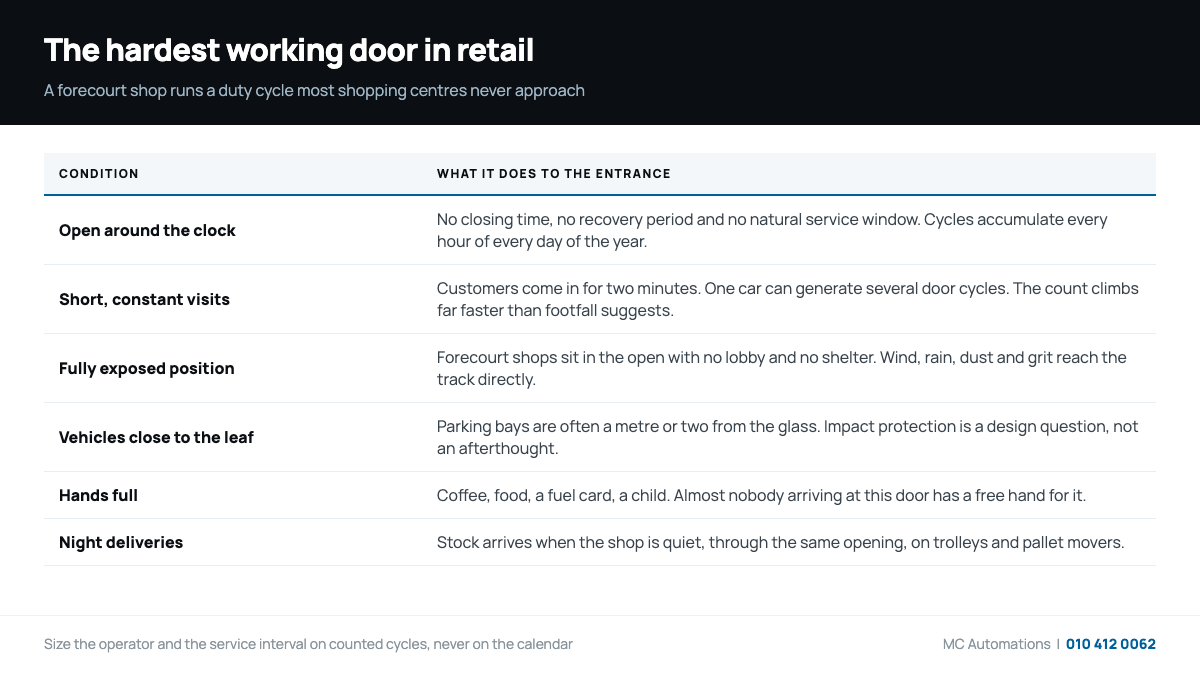
The cycle count is the part that catches people out. Footfall figures understate it badly, because a single customer often generates several door cycles — in for a coffee, out to the car, back in to pay. On a busy site the opening can exceed in a quarter what an office entrance accumulates in several years.
That is why service intervals on petrol station automatic doors should be set against counted cycles rather than the calendar. A fixed six-month interval is right for most buildings and under-serves a forecourt noticeably.
How close is the entrance to the dispensers?
This is the question that should be asked at survey stage and usually is not, and it is specific to this sector.
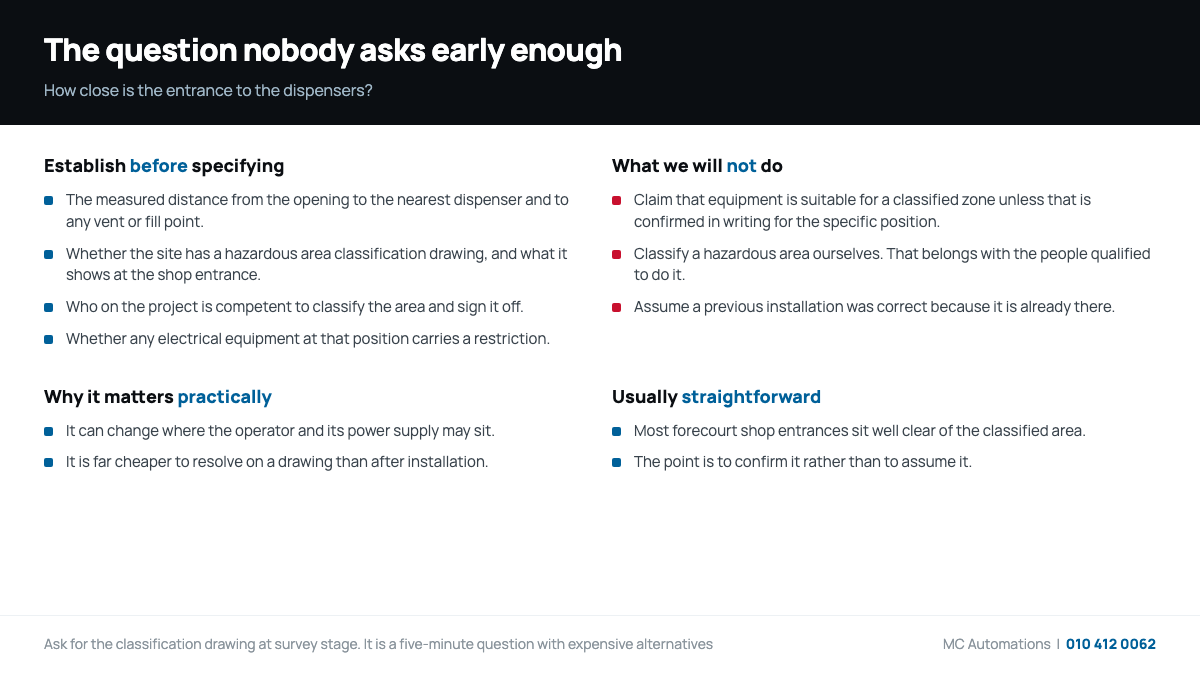
Fuel dispensing sites have areas around dispensers, vents and fill points where electrical equipment is subject to restriction, and those areas are defined on a hazardous area classification for the site. In practice most forecourt shop entrances sit well clear of them, because the shop is deliberately set back. The point is not to be alarmed; the point is to confirm it rather than assume it.
What we will not do is classify a hazardous area ourselves or claim that equipment is suitable for a classified position unless that has been confirmed in writing for that specific position. Classification belongs with the people qualified to do it, and we would rather ask for the drawing at survey than discover the issue after installation.
Ask three things at survey: the measured distance from the opening to the nearest dispenser and fill point, whether a classification drawing exists for the site, and who signs it off. It is a five-minute conversation with expensive alternatives.
Exposure, grit and the floor track on petrol station automatic doors
Petrol station automatic doors have no lobby in front of them. The entrance is in the open, often facing a prevailing wind across an apron of hard standing, and everything that blows across a forecourt ends up in the opening.
The floor track is where that shows up first. Sand, grit, leaves and spilled product collect in it, and a track carrying grit will wear carriages and rollers far faster than a clean one. On a forecourt the floor guide is a routine service item rather than an occasional check, and sweeping the track is the single most useful thing site staff can do between visits.
Wind matters too. An exposed opening on a windy site loads the operator on every cycle, which belongs in the sizing conversation rather than being discovered through premature wear.
Vehicles are very close to the glass
Parking bays sit closer to petrol station automatic doors than to almost any other shopfront, frequently a metre or two, which puts vehicles closer to the entrance than almost any other retail setting. Reversing manoeuvres happen at the glass line, often by drivers who are watching the pumps rather than the shop.
Impact protection is therefore a design question rather than an afterthought. Bollards or a kerb line in front of the opening, positioned so they do not obstruct the clear opening or an escape route, are far cheaper than a replaced leaf and an entrance out of service during trading.
Hands full, and not looking
Sensing on petrol station automatic doors should assume a customer with no free hand and divided attention. People arrive carrying coffee, food, a card and sometimes a child, having just come from a pump, and they are frequently looking back at the car rather than at the door.
Activation distance matters more than it sounds. The door should already be moving before somebody reaches it, so nobody has to break stride or wait in the opening with full hands. A hesitant door at this position generates complaints out of proportion to the actual delay.
Trading through the night
Petrol station automatic doors usually support more than one trading arrangement, because most forecourts trade for far longer than the shop is openly accessible, and the entrance has to support more than one arrangement in a day.
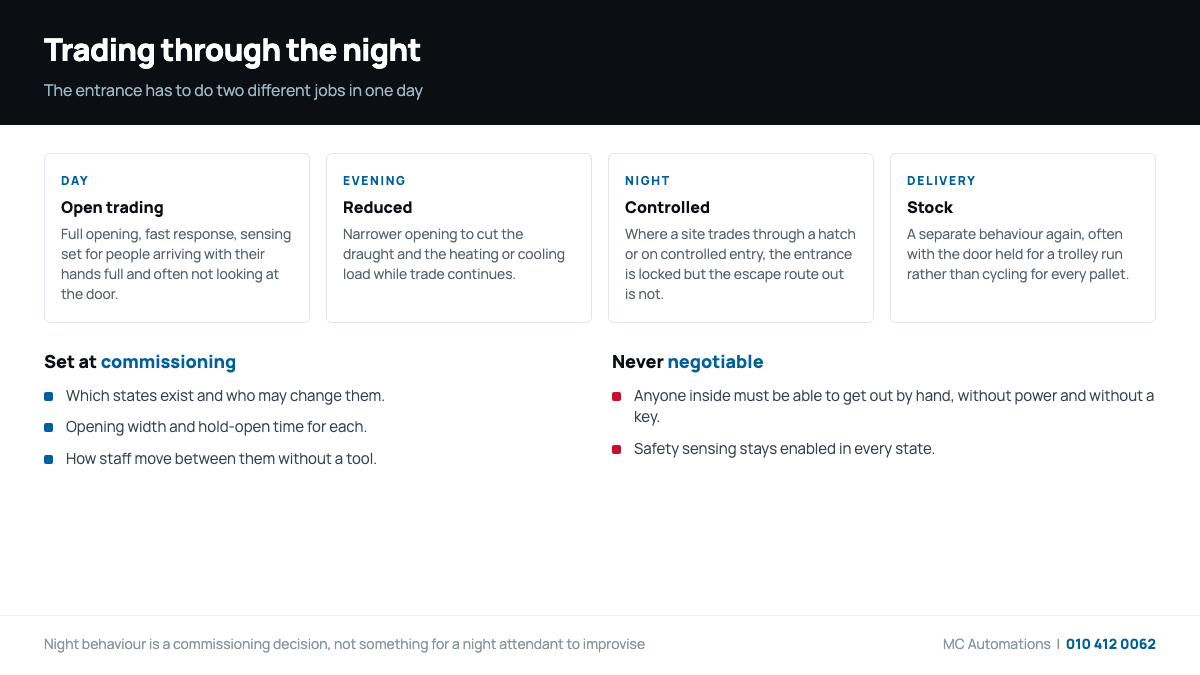
Where a site moves to controlled entry or hatch service at night, the critical point is that the locking applies to getting in, never to getting out. Anybody inside must be able to leave by hand, without power and without a key, and safety sensing stays enabled in every state. Our automatic door access control page covers the reader and locking options, and the physical side is in our guide to automatic door security, which is candid about what an entrance can and cannot be expected to resist.
Set the states at commissioning and record them. A night attendant should be able to move between them without a tool, and should not be able to override the emergency behaviour.
Power, outages and the forecourt
Petrol station automatic doors feel load shedding more than most retail entrances, because the shop is often the only part of the site that can keep trading when the pumps cannot.
Two questions follow. Is the entrance on the backup supply, or does it become a manual door for the duration? And what does it do in the gap between the mains dropping and a generator picking up — which is decided by the fire strategy for the site rather than by preference. Our write-up on automatic doors and load shedding covers that behaviour in more detail.
Servicing petrol station automatic doors on a site that never closes
There is no closing time on a forecourt, so petrol station automatic doors are serviced during trading, so service work happens during the quietest hours rather than out of hours. In practice that is usually the early hours of the morning, and the entrance has to be left trading when the team leaves.
A visit covers the drive and belt, the track and carriages, the floor guides, every sensor on the opening, the safety arrangement and the power-loss behaviour. On a forecourt the track and the sensors earn the most attention, because grit and exposure are what actually degrade these entrances.
Same-day call-outs are available in Gauteng; elsewhere the visit is planned and confirmed at booking. If an entrance is down now, book a technician. For sites in a group, a service level agreement across the estate is materially cheaper than individual call-outs.
Specifying a forecourt entrance
Most of the difficulty with petrol station automatic doors is settled before anything is ordered.
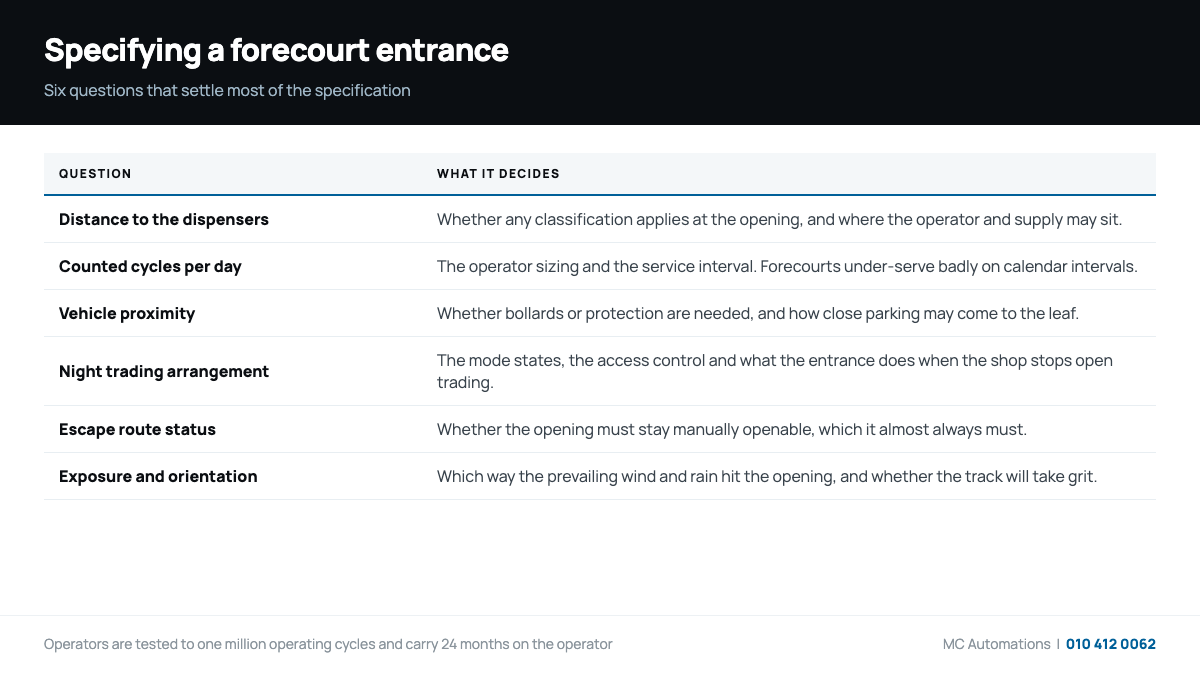
If you run several sites, specify once and buy per site. One operator specification across the estate means one spares holding, one set of commissioning values and a technician who already knows what is on the wall at site number four. Forecourt groups refurbish continuously rather than all at once, which makes a single standard more valuable here than almost anywhere.
Requirements for entrances on escape routes derive from the National Building Regulations and the standards published by the South African Bureau of Standards, applied through the fire strategy prepared for the site. Hazardous area classification is a separate assessment again, carried out by whoever is competent to do it for that forecourt.
One note on scope: we supply, install and service pedestrian automatic entrances. We do not supply roller shutters, security gates or grilles, and we do not supply, fit, retrofit or service door closers.
Retrofit on an operating forecourt
Almost all work on petrol station automatic doors is replacement rather than new build. A site has been trading for fifteen years, the original entrance has been attended too many times, and the shop cannot close while it is changed.
That constraint shapes the job more than the engineering does. The leaf, frame and glass usually stay and only the operator above the opening changes, which brings most replacements inside a single overnight window. Where the opening itself has to change, that is a building decision with a different approval path and should be programmed separately rather than bundled with the door.
Three things decide whether a retrofit is simple: headroom above the opening for the header, a power supply nearby or a practical route for one, and whether the existing leaf is within the operator’s weight range. A survey settles all three quickly, and on a forecourt it should also capture the distance to the dispensers and the cycle count while somebody is standing there.
Plan the temporary arrangement before the night rather than during it. A shop that trades through the work needs a route for customers, and the attendant needs to know what the entrance will be doing at three in the morning.
The rest of the site
Discussion of petrol station automatic doors tends to stop at the shop front, but most forecourts have more than one opening worth thinking about.
Many sites now carry a fast food outlet, a coffee franchise or a seating area, each with its own entrance and its own trading hours. Those doors often run on a different schedule from the shop and sometimes on a different tenant’s budget, which is how a forecourt ends up with three brands of operator and three service arrangements on one apron.
Staff and back-of-house doors take stock deliveries on trolleys and pallet movers, usually at night. They see less traffic than the shop front but carry heavier, wider loads, and they are the openings most often left off the service schedule because no customer uses them.
Where a site has a car wash or an air and water bay, the entrances near them pick up more water and more grit than the rest of the forecourt. That is a positioning and drainage question as much as a door question, and it is worth raising at survey.
What goes wrong with petrol station automatic doors
Four things account for most of the failures we attend on forecourts.
The track is never swept. Grit does more damage to these entrances than cycles do. It is also the cheapest thing on this list to prevent, and site staff can do it.
Calendar servicing on a counted-cycle problem. A forecourt entrance on a standard interval is being under-served, and the symptom is a door that gets noisier and slower through its second year.
Impact nobody reported. A reversing vehicle catches the leaf or a bollard, the door still works, and nothing is logged. The alignment is out from that moment and the wear accelerates quietly.
Night mode left to the attendant. Where the states were never commissioned properly, staff improvise, and the usual improvisation is to prop or defeat something. If the night arrangement is awkward, fix the arrangement rather than blaming the person on shift.
Petrol station automatic doors: quick answers
How often should a forecourt shop door be serviced?
More often than a standard six-month interval, and set against counted cycles rather than the calendar. A forecourt shop trades around the clock and a single customer can generate several door cycles, so the opening accumulates wear far faster than footfall figures suggest.
Does the entrance need special equipment because of the fuel?
It depends entirely on where the opening sits relative to the dispensers, vents and fill points, which is defined by the site’s hazardous area classification. Most forecourt shop entrances are set well clear of classified areas, but that should be confirmed from the drawing at survey stage rather than assumed. We do not classify hazardous areas ourselves.
Can the shop door be locked at night while the site still trades?
Yes, where a site moves to hatch service or controlled entry. The locking applies to entry only: anyone inside must still be able to leave by hand, without power and without a key, and safety sensing stays enabled in every state. The states are set at commissioning rather than improvised by a night attendant.
What wears out first on a forecourt entrance?
The floor track and the carriages, because grit, sand and spilled product blow across an open forecourt and collect in the opening. Sweeping the track is the most useful thing site staff can do between service visits, and the floor guide should be treated as a routine service item rather than an occasional check.
How do we protect the door from vehicles?
Bollards or a kerb line in front of the opening, positioned so they do not obstruct the clear opening or an escape route. Parking bays on a forecourt often sit a metre or two from the glass, so impact protection belongs in the design rather than being added after a reversing incident.
Do you work across a group of filling stations?
Yes, and it is the sensible way to buy. One operator specification across the estate means a single spares holding and consistent commissioning settings, which matters because forecourt groups refurbish continuously rather than all at once. A service level agreement across the sites is cheaper than individual call-outs.
Talk to us about the site
Tell us how many sites are involved, roughly how many cycles a day the shop entrance takes, and how far the opening sits from the nearest dispenser. Request a quote and we will work through it site by site, or call 010 412 0062.
