
Automatic Warehouse Doors
Powered pedestrian entrances for warehouse and industrial buildings, specified for dust, impact and the traffic they actually carry.
Automatic warehouse doors is a phrase that covers two completely different products, and the first job of this page is to separate them, because ordering the wrong one wastes months.
What automatic warehouse doors usually means
Ask ten people and you get two answers. Some mean the vehicle opening: the roller shutter or high-speed door a forklift drives through. Others mean the pedestrian entrance: the personnel door people walk through, between the office and the floor, at the welfare block, or across a compartment line.
We work on the second. Our automatic warehouse doors are powered pedestrian entrances — sliding, swing and telescopic — specified for industrial conditions. We do not supply roller shutters, gates or garage doors. Vehicle openings, shutters and dock equipment are a different trade with different equipment and different safety rules, and they are not what we do.
That distinction matters commercially. A pedestrian entrance in a warehouse is not a lighter version of a retail entrance. It lives in a harsher environment and it is used differently, which changes almost every specification decision.
Where automatic warehouse doors actually go
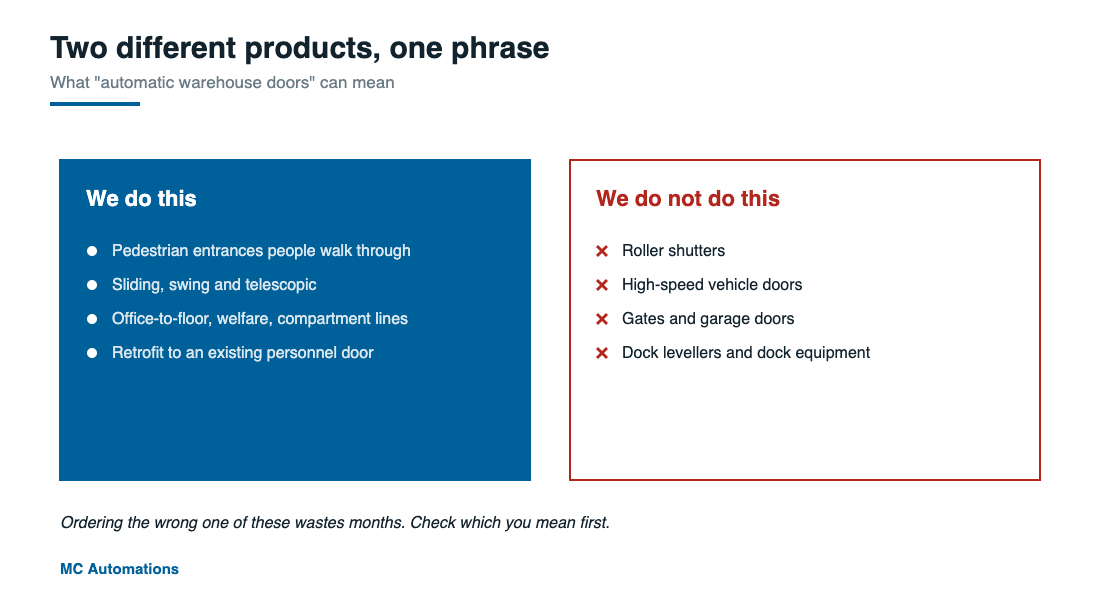
- Office to floor. The most common position, and the one most often propped open. Staff cross it constantly, frequently carrying something, and it usually separates a heated or cooled office from an unconditioned warehouse.
- Welfare and canteen blocks. High footfall at fixed times, hands often full, and a hygiene expectation that makes hands-free operation worth paying for.
- Compartment lines. Where a fire barrier crosses a route people use. A manual door here gets wedged; a powered one does not need to be.
- Cold and controlled areas. A pedestrian entrance beside the vehicle opening, so people are not walking through the shutter aperture.
- Goods-in reception. Where drivers and visitors arrive on foot and the entrance is the first thing they meet.
Why industrial entrances wear faster
The same operator that runs quietly for years in an office will not last as long on a warehouse floor, and the reasons are mostly environmental rather than mechanical.
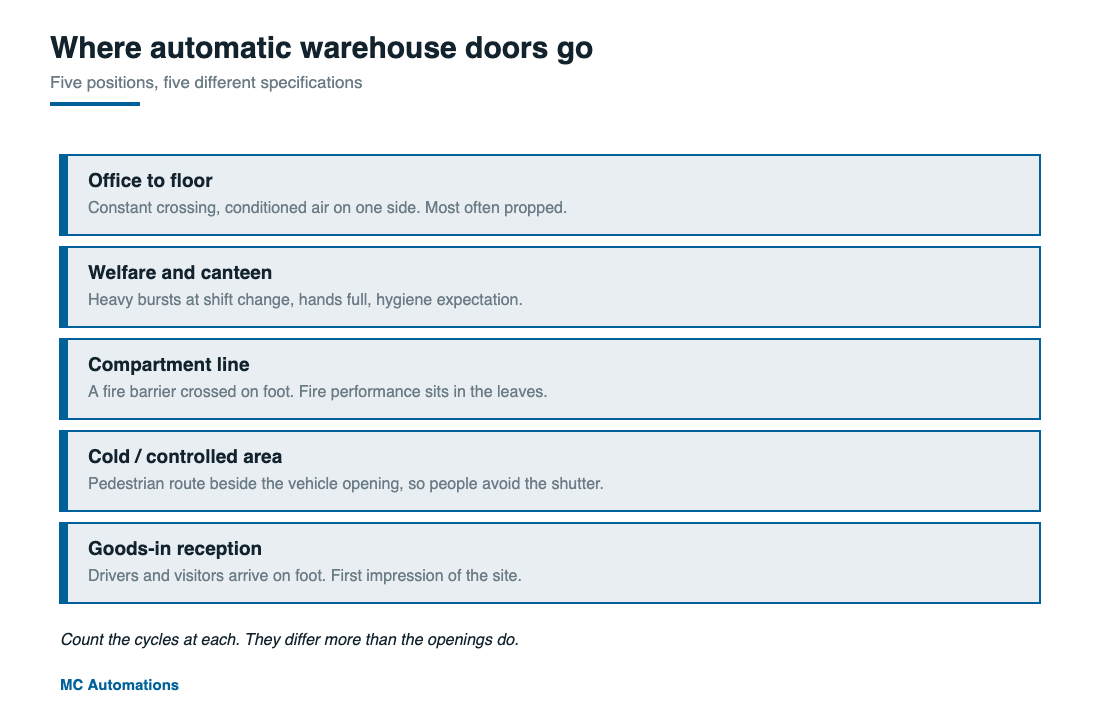
- Dust and grit. Concrete dust, pallet debris and whatever comes in on tyres all end up in the track. This is the single biggest factor in the working life of automatic warehouse doors, and it is the one nobody budgets for.
- Forklift and pallet impact. No cycle test models a pallet corner catching a leaf. Impact is the most common reason an industrial operator is replaced early rather than serviced.
- Temperature swing. A door between a hot roof space and a cooled area moves through a bigger range than a shopfront ever does, and seals and electronics both feel it.
- Vibration. Racking traffic and compressors shift sensor aim over time, so drift shows up sooner than it would elsewhere.
- Propping. The defining industrial failure. A door that slows people down gets wedged with whatever is nearest, and then it is neither automatic nor closed.
Specifying for the traffic, not the opening
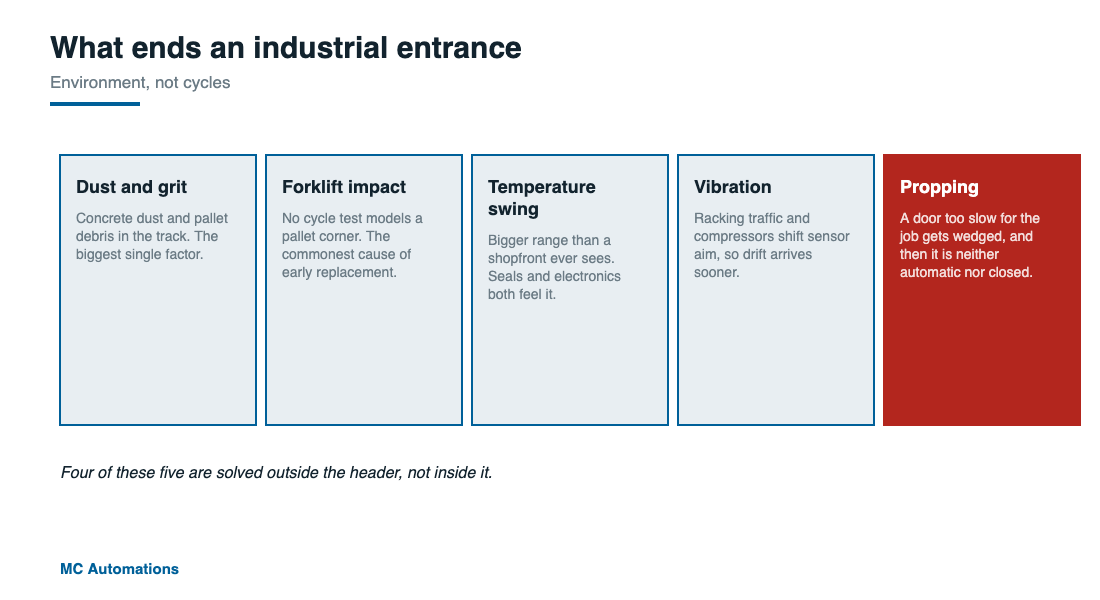
Opening width is what people quote. Traffic is what decides the specification. Count the cycles before anything else: a welfare door at shift change does more work in ten minutes than the goods-in entrance does all morning, and automatic warehouse doors sized on width alone routinely end up under-specified for the busy one and over-specified for the quiet one.
Three numbers settle the operator choice — the clear opening you need, the weight of the leaf once it is glazed or clad, and the real daily cycle count. The MC-125 sliding operator covers the heavier and busier positions; the MCW-100 swing operator suits a new or existing swing leaf where a slide does not fit. Where the wall space either side is tight, a telescopic arrangement gets a wider clear opening out of the same reveal.
Safety where forklifts and people share space
A retail entrance is designed around people walking. An industrial one has to cope with people walking, people carrying, and vehicles moving nearby, which raises the safety stakes on automatic warehouse doors considerably.
Activation and safety sensing do different jobs and both matter more here. Activation opens the door for an approaching person; presence sensing holds it while somebody is standing in the opening. In a warehouse the presence field is the one that earns its keep, because a person pushing a cage or carrying a box does not move like a shopper and is far more likely to stall mid-opening.
Two further decisions belong in the specification rather than in a conversation afterwards. Opening and closing forces are set on site at commissioning against the real traffic, not left on a factory default. And the behaviour on power loss — battery backup, fail-safe or fail-secure, manual release — changes what is fitted inside the header, so it is decided before the order. Sensor arrangement and sensor replacement is worth getting right first time on an industrial entrance; re-aiming a badly positioned sensor forever is more expensive than positioning it properly once.
Compartment lines and fire
Warehouses are compartmented, and a compartment line crossed constantly by people on foot is exactly where a manual fire door gets defeated. If the entrance sits on such a line, the leaves themselves carry the fire performance and the requirement is confirmed per project rather than taken from a catalogue. That is a different specification from an ordinary industrial entrance and it is covered on our fire rated automatic doors page.
Where the doorway also sits on an escape route, what it must do on alarm and on power loss is set by the building’s fire strategy and confirmed with the fire consultant or the local authority. It is not a preference and it is not ours to decide.
Protecting the door is cheaper than replacing it
Most of the working life you get from automatic warehouse doors is decided by what surrounds them rather than by the operator inside the header.
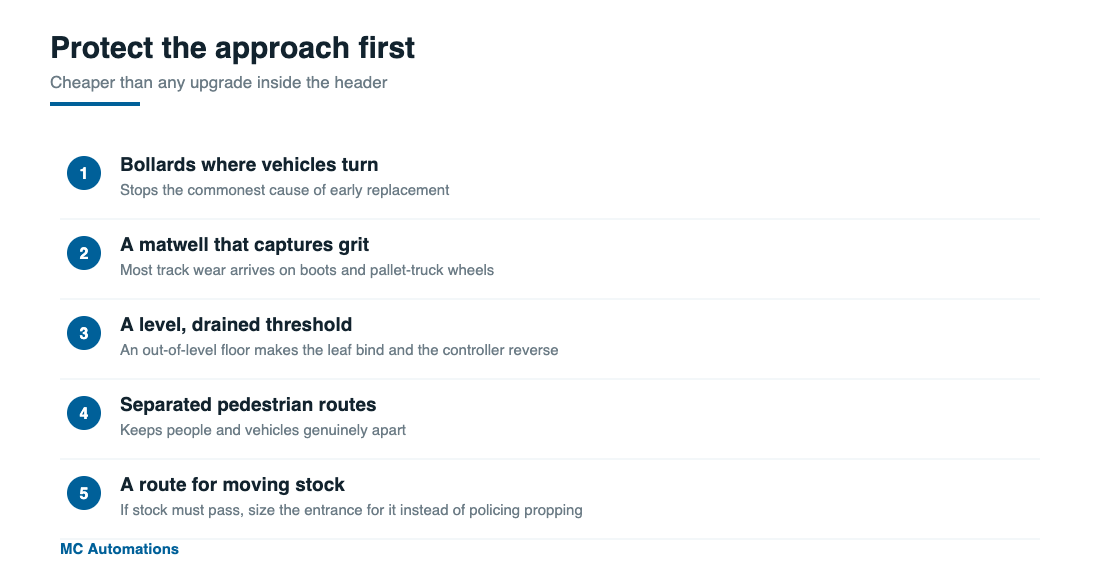
- Bollards where vehicles turn. A bollard costs a fraction of an operator and stops the single most common cause of early replacement.
- A matwell that actually captures grit. Most track wear arrives on the soles of boots and the wheels of pallet trucks.
- A drained, level threshold. A floor that is out of level makes the leaf bind, the controller reads it as an obstruction, and the entrance starts behaving oddly for reasons nobody connects to the floor.
- Guarding on the approach. Keeping pedestrian and vehicle routes genuinely separate protects both the people and the door.
- Somewhere else to prop. If stock has to move through, size the entrance for that job. Propping is a specification failure, not a discipline failure.
Hygiene, dust and controlled areas
Some warehouse entrances sit between areas that must not share air: food storage, pharmaceutical handling, paint or powder areas, cold rooms. Where the seal matters as much as the movement, a hermetically sealed arrangement is a different product from a standard slide, and it is specified on the sealing requirement rather than on traffic alone.
Where the requirement is simply keeping dust in one place, a well-sealed standard entrance with the right threshold detail usually does the job. Worth asking which of the two you actually need before paying for the more specialised one.
Servicing intervals in industrial buildings
Service intervals should follow the cycle count, not the calendar, and in a warehouse that usually means more frequent attention than a facilities schedule assumes. A welfare door at shift change and a goods-in entrance on the same annual visit means one is being over-serviced while the other runs to failure.
What a visit covers on automatic warehouse doors is largely what the environment does to them: clearing the track properly rather than sweeping around it, checking the floor guides for grit wear, re-aiming sensors that vibration has shifted, and looking for impact damage before it becomes a track problem. Our service visits record the condition each time, so the interval can be adjusted from evidence rather than habit.
Where an entrance has already failed, we attend repairs on any major brand, not only the operators we supply.
Installing without stopping the operation
Warehouses rarely close, which is the practical constraint that shapes most industrial installations. Automatic warehouse doors usually have to go in around a live operation, and the sequencing matters more than the product choice.
Tell us at quotation stage whether the opening has to stay usable during the works, whether there is a shift pattern that makes some hours impossible, and whether a facilities contractor has to sign the work off. Those three answers decide whether we work in normal hours, after hours, or in a staged sequence where the opening is temporarily secured and reopened each day. After-hours work costs more; being surprised by it costs more still.
Where an entrance is being replaced rather than created, the old leaves usually come out and the new arrangement goes in within the same visit. Where the opening is new, the building work has to be complete and the power has to be at the header before we attend, and the most common cause of a wasted trip on automatic warehouse doors is a header with no supply to it.
Retrofit or replace
If a warehouse personnel door already exists and works mechanically, automating it is frequently cheaper than replacing the entrance. Three questions decide whether that is available: whether the header can carry a current operator, whether the leaf weight and clear opening still suit how the area is used now, and whether the existing leaf is in good enough condition to be worth driving.
Where all three answers are yes, a retrofit restores the entrance without the cost of new framing. Where any one is no, pricing both options separately is worth doing, because the gap is often smaller than people expect once making good around a new frame is included. Ask for automatic warehouse doors to be quoted as a retrofit and as a full replacement, then compare like for like.
Cost drivers particular to industrial sites
- Environment protection. Bollards, guarding and threshold work are frequently excluded from a bare supply price and then discovered later.
- Power to the header. If there is no supply at the opening, that is an electrical job before it is a door job.
- Duty rating. A welfare entrance at shift change needs an operator specified for that traffic, not the cheapest unit that fits the width.
- Access to the opening. Racking, stock or a live picking aisle in front of the doorway all add time.
- Out-of-hours attendance. Sometimes unavoidable, always worth agreeing in advance rather than at invoice.
None of those are hidden costs if they are named at quotation. They become hidden costs when a quotation covers only the operator and everything around it arrives later.
A short glossary
- Pedestrian entrance. A doorway people walk through. What automatic warehouse doors means on this page.
- Vehicle opening. A shutter or high-speed door a forklift drives through. A different trade; not what we supply.
- Clear opening. The usable width once the door is open, which is always less than the structural opening.
- Duty rating. The traffic level an operator is specified to handle continuously.
- Presence sensing. The safety field that holds the door while somebody is standing in the opening.
- Retrofit. Adding an operator and sensors to an existing leaf, keeping the frame and track.
- Compartment line. A fire boundary in the building that a doorway crosses.
Guidance published by the South African Bureau of Standards is a reasonable starting point for the vocabulary, though the requirement for any particular opening is confirmed for that building rather than taken from a general document.
Common mistakes on industrial entrances
- Specifying automatic warehouse doors on width alone. The opening tells you what fits. The traffic tells you what survives.
- Buying the cheapest operator for the busiest door. The welfare entrance at shift change is usually the hardest-working opening in the building and the one most often under-specified.
- Treating propping as a staff problem. If automatic warehouse doors get wedged, the specification did not match how the building works.
- Leaving the power supply until installation day. No supply at the header means a wasted visit and a rescheduled job.
- Skipping the bollards. Protecting the approach costs a fraction of replacing automatic warehouse doors after a forklift finds them.
- Setting one service interval for the whole site. Entrances in a warehouse wear at very different rates and should be on different schedules.
None of these are exotic failures. They are the ordinary ways automatic warehouse doors end up costing more than they should, and every one of them is avoidable at specification stage.
What to send us for a quotation
Five things get you a realistic answer without a site visit, and they are the same five that stop a quotation being revised later.
- The clear opening you need, and the structural opening you have.
- A photograph of the doorway, taken far enough back to show the wall either side and the header above.
- An honest daily cycle count, or the best estimate you can defend.
- What is on each side: office, floor, cold area, welfare block, compartment line.
- Whether vehicles pass anywhere near the approach.
From that we will tell you which operator fits, what the entrance needs to cope with the environment, and what has to be confirmed before an order. If the opening does not need automating at all, that answer is free too.
Quick answers on automatic warehouse doors
- Automatic warehouse doors here means powered pedestrian entrances, not vehicle openings.
- Automatic warehouse doors do not include roller shutters, gates or garage doors, which we do not supply.
- Automatic warehouse doors are specified on traffic and leaf weight, not on opening width alone.
- Automatic warehouse doors wear fastest from dust, grit and forklift impact rather than from cycles.
- Automatic warehouse doors need presence sensing more than retail entrances, because people carry loads through them.
- Automatic warehouse doors on a compartment line carry their fire performance in the leaves, confirmed per project.
- Automatic warehouse doors should have bollards and a matwell before they have upgrades inside the header.
- Automatic warehouse doors get propped when they are too slow for the job, which is a specification failure.
- Automatic warehouse doors follow a service interval set from the real cycle count, not the calendar.
- Automatic warehouse doors can be retrofitted to an existing leaf where the header will carry an operator.
- Automatic warehouse doors carry a 24-month warranty on the operator.
- Automatic warehouse doors are repaired on any major brand, not only the ones we supplied.
Frequently asked questions
Do you supply roller shutter doors for warehouses?
No. We do not supply roller shutters, gates or garage doors. We work on pedestrian entrances — sliding, swing and telescopic doors that people walk through. Vehicle openings are a different trade with different equipment and different safety rules.
Can an existing warehouse personnel door be automated?
Often yes, if the header will carry an operator and the leaf weight and clear opening still suit how the area is used. The leaves, track and frame are retained and only the drive and sensors are added, which is usually the cheaper route.
How often should an industrial entrance be serviced?
On an interval set from its real cycle count, which in a warehouse is normally more often than a facilities schedule assumes. Dust and impact, not cycles alone, drive the wear.
What stops forklifts damaging the door?
Bollards where vehicles turn, genuinely separated pedestrian and vehicle routes, and a threshold that is level and drained. Impact damage is the most common reason an industrial operator is replaced early.
Our staff prop the door open. What is the fix?
Usually the specification rather than the staff. If stock has to move through the opening, the entrance was sized for the wrong job. Solve the reason people prop it instead of policing the behaviour.
Do you work outside Gauteng?
Yes. We install and service automatic entrances nationwide, and we attend repairs on any major brand rather than only our own operators.
Talk to us about a specific opening
Send the opening size, a photograph of the doorway and an idea of daily traffic, and we will tell you what suits the position and what it needs to survive the environment. Request a quote or call 010 412 0062.
In short
Automatic warehouse doors at a glance
- Pedestrian entrances only — no roller shutters, gates or garage doors.
- Specified on traffic and leaf weight, not on opening width.
- Dust, grit and forklift impact end more industrial entrances than cycles do.
- Bollards and a matwell buy more working life than anything inside the header.
- Service intervals follow the cycle count; repairs cover any major brand.