
Hermetically sealed doors
MCL-165
A sliding door that seals when it closes. Built for theatres, cleanrooms and any room where controlling air leakage matters more than convenience.
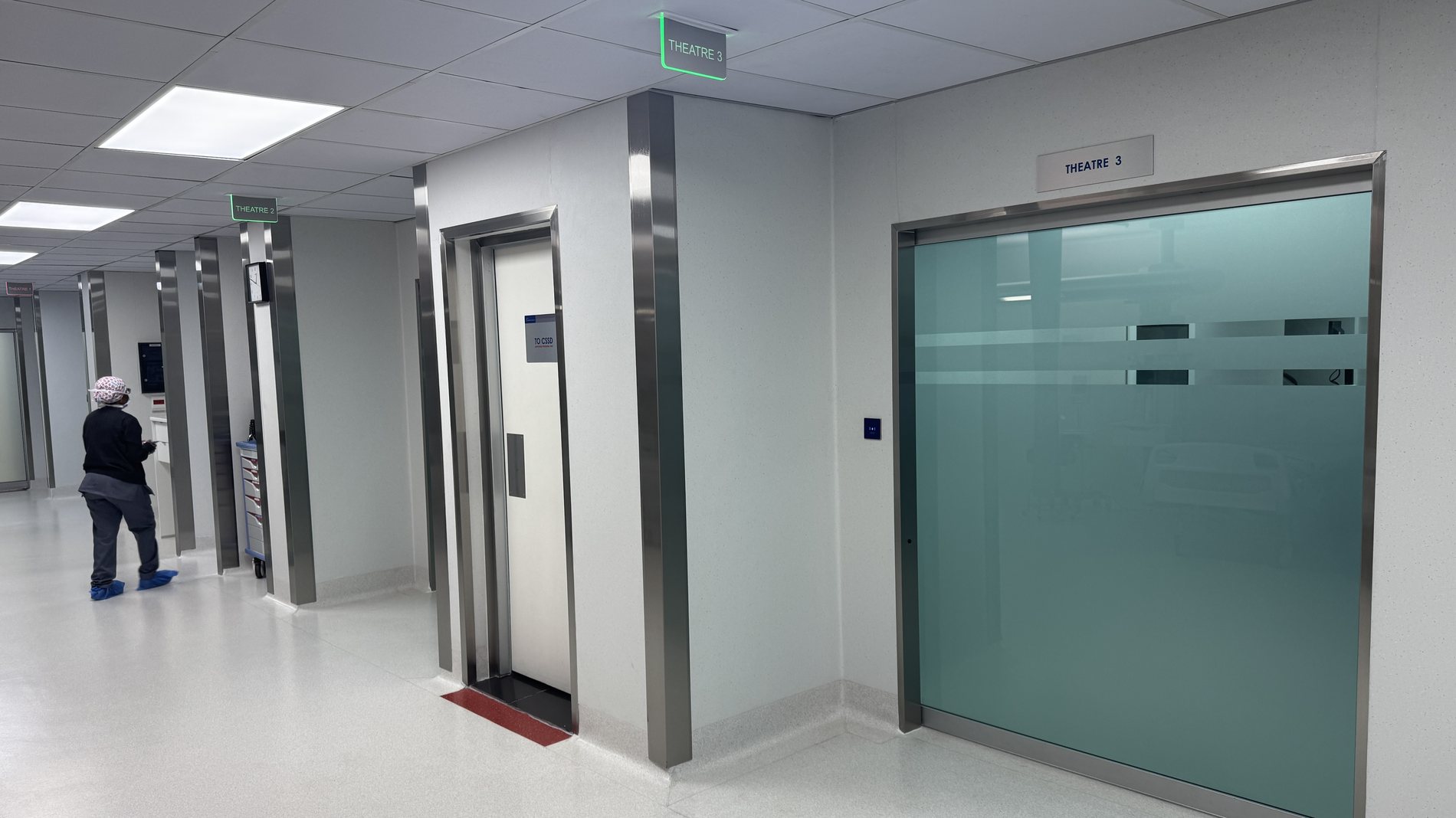
Overview
Hermetically sealed doors: shut versus sealed
An ordinary automatic sliding door closes. Hermetically sealed doors close and then seal, which is a different job and needs a different track.
The MCL-165 uses a patented track system that draws the leaf against the frame as it finishes closing, so the gap that a normal sliding door leaves is closed. That is what lets a room hold its air rather than exchange it with the corridor every time somebody walks through.
It matters in two ways. Air handling is expensive, and a room that leaks costs more to condition than one that does not. And where the point of the room is to keep what is inside separate from what is outside, an entrance that does not seal undermines everything else you have specified.
The system is designed for normal service as an automatic pedestrian sliding door, and for sealing in dry rooms. It is not a fire door and it is not a substitute for one; where a fire rating is required that is a separate specification and we will say so.
Everything else about the entrance still applies. It is still a powered door in a busy human-impact position, so the activation and safety devices around it matter as much as they do on our automatic sliding doors, and it still needs a service interval set against the cycles it actually carries. See spare parts and multi-brand service for how we look after doors after installation.
- Patented sealing track — the leaf seals against the frame when closed
- Windproof and dustproof when sealed
- Quiet running under normal pedestrian service
- Hands-free activation — elbow or foot switch, hands-free sensor, radar or remote
- External power beam option
- Lead-lined leaves available where radiology shielding is required
Applications
Where hermetically sealed doors are specified
Operating theatres
Hands-free entry with the room’s air held rather than exchanged with the corridor.
Cleanrooms
Controlled environments where air permeability is part of the specification.
Laboratories
Separation between spaces held at different conditions.
Radiology
Lead-lined leaves where shielding is required alongside the seal.
Intensive care and isolation
Entrances that must seal reliably and open hands-free.
Food and pharmaceutical
Production areas where dust and draught control is part of the process.
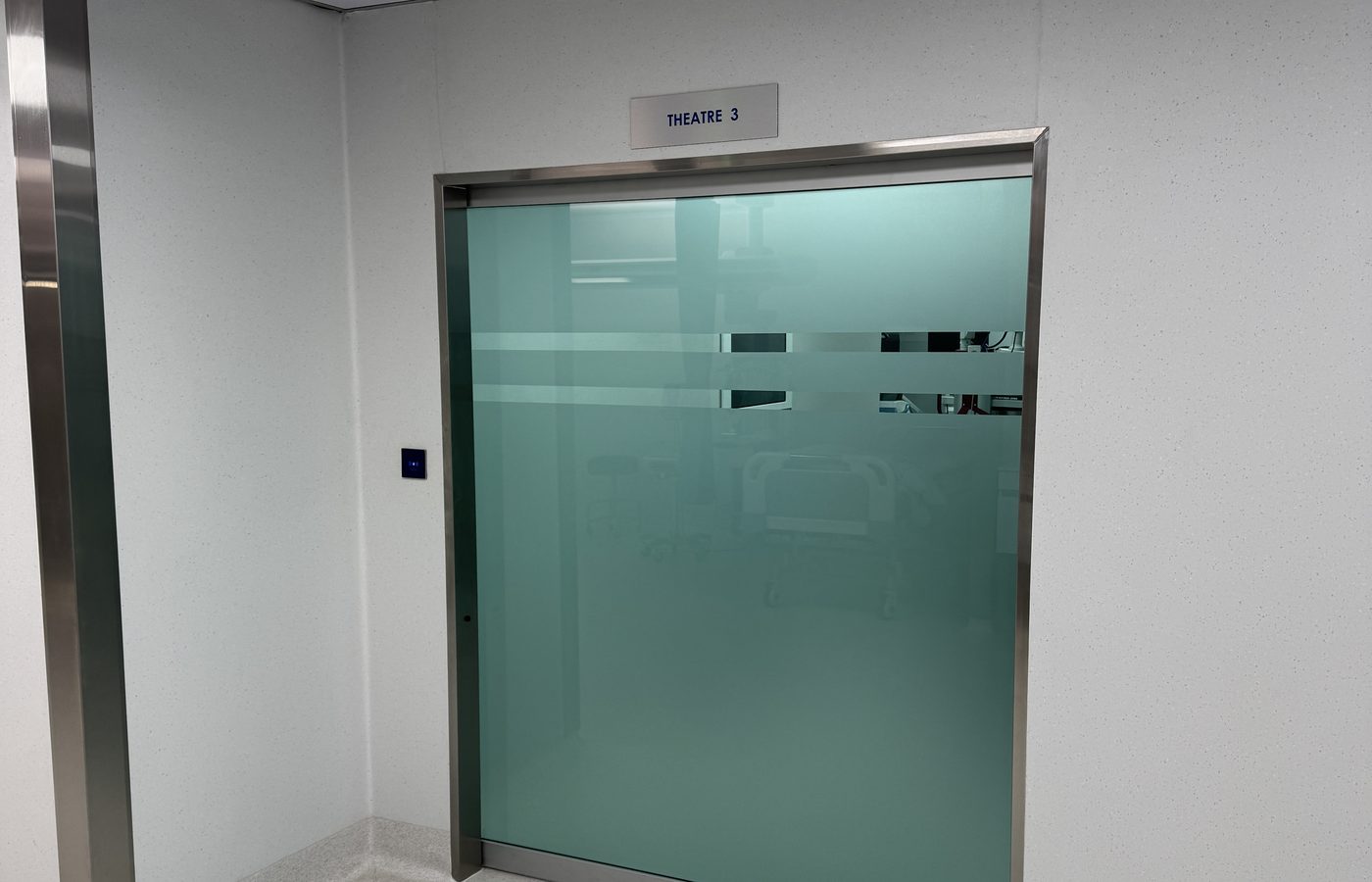
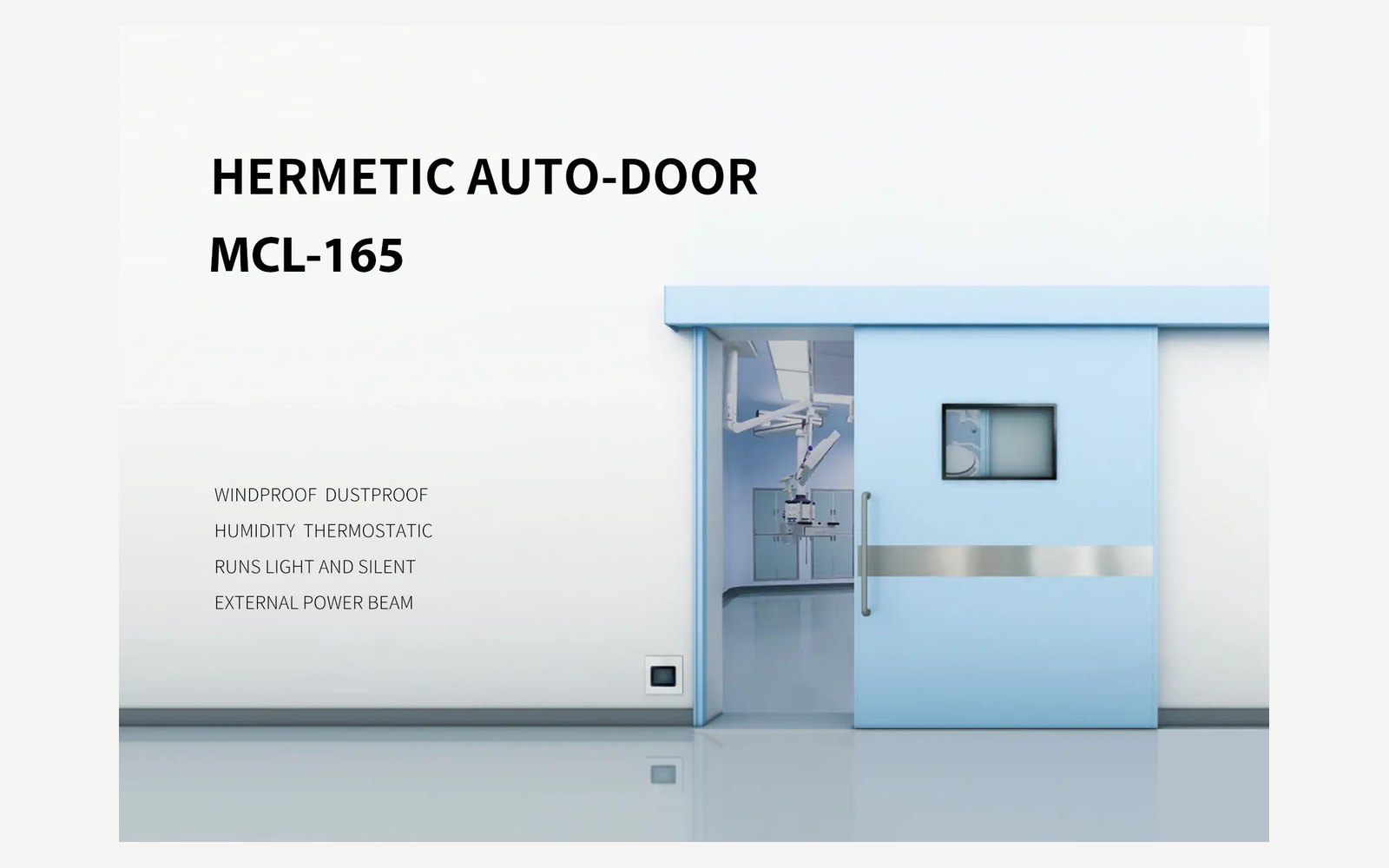
Specification
MCL-165 hermetically sealed doors specification
- Type — hermetically sealing automatic pedestrian sliding door
- Sealing — patented track system, seals against the frame when closed
- Environment — designed for sealing in dry rooms
- Performance — windproof and dustproof when closed; quiet in normal service
- Activation — hands-free switch, elbow or foot push button, radar or remote
- Options — external power beam; lead-lined leaves for radiology
Hermetically sealed doors are specified per room. Leaf construction, seal arrangement, activation, interlocking and any shielding are decided against the room’s requirements, so we confirm the specification from a site assessment. We do not publish laboratory certification or pressure-differential figures for this door because we do not hold that documentation — if your project requires certified performance data, tell us at enquiry stage and we will obtain it in writing or tell you we cannot.
Hygiene and activation
Nobody should touch the door
In a theatre or a cleanroom the handle is the problem. Hermetic doors are activated hands-free as standard — an elbow or foot push button, a hands-free sensor, detection radar or a remote — so the person going through does not contact the door at all.
Interlocking two hermetically sealed doors is common in these rooms, so an airlock cannot have both leaves open at once. That is a wiring and control decision, which is why it needs to be settled at specification rather than added later.
Requirements for powered pedestrian doors in South Africa are published through SABS.
Questions
Frequently asked
What makes hermetically sealed doors different from ordinary automatic doors?
The track. Hermetically sealed doors draw the leaf against the frame as it finishes closing so the gap is sealed, where a standard sliding door simply stops in the closed position.
Where is it used?
Operating theatres, cleanrooms, laboratories, radiology, isolation rooms, and food or pharmaceutical production — anywhere the room’s air needs to stay separate from the corridor’s.
Can it be opened without touching it?
Yes, and normally it is. Elbow or foot push buttons, hands-free sensors, detection radar and remotes are all standard options.
Is a lead-lined version available for radiology?
Yes. Lead can be built into the leaf where shielding is required alongside the seal. The shielding specification is confirmed per project.
Can you provide certified performance data?
Not from this page. We do not publish certification or pressure-differential figures we do not hold in writing. If your project requires certified data, raise it at enquiry stage and we will obtain it or tell you plainly that we cannot.
Do you service hermetically sealed doors you did not supply?
Yes. We service and repair automatic doors from other manufacturers as well as our own.
Commissioning
How the entrance is set up
Hardware alone does not make hermetically sealed doors safe. Opening and closing speed, hold-open time, force and the detection zones are set for the way the doorway is really used, then demonstrated at handover and written down. Most faults we attend are sensors knocked out of alignment rather than motors that have failed.
We walk the opening at handover so the safety zones are proven with a trolley and at normal walking pace, not just on paper.
Aftercare
Servicing, spares and agreements
Service intervals should follow cycles, not the calendar: a mall entrance can do more work in a month than an office door does in a year. A visit checks and realigns sensors, inspects belt, rollers and guides, re-checks opening and closing force and replaces wear parts before they strand the door.
Consumable and wear items, including belts, rollers, floor guides and seals, are replaced as part of servicing rather than under warranty. A service level agreement runs alongside the product warranty; it neither replaces nor extends it.
Budget
How hermetically sealed doors are priced
Four things move the number: the opening width, the glass, the sensor layout and whether access control is included. Send the opening size and a photograph and a quotation usually follows within two working days.
Figures exclude VAT unless the quotation says otherwise, and any published guidance on this site is indicative rather than a fixed price.
Are the operators made in South Africa?
The MC-125 and MCW-100 are imported and assembled at our Laser Park facility in Johannesburg, where spares and technical support are held locally.
Who carries out the installation?
Our own technicians, or technicians working under our instruction. We commission the entrance on completion and demonstrate its operation before handover.
In short
Hermetically sealed doors at a glance
- Hermetically sealed doors are quoted against the opening we measured, not a catalogue price.
- Ask about hermetically sealed doors and we confirm the opening, the head and the power position first.
- Hermetically sealed doors are installed and commissioned by our own technicians.
Air seal, pressure regime and what the room is trying to do
Specifying hermetically sealed doors starts with a question about the room rather than the door: is it trying to keep something in, or keep something out?
A positive-pressure room — an operating theatre, a clean production area — pushes air outward to keep contamination from entering. A negative-pressure room — isolation, certain laboratory and processing areas — pulls air inward to keep what is inside from escaping. The doorway is part of that regime, not a hole in it, and hermetically sealed doors are specified to suit the direction the air is meant to travel.
That has practical consequences. A leaf that seals on closing changes the pressure in the room each time it cycles, so the frequency of opening matters to the people who commissioned the air handling. Where a doorway is opened constantly, an interlocked pair or a lobby arrangement is often the correct answer rather than a single faster door.
The seal itself is the specification. A standard sliding entrance closes; hermetically sealed doors compress a gasket against the frame as the leaf reaches its closed position, which is a different mechanism and a different maintenance item. Where the requirement is simply keeping dust in one place, a well-detailed standard entrance with the right threshold may be the honest answer, and we would rather tell you that than sell the more specialised product.
Cleaning, materials and surfaces that survive the regime
The cleaning protocol is frequently harder on hermetically sealed doors than the traffic is.
Surfaces in clinical and controlled areas are wiped down with agents chosen for what they kill rather than for what they are kind to. Over years that regime works on the leaf face, the frame, the seals and any exposed fixing. Flush faces with no ledges, no exposed fasteners and no horizontal surfaces to collect anything are specified for that reason rather than for appearance.
The header matters as much as the leaf. A hermetic entrance with an operator housing that cannot be wiped down has moved the problem rather than solved it, so the cover detailing and the junction between header and wall are part of the specification conversation.
Seals are a wear item on hermetically sealed doors in a way they are not elsewhere. They are compressed on every cycle and attacked by the cleaning regime, and a seal that has hardened or taken a set no longer does its job even though the door still looks and sounds correct. Checking them is a scheduled task, not something to wait for a complaint about.
Access control, interlocks and hands-free entry
Almost every hermetic doorway carries an access requirement, and it interacts with the sealing requirement in ways worth settling early.
Hands-free activation is usually the point. Staff arriving at a theatre or a controlled area have scrubbed, or are carrying, or must not touch a surface between one zone and the next. A wave sensor, a foot switch or a proximity reader keeps the leaf untouched; a push pad defeats the hygiene case for the doorway entirely.
Interlocking is the other common requirement. Where two doors form an airlock, they are wired so both cannot stand open at once, and what happens when somebody needs to pass through in a hurry has to be decided before the order rather than discovered during commissioning.
Behaviour on power loss and on alarm is the third. Hermetically sealed doors on an escape route must satisfy the building’s fire strategy, and that is confirmed with the fire consultant or the local authority rather than chosen by us. Where a room’s containment matters more than its egress, that tension is resolved by the people who own the risk, in writing, before anything is installed.
Commissioning and handover on a controlled entrance
A hermetic entrance is commissioned against the room, not against a catalogue default. Opening and closing speed, hold-open time, force and the detection fields are set for the traffic the doorway actually carries, demonstrated at handover and written down.
On hermetically sealed doors we also prove the seal at handover rather than assuming it. A leaf that reaches its closed position but does not compress evenly along its length is a doorway that will fail a later audit, and finding that on handover day is considerably cheaper than finding it during validation.
Everything set is recorded, so the next visit starts from a baseline. On a controlled area that record is frequently required evidence rather than a convenience.
Quick answers on hermetically sealed doors
- Hermetically sealed doors compress a seal on closing; a standard sliding door only shuts.
- Hermetically sealed doors are specified on the sealing requirement, not on traffic alone.
- Hermetically sealed doors suit theatre, isolation, laboratory and controlled processing areas.
- Hermetically sealed doors are specified around the room’s pressure regime, positive or negative.
- Hermetically sealed doors use flush faces with no ledges, because of the cleaning regime.
- Hermetically sealed doors treat seals as a scheduled wear item, checked rather than awaited.
- Hermetically sealed doors are normally hands-free, since touching the leaf defeats the point.
- Hermetically sealed doors in an airlock are interlocked so both leaves cannot stand open.
- Hermetically sealed doors on an escape route follow the building’s fire strategy, confirmed per project.
- Hermetically sealed doors carry a 24-month warranty on the operator; seals and sensors are separate.
What to send us to price a hermetic opening
Six things get a realistic figure for hermetically sealed doors without a site visit, and they are the same six that stop a quotation being revised later.
- The clear opening you need, and the structural opening you have.
- What the room is — theatre, isolation, laboratory, cold or processing — and whether it runs positive or negative pressure.
- The cleaning regime the surfaces have to survive.
- Whether the doorway is one of an interlocked pair, and what must happen if somebody needs through in a hurry.
- How the doorway is activated: wave sensor, foot switch, reader, or a combination.
- Whether it sits on an escape route, and who owns the fire strategy for that route.
From that we can say whether hermetically sealed doors are what the opening actually needs, what arrangement suits it, and what has to be confirmed before an order. Where a well-detailed standard entrance would do the job, we will say so; the specialised product is worth its cost only where the seal genuinely matters.
Servicing a sealed entrance
Hermetically sealed doors are serviced on an interval set from the real cycle count, and in a controlled area that usually means more often than a general facilities schedule assumes. A theatre doorway at a busy list does more work in a morning than a plant room door does in a month.
A visit checks and realigns the sensors, inspects the drive, carriages and guides, re-checks opening and closing force, and examines the seal along its full length for hardening, set or damage. Wear parts are replaced before they strand the entrance rather than after. Everything set is written down, because on a controlled area that record is frequently evidence rather than a courtesy.
Our warranty is 24 months on the operator. Seals, sensors and wear parts are quoted and warranted separately, and we confirm that in writing before an order.
Getting the room and the doorway specified together
The most expensive mistake on hermetically sealed doors is specifying the doorway after the room has been signed off. The air handling, the pressure regime, the cleaning protocol and the door are one system, and the door is the part that gets drawn last.
Bring the entrance into the conversation while the room is still being designed and three things become easier. The reveal can be sized for the operator rather than the operator squeezed into a reveal. The header can be detailed so it can actually be wiped down. And the interlock, the activation method and the behaviour on alarm can be agreed with the people who own the fire strategy rather than negotiated afterwards.
Where we are brought in at the end, we will still make it work, and we will tell you plainly which compromises the late start has cost. Hermetically sealed doors retrofitted into an opening drawn for a standard door usually give away clear width, which on a theatre or an isolation room is the dimension nobody wanted to lose.
Specifying hermetically sealed doors?
Send us the room, the opening size, whether the door forms part of an airlock, the activation you need and any shielding requirement. We will come back with a specification, installation and commissioning quoted together.