
Entrance technology
Automatic door access control, integrated properly
Automatic door access control is where two systems have to agree: the reader decides who may enter, and the operator moves the leaf. We specify, install and commission both, so the lock releases before the door pulls and the safety sensors still own the opening.
How it works
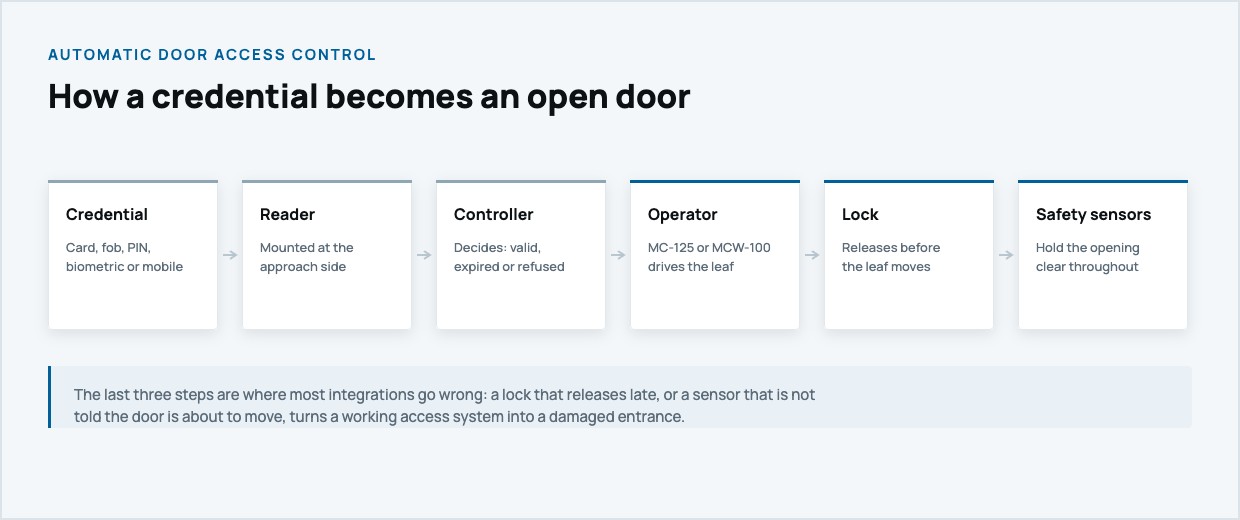
From credential to open door
Six links, and the last three are the ones that fail on site. Most automatic door access control problems are not access problems at all — they are sequencing problems between the lock, the operator and the sensors.
A reader that grants access half a second after the operator starts pulling will drive a leaf against an engaged lock. Do that a few hundred times and the belt, the carriage or the lock gives way. Getting the order right is the whole job.
Credentials
Ways in, and where each one earns its place
There is no single right credential for automatic door access control. There is a right one for the door, the people using it and how often that changes.
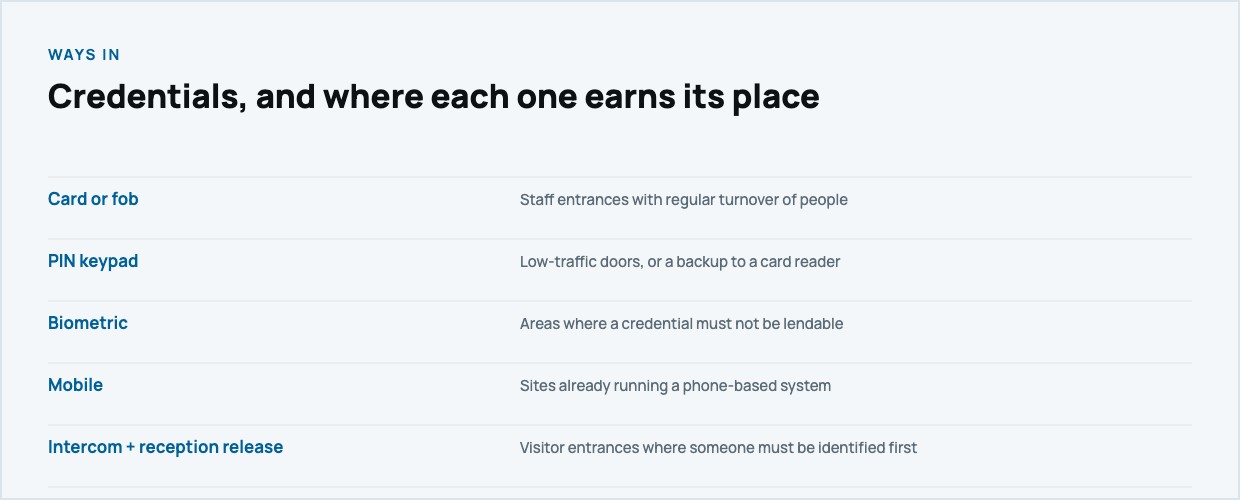
Where you already run an access platform, we integrate with it rather than replacing it. The entrance side is what we specify: the interface into the operator, the locking, the activation devices and the safety sensing.
Time schedules
One entrance, three behaviours across a day
A retail or office entrance rarely behaves the same way all day. Access control is what lets one door be open on approach at 10am, credential-only at 7pm and locked at midnight.
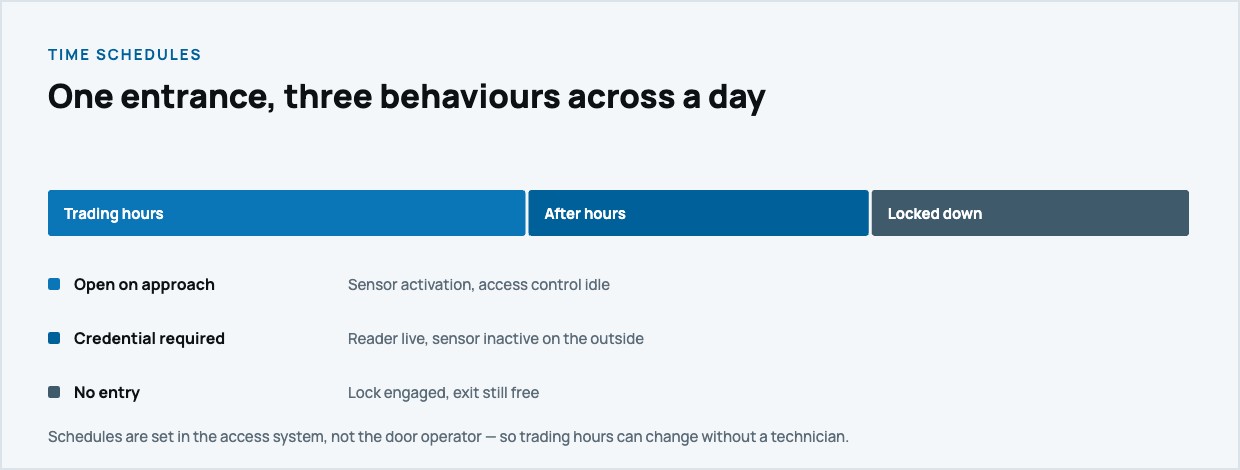
Exit almost always stays free. Changing when people may come in is an access decision; changing whether they may get out is a life-safety one, and those are not the same conversation.
Failure modes
Load shedding, power loss and the fire alarm
In South Africa an entrance has to be specified for power that is not guaranteed. That changes how automatic door access control is wired, not just what it costs.
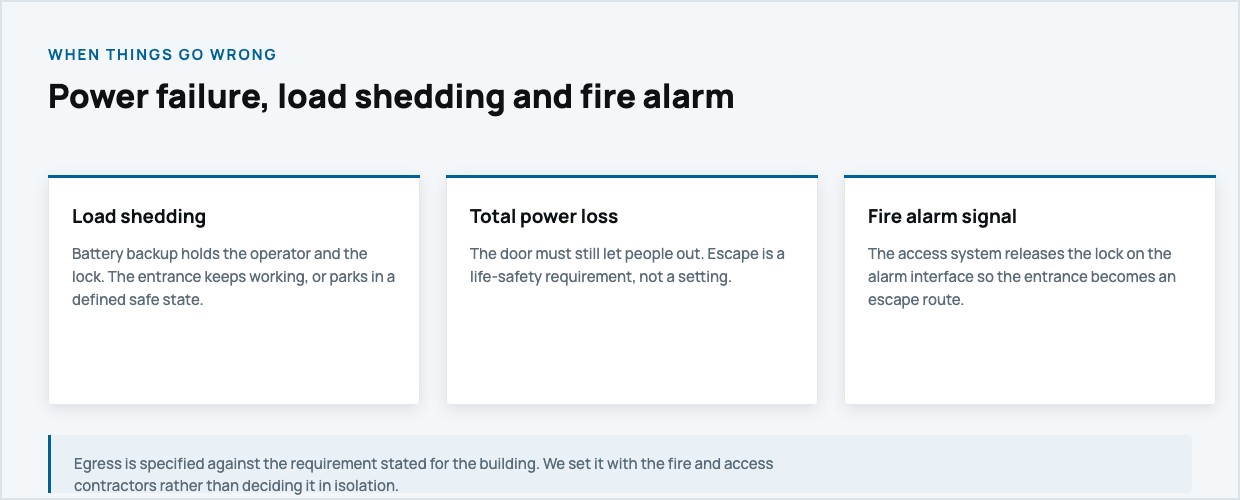
Battery backup keeps the operator and the locking alive through load shedding. On a total loss of power the entrance must still permit escape, and on a fire alarm signal the access system releases the lock so the door becomes an escape route. Requirements for powered pedestrian doors in South Africa are published through SABS, and we set the behaviour with your fire and access contractors rather than deciding it alone.
What it fits
Which entrances we integrate
Access control goes onto the entrance you already have, or onto a new one we supply.
- Automatic sliding doors — the most common pairing, on the MC-125 operator.
- Automatic swing doors — the MCW-100 retrofits a door you already have, which makes it the usual answer for a controlled staff entrance.
- Telescopic sliding doors — where the reveal is too tight for a standard slider.
- Hermetically sealed doors — theatres and cleanrooms, where the credential and the seal both matter.
- An existing entrance — adding control to a door that currently just opens for everyone.
Common questions
Automatic door access control, answered
Can access control be added to an existing automatic door?
Usually. If the operator is sound and still supported, adding a reader, an interface and locking is far cheaper than replacing the entrance. Where the operator is obsolete we quote modernisation instead.
Will it work with the access system we already run?
In most cases yes. We integrate with your platform on the entrance side rather than asking you to change readers and credentials across the building.
What happens during load shedding?
With battery backup the operator and locking keep working, or the entrance parks in an agreed safe state. Without it, the door must still allow escape.
Does access control override the safety sensors?
No, and it should never be wired to. The sensors keep control of the opening regardless of who was granted entry.
Can different doors behave differently at the same site?
Yes. A main entrance can be open on approach while a staff door stays credential-only, on separate schedules.
Do you service access-controlled entrances?
Yes — on any major brand. See automatic door repairs.
Options
Which configuration suits the opening
For access control the decision follows the opening rather than preference. Single sliding is the everyday answer; bi-parting halves the travel on the busiest entrances; telescopic suits a narrow wall; swing operators automate hinged doors; revolving and hermetic entrances answer particular problems and are never priced unseen.
- MC-125: up to 150 kg single leaf or 2 × 120 kg bi-parting, 1450–5000 mm.
- MCW-100: hinged doors to 1,200 mm / 150 kg (interdependent).
- Imported and assembled at Laser Park, Johannesburg, with a 24-month operator warranty.
Survey
What a site survey establishes
Three things decide whether access control goes in cleanly: the structural opening, what the head can carry, and where the power arrives. We measure the structural opening rather than any existing frame, check whether the head is level and adequately supported, and establish what sits above it, because a bulkhead, a sprinkler line or a services void will all dictate where an operator header can physically go.
Where a quotation is prepared from photographs and dimensions rather than our own survey, the figure is confirmed after measuring. We do not price revolving or hermetic entrances without seeing them, and where a site visit is chargeable we tell you before we attend.
Load-shedding
Keeping access control usable in a power cut
An optional battery backup keeps the operator running through a slot. Without one, the entrance parks in the fail-open or fail-secure state chosen for the building, and the manual release is demonstrated at handover.
Our programme assumes power is available at the head where the system requires it. Where it is not, we say so at survey rather than improvising on installation day.
How quickly can I get a quotation?
Most quotations go out within two working days of us receiving the opening size and a photograph. Revolving and hermetic entrances are surveyed first.
How often should the entrance be serviced?
Against its cycle count rather than a fixed date. Intervals, response times and what is included are defined in your service level agreement.
What warranty applies to the operator?
The MC-125 and MCW-100 carry a 24-month (two-year) warranty. The warranty that applies to your installation is the one recorded on your quotation and invoice.
In short
Automatic door access control at a glance
- Automatic door access control are quoted against the opening we measured, not a catalogue price.
- Ask about automatic door access control and we confirm the opening, the head and the power position first.
- Automatic door access control are installed and commissioned by our own technicians.
- Automatic door access control carry a 24-month warranty on the operator.
- Spares for automatic door access control are held in Johannesburg, so a repair does not wait on an import.
- Send the opening size and a photograph and a quotation for automatic door access control usually follows within two working days.
Matching the credential to the doorway
Automatic door access control fails most often not because the technology was wrong but because the credential was wrong for the people using it.
- Cards and fobs. Cheap to issue, easy to revoke, and routinely lent out. Fine for a back office, weak where you genuinely need to know who came through.
- Mobile credentials. Nothing to issue and nothing to lose, but they depend on a phone with charge and on a user who has installed something.
- Keypads. No credential to carry and no credential to lose, and the code is shared within a week. Suitable for a low-risk store room; unsuitable as the building’s secure line.
- Biometrics. Strong on identity and slow at a busy doorway, so they belong on a controlled area rather than a main entrance at nine in the morning.
- Request-to-exit and free egress. Not a credential at all. Getting out is a life-safety function and is never gated by automatic door access control.
On a main entrance the usual arrangement is open during trading hours on sensor activation, then credentialled outside them. That is one doorway with two behaviours, and it is decided before the order because it changes what sits in the header.
Where the wiring actually goes
The part of automatic door access control that causes most trouble on site is the boundary between the reader and the operator.
A reader does not open a door. It makes a decision and passes a signal to the controller, and the controller decides what the leaf does. That means three things have to be agreed: what cable runs between them, who pulls it, and what voltage and contact type the operator expects. Where the access system is supplied by one contractor and the entrance by another, that boundary is where projects stall.
We will tell you what our controller needs and what it can accept. Where the access installer needs a dry contact, a timed pulse or a status output back, those are ordinary requirements and are easier to satisfy at first fix than after the ceiling is closed.
Power is the other boundary. Automatic door access control components and the operator may sit on different supplies, and if one has battery backup and the other does not, the entrance behaves strangely during an outage rather than failing cleanly.
For the physical side of the same question — where an entrance is actually tested, what the four locking arrangements mean and how glass choice affects it — see our guide to automatic door security.
Fail-safe, fail-secure and the argument between them
The single most consequential decision in automatic door access control is what the entrance does when the power goes.
Fail-safe releases the lock, so people can get out. It is what a life-safety route requires.
Fail-secure holds the lock, so nobody can get in. It is what a secure area wants.
Many doorways are asked to be both, and they cannot be. The resolution is not technical, it is a decision about which risk the building is prepared to carry, and it is made by the people who own that risk — usually the fire consultant and the security manager together — and recorded in writing before installation.
Battery backup changes the shape of the question rather than answering it. It buys a period during which the entrance behaves normally, which means the fail state is deferred rather than avoided, and somebody still has to decide what happens when the batteries are flat.
Quick answers on automatic door access control
- Automatic door access control gates entry, never egress; getting out is a life-safety function.
- Automatic door access control behaviour on power loss is decided before the order, not after.
- Automatic door access control readers signal the controller; the controller moves the leaf.
- Automatic door access control on a main entrance usually means two behaviours across the day.
- Automatic door access control with keypads shares its code within a week; plan accordingly.
- Automatic door access control using biometrics is slow at a busy doorway by design.
- Automatic door access control cabling and contact type are agreed at first fix, not at handover.
- Automatic door access control is fitted to any major operator brand, nationwide.
One entrance, several behaviours across a day
Most main doorways need automatic door access control to do different things at different times, and setting that out properly is what separates a working entrance from one that gets propped.
A typical retail or office pattern runs in three states. Open, during trading hours, where the doorway operates on sensor activation and the access system is doing nothing but logging. Credentialled, before and after those hours, where staff get in on a card and nobody else does. Locked, overnight, where the entrance is the building’s secure line and only a keyholder with an alarm code should be opening it.
Those states have to be scheduled somewhere, and where that schedule lives matters. On the access system, it can be changed by whoever runs the access system. On the door controller, it is more robust but less convenient. Neither is wrong; what is wrong is nobody knowing which one is in charge when a public holiday lands and the doorway behaves unexpectedly.
Automatic door access control also has to fail predictably at the edges of those states. What happens if somebody is still inside at lock time, what happens on a fire alarm during trading hours, and what happens if the schedule and the alarm system disagree are all questions worth answering before the entrance is commissioned.
Auditing, privacy and what the log is actually for
An access log is a record of people’s movements, and treating it casually is both a privacy problem and a practical one.
The useful question is what the log is for. If it exists to investigate incidents, it needs enough retention to cover the gap between an incident and somebody noticing. If it exists to manage headcount or time and attendance, that is a different purpose and it should be stated as one. If nobody can say what it is for, the honest answer is usually to collect less.
Automatic door access control on a shared or tenanted building raises the question sharply, because the data is about one party’s staff and held by another. Who can read it, who can export it and how long it lives are agreements to make in advance rather than after somebody asks.
We fit and commission the entrance side of this. The policy is the building’s, and we would rather raise the question early than have an entrance commissioned around assumptions nobody wrote down.
Retrofitting control onto an existing entrance
Adding automatic door access control to a doorway that already works is usually straightforward, and the three things that decide it are structural rather than electronic.
The controller has to accept an external input, which nearly all current operators do and some older ones do not. There has to be a route for cable between the reader position and the header, which on a glazed shopfront is the awkward part. And there has to be enough power, on a supply that behaves the same way as the operator’s during an outage.
Where the operator is obsolete, adding control to it is usually the moment to price a modernisation instead. Spending on a reader wired into a controller that cannot be replaced is money placed on the wrong side of the entrance’s remaining life.
What to send us to specify an entrance with control
Automatic door access control is quoted against the entrance and the policy together, so four answers get you a real number.
- What the doorway is: main entrance, staff door, controlled area, escape route, or more than one of those.
- The operator make and model already in the header, if there is one.
- The credential you want and who has to carry it, including visitors, contractors and deliveries.
- What the entrance must do on power loss and on fire alarm, and who has signed off that answer.
That last one is the answer we chase most often. Automatic door access control quoted without it gets revised, because fail-safe and fail-secure need different hardware and the decision is not ours to make. Where the fire strategy and the security policy conflict, we will flag it rather than pick a side, and we will fit whatever the people who own the risk decide.
Controlling who comes through the door?
Send us the entrance and the access system you run, and we will quote the integration — reader interface, locking, activation and safety sensing.