
Office park automatic doors for landlords and managing agents: who owns which entrance, the access states a working week needs, the morning peak that sizes the lobby, standardising across an estate, and why maintenance recovery changes the contract.
Automatic Door Security: What a Glass Entrance Can and Cannot Do
Automatic door security is the question we get asked last and should be asked first. An entrance gets specified for width, for traffic and for looks, and then somebody asks, three weeks before handover, what happens to it at night. By then the leaf build is fixed, the glass is ordered and the options have narrowed to whatever can be bolted on.
This page sets out the honest position. It covers where an entrance is actually tested, what locking an automatic door really means, why the glass specification matters more than the lock, and the escape-route rule that governs every one of those decisions. It is written for South African buildings, where the power going off is a design condition rather than an emergency.
Automatic door security starts from an honest position
An automatic glass entrance is not a security barrier and nobody should sell it to you as one. It is a managed opening: its job is to let the right people through easily and to close behind them. Good automatic door security makes an entrance a credible deterrent and a meaningful delay. It does not make it impenetrable, and any supplier who tells you otherwise is selling something they cannot back.
That matters because the useful conversation is about layers. The entrance is the outermost layer and the most visible one. What sits behind it — the alarm, the response, the internal locking, what is actually worth stealing and where it is kept — does the heavier work. An entrance that buys a few noisy minutes has done its job.
Where an entrance is actually tested
The glass is rarely the first thing attacked, because breaking it is loud and slow. The weaknesses in automatic door security are usually mechanical and unglamorous.
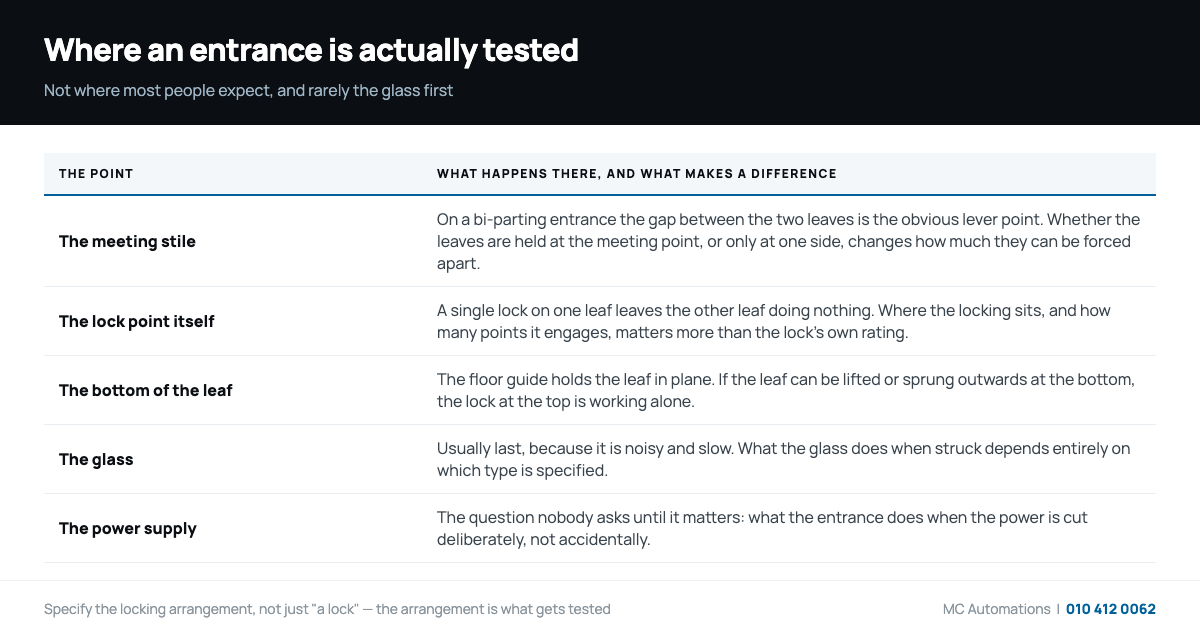
Notice how many of those are specification decisions rather than product decisions. Where the locking engages, whether the bottom of the leaf is held, and what the entrance does on power loss are all settled on a drawing long before anyone chooses a brand.
What “locked” actually means
This is the single biggest source of confusion in automatic door security. Four quite different arrangements all get described, on quotations and in handover meetings, as a locked door.
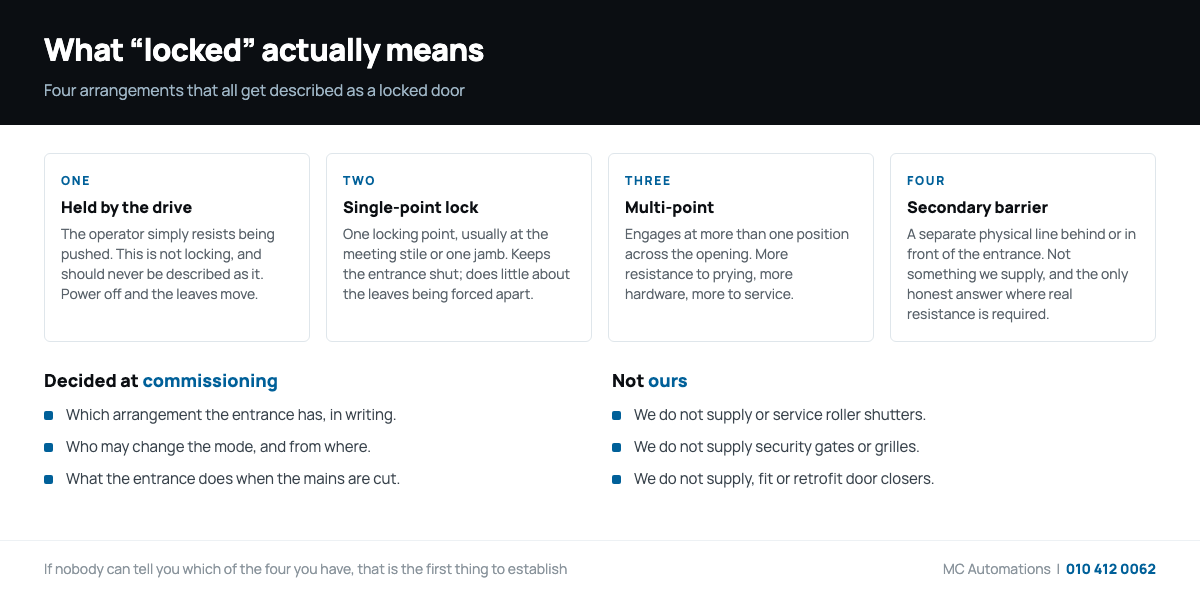
The first one is not locking at all, and it is more common than it should be. An operator holding its position resists a casual push and nothing more. Cut the power and the leaves can be slid apart by hand, which is exactly what you want for escape and exactly what you do not want at two in the morning.
If nobody at your building can tell you which of the four you have, establishing that is the first and cheapest thing you can do. Our automatic door access control page goes into the fail-safe and fail-secure argument, which is where this decision ultimately lands.
Toughened or laminated: the glass decision
Glass is the part of automatic door security people assume is settled. Both types are safety glass, and both are correct choices for different reasons. They behave in completely opposite ways when struck, and that difference is the most under-discussed element of automatic door security.
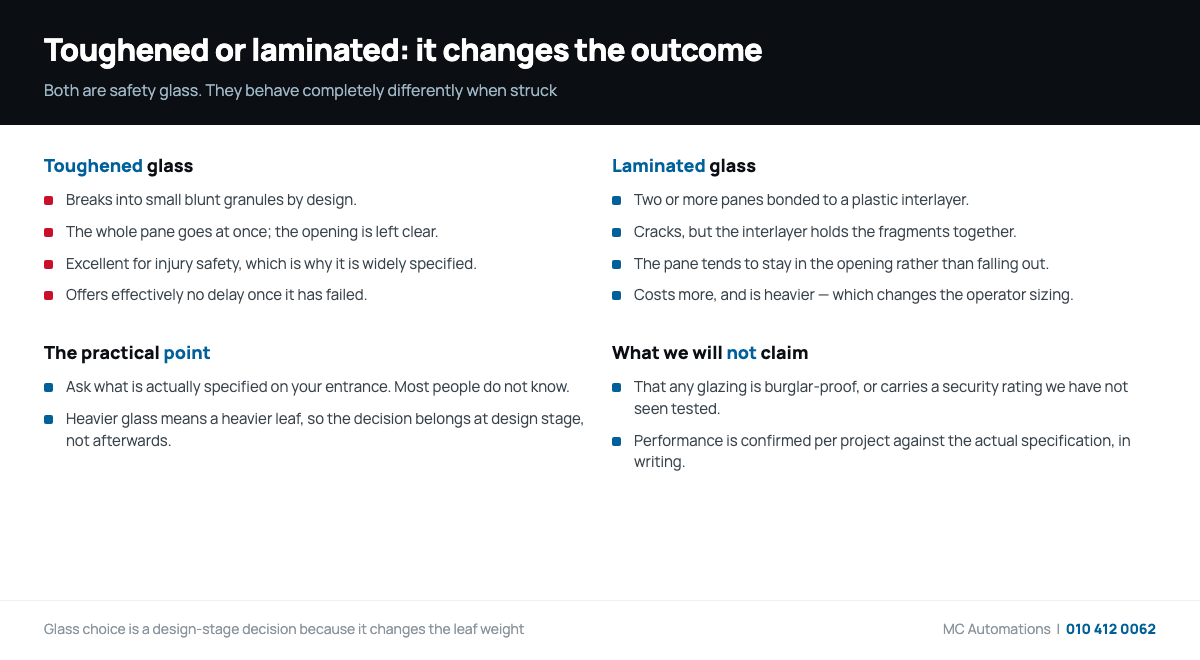
The practical consequence is that this belongs at design stage. Laminated glass is heavier, a heavier leaf needs a different operator specification, and you cannot sensibly change the glass after the operator has been sized. Decide it with the sliding entrance specification, not afterwards.
Security against escape: the rule that wins
Here is the constraint that bounds every automatic door security decision above. An entrance on an escape route has to be openable by hand, without a key and without power, for as long as anybody is inside the building. No automatic door security arrangement is permitted to override that.
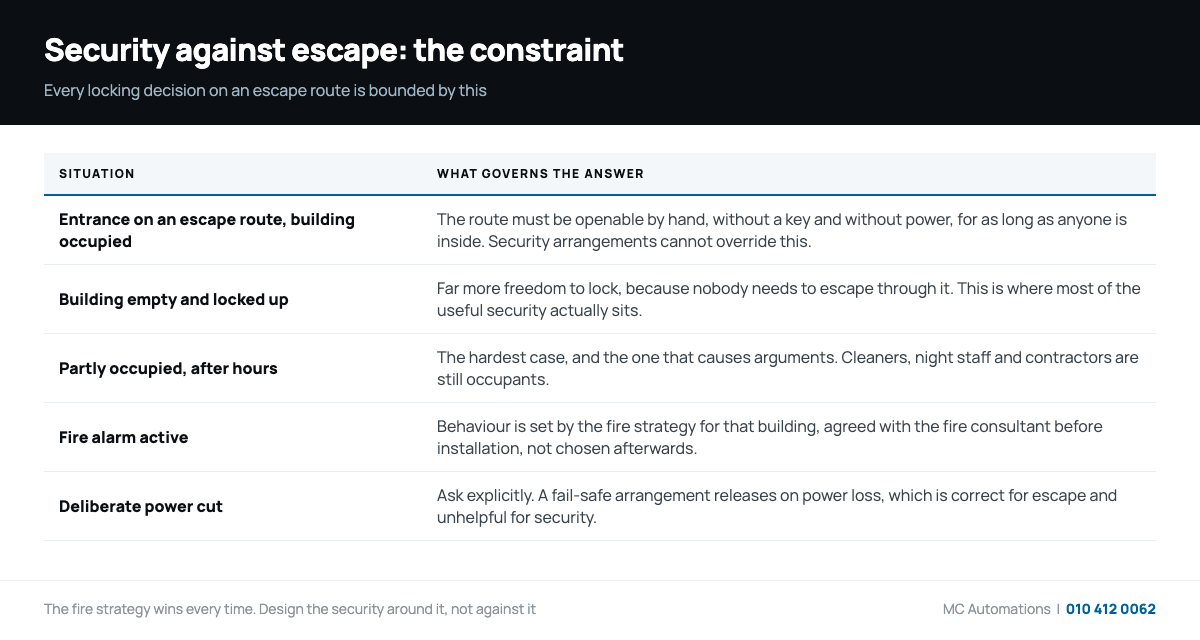
Far from being an obstacle, this is clarifying. It tells you that the real security freedom exists when the building is empty and locked up, which is also when you need it. The arguments happen in the middle case — partly occupied, after hours, with cleaners and contractors still on site, who are occupants whether or not anyone thought of them that way.
Requirements for entrances on escape routes derive from the National Building Regulations and the standards published by the South African Bureau of Standards, and they are applied through the fire strategy prepared for your specific building. Where a fire-resisting leaf is involved, our fire-rated automatic doors page sets out precisely what we will and will not state.
Automatic door security when the power is cut
In South Africa this is not a hypothetical. Load shedding has trained every building to expect power loss, and it has also made a deliberate cut indistinguishable from a scheduled one.
Ask the question explicitly: when the mains drop, does this entrance release or stay secured? A fail-safe arrangement releases, which is correct for escape and useless for security. A fail-secure arrangement stays locked, which is the opposite problem. Which one is right is decided by the fire strategy and by whether the building is occupied, not by preference. Our write-up on automatic doors and load shedding covers the behaviour in more detail.
The second question is quieter and just as important: is the entrance on backup power at all? An operator on a generator or inverter keeps working through an outage. One that is not becomes a manual door for the duration, and all your automatic door security assumptions change with it.
Night modes and reduced opening
Between fully trading and fully locked there is a range of automatic door security that most buildings never use. A mode switch can reduce the opening width, drive only one leaf, or restrict entry to a credential while still letting people out freely.
That middle ground is where automatic door security is most practical, because it does not force a choice between trading and locking. We set these states out in detail for hospitality on our hotel automatic doors page, but the principle applies to any building with staff on site outside trading hours.
Two rules make it work. The mode switch belongs behind a counter rather than beside the door, and only named people should be able to change it. And whatever the switch does, it must never be able to override the emergency behaviour.
What belongs behind the entrance
Where a building genuinely needs resistance rather than deterrence, the answer is a second physical line, and it is worth being clear that this is not something we supply. We do not supply or service roller shutters, we do not supply security gates or grilles, and we do not supply, fit or retrofit door closers. We do pedestrian automatic entrances, and we would rather tell you where the boundary is than take an order that will disappoint.
What we will do is specify the entrance so it works properly alongside whatever sits behind it — so the shutter can actually close, so the automatic leaves park where they should, and so the two systems are not fighting each other at opening and closing time.
What we will not claim
We will not describe any entrance we supply as burglar-proof, attack-resistant or rated to a standard we have not seen tested for that specific build. Where a project requires a tested performance, that is confirmed in writing per project against the actual specification, and if we cannot confirm it we will say so.
This matters more than it sounds. Insurance and landlord requirements sometimes ask for specific performance, and an entrance described loosely at quotation stage becomes a problem at claim stage. If a specification requires a rating, get it stated explicitly rather than implied.
What to ask for when specifying automatic door security
Six questions settle most of automatic door security before anything is ordered. Which of the four locking arrangements is being supplied. Where the locking engages, and whether the bottom of the leaf is held. What glass is specified, and whether that has been reflected in the operator sizing. What the entrance does when the mains drop. Whether it sits on an escape route. And who may change the mode, from where.
Get those six answered in writing at quotation stage and the handover conversation becomes a formality. Leave them and you will be having the conversation three weeks before opening, with the leaf build already fixed.
If you have inherited a building and nobody knows the answers, that is normal and it is worth a survey. A service level agreement visit is a sensible moment to record the locking arrangement, the glass and the power behaviour for each entrance, so the information exists before you need it.
Automatic door security changes by building type
The same entrance hardware carries a different brief depending on what is behind it, and automatic door security is sized to the consequence rather than to the opening.
Retail shopfronts are the most exposed case, because the stock is directly behind the glass and visible from the pavement. The entrance is usually the only thing between the street and the floor, which is why most centre landlords require a secondary barrier and why the entrance alone is rarely accepted as the answer. Where the shopfront faces an internal mall rather than the street, the centre’s own perimeter does much of the work and the brief relaxes considerably.
Office lobbies invert the problem. There is little worth stealing in the lobby itself, so the entrance is about controlling who gets past reception and into the lifts. Here automatic door security is mostly about credentials and after-hours access rather than physical resistance, and the real line sits at the turnstile or the lift lobby.
Industrial and warehouse pedestrian doors are the ones that get neglected. They are out of sight, often at the back of a yard, and they are frequently the easiest point on the perimeter. A pedestrian door beside a loading bay deserves the same attention as the shopfront, and usually gets none.
Healthcare and hospitality both run around the clock, so the building is never truly empty and the free-locking period never arrives. That pushes the emphasis onto zoning: the main entrance stays open and controlled, while internal departments and back-of-house doors carry the restriction.
Surveying the entrances on a building you have inherited
Most facilities managers take over buildings where nobody recorded any of this. Before you can improve automatic door security, you need to know what you have, and that is a walk round with a notebook rather than a project.
For each entrance record six things: whether it is on an escape route, which of the four locking arrangements it has, whether the leaves can be forced apart by hand when the power is off, what the glass is, whether the entrance is on backup power, and who holds the key or credential that changes its mode. That last one catches people out more than any technical detail, because the answer is often a former employee.
Then test the one thing that cannot be established by looking: cut the power to a single entrance, with the building empty and somebody watching, and see what it actually does. Documented behaviour and real behaviour diverge surprisingly often, particularly where an entrance has been attended several times over the years by different contractors.
Write the results down per entrance and keep them with the building file. The cost of not having this is that every future automatic door security question starts from scratch, and the answer gets guessed rather than looked up.
The mistakes that undo good automatic door security
Three habits defeat an otherwise sound arrangement, and all three are understandable.
The first is defeating the safety sensing to keep an entrance trading. Taping over a sensor so a faulty door stops reopening turns a safety device off on an opening that people walk through. A door out of service is an inconvenience; a door that closes on somebody is a different category of problem entirely. If an entrance is misbehaving, work the symptom properly — our automatic door troubleshooting guide sets out what is safe to check.
The second is propping an entrance open during deliveries or hot weather. A propped leaf is no longer a controlled opening, it is frequently on an escape route, and it almost always stays propped for longer than intended.
The third is leaving the mode switch accessible. A switch beside the door that anybody can reach is not a control, and it means your locking arrangement is only as good as the least careful person on shift.
Automatic door security: quick answers
Are automatic doors secure?
They are a managed opening rather than a security barrier. Properly specified, an automatic entrance is a credible deterrent and a meaningful delay, and that is the honest claim. Where a building needs genuine resistance, the entrance should be one layer with a second physical line behind it.
Can an automatic door be locked at night?
Yes, but “locked” covers four very different arrangements: held by the drive, which is not locking at all; a single-point lock; multi-point locking; or a separate secondary barrier. Establish which one your entrance actually has, because the quotation and the handover often describe all four the same way.
What happens to the lock during load shedding?
It depends whether the arrangement is fail-safe or fail-secure. Fail-safe releases on power loss, which is correct for escape routes and unhelpful for security; fail-secure stays locked. Which is appropriate is set by the fire strategy for your building and by whether anyone is inside, not by preference.
Is laminated glass better than toughened for security?
For delay, yes. Toughened glass breaks into small granules and the whole pane goes at once, leaving the opening clear. Laminated glass cracks but the interlayer holds the fragments, so the pane tends to stay in place. Laminated is heavier, so it has to be decided at design stage because it changes the operator sizing.
Can you lock an automatic door that is on an escape route?
Not in a way that prevents escape. While anyone is in the building, that entrance must be openable by hand, without a key and without power. Most of the useful security sits in the period when the building is empty and locked up, which is also when it matters most.
Do you supply security shutters or gates for automatic entrances?
No. We supply, install and service pedestrian automatic entrances only. We do not supply or service roller shutters, we do not supply security gates or grilles, and we do not supply, fit or retrofit door closers. We will specify the entrance to work properly alongside whatever secondary barrier you use.
Get the security questions settled early
Tell us what the building is, whether the entrance is on an escape route, and what you need it to do after hours. Request a quote and we will set the locking arrangement, the glass and the power behaviour out in writing, or call 010 412 0062 if you would rather talk it through first.
