
Automatic doors Africa: MC-125 and MCW-100 supplied from South Africa
Automatic doors Africa projects reach us in one of two ways. Either a main contractor in Nairobi or Lagos has a specification that calls for a sliding entrance and no local supplier who will stand behind it, or a South African client is building in a second country and wants the same entrance they already run in Johannesburg. We export the MC-125 and MCW-100 operators into both situations, and we install and commission them ourselves.
That last part is the part worth reading carefully. Plenty of suppliers will put an operator in a crate and wish you luck. An automatic entrance is not a product you receive, it is a product that has to be set up against the actual door leaf, the actual floor level and the actual traffic of the building it serves. So when we talk about automatic doors Africa work, we mean equipment plus a commissioning team, quoted as one project.
What crossing a border actually changes
The operator does not change. An MC-125 driving a 120 kg leaf in Lusaka is doing the same mechanical job it does in Sandton. What changes is everything around it, and those are the things that decide whether an entrance is still working in year four.
Power quality is the first. A great deal of African commercial building runs on supply that sags, spikes or disappears on a schedule. An automatic door operator is a motor, a controller and a sensor loop, and the controller is the part that objects to dirty power. We specify differently where we know the supply is unstable, and we say so in the quotation rather than discovering it on site.
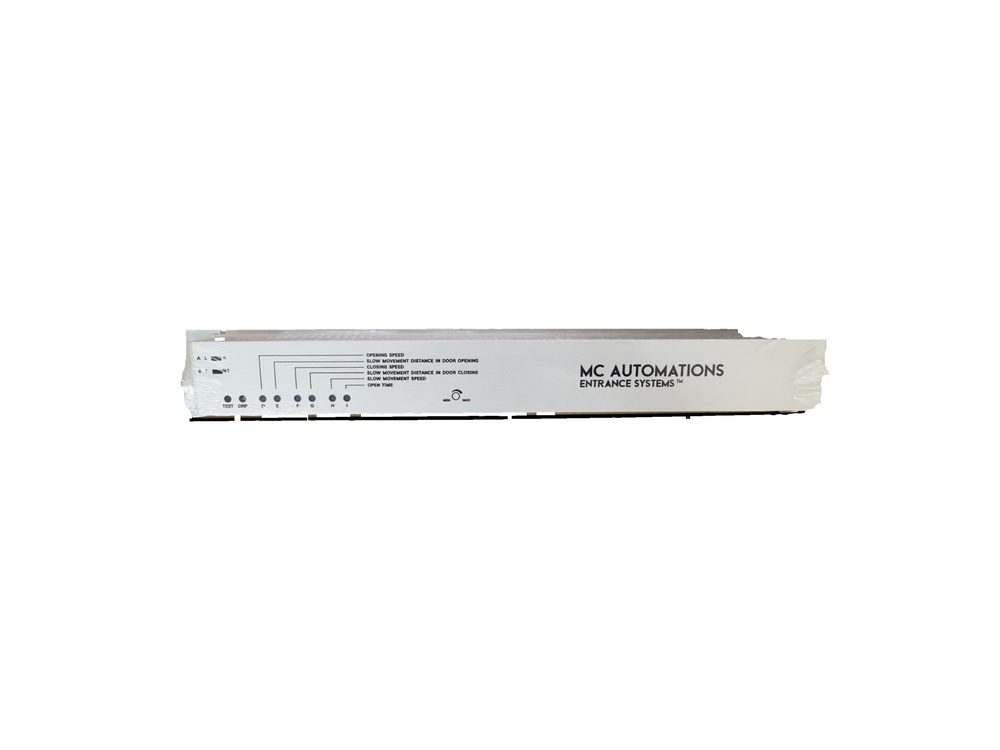
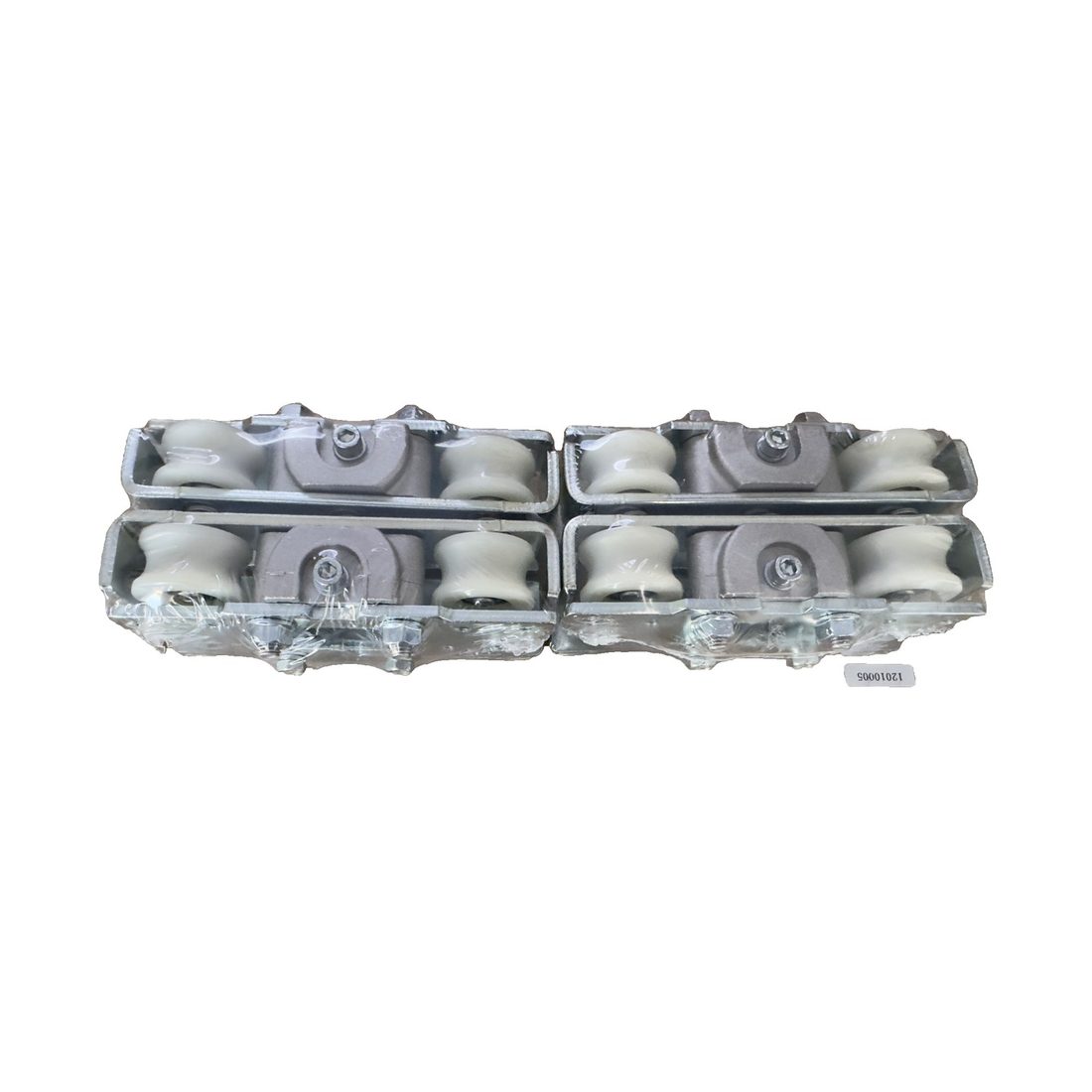
Dust is the second. Fine airborne dust is the quiet killer of sliding gear, because it works into the track and the carriage wheels and turns a smooth run into a grinding one over a season. Coastal projects have the opposite problem and a worse one, which is salt. Salt attacks fixings, it attacks the underside of the header, and it does it continuously.
Heat is the third, and it is the one most people underestimate. Controllers have a working temperature range. A header box in direct sun on a west-facing elevation is a different thermal environment to the same box under a canopy, and the difference shows up as intermittent faults that are maddening to diagnose remotely.
The fourth is not environmental at all. It is who is going to touch the door after we leave.
The two operators we export
On automatic doors Africa projects we export two units, and only two. That is deliberate. A narrow range means we hold the spares that matter, our technicians know both units without a manual, and a fault on a Tuesday in Maputo is a fault we have seen before.
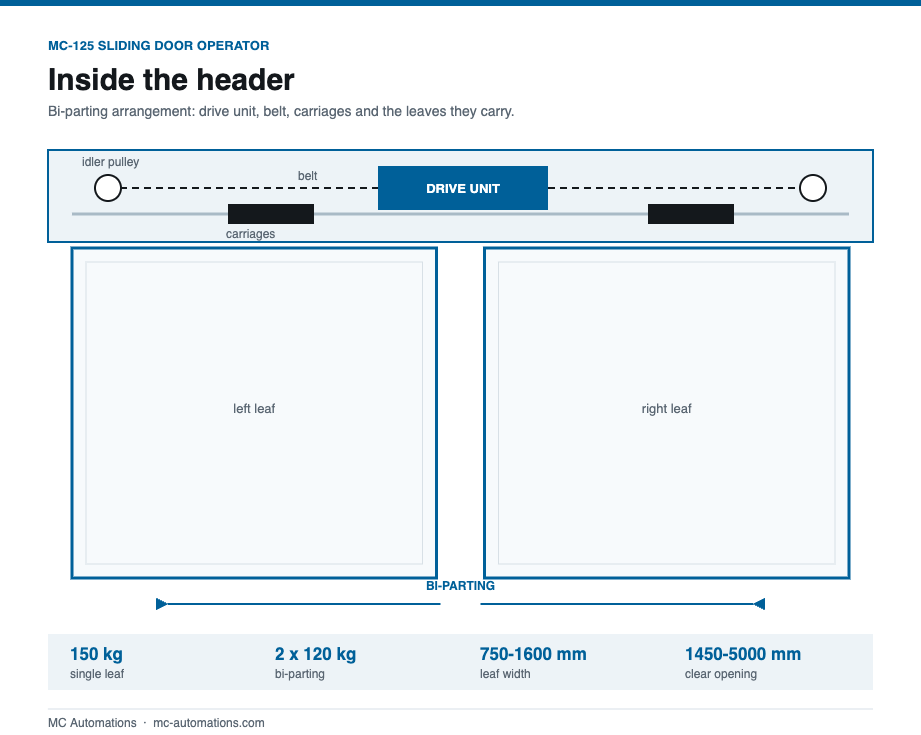
The MC-125 automatic sliding door operator is the workhorse. It drives single and bi-parting sliding leaves and it is the unit we specify for retail entrances, hospital corridors, office lobbies and airport landside doors. In South Africa it starts at R27 590 excluding VAT.
The MCW-100 automatic swing door operator handles swing leaves, which is what you need where a slide is impossible or where an existing timber or steel door has to become automatic without being replaced. In South Africa it starts at R15 900 excluding VAT.
Both figures are South African prices, and they are the operator only. They are not the price of an installed entrance anywhere, and they are certainly not the landed price of an automatic door in another country. Automatic doors Africa work is quoted per project, in writing, and we will come back to why we refuse to publish a number for it.
Both units are imported and assembled at our Laser Park facility in Johannesburg. We do not describe ourselves as a manufacturer of automatic doors and we would rather say that plainly than let a brochure imply otherwise. What we do own is the assembly, the specification and the service standard, and the 24-month warranty on the operator that follows from it.
Where our responsibility starts, and where it stops
This is the section most suppliers leave vague, so here it is directly.
On automatic doors Africa projects we are responsible for the operator, its specification against your opening, its installation, its commissioning, and the warranty on the unit. We are responsible for telling you honestly whether an MC-125 or an MCW-100 is the right answer for a given opening, including when the answer is that neither is.
We are not a local authority in any of these markets and we do not pretend to be. We do not hold local building approvals or local fire approvals in the countries we supply and install into. Where an entrance sits on an escape route, where it interacts with a fire strategy, or where it has to satisfy a local accessibility code, that is work for your local consultant and we will say so in writing rather than sign something we are not qualified to sign. We will give your consultant every technical detail they ask for about the operator. We will not give them a compliance certificate for a jurisdiction we do not practise in.
We also do not do roller shutter doors, and we do not supply, fit, retrofit or service door closers. Pedestrian automatic entrances are the whole of what we do.
How an automatic doors Africa project actually runs
There is a sequence, and skipping steps in it is how automatic doors Africa projects go wrong.
An automatic doors Africa quotation starts with the opening, not the operator. We need the structural opening, the leaf weight and material, the floor condition, the header depth available, and a photograph of what is there now. Half the specification errors we see in automatic doors Africa enquiries come from someone ordering an operator against a door width rather than against a leaf weight.
Then the environment, which on automatic doors Africa work drives more of the specification than anything else. Is it coastal. Is the supply stable. Is it under cover or in direct sun. Is it a controlled interior or a dust-loaded loading elevation. These answers change the specification, and sometimes they change the recommendation from a slide to a swing.
Then the traffic. A boutique hotel entrance and a supermarket entrance in the same city are not the same duty. Cycle count drives the service interval, and the service interval is the thing that determines the real cost of the entrance over its life rather than the price on the order.
Then, and only then, the quotation. It covers the operator, the installation, the commissioning and the handover, as one figure, in writing.
Why we will not publish an automatic doors Africa price
We publish South African prices openly because we can stand behind them. We will not publish a landed price, a freight figure, a duty estimate or a lead time for another country, and it is worth explaining why rather than looking evasive.
Freight and duty move. They move with the route, the consignment, the regime and the month. A number published today is a number that misleads somebody in six months, and the person it misleads is the one building a budget around it. Lead times are the same, with the added problem that they depend on a border we do not control.
So we quote per project, in writing, with the figure valid for a stated period. It is slower than publishing a price list and it is the only honest way to do it.
Servicing an entrance a long way from Johannesburg
Our 24/7 breakdown line on 010 412 0062 is real and it is answered. What we will not do is imply that a call from another country produces a technician the same day. Our same-day call-out commitment is a Gauteng commitment and we are not going to blur that to make a page read better.
What we do instead, on automatic doors Africa projects, is design for the distance. That means agreeing a spares holding on site or with the client facilities team as part of the original project, so that the parts most likely to be needed are already in the building. It means commissioning the client own maintenance people at handover, so somebody local can do the routine work and the first-line diagnosis. And it means we support that person by phone and by email rather than pretending a flight is a service plan.
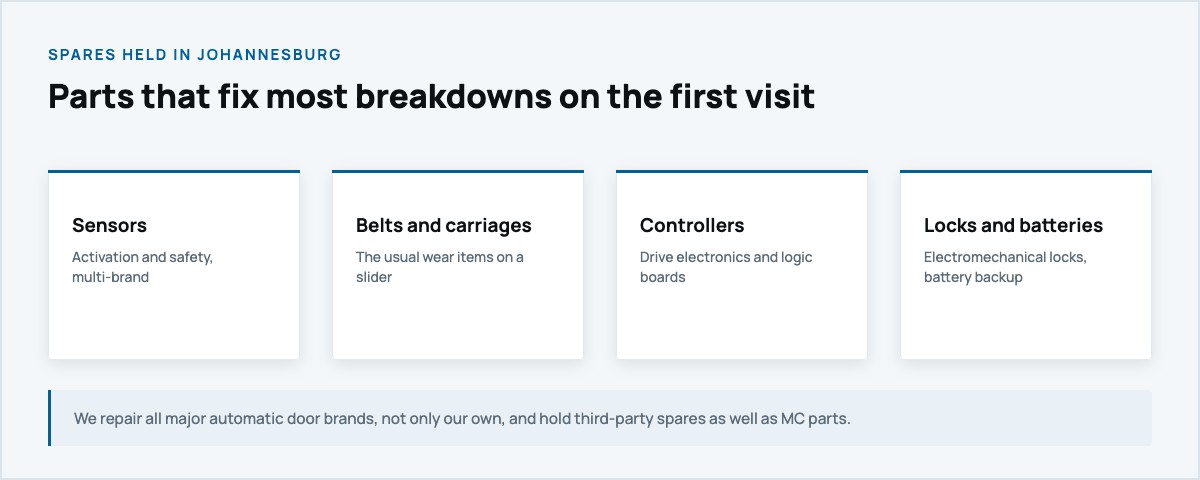
For third-party equipment already in a building, we service GEZE, dormakaba, ASSA ABLOY, record and TORMAX systems. We are an independent service provider and we are not an agent, distributor or authorised representative of any of those companies.
The markets we supply and install into
These are the markets we quote automatic doors Africa projects into. Country coverage is by project, not by branch, because we do not have branches in any of them and we are not going to invent one.
To be unambiguous about it: we quote automatic doors Africa work into every country on the continent. There is no approved list and no territory we decline on principle. What changes from one country to the next is the freight route, the customs position and how practical it is for our own team to reach site, and all three are settled per project in writing rather than assumed.
Alongside the markets named below we also quote regularly into Ghana, Senegal, Uganda, Rwanda, Zambia, Tunisia, Cameroon, Gabon and Eswatini, and we will quote anywhere else in Africa on the same terms. Where a country is not named on this page it is because we have not yet written about it, not because we do not serve it.
In North and West Africa we work into Egypt, Nigeria, Algeria, Morocco, Ghana and Cote d Ivoire, with Accra the market where harmattan dust and coastal salt work on the same entrance in one year. Cairo is the capital of Egypt and the market where dust, not salt, governs the specification, and in Nigeria we quote both Abuja, the capital, and Lagos, which is the commercial centre and the source of most of our Nigerian enquiries. In Cote d Ivoire, where Abidjan is the economic capital and the market where rain and threshold drainage govern the detail, Yamoussoukro is the official capital while Abidjan is the largest city and the more common project location.
In East Africa we work into Kenya, Ethiopia and Tanzania. Our automatic door operators Nairobi page covers that market in detail. Nairobi and Addis Ababa are the usual project cities, and Kampala sits in the Lake Victoria basin where surge, not wear, is the realistic failure mode. In Tanzania, Dodoma is the capital and Dar es Salaam is the largest city and the busier commercial market, and the one where salt rather than dust governs the specification.
Across SADC we work into Botswana, Namibia, Mozambique, Zimbabwe, Zambia, Lesotho, Malawi and Angola. Luanda is the coast where salt is never rinsed off, and Lusaka is where the daily temperature swing ages an entrance faster than the traffic does. See Gaborone, Windhoek and Maputo and Harare in detail. These are the markets where road freight from Laser Park is realistic and where our response, while never same-day, is closest to domestic.
In the island markets we work into Madagascar, Mauritius, Seychelles and Cape Verde. Every island project is a salt-air project and we specify it that way from the start, with a spares holding on site as standard rather than as an upsell.
Choosing between a slide and a swing
Most automatic doors Africa enquiries arrive asking for a sliding entrance, because a slide is what people picture when they picture an automatic door. It is often the right answer and it is not always the right answer, and the difference is usually structural rather than aesthetic.
On automatic doors Africa projects a slide still needs somewhere for the leaf to go. That sounds obvious until you are standing in front of an opening where the wall beside it carries services, or where a structural column sits exactly where the parked leaf would sit. It also needs a header capable of carrying the operator and the leaf weight, and on refurbishment work in older buildings that header is frequently the constraint that decides the project.
A swing needs clear arc. It needs nobody standing in that arc, which is why we are cautious about swing operators on busy retail thresholds, and it needs a leaf and frame in good enough condition to take the drive. Where a swing earns its place is refurbishment: an existing timber or steel door that has to become automatic without the expense and disruption of replacing the whole entrance. That is exactly the MCW-100 job.
For automatic doors Africa projects specifically, there is a third consideration that rarely comes up domestically. A slide has more moving parts exposed to the environment than a swing does. In a heavily dust-loaded or strongly coastal location, that difference matters over a five-year horizon, and it occasionally pushes us to recommend a swing where a slide would have been the obvious domestic choice.
Handover is the part that decides the outcome
On a domestic project, a weak handover is recoverable, because we can be on site. On automatic doors Africa projects it is not, and we treat handover as the deliverable rather than as paperwork at the end of one.
Handover means the client own maintenance people have watched the commissioning, not just received a folder. It means they have seen the operator opened, seen where the controller sits, and been shown the two or three faults that account for most call-outs and what each one looks like. It means they know how to put the entrance into a safe manual state at two in the morning without waiting for anybody.
It also means a written record of the actual commissioning settings for that specific door, so that a year later nobody is guessing at what the opening speed or the hold-open time was supposed to be. Settings drift, people adjust things, and a baseline written down at handover is what lets somebody restore the door instead of experimenting on it.
Where we agree a spares holding, we agree it against the traffic and the environment of that building rather than from a standard list. A high-cycle supermarket entrance in a dusty inland city and a low-cycle office lobby on a coast need different parts on the shelf, and pretending otherwise is how a client ends up holding stock they never use while waiting on the one part they do.
What we need from you to quote
The fastest route to a real number on an automatic doors Africa project is a complete first enquiry. Incomplete enquiries are not a problem, we will simply come back with questions, but they cost a week each time.
We need the structural opening in millimetres, the leaf weight and what the leaf is made of, the depth available above the opening for a header, the floor condition across the threshold, and the country and city. We need to know whether the location is coastal, whether it is dust-exposed, whether the entrance is under cover or in direct sun, and whether mains supply at that building is stable or subject to interruption.
We need a sense of the traffic, even a rough one. Openings per day changes the duty class, and duty class changes both the specification and the service interval. And we need a photograph. One photograph of the existing opening answers more questions than a page of description.
Automatic doors Africa: the short version
If you read nothing else on this page, this is the whole of our automatic doors Africa position in one place.
We export two operators and only two, the MC-125 for sliding leaves and the MCW-100 for swing leaves, and both are imported and assembled at Laser Park in Johannesburg. Every automatic doors Africa project includes our own installation and commissioning team, because we will not warrant an entrance somebody else fitted from a crate.
We quote automatic doors Africa work per project and in writing, and we publish no landed price, no freight figure and no lead time, because those move and a stale number misleads whoever budgets against it. The published R27 590 and R15 900 operator prices are South African prices excluding VAT.
We carry the 24-month operator warranty into every automatic doors Africa project. We do not carry local building or fire approvals, and on any automatic doors Africa job touching an escape route your local consultant owns that question, not us.
Support at distance is designed in rather than promised away. On automatic doors Africa projects that means an agreed spares holding, your own team trained at handover, and our line on 010 412 0062 for first-line diagnosis. It does not mean a same-day technician, which remains a Gauteng commitment only.
Frequently asked
Do you actually install, or do you only export the operators?
We install and commission. Automatic doors Africa projects are quoted as equipment plus an installation and commissioning team, because an operator that arrives in a crate and is fitted by somebody who has never seen one is not an entrance we are willing to warrant.
What does an automatic door cost delivered to my country?
We will not publish that figure, because freight, duty and route change and a stale number misleads whoever budgets against it. Our South African operator prices are published openly, R27 590 excluding VAT for the MC-125 and R15 900 excluding VAT for the MCW-100, and every automatic doors Africa project is quoted in writing against your actual opening.
Does the warranty apply outside South Africa?
The 24-month warranty is on the operator and it travels with the operator into every automatic doors Africa project. What it does not include is a same-day attendance anywhere outside Gauteng. On automatic doors Africa projects we agree the support arrangement, including any spares held on site, as part of the original quotation so that nobody is guessing later.
Can you certify the entrance for our local fire or building code?
No, and you should be wary of a supplier who says yes. We do not hold local building or fire approvals in these markets. We give your local consultant the full technical detail on the operator and they carry the compliance question in their own jurisdiction.
Who maintains the door once you have flown home?
On automatic doors Africa projects, ideally your own facilities team, trained by us at handover, working from a spares holding we agree with you up front. We support them by phone and email on 010 412 0062. Designing the maintenance around the distance is part of the project, not an afterthought.
Talk to us about an automatic doors Africa project
If you have an opening, a building and a country, we can quote the automatic doors Africa project. Send the leaf weight, the structural opening, a photograph of the existing entrance and a note on the environment, whether it is coastal, dusty, covered or exposed, and whether the power supply is stable. That is enough for a real answer rather than a brochure answer.
Call us on 010 412 0062 or use the request a quote form. For the technical detail on the units themselves, the MC-125 and MCW-100 pages carry the full specification, and our automatic door servicing page explains how we structure maintenance agreements. Wider industry guidance on powered pedestrian doors is published by the South African Bureau of Standards.