
Automatic door operators Luanda: supplied and supported from South Africa
Luanda is a coastal city that hardly ever rains. The cold Benguela current keeps the air damp and the sky grey while leaving the ground dry, and that combination is unusual enough to catch out anyone specifying from a textbook. Salt arrives on the air all year and almost nothing washes it off again. We export the MC-125 and MCW-100 into Angola and we install and commission them ourselves.
automatic door operators Luanda projects are quoted from Johannesburg, per project, in writing. We have no branch in Angola and we are not going to pretend otherwise.
Salt that is never rinsed off is the whole design problem
On automatic door operators Luanda sites the operator is rarely the first thing to go. The fixings are.
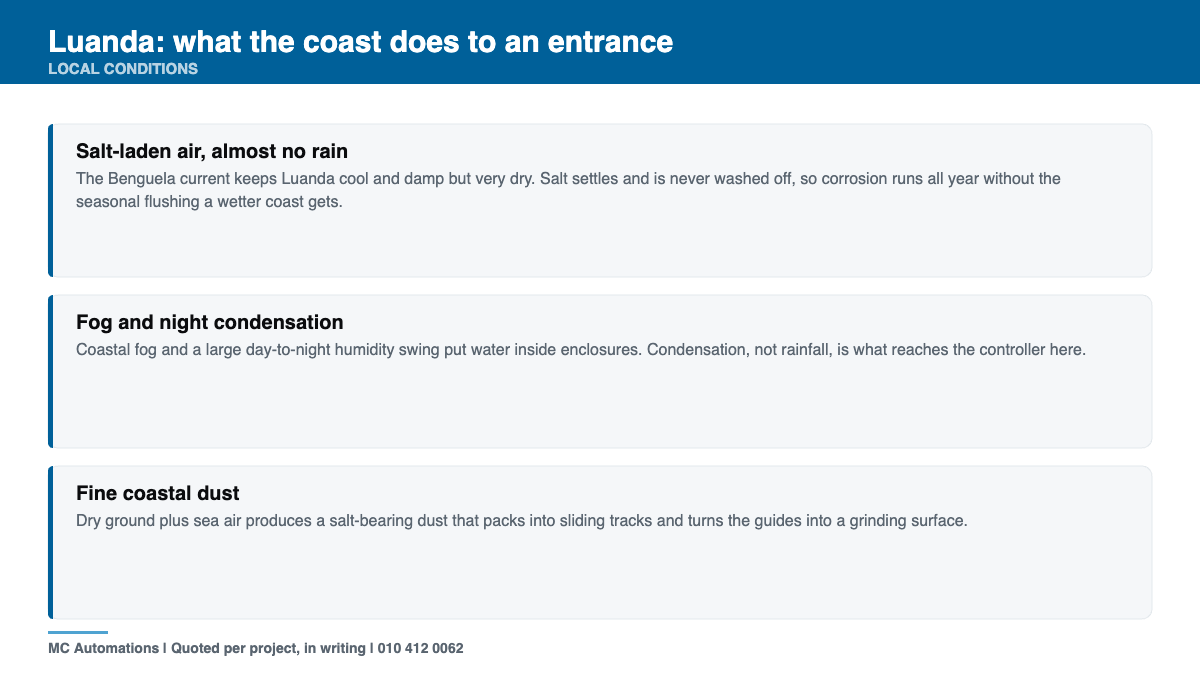
On a wet coast, rain does something useful: it flushes salt off the frontage several times a year. Luanda does not get that. Salt settles on brackets, track fasteners and cable glands and simply stays there, holding moisture against the metal through every damp night. Ordinary plated screws begin to bloom within a season and nobody notices until a bracket lets go under load.
So automatic door operators Luanda specifications start with the ironmongery and the fasteners, not the motor. Stainless fixings throughout the exposed assembly, sealed cable entries, and a controller enclosure that is genuinely closed against damp rather than merely covered. It costs more at quotation and it is the difference between an entrance that lasts and one that embarrasses you in year three.
What Luanda is not
Before specifying automatic door operators Luanda entrances it is worth saying plainly what this city is not, because the wrong mental model produces the wrong specification.
It is not a tropical downpour city. Luanda is dry enough that a drainage-first specification written for Abidjan or a monsoon coast is aimed at the wrong problem here. The water that matters arrives as fog and condensation, not as rain hitting a threshold.
It is also not a hot city in the way its latitude suggests. The Benguela current keeps it comparatively mild, so the thermal demand on a controller is modest. Corrosion, not heat, is what shortens equipment life on this coast.
Fog, condensation and the controller
Electronics fail in damp long before they fail in heat, and Luanda is damp in a way that does not announce itself.
Coastal fog and a large day-to-night humidity swing put water inside enclosures without a drop of rain falling. Condensation forms whenever a damp day is followed by a cooler night, and condensation inside a controller is what kills boards.
On automatic door operators Luanda installations the measures that matter are unglamorous: mount the controller out of the splash and fog line, seal the entries properly rather than stuffing them, and let the enclosure breathe where the design intends it to. We confirm the operating range against the actual mounting position on your building rather than quoting a brochure figure, and we confirm the supply voltage and frequency at your site in writing before anything is ordered.
The two operators we export to Angola
For automatic door operators Luanda supply we carry two units, deliberately.
The MCW-100 is our swing operator, from R15 900. The MC-125 is our sliding operator, from R27 590. Both figures are South African prices, excluding VAT, and neither includes the door leaf, the glass, the freight or the installation. They are the starting point of a conversation, not a delivered cost in Luanda.
Both units are imported and assembled at our Laser Park facility. We are not a manufacturer and we do not claim to be one. On automatic door operators Luanda supply what we own is the assembly, the commissioning standard and the spares holding behind them.
Both carry a 24-month warranty on the operator. That is the operator specifically, not the whole installed assembly.
We install and commission
On automatic door operators Luanda work we do not sell a crate and wish you luck.
For automatic door operators Luanda projects our own team travels to site, installs, commissions and hands over. Commissioning is the part worth reading twice: an operator in a box is not an entrance, and setting a door up against the real leaf, the real floor and the real traffic is where the job is won or lost. We record the commissioned settings so that anyone who touches the entrance later has a baseline to restore it to.
Where a client wants to use their own contractor for the builder work around the opening that is normally fine, but the operator installation and commissioning stay with us.
What we are not responsible for in Angola
On automatic door operators Luanda quotations this is the section most suppliers leave out, so we will be direct.
We hold no Angolan building approvals and no Angolan fire approvals. We are a South African supplier. Local compliance, permits, inspections and any fire-engineering sign-off are the client’s responsibility through their own local professionals, and we state that in writing on every quotation rather than letting it become a surprise.
We also do not do everything. We do not supply, fit, retrofit or service roller shutter doors, and we do not supply, fit, retrofit or service door closers. Pedestrian entrances are what we do. If your enquiry is really about a shutter or a closer, we would rather tell you now than take the order.
Lead times, freight, duties and clearing are quoted per project once the scope is fixed. We will not publish a number for those here, because any number we published would be wrong for your project.
Getting a Luanda quotation right first time
Most of the delay on a automatic door operators Luanda order is not freight. It is the back-and-forth caused by a thin enquiry. Send us this and the quotation comes back properly the first time:
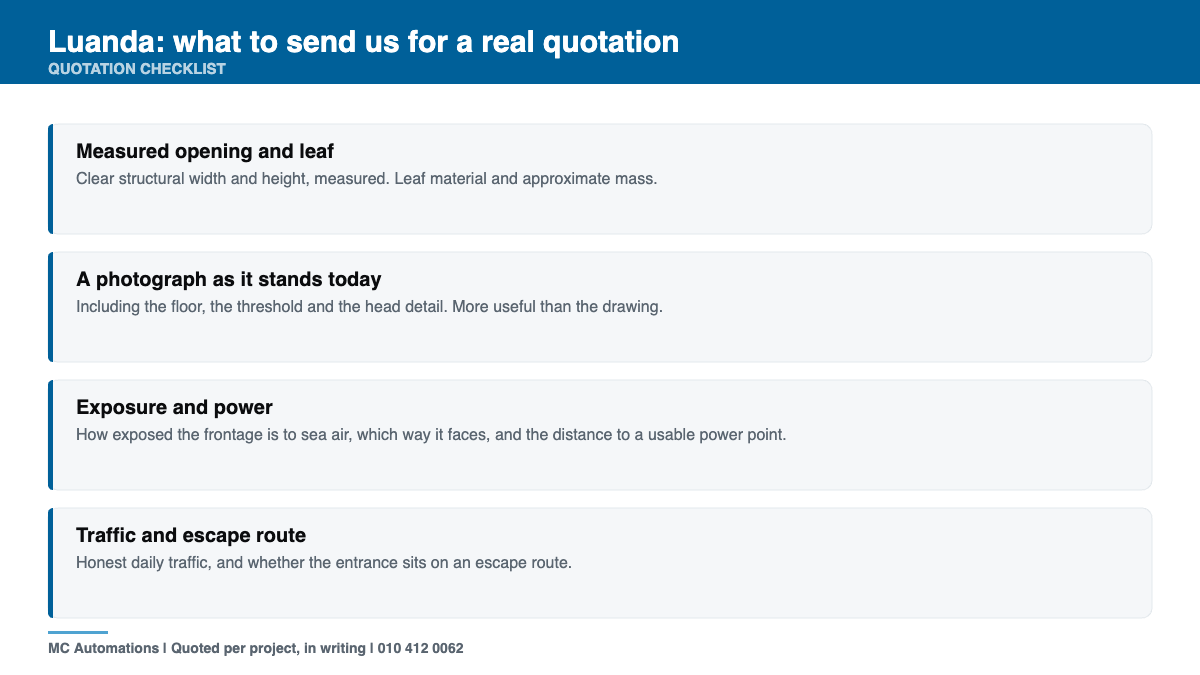
- The clear structural opening width and height, measured, not assumed from a drawing.
- Whether the leaf is glass, aluminium framed, timber or steel, and its approximate mass.
- Whether you want a slide or a swing, or whether you want us to tell you which suits the opening.
- A photograph of the opening as it stands today, including the floor and the head detail.
- How exposed the frontage is to sea air, and which way it faces.
- Distance from the opening to the nearest usable power point, with the supply voltage and frequency.
- The expected daily traffic, honestly rather than optimistically.
- Whether the entrance sits on an escape route, because that changes the specification.
That list is short on purpose. automatic door operators Luanda enquiries that arrive with those eight things get a real quotation; enquiries that arrive with only a width get a list of questions.
Service intervals on a dry coast
A automatic door operators Luanda entrance needs attention on a schedule set by salt, not by cycle count.
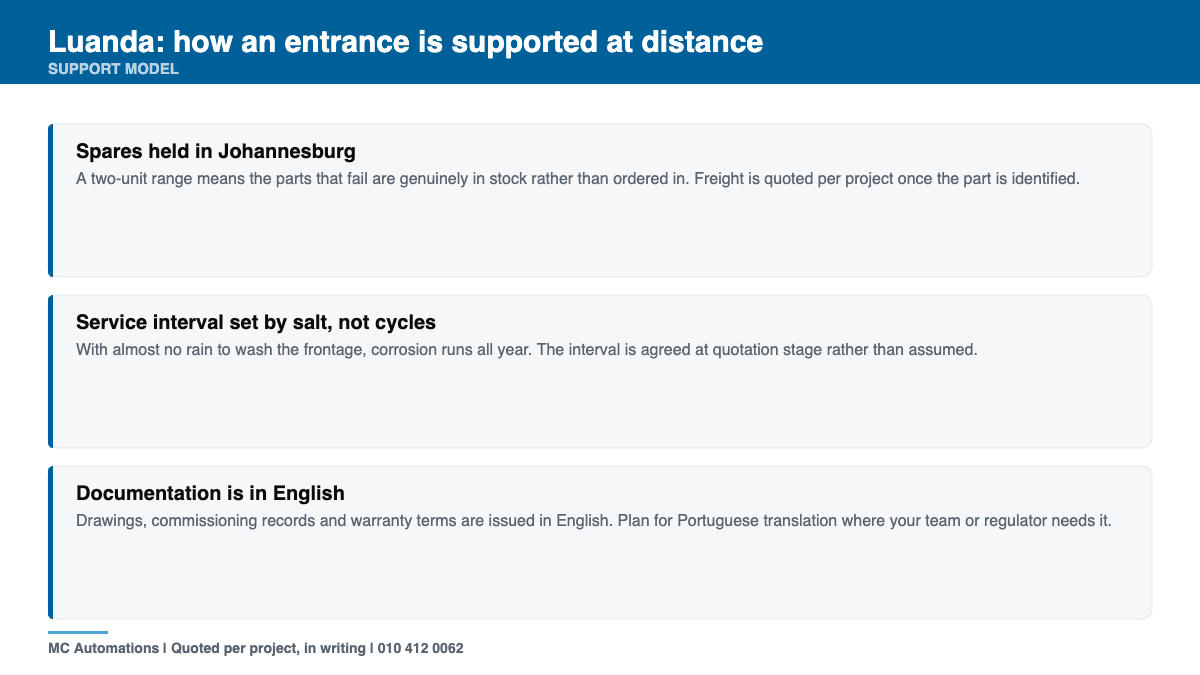
Because there is no seasonal rain to flush the frontage, corrosion runs continuously rather than in bursts. Exposed fasteners degrade whether the door has run ten thousand cycles or a hundred thousand, and a salt-bearing dust packs into the tracks at the same time. We would rather agree a realistic interval at quotation stage than win the order on an optimistic number and have the entrance disappoint in year four.
What a service visit consists of is simple: wash down and clear the track, replace corroded fixings before they fail rather than after, inspect the harness and cable entries, test the safety sensors properly rather than waving a hand through them, and restore the commissioned settings if the door has drifted.
Maintaining an entrance after we leave
Between our visits, most of what keeps automatic door operators Luanda entrances healthy can be done by a competent local hand.
Rinsing exposed surfaces with clean fresh water is worth more here than anywhere else we export to, precisely because the weather will never do it for you. Keeping the track clear and reporting a change in sound or speed early are the other two things that matter. An entrance that has drifted from its commissioned state is not obviously broken; it is simply worse, and without a recorded baseline nobody can tell how far it has moved.
On automatic door operators Luanda handovers we leave that baseline written down, and we will talk a local technician through a fault over the phone on 010 412 0062 rather than insisting that only we may touch it.
Slide or swing for a Luanda opening
For automatic door operators Luanda the choice is decided by the opening, the traffic and the exposure to sea air, not by preference.
A slide suits high, continuous, two-way pedestrian traffic and a wide clear opening: hotel lobbies, retail frontage, banking halls, airport landside areas. It has more exposed running gear, which on this coast means the stainless specification and the service interval matter more, not less.
A swing suits lower traffic, narrower openings, and situations where an existing leaf is being automated rather than replaced. It presents less hardware to the air, it is the cheaper entry point, and it is often the right answer for a side entrance, an office suite or an accessible door on an existing building.
Where an entrance sits on an escape route the requirement changes again, and we will say so plainly. Escape-route specifications are a conversation with your local fire professional, not something we will sign off from Johannesburg.
Refurbishment versus new build
Most of our automatic door operators Luanda enquiries are refurbishment, and refurbishment is the harder job.
On a new build the opening is made for the operator, which is rarely the case on automatic door operators Luanda work. On a refurbishment the operator has to work with a floor that is not level, a head detail that was never designed to carry a track, and a leaf that may be heavier than anyone remembers. That is why the photograph of the existing opening matters more than the drawing.
On automatic door operators Luanda refurbishments there is also a real question about what is worth saving. Where an existing leaf is sound, automating it with an MCW-100 is usually better value than replacing the whole entrance. Where the leaf, the frame and the floor are all tired, patching an operator onto it is money spent badly and we will say so.
The sectors we work into
automatic door operators Luanda demand follows the building stock, and this is a coastal capital with a strong corporate and energy-sector presence.
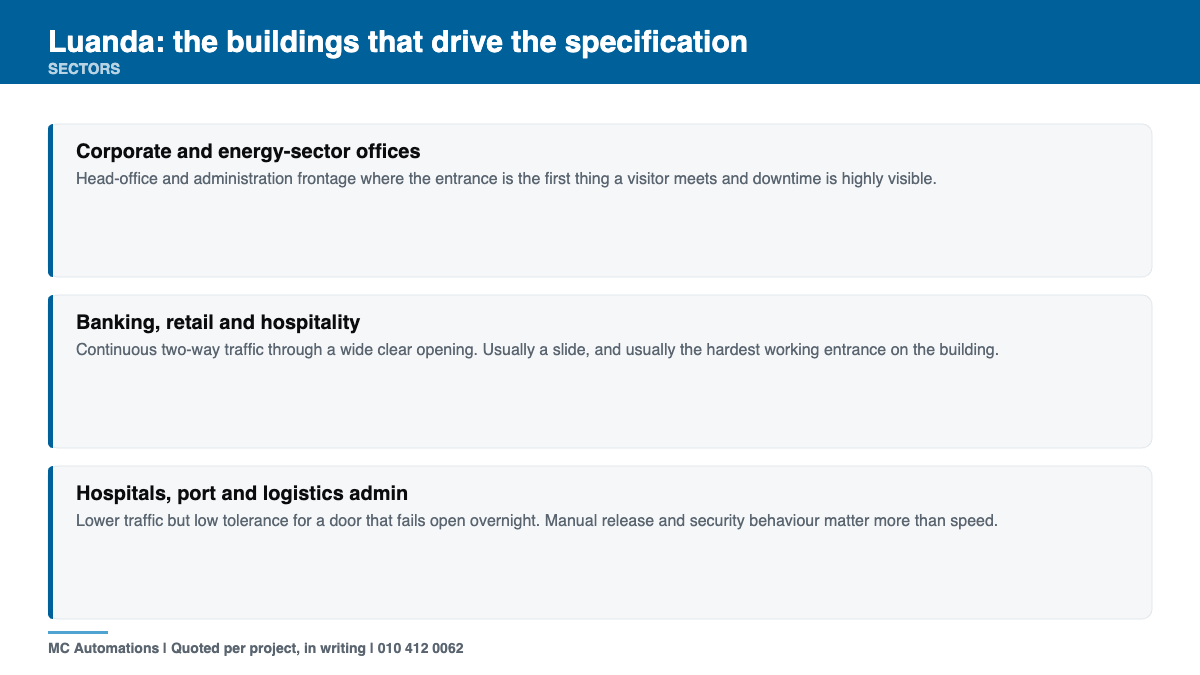
Corporate and energy-sector head offices, banking halls, retail and shopping centres, hotels, hospitals and clinics, government buildings, and port and logistics administration blocks are where the enquiries come from. Each has a different traffic pattern and a different tolerance for downtime, which is why we ask about honest daily traffic rather than assuming.
We also do airports, and on automatic door operators Luanda sites we service the major international brands already installed in the region: GEZE, dormakaba, ASSA ABLOY, record and TORMAX. That is a service relationship only. We are not an agent or a distributor for any of them, we are independent, and we say so on every quotation.
Why a narrow product range helps at distance
A two-unit range reads like a limitation until there is a fault and the workshop is on the other side of the continent.
A supplier carrying many operator families cannot hold deep spares for any of them, and cannot have technicians who know each one thoroughly. On automatic door operators Luanda projects that gap becomes the client’s problem rather than the supplier’s. A narrow range means the spares that matter are genuinely held, a fault described over the phone is one we have seen many times, and the part we send is the right one first time.
Planning for the life of the entrance
What automatic door operators Luanda entrances cost is settled over fifteen years, not at purchase, and here the dominant variable is corrosion rather than cycles.
A automatic door operators Luanda entrance that is looked after on a sensible interval will comfortably outlast one left alone, and the gap between the two is far wider than any difference between one good operator and another. That is why we would rather have a frank conversation about the service interval at quotation stage than be optimistic to win an order.
On automatic door operators Luanda handovers it is also why the commissioning settings get written down. Without a recorded baseline nobody can tell how far an entrance has drifted or restore it properly.
A note on cross-border warranty
On automatic door operators Luanda orders, the 24-month warranty is on the operator and it travels with the operator. If the unit is defective we repair or replace it, and its being in Angola does not change that obligation.
What the warranty does not cover is the same everywhere: damage from a power event, damage from an entrance being forced, or wear accelerated by a door nobody maintained. Salt left on an entrance for years will shorten the life of a perfectly sound operator. That is a maintenance question rather than a warranty question, and we prefer to set the expectation at quotation than argue about it in year two.
automatic door operators Luanda: the short version
If you read nothing else about automatic door operators Luanda: salt decides the specification and nothing washes it off, stainless fixings and sealed enclosures are not optional, our documentation is in English and you should plan for Portuguese translation, the two units start at R15 900 and R27 590 South African excluding VAT, the operator carries 24 months, we install and commission with our own team, we hold no Angolan approvals, we do not touch roller shutters or door closers, and every figure that matters is quoted per project in writing.
Same-day call-outs are a Gauteng service. Angola is planned work, and we will be honest about that rather than implying a response we cannot deliver.
Frequently asked
Do you have an office or branch in Luanda?
No. We have no branch, no local office and no local phone number in Angola. automatic door operators Luanda projects are quoted, supplied, installed and commissioned from Johannesburg, and we would rather say that plainly than invent a local presence.
Is your documentation available in Portuguese?
Our drawings, commissioning records, operating instructions and warranty terms are issued in English. We ask clients to plan for Portuguese translation where their facilities team or regulator needs it, and we flag it on the quotation rather than at handover.
Do your operators meet Angolan building and fire regulations?
We hold no Angolan building or fire approvals. Local compliance and any fire-engineering sign-off are the client’s responsibility through their own local professionals. We state this on every quotation.
Why does a dry city need a marine specification?
Because dryness is the problem. Salt still arrives on the air every day, and without rain to rinse it away it accumulates on fixings continuously. Luanda needs the corrosion answer more than a wetter coast does, not less.
Can you service the GEZE or dormakaba doors already in our building?
Yes. We service GEZE, dormakaba, ASSA ABLOY, record and TORMAX equipment. That is a service relationship only; we are independent and are not an agent or distributor for any of those brands.
Talk to us about a Luanda entrance
automatic door operators Luanda enquiries are welcome. Send the eight facts listed above and we will come back with a real quotation rather than a brochure. Start with our automatic doors Africa overview for how we work across the continent, or read how we operate as an automatic door service provider on equipment we did not originally install.
You can reach us on 010 412 0062 or through our contact page. For South African standards background, the South African Bureau of Standards publishes the national standards our own work is measured against.