
Fire Rated Automatic Doors
Powered entrances whose leaves resist the spread of fire, specified against your opening and your building’s fire strategy.
Fire rated automatic doors sit in an awkward place: they have to behave like an ordinary entrance every day, and like a fire barrier on the one day it matters. Getting that combination right is a specification exercise, not a shopping exercise, and the detail that decides it is almost never the price.
This page explains what fire rated automatic doors do, what the rating actually covers, and what you should insist on seeing in writing before an order is placed.
What fire rated automatic doors actually are
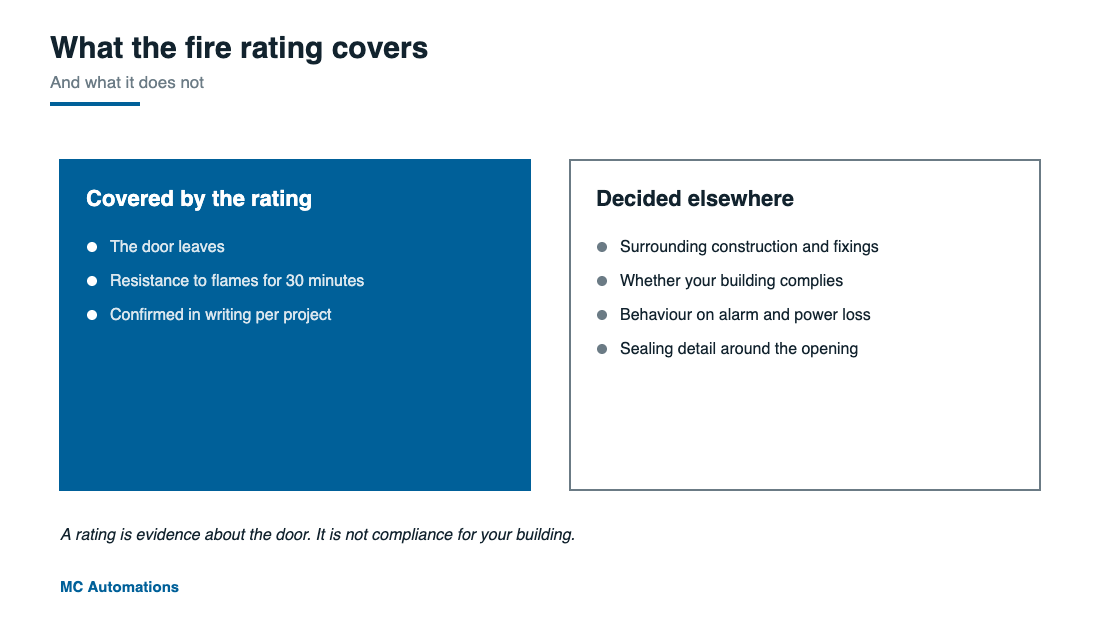
A fire rated automatic door is a powered entrance whose leaves are built to resist the spread of fire for a defined period, while still operating as a normal automatic sliding door for everyday traffic. The door leaves can resist flames for 30 minutes, which is intended to contain a fire and allow occupants time to evacuate.
The important qualification, and the one most suppliers gloss over: fire performance, the rating, and the standard it is tested to are confirmed in writing per project against South African requirements. There is no single universal rating that applies to every opening, every building and every fire strategy. If a supplier quotes you a rating without reference to your project, treat that as a warning rather than a reassurance.
What the rating covers, and what it does not
This is where most misunderstandings live, so it is worth being blunt about the limits of fire rated automatic doors.
- The rating applies to the door leaves, not to everything around them. The surrounding construction, the fixings and the sealing detail are part of the outcome and are the responsibility of the building’s fire strategy.
- A rating is not a compliance certificate for your building. It is evidence about a product. Whether the installed entrance satisfies the requirement for that position is decided by the fire consultant or the local authority, not by the supplier and not by a brochure.
- An operator is not a fire rating. The drive unit moves the leaves. It is the leaf construction that carries the fire performance.
- Everyday automatic-door safety still applies. Fire rated automatic doors need the same activation and safety sensing, the same force settings and the same commissioning as any other powered entrance.
How fire rated automatic doors behave on an alarm
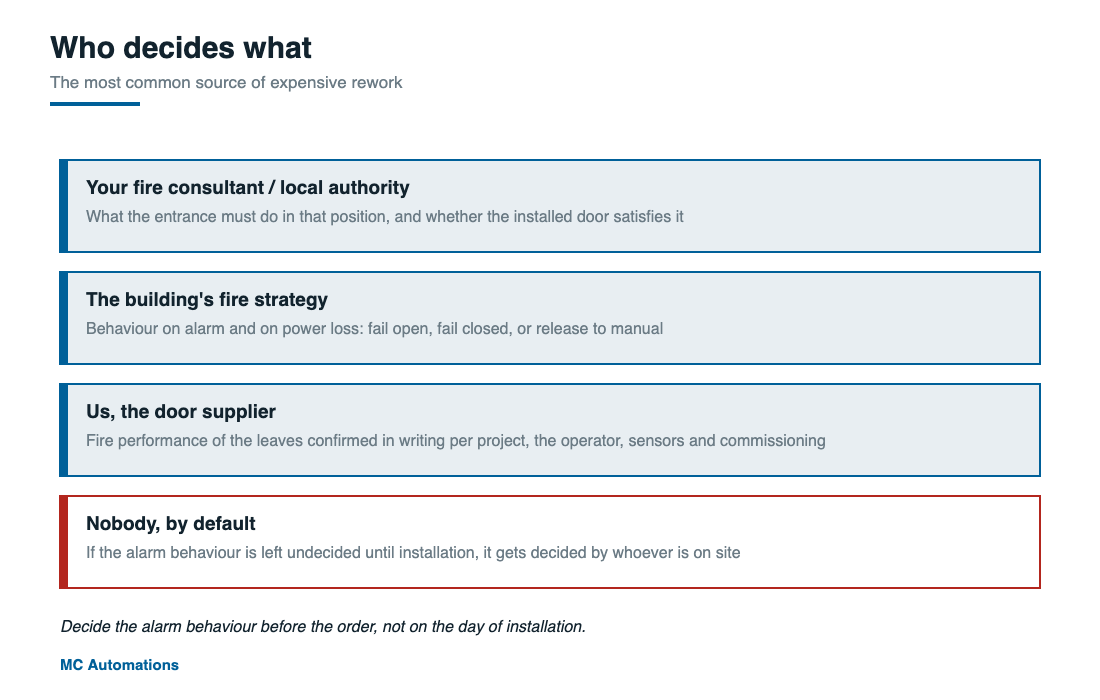
Behaviour on alarm is a design decision taken before the order, because it changes what is fitted inside the header and how the door is wired to the building.
Where the doorway sits on an escape route, what the door must do when the alarm sounds or the power drops is set by the building’s fire strategy, not by preference and not by the door supplier. It should be confirmed with the fire consultant or the local authority before anything is ordered. The same applies to whether the entrance must fail open, fail closed, or release to manual operation.
That single conversation, held early, prevents the most expensive category of rework on fire rated automatic doors: an entrance that is fitted, commissioned and then has to be rewired or replaced because its alarm behaviour does not match the fire strategy.
Where fire rated automatic doors are used
- Compartment lines in larger buildings, where a fire barrier crosses a route people use constantly and a manual door would simply be propped open.
- Healthcare, where staff move beds and trolleys through compartment lines and hands-free operation is not a luxury.
- Hotels and public buildings, where the entrance must look and behave like a normal doorway and still hold a line.
- Industrial and warehouse settings, where a compartment line crosses a traffic route used by pallet movers — see automatic warehouse doors.
- Retail and shopping centres, at service corridors and back-of-house boundaries rather than at the shopfront itself.
The common thread is a doorway that must not be propped, on a line that must not be broken, in a place where people are moving with their hands full.
Specifying fire rated automatic doors: what to get in writing
Because the rating is confirmed per project, the paperwork matters more here than on an ordinary entrance. Ask for each of these as a written line, not a verbal assurance.
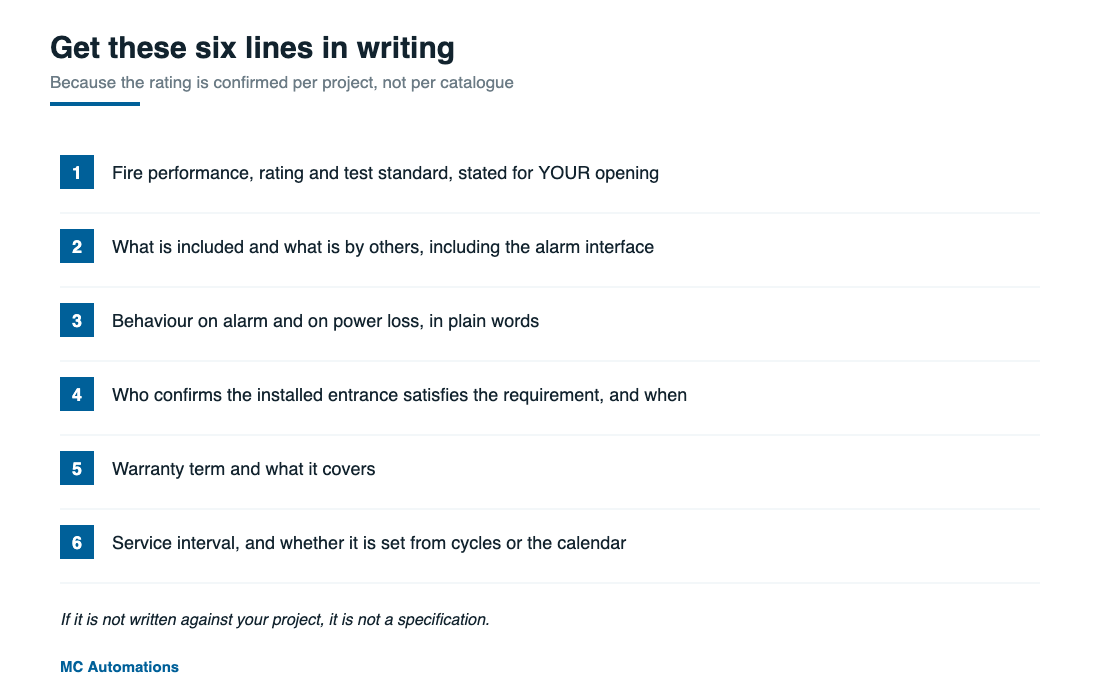
- The fire performance, the rating, and the standard it has been tested to, stated for your opening.
- What is included and what is by others: the leaves, the operator, the sensors, the electrical supply, and the interface to the fire alarm.
- The behaviour on alarm and on power loss, written out in plain words.
- Who is confirming that the installed entrance satisfies the requirement for that position, and when.
- The warranty term and what it covers. The fire-rated sliding door operator carries a 24-month warranty.
- The service interval proposed, and whether it is set from the cycle count or the calendar.
A supplier who can produce those six lines without hesitation is a supplier who has done this before. One who cannot is asking you to carry a risk that is not yours to carry.
Everyday use is what breaks fire rated automatic doors
The failure mode people expect is dramatic. The failure mode that actually happens is mundane: the door stops working properly as an everyday entrance, someone props it, and the compartment line is open for months before anyone notices.
That makes ordinary reliability a fire-safety issue rather than a convenience issue. Fire rated automatic doors that are slow, noisy, badly commissioned or prone to nuisance opening get defeated by the people who use them, and a defeated door provides no protection at all.
- Commission properly. Opening and closing forces, speeds, hold-open times and sensor aim are set on site, against the real traffic, not left on a factory default.
- Size for the real traffic. An entrance on a busy compartment line does more cycles than people assume, and lifespan is measured in cycles. Under-specifying guarantees early wear.
- Protect the approach. Trolley and pallet impact is the most common reason an operator is replaced early, and a bollard costs less than a door.
- Fix faults quickly. A fire rated automatic door waiting on a part is a compartment line that is either propped or blocked, and both are bad outcomes.
Servicing and inspection
Fire rated automatic doors need the service regime of a powered entrance and the inspection discipline of a fire-safety component, and those are not the same thing on the same schedule.
The mechanical service interval should follow the real cycle count rather than the calendar, because a compartment door in a hospital corridor and one in a quiet back-of-house area wear at completely different rates. The fire-related checks — that the alarm interface still does what the fire strategy says, that nothing has been propped, wedged or disabled, and that the leaves still close and latch as intended — belong to the building’s own fire-safety regime, and the frequency of those is set there rather than by us.
Keep both records. When someone asks whether the entrance has been maintained, “we service it” is a weaker answer than a log with dates against it.
Common mistakes with fire rated automatic doors
- Treating a product rating as building compliance. The rating is evidence about the door; compliance is decided for your building, in that position, by the people qualified to decide it.
- Leaving alarm behaviour until installation. By then the wiring and the header contents are already fixed.
- Specifying the cheapest operator on a busy compartment line. Fire rated automatic doors fail as fire barriers when they stop working as doors.
- Assuming any automatic door can be upgraded to a fire rating. The fire performance lives in the leaf construction, so adding an operator to an existing leaf does not create a fire rated entrance.
- Accepting a verbal rating. If it is not written against your project, it is not a specification.
Fire rated automatic doors or a hold-open device?
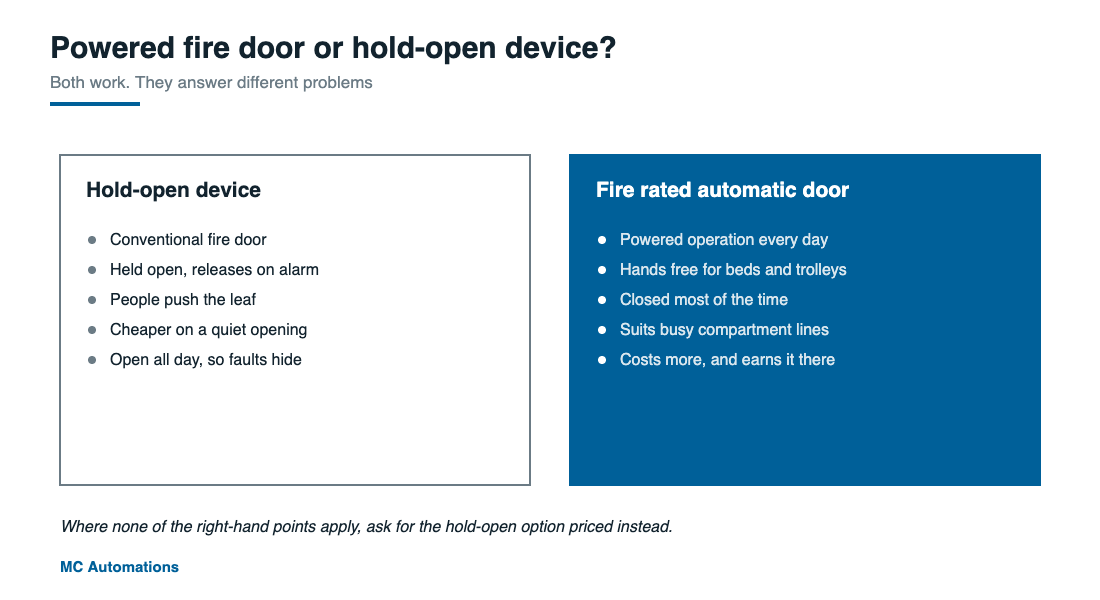
There is a cheaper-looking alternative that gets proposed often, and it is worth understanding before you compare prices. A conventional fire door can be held open on a magnetic device that releases when the alarm sounds, letting the door close on its own.
That arrangement works, and on a low-traffic opening it is frequently the sensible answer. What it does not give you is powered operation: people still push the leaf, which matters where hands are full, where beds and trolleys cross the line, or where accessibility is part of the brief. It also does nothing for the propping problem, because a door on a hold-open is already open all day and nobody thinks about it until it fails to release.
Fire rated automatic doors earn their cost where the crossing is busy, where users cannot reasonably push a leaf, or where the door must be closed most of the time and still not slow anybody down. Where none of those apply, say so and price the hold-open option instead. We would rather quote the cheaper arrangement than sell you powered fire rated automatic doors you do not need.
What drives the cost of fire rated automatic doors
Two quotations for what looks like the same opening can differ widely and both be honest, because fire rated automatic doors carry costs that an ordinary entrance does not. Knowing where the money goes makes the comparison possible.
- The leaf construction. This is where the fire performance lives, and it is the largest single difference from a standard automatic entrance.
- The alarm interface. Wiring the entrance to the building’s fire alarm, and proving it behaves as specified, is work. It should appear as work on the quotation.
- Structural and sealing detail. What surrounds the door matters to the outcome, and making good around it is frequently excluded and then discovered later.
- Duty rating. A compartment line on a hospital corridor needs an operator specified for that traffic, not the cheapest unit that fits.
- Commissioning and documentation. Setting the door up against real traffic and producing the written confirmation of performance takes time that a bare supply price does not include.
- Sensors and safety. Activation and safety sensing are separate functions, and a quote naming only one has left something out.
Ask for the leaves, the operator, the sensors, the alarm interface, the installation and the commissioning as separate lines. A supplier who cannot break fire rated automatic doors down that way is quoting a price rather than a scope.
The people who use the door decide whether it works
A compartment door is only as good as the behaviour around it, and that is a training question as much as an engineering one. Every fire rated entrance we have seen defeated was defeated by reasonable people solving a short-term problem.
Staff prop doors to move stock, to cool a corridor, or because the door is slow and they are carrying something. None of that is malice, and none of it is solved by a notice on the wall. It is solved by specifying an entrance that suits how the building actually works, so nobody needs to defeat it, and by showing people the manual release at handover rather than assuming they will find it.
Show the release to staff when the entrance is handed over, write down where it is, and show it again when the people who were there at handover have moved on. Fire rated automatic doors sit in buildings for years, and the staff who were trained on day one are rarely the staff present on the day it matters.
Handover: what to keep
When the entrance is handed over, the paperwork is the part you will still need in three years. Keep it somewhere the facilities manager can find it, not in an email thread.
- The written confirmation of fire performance, rating and test standard for that opening.
- The commissioning record: forces, speeds, hold-open time and sensor arrangement as set on the day.
- The alarm behaviour as configured, in plain words.
- The location of the manual release, and who was shown it.
- The service interval agreed, and on what basis it was set.
- Warranty terms and what they cover.
A short glossary
- Compartment line. A boundary in a building intended to contain fire and smoke for a period. Fire rated automatic doors exist to let people cross one without breaking it.
- Leaf. The moving panel of the door. On fire rated automatic doors this is where the fire performance is built in.
- Operator. The drive unit that moves the leaves, such as the MC-125. It carries no fire rating of its own.
- Alarm interface. The connection between the entrance and the building’s fire alarm, which triggers the specified behaviour.
- Manual release. The means of moving the leaf by hand when there is no power.
- Commissioning. Setting the door up on site against real traffic rather than accepting factory defaults.
- Fire strategy. The building’s own plan for containing fire and evacuating people. It decides what the entrance must do; the door does not decide for it.
Published guidance from the South African Bureau of Standards is a reasonable starting point for the vocabulary, but it is not a substitute for a fire consultant looking at your building.
Quick answers on fire rated automatic doors
- Fire rated automatic doors are powered entrances whose leaves resist the spread of fire for a defined period.
- Fire rated automatic doors supplied here have leaves that can resist flames for 30 minutes.
- Fire rated automatic doors have their fire performance, rating and test standard confirmed in writing per project.
- Fire rated automatic doors carry their rating in the leaf construction, not in the operator.
- Fire rated automatic doors must have their alarm behaviour decided before the order, not at installation.
- Fire rated automatic doors on an escape route follow the building’s fire strategy, confirmed by the fire consultant or local authority.
- Fire rated automatic doors still need ordinary activation and safety sensing, force settings and commissioning.
- Fire rated automatic doors that are unreliable get propped, and a propped door protects nothing.
- Fire rated automatic doors need both a mechanical service interval and the building’s own fire-safety inspection regime.
- Fire rated automatic doors cannot be created by adding an operator to an ordinary door leaf.
- Fire rated automatic doors come with a 24-month warranty on the operator.
- Fire rated automatic doors should never be quoted with a rating that is not tied to your specific opening.
Frequently asked questions
What fire rating do your automatic sliding doors have?
The door leaves can resist flames for 30 minutes. The fire performance, the rating and the standard it is tested to are confirmed in writing per project against South African requirements, because the requirement depends on the opening and the building rather than on a catalogue entry.
Does a fire rating make my building compliant?
No. A rating is evidence about the door. Whether the installed entrance satisfies the requirement for that position is decided by your fire consultant or the local authority. We will not issue a compliance statement for your building, and you should be wary of anyone who does.
What happens when the fire alarm goes off?
Whatever the building’s fire strategy specifies. That behaviour is decided before the order because it changes what is fitted inside the header and how the door is wired to the alarm. It is confirmed with the fire consultant or local authority, not chosen by preference.
Can you make my existing automatic door fire rated?
No. The fire performance is in the leaf construction, so it cannot be added by changing the operator. An existing entrance on a compartment line needs the door itself replaced, not automated differently.
Do fire rated automatic doors need different servicing?
They need both: the mechanical service interval of a powered entrance, set from the real cycle count, and the fire-related checks that belong to your building’s own fire-safety regime. Keep a record of each.
What warranty applies?
The fire-rated sliding door operator carries a 24-month warranty. Wear parts and glass are quoted and warranted separately, and that is confirmed in writing before an order is placed.
Talk to us about a specific opening
Fire rated automatic doors are quoted against a specific opening and a specific fire strategy, never against a catalogue. Send the opening size, the position in the building and what your fire consultant has specified, and we will tell you what fits and what has to be confirmed before an order. Request a quote or call 010 412 0062.
In short
Fire rated automatic doors at a glance
- Leaves resist flames for 30 minutes; the rating is confirmed in writing per project.
- The rating is evidence about the door, not compliance for your building.
- Alarm and power-loss behaviour follow the fire strategy, decided before the order.
- The fire performance is in the leaf, never in the operator.
- 24-month warranty on the operator; wear parts and glass quoted separately.