
Swing
Automatic swing doors, on the door you already have
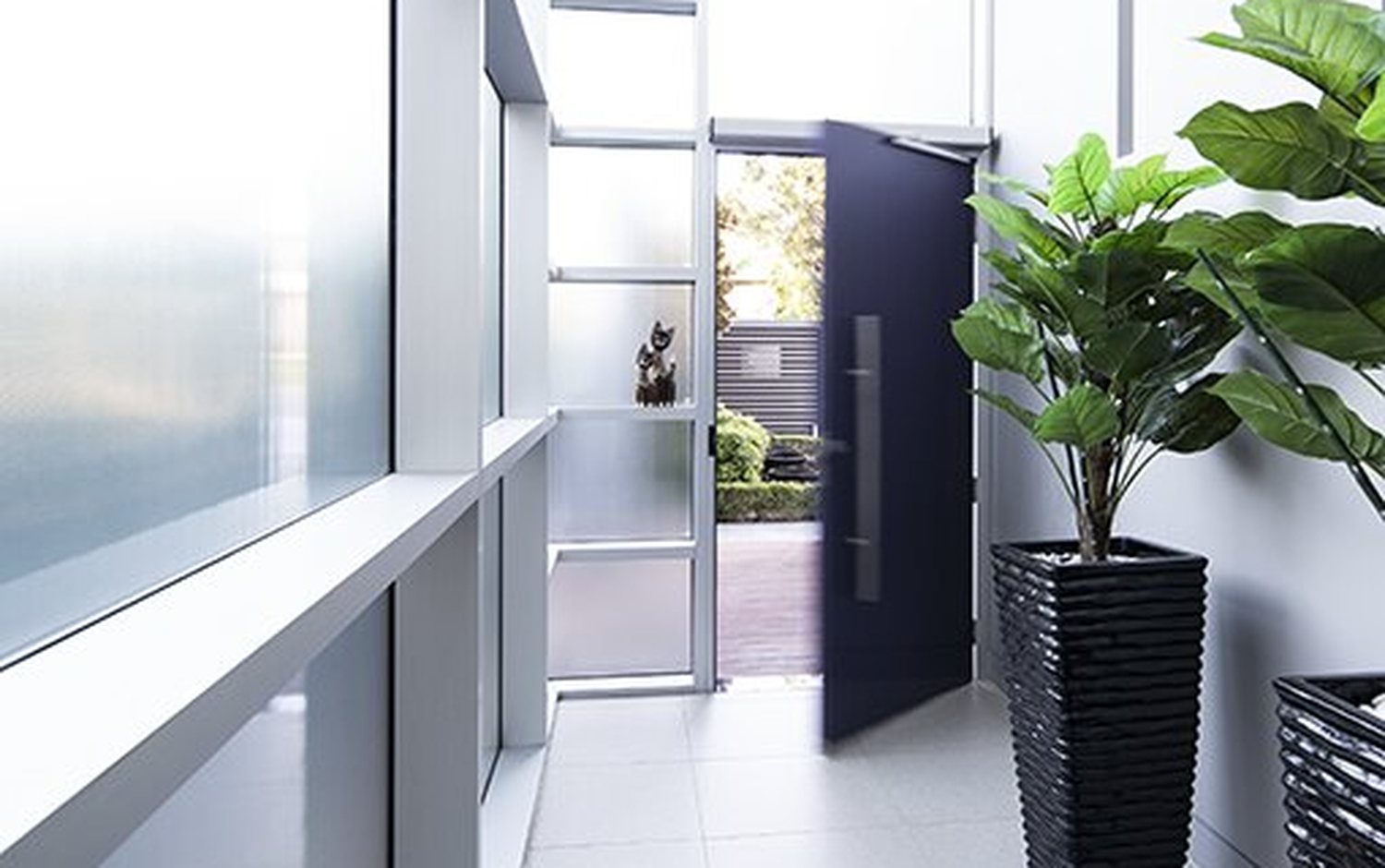
Our MCW-100 operator turns a new or existing swing door into an automatic one, with an opening angle adjustable from 60° to 110° and leaves up to 150 kg. The usual route to an accessible entrance without rebuilding it.
Why swing
When a swing operator is the right answer
Most requests for automatic swing doors start with a door that already exists and a building that has to be easier to get into.
A sliding door needs wall space to park a leaf and a structure above it to hang from. A swing operator needs neither — it fits to the frame of a door that is already hung, which makes it the practical answer for offices, clinics, schools, back-of-house entrances and any refurbishment where the opening cannot change.
Automatic swing doors are also the cheapest way to make an entrance accessible. A door that is heavy for a wheelchair user, someone with a trolley or a parent with a pushchair becomes usable without touching the frame, the glass or the floor.
Activation
How people open automatic swing doors
Automatic swing doors are specified as much by how they are triggered as by the door itself. We fit and configure:
Motion and touchless sensors for hands-free entry where hygiene or convenience matters.
Push plates, hard-wired or wireless, including low-mounted plates for wheelchair access.
Floor mats where a sensor would be triggered by passing traffic.
Radio controls for staff-only or controlled operation.
Card readers and access control, so the door behaves differently in and out of hours.
Full and low-energy operation are both available. Low energy suits accessible entrances where the door must open gently and predictably rather than quickly.
The operator
A door closer is not an operator, and the two get confused on quotations more than anything else on a swing entrance. Our comparison of an automatic door closer vs door operator sets out the difference. We do not supply, fit, retrofit or service door closers.
MCW-100 specification
Every set of automatic swing doors we supply runs on the MCW-100, imported and assembled at our Laser Park facility in Johannesburg.
Opening angle adjustable from 60° to 110°.
Leaf weight up to 150 kg.
Converts a new or existing door to automatic operation.
Full and low-energy operation.
Because we assemble locally, operators, sensors, controls and spares sit on a shelf in Johannesburg rather than six weeks away on a container. Full detail — door sizes, speeds, hold-open time, power and warranty — is on the MCW-100 operator page.
Safety
A swinging leaf needs watching
Automatic swing doors sweep through space that people occupy, which makes sensor coverage more important here than on a sliding door. Safety sensors watch the swing path and the hinge side, and hold the door if anyone is in the way.
We set that coverage on site at commissioning against how the entrance is actually used, not to a factory default, and we test it at every service visit as routine work rather than after a complaint. Opening and closing speeds, hold-open time and the back-check near the end of travel are all adjusted at the same time.
Afterwards
Keeping them running
Wear on automatic swing doors tracks cycles rather than the calendar, and the hinges and closer take the load a sliding track never sees.
As standard we service an automatic door every six months, and in high-traffic areas more often; quieter entrances run longer. A well-maintained door should give around 20 years of service. We service automatic swing doors from other manufacturers alongside our own, so an unfamiliar operator is not a reason to replace a working entrance. Requirements for powered pedestrian doors in South Africa are published through SABS.
Where they end up
Buildings that suit a swing operator
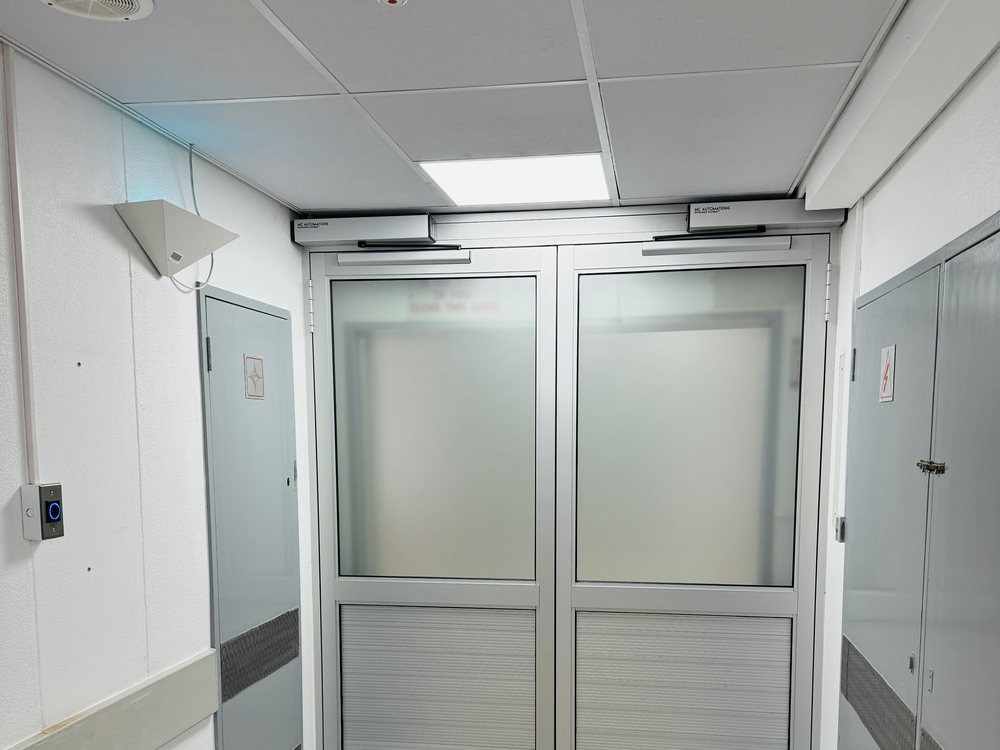
Healthcare is where we fit the most automatic swing doors by some margin. Ward corridors, consulting rooms and departmental entrances usually have a perfectly good fire-rated door already hung, and the requirement is to make it hands-free rather than to replace it.
The same logic applies in offices and schools: reception doors, accessible WCs, boardrooms and staff entrances where a door exists, the opening cannot move, and somebody needs to get through it carrying something.
They also suit entrances with an airlock or lobby, where two swing doors in sequence hold conditioned air better than a single sliding opening would.
Common questions
Automatic swing doors, answered
Can you automate my existing door?
Usually. The MCW-100 fits to a new or existing swing door with leaves up to 150 kg. We check the leaf, the frame and the headroom on site first, because not every door and frame will carry an operator.
What is low-energy operation?
A slower, gentler opening cycle intended for accessible entrances, where the door should never surprise somebody approaching it. Full-energy operation is faster and suits higher traffic.
Swing or sliding for my entrance?
If you have the wall space and high traffic, sliding usually wins. If the door already exists, the opening cannot change, or there is nowhere for a leaf to park, a swing operator is the answer.
Will it still open in a power failure?
That depends on the locking and the building’s escape strategy, which we confirm on survey. Most swing doors can still be pushed manually, and battery backup can be fitted where the entrance has to keep operating.
Options
Which configuration suits the opening
For automatic swing doors the decision follows the opening rather than preference. Single sliding is the everyday answer; bi-parting halves the travel on the busiest entrances; telescopic suits a narrow wall; swing operators automate hinged doors; revolving and hermetic entrances answer particular problems and are never priced unseen.
- MC-125: up to 150 kg single leaf or 2 × 120 kg bi-parting, 1450–5000 mm.
- MCW-100: hinged doors to 1,200 mm / 150 kg (interdependent).
- Imported and assembled at Laser Park, Johannesburg, with a 24-month operator warranty.
Specification
How the job is specified
A survey for automatic swing doors is short but specific: opening width and height measured to the structure, the condition and support of the head, what runs above the ceiling line, the power position, and how people approach the doorway. Those notes become the specification on your quotation, and the written specification is what governs the job.
Revolving and hermetic entrances are never priced unseen. Where a site visit carries a charge, we say so before attending rather than afterwards.
Load-shedding
Keeping automatic swing doors usable in a power cut
An optional battery backup keeps the operator running through a slot. Without one, the entrance parks in the fail-open or fail-secure state chosen for the building, and the manual release is demonstrated at handover.
Our programme assumes power is available at the head where the system requires it. Where it is not, we say so at survey rather than improvising on installation day.
Are the operators made in South Africa?
The MC-125 and MCW-100 are imported and assembled at our Laser Park facility in Johannesburg, where spares and technical support are held locally.
How often should the entrance be serviced?
Against its cycle count rather than a fixed date. Intervals, response times and what is included are defined in your service level agreement.
In short
Automatic swing doors at a glance
- Automatic swing doors are quoted against the opening we measured, not a catalogue price.
Handing, arm geometry and the things that decide the fit
Most of the specification work on automatic swing doors happens before anyone looks at a product. Four questions settle it, and getting them wrong is the usual reason an installation date slips.
- Which way does the leaf swing? Inward or outward. This decides whether the operator uses a pull-arm or a push-arm arrangement, and the two need different clearances above the door.
- Which hand is it? Standing outside the doorway, is the hinge on the left or the right. A photograph taken from outside answers this faster than any description.
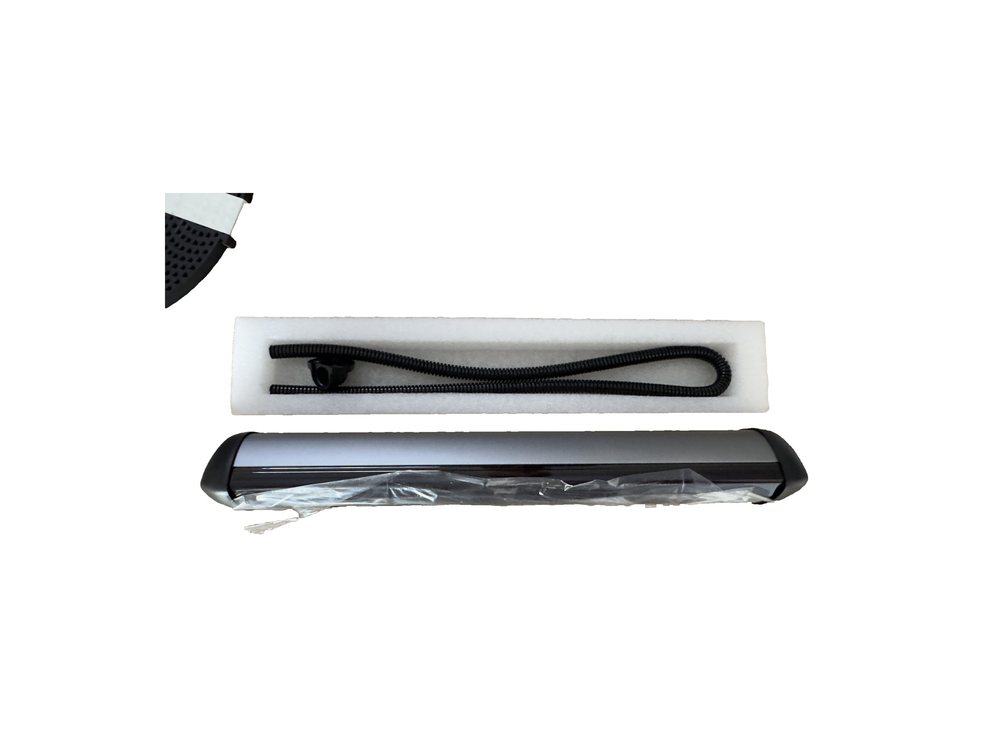
- What is above the door? The unit is 475 × 81 × 98 mm and around 5 kg, small enough to sit above a reception door without dominating it, but the head still has to take a fixing and there has to be depth for the arm to sweep.
- Single leaf or a pair? A pair needs two units and a sequencing arrangement so the leaves meet in the right order, which matters where one carries a rebate or an astragal.
On automatic swing doors the weight and width limits interact rather than applying separately. Up to 150 kg and up to 1200 mm wide are the published figures, but a leaf near the top of one range cannot also sit near the top of the other. We assess the leaf, hinges and head fixing before confirming, and a door operating near the limit should run at reduced speed.
Wind, exposure and why external leaves behave differently
The published figures were tested without wind pressure. That single sentence explains most of the difference between an external and an internal installation.
A leaf on an exposed elevation is being pushed or held by air as well as by the operator, and the force required varies with the weather rather than staying constant. Automatic swing doors on an exposed entrance are specified with margin, run at reduced speed near the limit, and benefit from a wind lobby or a recessed reveal where the building allows one.
The same applies to stack pressure inside tall buildings, which quietly makes a ground-floor entrance far harder to open than the drawing suggested. Where a doorway is fighting pressure, the honest answer is often a different arrangement rather than a bigger operator.
Exposure also shortens the service interval. Sun, driving rain and coastal salt age the arm bushes, the fixings and the cabling faster than an interior doorway sees, so an external swing entrance belongs on a shorter schedule than the office door down the corridor.
Low energy, push-and-go, and choosing the behaviour
How automatic swing doors are triggered changes the feel of a space more than the operator choice does.
Fully automatic opens on approach from a sensor above the opening. It suits healthcare, welfare and anywhere hands are full, because nobody touches the leaf.
Push-and-go waits. A light push on the leaf tells the operator to take over and complete the opening under power. It suits a boardroom, a restaurant or a consulting room where a door opening for every passer-by would feel wrong, and it removes the nuisance activations that come from a corridor running past the doorway.
Activated on demand — a push pad, a card reader, a request-to-exit button — suits controlled areas where the door should open for the right person rather than for anyone.
Low-energy operation is a separate decision again. Where a doorway is used by people who cannot move quickly out of a swinging leaf’s path, the opening and closing speeds are set down rather than up, and the leaf becomes something that can be stopped by hand. That is a specification choice made before the order, not a setting adjusted afterwards.
Safety around a swinging leaf
A swinging leaf sweeps an arc, and everything inside that arc is the safety problem. This is the substantive difference between automatic swing doors and a sliding entrance, where the leaf stays in its own plane.
The sweep has to be kept clear on both sides. A bin, a plant, a queue barrier or a chair placed inside the arc turns a safe doorway into a trapping hazard, and layout changes are the most common cause of a swing entrance starting to behave badly.
Where people can stand in the arc without being seen — behind the leaf as it opens, or on the closing side — presence sensing covers them, and the fields are set against the real doorway rather than left on factory defaults. Opening and closing forces are set on site at commissioning, demonstrated at handover and written down.
And where the doorway sits on an escape route, what it must do on alarm and on power loss is set by the building’s fire strategy and confirmed with the fire consultant or the local authority. It is not a preference and it is not ours to decide.
Quick answers on automatic swing doors
- Automatic swing doors run on the MCW-100, supplied from R15 900 excluding VAT.
- Automatic swing doors take leaves up to 150 kg and up to 1200 mm wide, limits interacting.
- Automatic swing doors drive aluminium, framed, timber, metal and glass leaves.
- Automatic swing doors use a pull-arm or push-arm depending on opening direction.
- Automatic swing doors are the usual answer where there is no wall space to slide into.
- Automatic swing doors on exposed elevations run with margin, because wind was not in the test.
- Automatic swing doors with push-and-go stay still until somebody actually intends to use them.
- Automatic swing doors need the sweep of the leaf kept clear on both sides.
- Automatic swing doors carry a 24-month warranty on the operator; sensors are separate.
- Automatic swing doors are serviced and repaired on any major brand, nationwide.
Automating a door that is already hanging
Most swing jobs are retrofits, and a retrofit is decided by the doorway rather than by the operator. Automatic swing doors added to an existing leaf keep the frame, the hinges and the door itself, which is why the route is usually cheaper than replacing the entrance.
Four things decide whether it is available. The leaf has to be within weight and width, and those limits interact. The hinges have to be sound, because an operator drives through them and a tired hinge fails faster once it is being worked. The head has to take a fixing with depth for the arm to sweep. And there has to be an electrical supply at the opening — on a retrofit in an older building there usually is not, and that is an electrical job before it is a door job.
The other thing that usually comes off is the door closer. An operator fighting a closer wears both out and pushes the opening force back up, which defeats the point of automating the doorway in the first place. We do not supply closers, but we will remove one that is in the way.
Where the leaf is too heavy, too wide, or hung on hinges that will not take the duty, we will say so rather than fit something that will fail. Occasionally the honest answer on automatic swing doors is a new leaf built with the operator in mind, and that costs less than fitting twice.
What to send us to price a swing opening
Five things get a real number for automatic swing doors without a site visit, and they are the same five that stop a quotation being revised later.
- The leaf width and height, and its weight if the door is being made rather than already hanging.
- Whether it opens inward or outward, and which hand, photographed from outside the doorway.
- What sits above the door, and whether there is an electrical supply at the head.
- Single leaf or a pair, and whether the doorway is internal or on an exposed elevation.
- Any access-control requirement, and whether the entrance is on an escape route.
From that we confirm whether the leaf is inside the envelope, which arm arrangement suits it, and what the automation costs. If the doorway as it stands will not work, we will say what to change while it is still a drawing rather than after the frame is in.
Send us the door
A photograph of the door and its frame, the leaf width and rough weight, and whether there is power at the head is enough for us to say whether it will take an operator — and what the automatic swing doors would cost.