
Western Cape
automatic doors Cape Town: supply, installation and service
MC Automations supplies, installs, commissions and services automatic doors in Cape Town, with spares held in South Africa rather than ordered from overseas. Sliding, telescopic, swing, revolving and hermetically sealing entrances, specified for a coastal, wind-exposed environment.
Cape Town is the most environmentally demanding city we work in, and it is not close. Salt-laden air and sustained summer wind attack an entrance in ways an inland building never sees, and both are conditions the published operator limits were tested without. Specifying automatic doors Cape Town properly therefore starts with exposure — how far from the sea, which way it faces, how sheltered it is — before it gets anywhere near leaf weights.
Why automatic doors Cape Town wear the way they do
Traffic still drives wear, and cycle count still sets the maintenance interval. But on this coast three environmental factors sit on top of that and frequently overtake it.
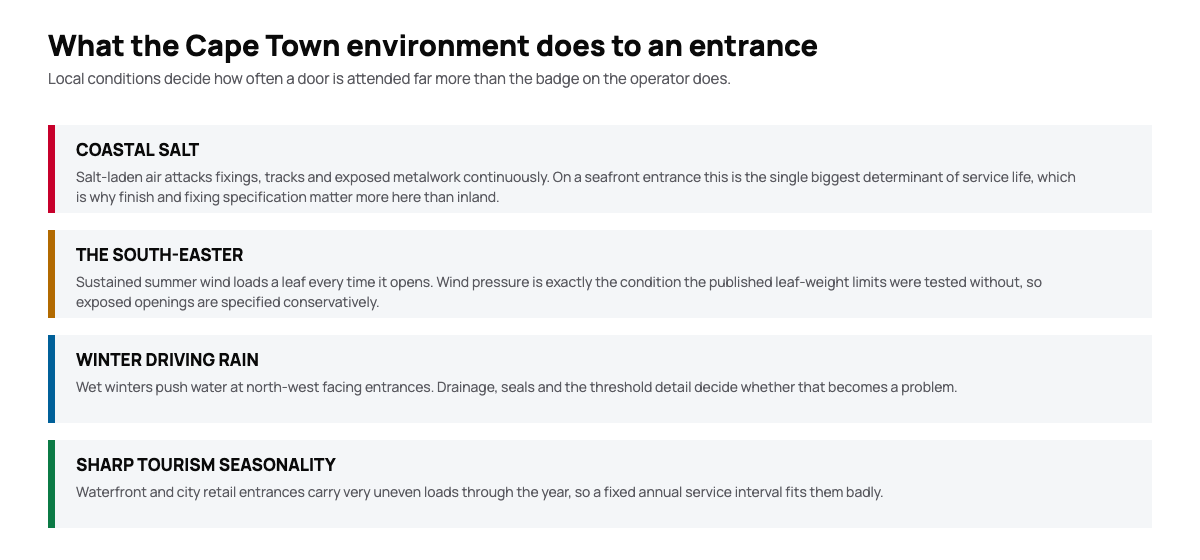
Salt decides service life. It attacks fixings, tracks and exposed metalwork continuously and does not stop between visits. On a seafront entrance the finish and fixing specification matters more than the operator choice, because the operator will outlast its own fixings if those were selected for an inland building.
Wind decides specification. The south-easter loads a leaf every time it opens, and wind pressure is precisely the condition the published leaf-weight and width limits were tested without. That is not a caveat to skim past: it means exposed automatic doors Cape Town are specified more conservatively than the same opening in Johannesburg, and we would rather say so up front than explain it after the door starts struggling.
Where automatic doors Cape Town are specified
The building stock decides the door type, the traffic assumption and the maintenance interval. These are the sectors we work in across Cape Town.
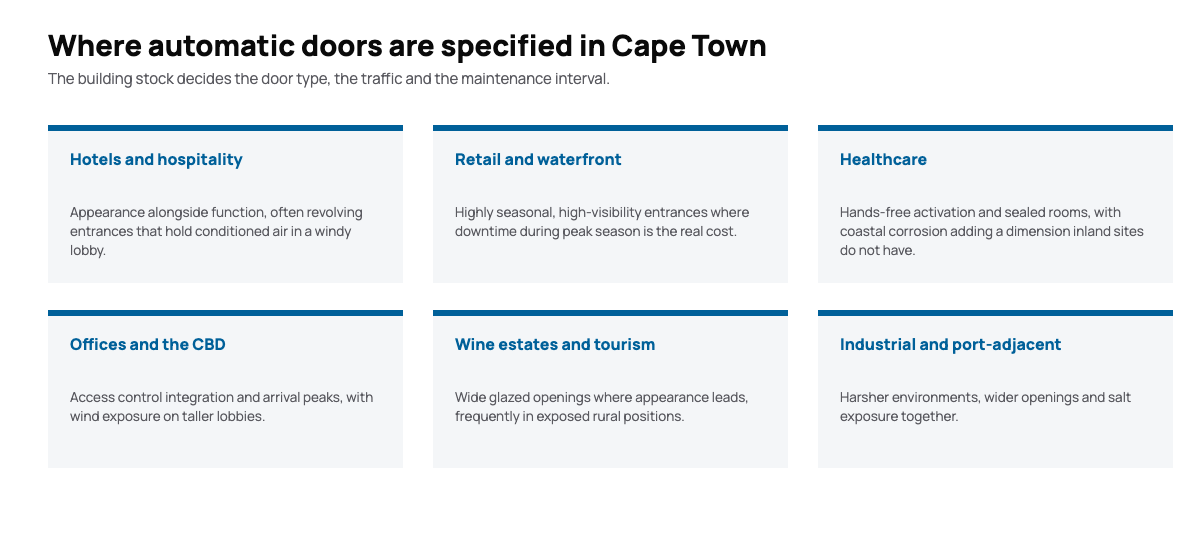
Hospitality defines this market. Hotel and waterfront entrances have to look right, hold conditioned air in a windy lobby, and survive salt — three requirements that pull against each other, which is why revolving entrances turn up more often in Cape Town lobbies than the national picture would suggest.
The second distinctive feature is seasonality. Waterfront and city retail entrances carry very uneven loads across the year, so servicing automatic doors Cape Town before the season rather than during it is the single most useful scheduling change most sites here can make.
How we support automatic doors Cape Town
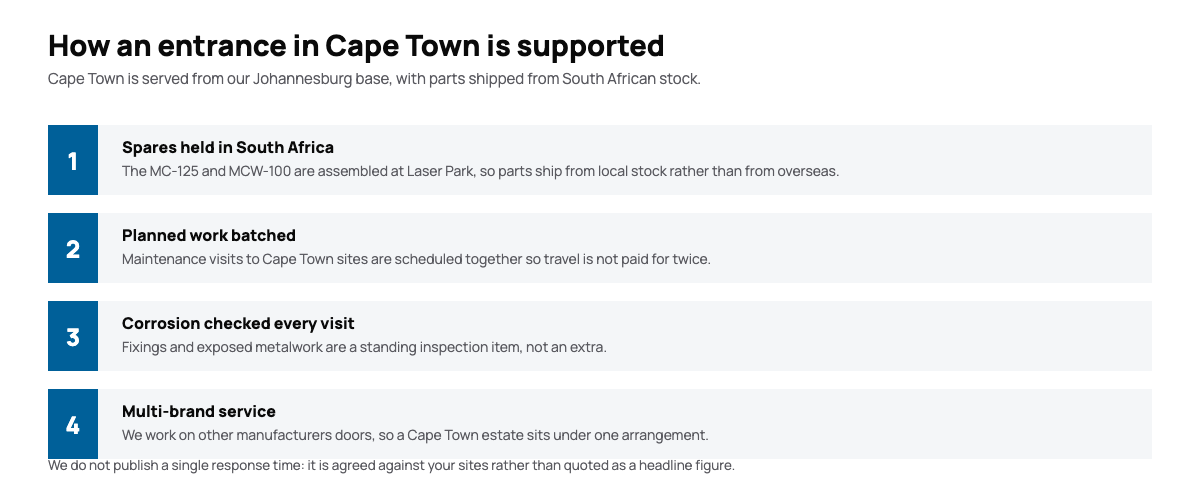
Cape Town is served from our Johannesburg base. That has one real advantage and one honest limitation, and both are worth stating. The advantage is parts: because the MC-125 and MCW-100 are imported and assembled at Laser Park, components for automatic doors Cape Town ship from South African stock rather than being ordered from overseas. The limitation is travel, which is why planned work is batched so a trip is not paid for twice.
We do not publish a single response time, here or anywhere. Response is agreed against your sites and the consequence of a failure. Our service level agreement page sets out the seven terms an agreement should define.
The systems we install in Cape Town
- Automatic sliding doors — the default for most commercial entrances. Figures in the MC-125 brochure.
- Telescopic sliding doors — a wide opening in a short facade. See the telescopic brochure.
- Automatic swing doors — hinged openings and accessibility retrofits, driven by the MCW-100.
- Automatic revolving doors — lobbies that need to hold conditioned air.
- Hermetically sealing doors — theatres, imaging and controlled rooms.
Working around a building that stays open
Almost every entrance we attend is in a building that stays open. In Cape Town that usually means working around a trading season rather than a trading day: hotel and waterfront entrances are far easier to take out of service in July than in December. Where automatic doors Cape Town need substantive work, doing it off-season costs the building far less in disruption than the same work at peak.
Wind adds a practical constraint. Work that involves removing a leaf on an exposed elevation is genuinely weather-dependent, and we would rather reschedule than handle heavy glass in a south-easter.
Maintaining automatic doors Cape Town properly
Set the interval against measured traffic, then add corrosion. The standing items are the carriage rollers, drive belt and tension, the track, activation and safety sensors, and the operator fixings — but here the fixings and exposed metalwork are inspected as a matter of course, because on automatic doors Cape Town near the sea that is what fails first and least visibly.
Seals matter more here as well. Driven winter rain finds a poorly detailed threshold quickly, and a door letting water past is telling you about its drainage rather than its drive.
Areas we cover
We cover the metro and the surrounding Western Cape from Johannesburg, with visits planned together. That includes the CBD, Foreshore and V&A Waterfront, the Atlantic seaboard through Sea Point, Green Point and Camps Bay, the southern suburbs through Claremont, Rondebosch and Constantia, the northern suburbs through Bellville, Durbanville and Tygervalley, Century City and Montague Gardens, and out to Somerset West, Stellenbosch and Paarl.
Exposure varies enormously across that list. automatic doors Cape Town on the Atlantic seaboard and Foreshore sit in the harshest conditions; the northern suburbs and winelands are materially gentler. We specify against the actual position rather than against the city.
Modernising rather than replacing
Many Cape Town entrances do not need a new door. Where the leaves, track and header are sound and only the drive has reached the end of its life, replacing the operator and sensors and keeping the rest is considerably cheaper. Our automatic door modernisation page covers what can usually be retained.
On this coast there is a second reason to look at it early: corroded fixings are cheap to replace during a planned upgrade and expensive to discover during a failure. If automatic doors Cape Town in your estate are more than a few years old and near the sea, that inspection is worth doing before something forces it.
What we need to price a Cape Town entrance
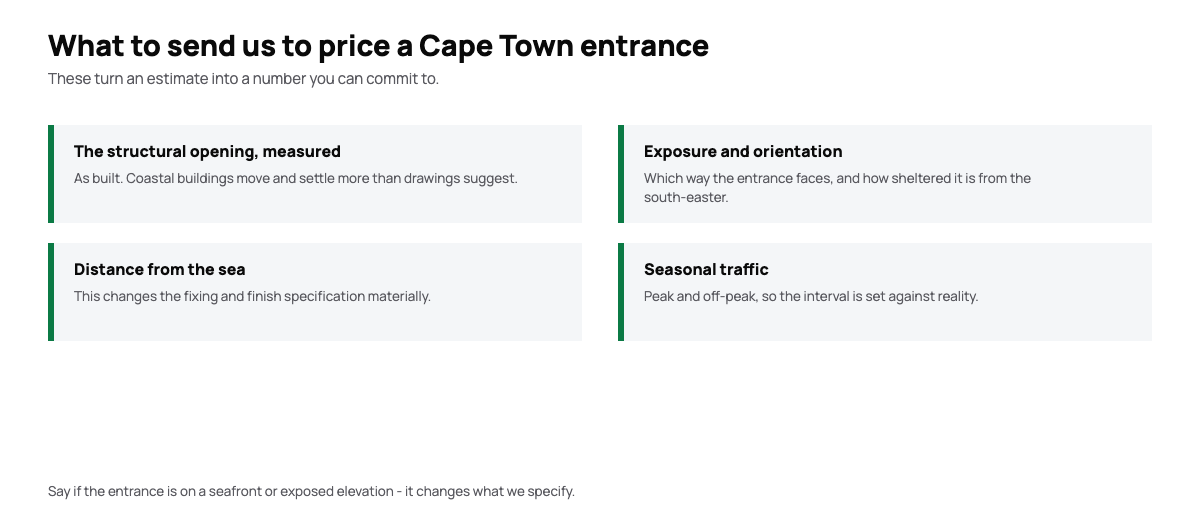
Send the structural opening measured as built, the clear opening you need, the header construction, the traffic, and photographs. Then add the two Cape Town questions: how far is the entrance from the sea, and how exposed is it to the south-easter? Those answers change the fixing specification, the finish and sometimes the configuration itself.
Automatic entrances in South African buildings are designed against the SANS 10400 series supporting the National Building Regulations; copies are published by the South African Bureau of Standards. We will tell you which requirements apply to your opening, and we do not publish a certification claim we cannot evidence.
Costs, and comparing quotations
There is no single figure for automatic doors Cape Town, and any supplier quoting one without seeing the opening is guessing. Published starting points and the four items that move the number are in our automatic door price guide. On this coast add one more line to the comparison: whether fixings and finish were specified for the exposure, because a cheaper quotation that ignored it is not cheaper over five years.
Otherwise the usual four checks apply — identical clear opening, equivalent safety devices, builders work in or out consistently, and commissioning priced rather than assumed.
automatic doors Cape Town: the short version
- Exposure first. Distance from the sea and orientation decide more about automatic doors Cape Town than the operator choice does.
- Wind is a specification input. The published limits were tested without wind pressure.
- Corrosion is the failure mode. Fixings and metalwork, checked every visit.
- Service off-season. Seasonal traffic makes a fixed annual visit the wrong interval for automatic doors Cape Town in retail and hospitality.
- Parts ship from local stock. Assembled at Laser Park, not ordered from overseas.
We supply, install, commission and service automatic doors Cape Town and will tell you plainly what we hold in writing and what we do not.
automatic doors Cape Town: frequently asked
Do you install automatic doors in Cape Town from Johannesburg?
Yes. We supply, install, commission and service nationwide from Laser Park. Parts ship from South African stock because both operators are assembled here rather than imported per order.
Does salt air really change the specification?
Yes, materially. Fixings, tracks and exposed metalwork corrode continuously near the sea, so finish and fixing selection matter more than the operator choice on a seafront entrance.
What does wind do to an automatic door?
It loads the leaf on every cycle. The published leaf weight and width limits were tested without wind pressure, so an exposed entrance is specified more conservatively.
When is the best time to service a seasonal entrance?
Before the season rather than during it. Waterfront and hospitality entrances carry very uneven loads, which makes a fixed annual visit the wrong interval.
Do you work on doors you did not supply?
Yes. We service and repair automatic doors from other manufacturers, so a Cape Town estate can sit under one asset register.
How quickly can you attend a breakdown in Cape Town?
We agree that against your sites rather than publishing a figure. Tell us whether the entrance is secure and whether anybody is at risk.
Other areas we cover
Cape Town is one of the cities in our automatic door service areas. We supply, install and service nationwide across all nine provinces from Laser Park, Johannesburg.
Automatic doors Durban · Automatic doors East London · Automatic doors Polokwane · Automatic doors Kimberley
Need automatic doors Cape Town?
Send the opening, the traffic and a photograph, and we will confirm the configuration in writing before anything is ordered.
The south-easter is the specification
Most cities let you specify an entrance on traffic and leaf weight. Cape Town does not, because automatic doors Cape Town have to cope with a wind that arrives for days at a time and does not moderate for anybody’s drawing.
The effect is largest on swing doors. Published operator figures are tested without wind pressure, so a leaf that sits comfortably inside the weight and width envelope on paper can be genuinely hard work on an exposed elevation in a south-easter. Automatic doors Cape Town on swing arrangements are specified with margin, run at reduced speed near the limit, and benefit from a wind lobby or a recessed reveal wherever the building allows one.
Sliding entrances fare better, because the leaf moves across the wind rather than into it, but they are not immune. A slide on a wind-loaded elevation sees higher running friction and more track wear, and the closing force setting has to account for air pushing the leaf rather than assuming still conditions.
Stack pressure inside taller buildings compounds it. A ground-floor entrance in a tower can be fighting both the weather outside and the building’s own internal pressure, and where a doorway is losing that fight the honest answer is frequently a lobby rather than a bigger operator.
Salt, rain and what the Atlantic does to hardware
Salt-laden air attacks the parts of automatic doors Cape Town that nobody looks at: fixings, cable glands, connector pins and the housings of sensors mounted outside the line of the glass.
Corrosion at a connector is the classic coastal fault, and it presents as an intermittent problem rather than a failure. The door works, then does not, then works again, and every test on the bench passes. On a coastal entrance that symptom points at connections and cable entries long before it points at the component itself.
Winter rainfall adds driving water to the same surfaces. An entrance on a west-facing elevation takes rain horizontally rather than vertically, which finds gaps that a vertical test never would, so the detailing where the header meets the structure matters more here than inland.
The practical consequence is a shorter service interval on exposed automatic doors Cape Town installations, with attention paid specifically to fixings, glands and connections rather than only to the moving parts.
Heritage frontages and the constraint they impose
A large part of the Cape Town city bowl sits behind frontages that cannot simply be replaced, and that shapes what automatic doors Cape Town can be.
Where the opening is fixed by the building and cannot widen, a telescopic arrangement frequently earns its cost: stacking two panels a side gets a compliant clear opening out of a reveal that a standard slide could never serve. Where the frontage must not be visibly altered at all, a swing operator on the existing leaf is often the only route, and the question becomes whether the head will carry a unit.
Those jobs are surveyed rather than quoted from a photograph. What sits above the opening, whether it is structural, and whether power can be brought to the head without disturbing the facade are the three answers that decide the job, and none of them is visible from the pavement.
Quick answers on automatic doors Cape Town
- Automatic doors Cape Town are specified with wind margin; operator figures exclude wind pressure.
- Automatic doors Cape Town on swing arrangements suffer most from the south-easter.
- Automatic doors Cape Town fail at connectors and glands before they fail at components.
- Automatic doors Cape Town on west-facing elevations take rain horizontally, so detailing matters.
- Automatic doors Cape Town in heritage frontages are often telescopic or swing retrofits.
- Automatic doors Cape Town need a shorter service interval than an equivalent inland entrance.
- Automatic doors Cape Town are attended on a scheduled basis; same-day is Gauteng only.
- Automatic doors Cape Town are serviced on any major brand, nationwide.
Installing in a constrained city-bowl site
The physical job of fitting automatic doors Cape Town in the central city is frequently harder than the specification, and it is worth raising early because it shapes the programme and the price.
Access is the first constraint. Narrow pavements, loading restrictions and buildings with no service entrance mean material arrives in smaller loads and at agreed hours. That is normal and manageable, but it is not the same as backing a vehicle up to a doorway on an industrial park.
Working hours are the second. A retail frontage on a busy street is rarely allowed to be a building site during trading, so the work is staged, done after hours, or the opening is temporarily secured and reopened each day. Tell us which of those applies at quotation stage rather than after acceptance — after-hours work costs more, and being surprised by the need for it costs more still.
The third is the facade itself. Where the frontage is heritage-controlled or simply cannot be visibly altered, the header detail and the route for power become the whole conversation, and neither can be resolved from a photograph.
In short
Automatic doors Cape Town at a glance
- Automatic doors Cape Town are quoted against the opening we measured, not a catalogue price.
- Ask about automatic doors Cape Town and we confirm the opening, the head and the power position first.