Spare parts
Automatic door spare parts
Spares held in Johannesburg for automatic sliding, swing and revolving doors — what we stock, which systems we support, and how to order a part.

On this page
Parts
Spares held in Johannesburg
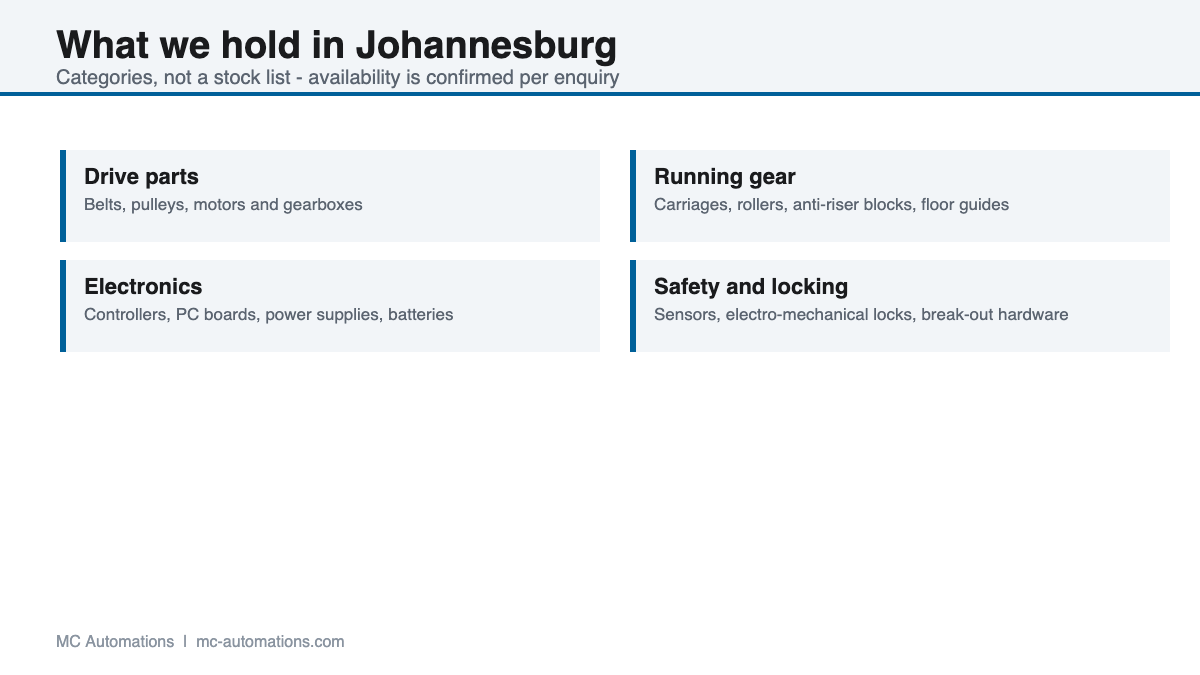
Sensors, controls, operators, belts, rollers and floor guides are held at our Laser Park facility, which is also where the MC-125 and MCW-100 are assembled.
That is what makes a same-week repair, and most automatic door modernisation work, possible at all. When a technician diagnoses a worn part during automatic door maintenance, the replacement is usually on a shelf in Johannesburg rather than six weeks away on a container. Requirements for powered pedestrian doors in South Africa are published through SABS.
Options
Which configuration suits the opening
For automatic door spare parts the decision follows the opening rather than preference. Single sliding is the everyday answer; bi-parting halves the travel on the busiest entrances; telescopic suits a narrow wall; swing operators automate hinged doors; revolving and hermetic entrances answer particular problems and are never priced unseen.
- MC-125: up to 150 kg single leaf or 2 × 120 kg bi-parting, 1450–5000 mm.
- MCW-100: hinged doors to 1,200 mm / 150 kg (interdependent).
- Imported and assembled at Laser Park, Johannesburg, with a 24-month operator warranty.
Before the order
Getting the opening right
Most trouble on an entrance starts at the opening rather than the operator. For automatic door spare parts we check the structural opening, the strength and level of the head, the space above the opening and the position of the power supply. An operator fixed to a head that cannot carry it is the most common cause of early failures, and it is entirely avoidable at survey stage.
A quotation prepared from a photograph and dimensions is confirmed against the real opening before anything is ordered.
Power
Power, load-shedding and access control
Decide early whether the entrance should fail open for escape or fail secure for stock, and whether a battery backup keeps it running through a load-shedding slot. Staff need to be shown the manual release either way.
Access control belongs in the same scope: card readers, push buttons, intercoms and time clocks all interrupt or enable the operator, and running cable into a finished ceiling afterwards costs far more than including it with the installation.
Common questions
Questions we are asked
How often should the entrance be serviced?
Against its cycle count rather than a fixed date. Intervals, response times and what is included are defined in your service level agreement.
Are the operators made in South Africa?
The MC-125 and MCW-100 are imported and assembled at our Laser Park facility in Johannesburg, where spares and technical support are held locally.
What warranty applies to the operator?
The MC-125 and MCW-100 carry a 24-month (two-year) warranty. The warranty that applies to your installation is the one recorded on your quotation and invoice.
Send us the door as it is
A photograph of the operator housing, the clear opening width and height, and a note on what the door is doing wrong is usually enough for us to say whether it is worth upgrading. If it is not, we will say so.
Automatic door spare parts we hold and fit
Most entrance breakdowns come down to a small number of parts. Holding automatic door spare parts in Johannesburg is what turns a week-long wait into a same-visit repair, and it is the reason we ask for the model label before anything is quoted.
Which automatic door spare parts fail first
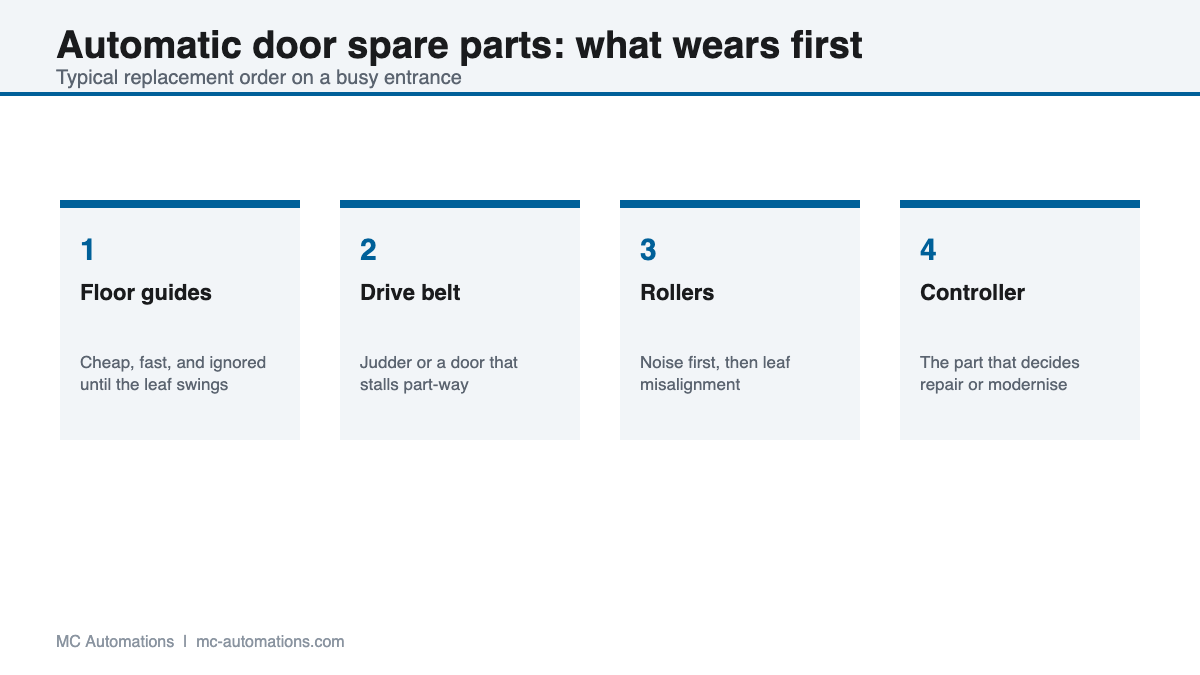
- Drive belts: the most commonly replaced of all automatic door spare parts, and the usual cause of a door that judders or stalls part-way.
- Carriages and rollers: worn rollers show up first as noise, then as a leaf that drops out of alignment.
- Floor guides: cheap, quick to change, and the part most often ignored until the leaf starts to swing at the bottom.
- Motors and gearboxes: replaced as a unit where the drive has been run against a binding leaf for months.
- Controllers and PC boards: the part that decides whether an old entrance can be repaired or should be modernised.
- Sensors: activation and presence units, which are safety parts and are never substituted with something that merely fits.
- Power supplies and batteries: including backup batteries, which age whether or not the door is used.
- Locks and break-out hardware: electro-mechanical locks, manual release handles and the fittings that keep an emergency exit legal.
- Seals and brushes: the parts that keep dust and draught out once the leaf closes.
How to order automatic door spare parts
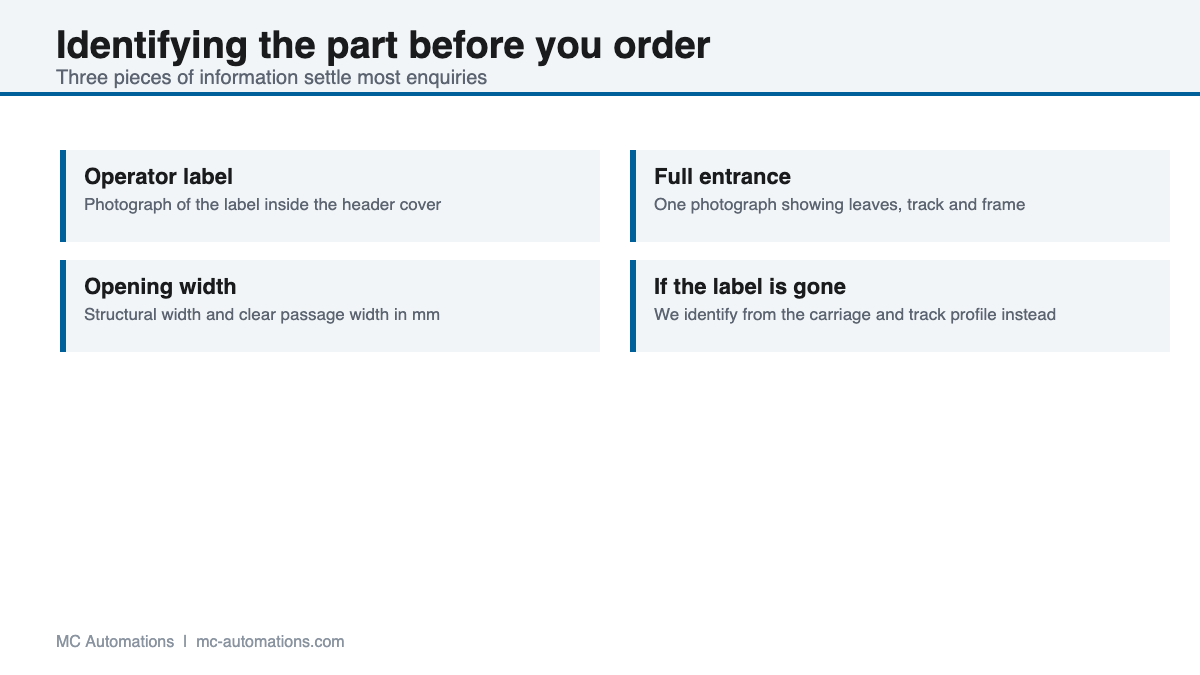
Send a photograph of the operator label, a photograph of the full entrance and the opening width. Those three things identify the range in most cases. Where the label is missing we will identify the automatic door spare parts from the carriage and track profile instead, which is slower but usually conclusive. We will tell you honestly when a part is obsolete and the sensible answer is modernisation rather than another repair.
Fitting and warranty
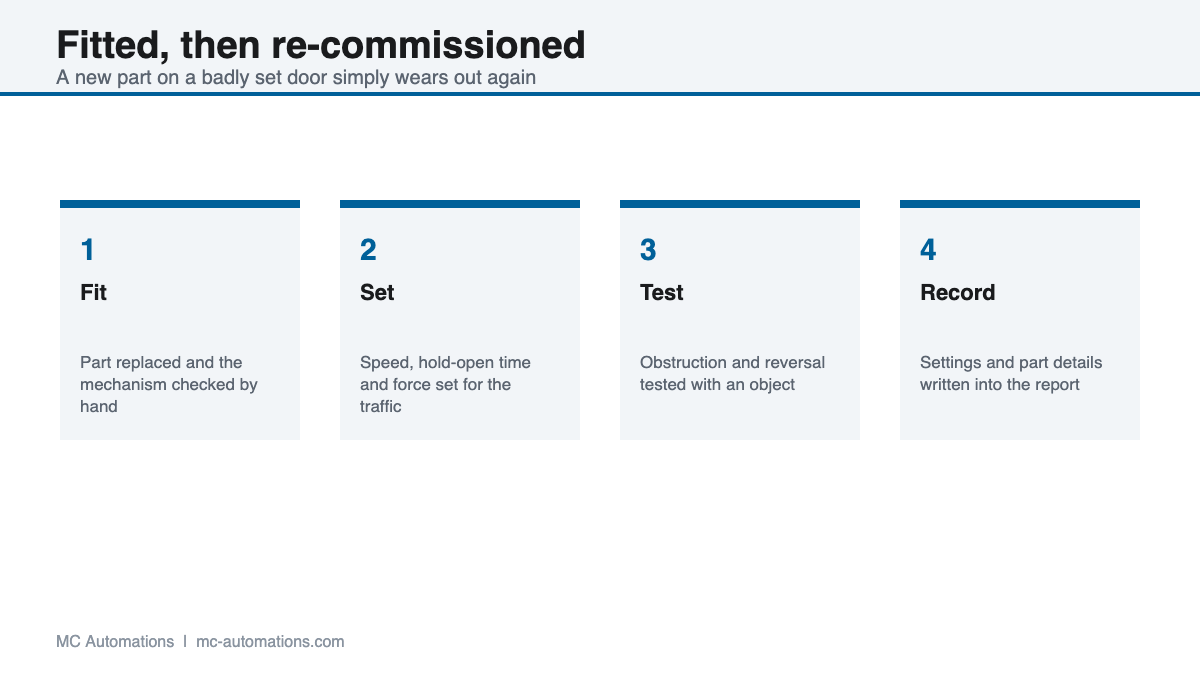
Automatic door spare parts can be collected or fitted by our technicians. Where we fit them, the door is re-commissioned afterwards: speeds, hold-open time, force and sensor coverage are set and recorded, because a new belt on a badly set door simply wears out again. Operators we supply carry a 24-month warranty, and we will confirm in writing what a replacement part is warranted for before you order it.
Identifying the part before you order it
The single biggest cause of a wrong order is a part identified from the symptom rather than from the operator. Automatic door spare parts are not interchangeable between makes, and two operators that look identical from below can take completely different carriages.
Start with the label inside the header. It carries the make and model, and on most units a serial number that fixes the production run. One photograph of that label answers more questions than a paragraph of description ever will. Where the header cannot be opened safely, photograph the operator cover, the leaf junction and the track end instead; between them they usually identify the unit.
Then describe the behaviour rather than the diagnosis. “It opens for nobody” and “it will not close” point at different automatic door spare parts, and the second of those is a safety fault rather than an inconvenience.
Finally, say whether the entrance is in service. A door that is jammed part-open, on an escape route, or closing on people changes the urgency and sometimes changes the part we recommend, because a stop-gap that keeps a doorway usable is occasionally the right answer while a longer-lead item is on order.
Wear parts, and what actually fails first
Automatic door spare parts divide neatly into things that wear out on a predictable curve and things that fail because something happened to them.
- Carriages and rollers. The most common mechanical replacement on a sliding entrance. They wear from grit rather than from cycles, which is why two identical doors in one building can need them years apart.
- Floor guides. Cheap, and routinely left too long. A worn guide lets the leaf swing at the bottom, which loads the carriages and turns a small part into a large one.
- Belts. Predictable, and usually replaced during a service rather than after a failure.
- Sensors. They drift before they die. Degraded detection, repeated re-aiming or physical damage are the points at which replacement earns its cost.
- Batteries. Backup batteries have a service life measured in years, and a tired one produces erratic behaviour that reads as a controller fault.
- Controllers. The expensive end, and rarely a wear item. A failed controller on an obsolete operator is usually the moment to price a modernisation instead of more automatic door spare parts.
Impact damage sits outside all of that. A leaf caught by a trolley or a pallet corner can take out a carriage, a guide and the track alignment in one moment, and it is the reason bollards and guarding repay themselves on industrial entrances.
Obsolescence, and planning for it
Every operator eventually reaches the point where automatic door spare parts stop being made. That is not a crisis if you see it coming and it is an expensive surprise if you do not.
The signals are consistent. Lead times that used to be days become weeks. A part that was always in stock starts arriving as a substitute. The supplier begins offering a retrofit kit rather than the component. When we see those on your operator we will say so plainly, because the decision changes: on an obsolete unit, replacing a controller may cost more than modernising the header and buys you nothing in reliability.
Where an entrance is critical and the operator is ageing, holding one spare of the part most likely to strand it is cheap insurance. We will tell you which part that is for your particular unit rather than selling you a shelf of stock you will never fit.
Fitting, and why the part is only half the job
Automatic door spare parts fitted without commissioning are a job half done. A sensor is positioned, aimed and proven against the real opening; a carriage set is fitted and the leaf re-levelled; a controller is replaced and every setting re-entered, because the defaults are not your entrance.
That is why we walk-test before and after. Before, to establish what the entrance is actually doing rather than what the fault report says. After, to prove the fix on the awkward approaches: slow, oblique, stopping in the opening, pushing something through. An entrance that passes a brisk walk and fails a slow one has not been commissioned, it has been assembled.
Opening and closing speed, hold-open time, force and the detection zones are set for the way the doorway is really used, then written down. The next visit starts from that record rather than from a guess, which is the difference between a maintained entrance and a serially repaired one.
Genuine MC-125 and MCW-100 parts
For our own equipment the answer is simple: the automatic door spare parts we fit to an MC-125 or an MCW-100 are the genuine parts for those operators, from the same supply we build the units from.
Both operators are imported and assembled at our Laser Park facility in Johannesburg. That is the reason the parts position works — because the units are assembled here, the component inventory sits here too, so a drive belt, a carriage set, a control board or a sensor for an MC-125 is a shelf item rather than an order placed overseas and waited on. Where a building has standardised on our operators, the automatic door spare parts for its whole estate come from one place.
Both units are tested to one million operating cycles. That is a test result rather than a service life, and the practical consequence for parts is that the wear items are known and stocked accordingly: belts, rollers and carriages, floor guides, control boards, sensors and power supplies.
The operator carries a 24-month warranty. Genuine automatic door spare parts fitted by our technicians carry their own warranty on the part and on the work, which is set out on the invoice rather than left to be assumed.
Parts for other manufacturers’ equipment
Most buildings do not have a single-brand entrance estate, and we work on what is there. We service automatic entrances built by other manufacturers, and we can usually supply the automatic door spare parts those units need.
One thing stated plainly, because it matters: we are independent of those manufacturers and are not an agent or authorised distributor for any of them. When we describe a part for another manufacturer’s operator we will tell you exactly what it is — whether it is an original component obtained through the trade, or a functionally equivalent part — before you order it. We will not describe automatic door spare parts as genuine unless they are genuine for the unit they are going into.
What this means in practice on a mixed estate is that one contractor can maintain the lot. A building with one manufacturer’s entrance at the front, a second manufacturer’s side door and our own MC-125 on the loading side does not need three service agreements. It does need an accurate inventory, which is why the first visit on equipment we did not install is a condition report: we record what is actually fitted, model by model, so that automatic door spare parts can be identified before something fails rather than after.
Two limits worth knowing. Older units reach a point where the manufacturer no longer supports them and automatic door spare parts stop being reliably available; at that point a planned modernisation — new drive, controller and sensors on the existing leaves — costs less than chasing parts. And we do not supply, fit, retrofit or service door closers. Our parts and service cover powered pedestrian entrances: operators, controllers, running gear, sensors and safety devices.
Quick answers on automatic door spare parts
- Automatic door spare parts are held in Johannesburg and fitted nationwide.
- Automatic door spare parts are supplied for any major brand, not only operators we installed.
- Automatic door spare parts are identified from the header label, not from the symptom.
- Automatic door spare parts for sensing start at R2 259,88 excl VAT for the MC-DL8 motion sensor.
- Automatic door spare parts for safety sensing run R2 777,90 to R4 112,23 excl VAT.
- Automatic door spare parts are confirmed in writing against your operator before an order.
- Automatic door spare parts wear from grit and impact far more than from cycle count.
- Automatic door spare parts on an obsolete controller usually argue for modernisation instead.
- Automatic door spare parts are commissioned after fitting, not simply installed.
- Automatic door spare parts carry their own warranty terms, separate from the 24-month operator warranty.
Ordering: what we need, and what happens next
A request for automatic door spare parts moves fastest when it arrives complete. Four things do it: the operator make and model from the header label, a photograph of the unit in place, a description of what the door is doing, and whether the entrance is still usable.
From that we confirm compatibility against your operator, quote the correct item, and tell you the realistic lead time rather than the optimistic one. Where a part is held in Johannesburg it usually travels with the technician on the attendance. Where it has to come in, we say so at quotation stage, because a date you can plan around is worth more than a date that slips.
We quote in writing before anything is ordered, and the quotation names the operator it was priced against. That matters on a portfolio: two entrances in the same building can carry different units, and automatic door spare parts ordered from a building name rather than a model number are how the wrong box arrives.
Fitting it yourself, and where that stops being sensible
Some automatic door spare parts are genuinely straightforward for a competent maintenance team. A floor guide, a cover panel, a brush seal — these are mechanical items with no safety function, and if your team is comfortable with them we will supply and explain rather than insist on attending.
Two categories are different. Anything in the safety chain — presence sensors, safety photocells, force settings — has to be commissioned and proven after fitting, because a sensor bolted on and left on factory defaults does not protect anybody. And anything that changes how the leaf is carried — carriages, belts, track components — affects the loading on everything else, so a leaf refitted slightly out of level quietly destroys the next set of carriages.
Where you are not sure which category a part falls into, ask. We would rather tell you it is a five-minute job you can do yourselves than sell an attendance nobody needed.
Warranty on parts, stated plainly
Our warranty is 24 months on the operator. Automatic door spare parts and wear items are quoted and warranted separately, under their own terms, and we confirm those in writing before an order rather than leaving them to be discovered afterwards.
That distinction matters because it is frequently blurred elsewhere. A two-year warranty on an operator is not a two-year warranty on the sensor bolted to it, and a wear part replaced under a service visit is not covered indefinitely against wearing again. We would rather be clear about the boundary up front than argue about it at the point somebody needs a part.
Where a part fails inside its own warranty period we replace it. Where it has been damaged — impact, water ingress on an exposed entrance, a supply fault — that is a new part, and we will say which of the two we think it is and why.
If you would rather we diagnosed it on site, book a technician.
Keeping a record that actually helps
The most useful thing a building can hold is not a shelf of automatic door spare parts. It is a list: every entrance, the operator in its header, the parts fitted and when, and the condition noted at the last visit.
That record turns purchasing from reactive to planned. It tells you which entrance is consuming the budget, which operator model recurs across your estate and is therefore worth holding a spare for, and which units are approaching the point where parts get scarce. It also means a technician attending an unfamiliar site is not diagnosing from scratch.
We record what was found, what was fitted and how it was set on every visit, and we will hand that over in a form you can keep. A maintained entrance and a repeatedly repaired one often differ by nothing more than whether anybody wrote down what happened last time.
Automatic door spare parts at a glance