
Product brochure
MC-125 brochure: automatic sliding door operator
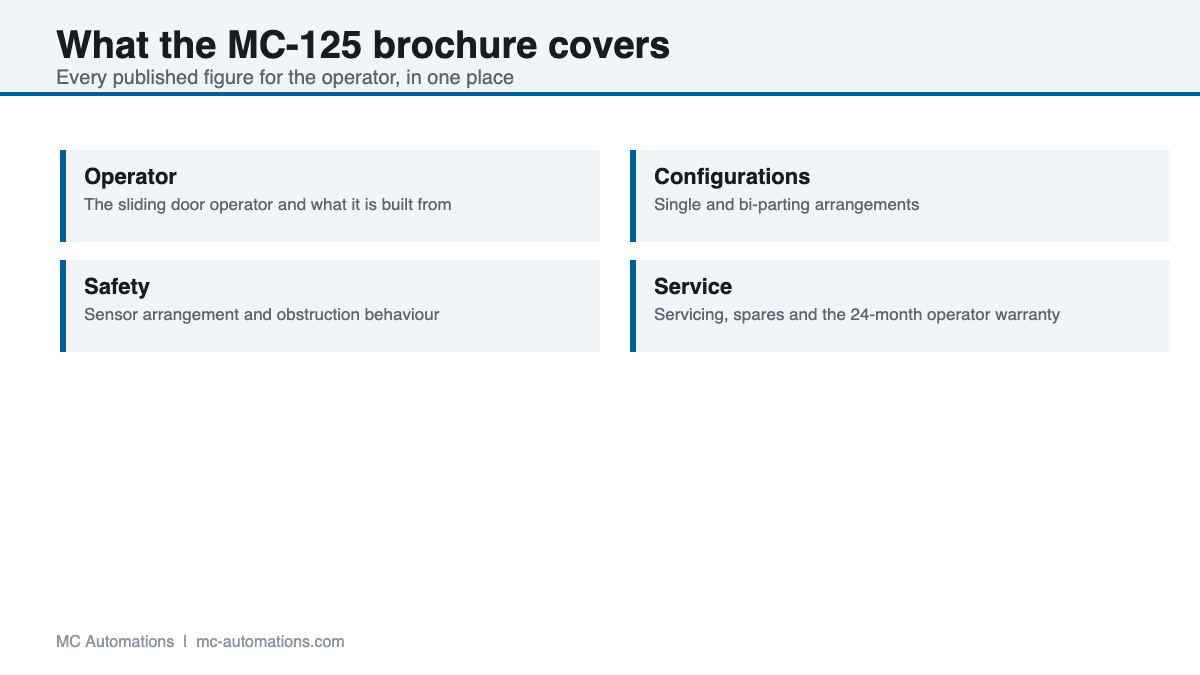
This MC-125 brochure puts every published figure for the MC-125 automatic sliding door operator on one page — leaf weights, clear openings, speeds, power and warranty. It is written to be printed, saved as a PDF or attached to a tender.
The MC-125 is the sliding door operator MC Automations supplies, installs and services across South Africa. It is imported and assembled locally at our Laser Park premises, which is why spares sit on a shelf in Johannesburg rather than on a container. This MC-125 brochure carries the specification exactly as it appears in the operator documentation we hold. Where a figure is not listed, it is because we do not hold it in writing — ask, and we will confirm it in writing before you specify it.
How to use this MC-125 brochure
The specification block below is the part most people need. If you are sizing an opening, read the clear-opening and leaf-width rows together — they constrain each other. If you are writing a tender, the MC-125 brochure specification can be quoted directly, because every figure in it comes from the operator documentation rather than from marketing copy. If you are comparing quotes, the rows worth checking against a competing offer are leaf weight, clear opening, manual opening force and warranty.
Use the print button at the top of this MC-125 brochure to produce a clean PDF. The print layout strips the navigation, buttons and pop-ups, so what comes out is the specification and the diagrams on their own.
What the MC-125 is built to do
A sliding door operator has one job: move a glass leaf out of somebody’s way before they break stride, then close it again without letting the building’s conditioned air out. The MC-125 does that with a brushless DC motor and a belt drive on a surface-mounted header. It drives a single sliding leaf up to 150 kg, or a bi-parting pair at 120 kg each.
Speeds are adjustable rather than fixed, which matters more than the headline numbers. A pharmacy entrance and a shopping-centre mall link need very different opening speeds, and one operator covers both because opening runs 150–460 mm/s and closing 130–460 mm/s. Hold-open time adjusts from 0 to 8 seconds, so a trolley-heavy retail entrance gets the time it actually needs.
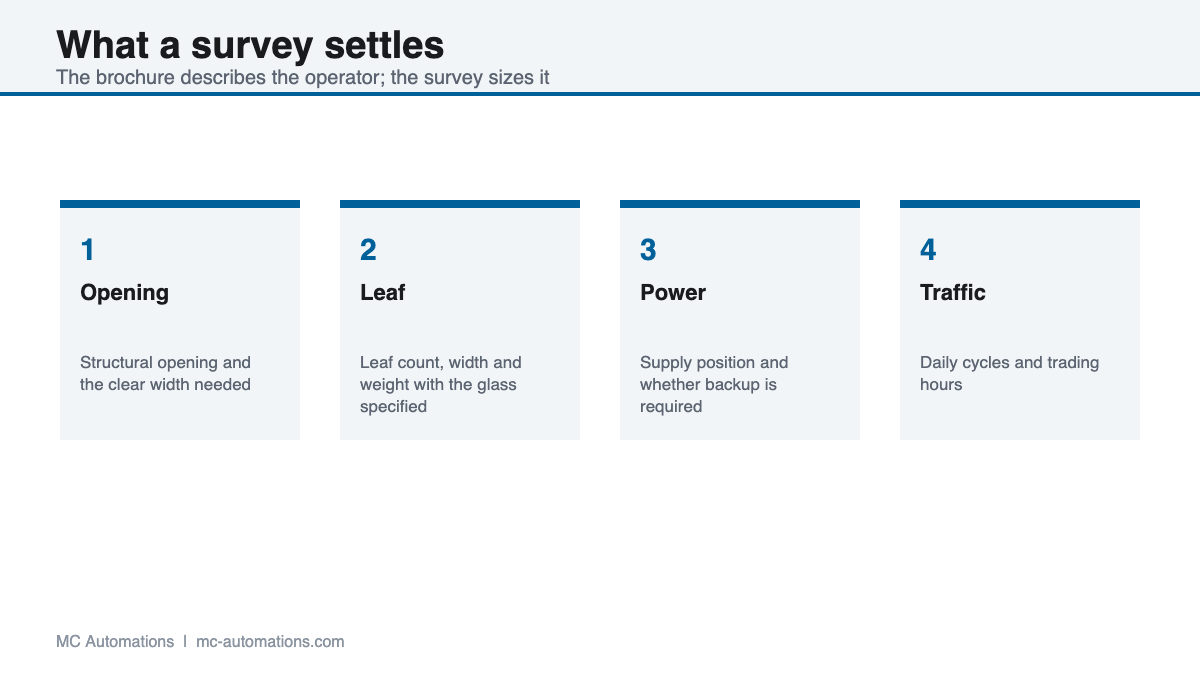
Four things to settle before you order
- The header. The operator is surface mounted and needs a solid, level header. A header out of level, or one that flexes, shows up as a door that binds at one end of its travel.
- The clear opening, measured. Not the nominal opening from the drawing — the opening as built, at the point the leaves will run.
- Traffic. Cycle count drives the service interval far more than age does. An entrance running several thousand cycles a day needs a different interval to an office side door.
- Temperature and exposure. The operator is rated −20 °C to +50 °C. A west-facing glazed lobby and a cold-store lobby sit at opposite ends of that band.
Automatic entrances in South African buildings are designed against the SANS 10400 series that supports the National Building Regulations; copies are published by the South African Bureau of Standards. We will tell you which requirements apply to your opening, and we do not publish a certification claim we cannot evidence.
Where the MC-125 is specified
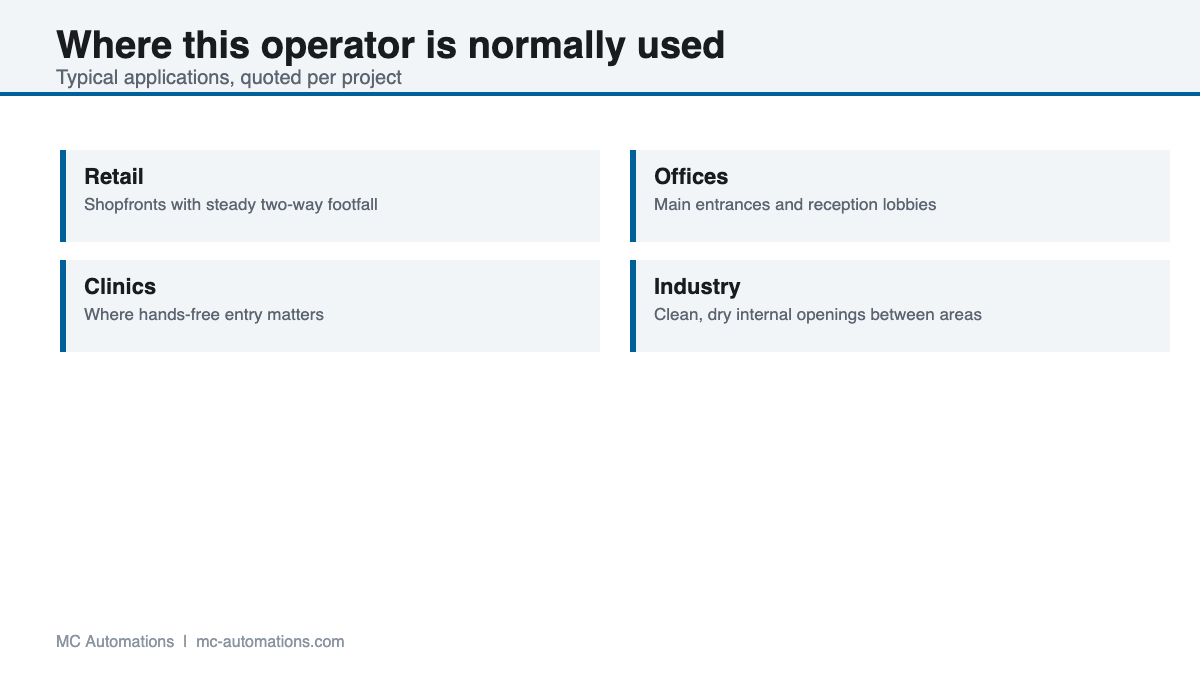
The MC-125 is used on retail and shopping-centre entrances, healthcare corridors and reception areas, hotel and hospitality entrances, office receptions, industrial and logistics doorways, and public buildings. One operator covers all of them because speed, hold-open time and opening size adjust to the entrance rather than the other way round.
Service, spares and warranty
The MC-125 carries a two-year warranty. Because the operator is imported and assembled locally, spares are held in Johannesburg and a technician arrives with the part that fits the fault rather than a diagnosis and a second visit. Maintenance intervals are set against the cycles an entrance actually carries rather than a generic calendar, and we service and repair automatic doors from other manufacturers alongside our own.
Installation and site readiness
Most of what determines whether an automatic sliding door reads well over its life is decided before the operator arrives on site. The MC-125 is surface mounted, which means it is fixed to the face of a header and the header carries the weight. That header has to be solid, level along its full length, and fixed to something structural. A header packed off a light steel stud line will flex a few millimetres under a 150 kg leaf, and a few millimetres is enough to make a door bind at one end of its travel and run cleanly at the other.
Level matters more than people expect. A sliding leaf hangs from carriages that run along a track; if the track falls even slightly, gravity assists the door in one direction and fights it in the other. The operator will compensate for a while, because it is driving a motor against a load, but the wear it is compensating with lands on the belt and the rollers. A door that needs its belt tensioned twice in a year is usually telling you about the header rather than about the operator.
The other site item is power. The MC-125 needs a dedicated supply within the AC 110–220 V ±10% band, terminated where the operator will sit rather than run in later along the header. Where an entrance also has access control, an intercom or a fire interface, those cables should be pulled at the same time; retrofitting them afterwards usually means opening a header that has already been closed up and finished.
MC-125 or MCW-100: which operator suits the opening
The MC-125 is a sliding door operator. Where the door has to swing rather than slide — a hinged leaf on a reception, a ward door, a door into a plant room — the operator in this range is the MCW-100 instead. The two are not interchangeable, and the decision is made by the door, not by preference.
Sliding suits an opening with wall space beside it and steady two-way traffic. Swinging suits an opening where there is no room for a leaf to stack, or where the door must hold a fire or acoustic rating that a sliding leaf cannot. If the opening is wide and traffic is heavy, sliding is almost always the better answer, because a swinging leaf sweeps an arc that people have to keep clear. Full figures for the swing operator sit on the MCW-100 product page, and both operators are imported and assembled locally on the same basis.
What this MC-125 brochure does not claim
It is worth being explicit about the limits of this document, because entrance specifications are an area where confident-sounding numbers get repeated until they are treated as fact.
- The one million cycle figure is a service-life test result. It is not a guarantee of a million trouble-free operations, not a maintenance-free period, and not a warranty term. The warranty is two years.
- No certification or third-party approval is claimed anywhere in this MC-125 brochure. Where a project requires evidence against a specific standard, ask us and we will tell you what documentation exists rather than assert compliance.
- Figures absent from the specification table are absent because we do not hold them in writing. Sound levels, ingress-protection ratings and duty classifications are the ones most often requested; if you need one for a specification, ask and we will confirm it in writing or tell you plainly that we cannot.
- Performance figures describe the operator as supplied and correctly installed. An operator on a flexing header, an under-voltage supply or misaligned sensors will not hold them, and no brochure figure survives a bad installation.
MC-125 brochure: maintenance and service intervals
Wear on a sliding door operator tracks cycles, not the calendar. A shopping-centre entrance can complete several thousand operating cycles a day, while an office side door may manage a few dozen. Two doors installed on the same date can therefore be years apart in real wear, which is why a fixed annual visit suits one and badly under-serves the other.
On a service visit the items that matter are the carriage rollers, the drive belt tension, the track, the activation and safety sensors, and the fixings holding the header to the structure. Sensors drift out of alignment more often than mechanical parts fail, and a door that has started closing too quickly on people is almost always a sensor or a setting rather than a worn operator. Because opening speed, closing speed and hold-open time are all adjustable, most complaints of that kind are corrected on site.
If an entrance is on a maintenance agreement we set the interval against measured traffic. The figures in this MC-125 brochure describe the operator as supplied; how long it holds those figures depends almost entirely on how often it runs and how well the header was built.
MC-125 brochure: terms used above
- Clear opening — the measured gap available to walk through when the leaves are fully open. Not the structural opening.
- Leaf — the moving panel itself. A single slide has one; a bi-parting pair has two that meet in the middle.
- Hold-open time — how long the door stays open after activation clears, adjustable here from 0 to 8 seconds.
- Manual opening force — the push needed to open the door by hand with no power. The MC-125 brochure figures are under 40 N single slide and under 50 N bi-parting.
- Service-life test — a test-condition result, quoted here as 1 000 000 cycles. It is not a maintenance interval and not a warranty period.
- Surface mounted — the operator fixes onto the face of the header rather than being concealed within it, which is why header condition matters so much.
MC-125 brochure: frequently asked
What size opening does the MC-125 suit?
A single sliding leaf gives a clear opening of 1450 to 3100 mm. A bi-parting pair covers 2500 to 5000 mm. Leaf width is limited to 750–1600 mm single and 650–1250 mm per leaf bi-parting.
How heavy a door can the MC-125 drive?
Up to 150 kg on a single sliding leaf, or two leaves of 120 kg each bi-parting.
Is the MC-125 manufactured in South Africa?
No. The MC-125 is imported and assembled locally at our Laser Park premises. Local assembly is why spares are held in Johannesburg rather than ordered in.
What does the one million cycle figure in this MC-125 brochure mean?
It is a service-life test result: the operator was tested to 1 000 000 cycles under test conditions. It is not a maintenance-free period and not a warranty term. The warranty is two years.
What happens during a power failure?
Battery backup is available as an option. Without it the door opens by hand — manual opening force is under 40 N single slide and under 50 N bi-parting.
Can the MC-125 work with access control?
Yes. The operator accepts external release signals, so it can be driven from readers, intercoms or a building management system. Our automatic door access control page covers how that is wired.
Specifying from this MC-125 brochure?
Send us the opening size, the leaf weight and the traffic the entrance carries, and we will confirm the configuration in writing before anything is ordered.
The MC-125 brochure at a glance
Reading the MC-125 brochure before you specify
This MC-125 brochure is written for the person who has to specify an entrance and defend the decision afterwards. The notes below explain how to use it on a real opening rather than on paper.
The leaf sets the operator, not the other way round
Leaf weight and leaf width are the two numbers that decide everything downstream. Glass thickness, whether the leaf is framed or frameless, and the ironmongery all add mass, and mass is what the operator accelerates and stops on every cycle. We measure the opening and calculate the leaf before quoting, because an operator chosen from a photograph is the one that runs hot, wears belts and fails in its second year.
Single or bi-parting
A single sliding leaf needs side room equal to the clear width it gives you. A bi-parting pair splits that side room in two, which is often the only way a wide clear opening fits into an existing shopfront. The choice changes the header length, the track and the sensor layout, so it is settled at survey rather than assumed.
Sensors, safety and the threshold
Activation sensors see somebody approaching. Presence sensors see somebody standing still in the opening, and they are what stop a closing leaf catching a trolley, a wheelchair or a child who has stopped to look at something. Our quotations list them individually, and every commissioning visit tests obstruction detection with an object rather than trusting a controller display.
Power, backup and escape
What happens during a power interruption is a design decision, not an afterthought. Battery backup, fail-safe or fail-secure behaviour and manual break-out are settled before the order, because they affect the hardware fitted inside the header. Where an entrance sits on an escape route, that decision is governed by the building, not by preference.
What this brochure deliberately does not contain
It carries no price, because the price depends on the leaf, the glass, the sensors and the site. It carries no response-time promise. It carries no certification figures we do not hold, and it does not describe the operator as maintenance-free. What it does state is what the product is and what we commit to: the MC-125 is imported and assembled at our Laser Park workshop, installed and commissioned by our own technicians, supported by spares held in Johannesburg and covered by a 24-month warranty on the operator.
Before you send an enquiry
Send the structural opening width and height, the clear passage width you need, a photograph of the existing entrance and an idea of daily traffic. With those four things we can confirm whether the MC-125 brochure describes the right operator for the opening, what configuration it needs, and what has to be established on site before the figure can be relied on.
Questions we are asked about the MC-125 brochure
Does the brochure give a price?
No. The price follows the leaf, the glass, the sensors and the site conditions, so it is quoted per opening after a survey rather than printed in a brochure that would be out of date within a season.
How wide an opening can a single leaf cover?
That depends on the leaf weight and the side room available, which is exactly what the survey establishes. Where a single leaf would need more side room than the shopfront has, a bi-parting pair is normally the answer.
Is the operator manufactured by MC Automations?
No, and we do not claim it. The MC-125 is imported and assembled at our Laser Park workshop in Roodepoort, which is also where the spares are held.
What happens during load shedding?
The behaviour is chosen before the order: battery backup, fail-safe or fail-secure operation, and manual break-out where the entrance sits on an escape route. Each option changes the hardware fitted inside the header.
Can it be fitted to an existing shopfront?
Often, yes. The survey checks whether the existing structure can carry the header and whether the floor is level enough for the track, then says plainly what has to be changed first.
What is covered by the warranty?
24 months on the operator. Wear parts such as belts, rollers and floor guides, and the glass itself, are quoted and warranted separately, and we confirm that in writing before an order is placed.
Who services it afterwards?
We do, on an interval set against the entrance’s real cycle count. We also service entrances installed by other suppliers, and the first visit on those doubles as a condition survey.
Download
Download the MC-125 brochure as a PDF
The MC-125 brochure on this page is also published as a three-page illustrated A4 PDF, sized for printing, saving to a project folder or attaching to a tender pack. Architects and facilities managers who ask us for an MC-125 brochure are usually sent exactly this file. This MC-125 brochure carries the same figures as the page above, with nothing added and nothing rounded.
- Page one — what the operator does, the headline figures, and a dimensioned drawing of the single-slide and bi-parting configurations.
- Page two — the full technical specification: clear openings, leaf widths and weights, manual opening force, opening and closing speeds, hold-open time, motor, power supply, operating temperature, service-life test, installation and warranty, plus control and integration.
- Page three — why MC Automations: service and breakdowns, spare parts and technical support, where the MC-125 is specified, and what to send us for a quotation.
Download the MC-125 brochure (PDF, 3 pages)
If you would rather work from the page than the PDF, the print button at the top of this MC-125 brochure produces the same content as a clean printout. Either way, send us the measured opening before you specify — the brochure narrows the choice, but the opening decides it.
In short
The MC-125 brochure at a glance
- The MC-125 brochure carries no price list: the operator is quoted against the opening we measured, not a catalogue price.
- Ask about the MC-125 and we confirm the opening, the head and the power position first.
- MC-125 operators are installed and commissioned by our own technicians.
- The MC-125 carries a 24-month warranty on the operator.
- Spares for every operator in this MC-125 brochure are held in Johannesburg, so a repair does not wait on an import.
- Send the opening size and a photograph and we can quote against a real entrance rather than an assumption.
- Service intervals in the MC-125 brochure are set against cycle count rather than the calendar.
- Commissioning ends with the speed, hold-open and force settings written down.
- We also service and repair automatic sliding doors supplied by other companies.
- Prices for the MC-125 exclude VAT unless the quotation states otherwise.
- Everything in this MC-125 brochure comes from the operator documentation we hold; nothing is estimated.