Servicing
Automatic door servicing
Planned servicing that keeps an entrance running — on our own doors and on other manufacturers’ equipment. What a visit covers, how often it should happen, and how we take over a door somebody else installed.
On the visit
What a service visit covers, before any modernisation
Every scheduled visit works through the same checks rather than a quick look and a signature, and it is usually where the case for automatic door modernisation first shows up:
Door movement. Opening and closing speeds, hold-open time and cushioning are checked against how the entrance is actually being used, not against the factory defaults.
Activation and safety sensors. Tested at every visit as routine work, not only after a fault. Sensors drift, get knocked by trolleys and dust over, and a mis-set safety sensor is the fault most likely to hurt somebody.
Mechanical components. Belts, rollers, carriages, floor guides and tracks inspected for wear and alignment.
Controls and locking. Controller behaviour, battery backup where fitted, access control interfaces and after-hours locking.
How often
Service intervals by building
As standard we service an automatic door every six months, and in high-traffic areas more often, whether or not automatic door modernisation is on the cards. Quieter entrances run longer between visits, because the interval is set against the cycles the door actually carries.
A shopping-centre entrance and a controlled office door can sit on identical hardware and need completely different schedules. Retail, hospitals, clinics and transport interchanges tend to sit at the three-month end, and they are also where automatic door modernisation pays back fastest. Office receptions, back-of-house doors and controlled-access entrances often run comfortably at six-monthly intervals.
We set the interval when we quote, based on the building and the traffic rather than a standard package. When a door stops holding its settings between visits, that is normally the point at which automatic door modernisation is cheaper than continuing to service it.
Other brands
Taking over a door somebody else installed
A lot of the entrances we modernise were installed by somebody else, sometimes by a contractor who is no longer trading and left no record of what was fitted.
We service and repair automatic doors from other manufacturers alongside our own, so an unfamiliar brand is not a reason to replace a working entrance. Where parts genuinely are unobtainable, automatic door modernisation to our own MC-125 or MCW-100 operators puts the door back on a supply chain with spares held in Johannesburg rather than six weeks away on a container. Requirements for powered pedestrian doors in South Africa are published through SABS.
Questions
Service and modernisation, answered
How often should an automatic door be serviced?
Every six months as standard, and more often in high-traffic areas. Quieter entrances can run longer, because we set the interval against the cycles the door actually carries rather than a calendar date.
Do you maintain doors you did not install?
Yes. We carry out automatic door maintenance and repairs on other manufacturers’ equipment as well as our own, which is what allows a mixed estate to sit with one supplier.
What happens if a door fails between visits?
Use the 24/7 technical support line rather than the office number. Because spares are held in Johannesburg, most common failures can be repaired without waiting on imported parts.
How long should an automatic door last?
Around 20 years if it is looked after, and automatic door modernisation can extend a door well past the life of its original operator. Wear tracks cycles rather than age, so the interval and the quality of each visit matter more than the door’s date of installation.
Aftercare
Servicing, spares and agreements
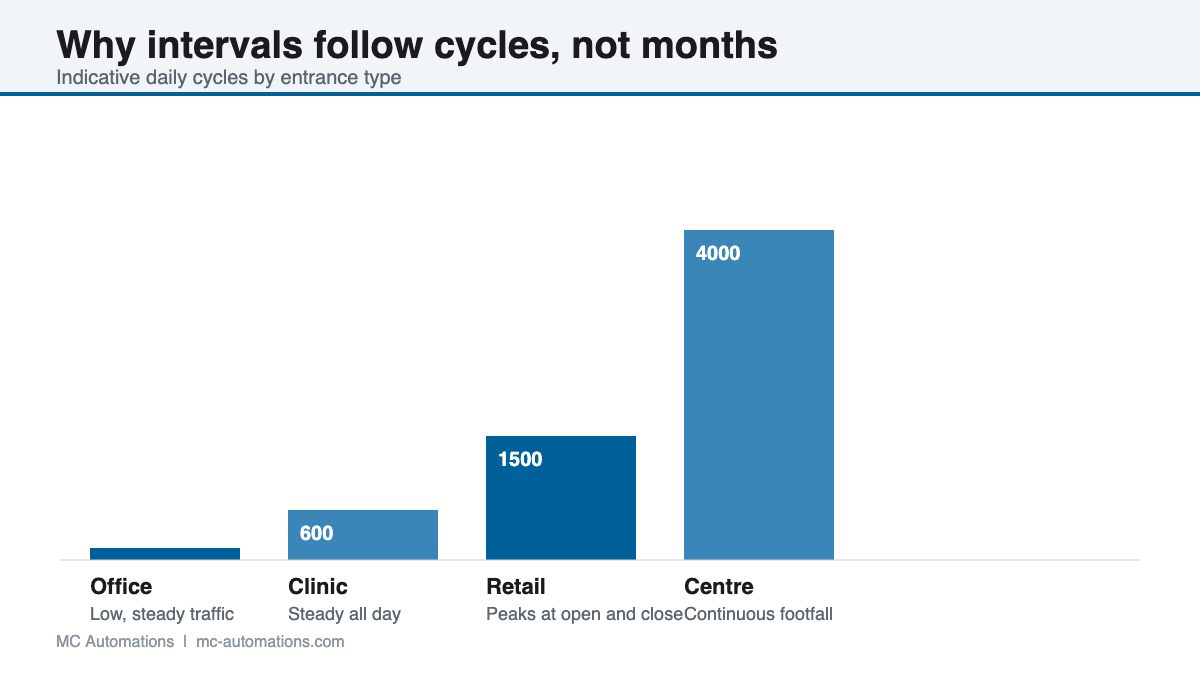
Service intervals should follow cycles, not the calendar: a mall entrance can do more work in a month than an office door does in a year. A visit checks and realigns sensors, inspects belt, rollers and guides, re-checks opening and closing force and replaces wear parts before they strand the door.
Consumable and wear items, including belts, rollers, floor guides and seals, are replaced as part of servicing rather than under warranty. A service level agreement runs alongside the product warranty; it neither replaces nor extends it.
Budget
How automatic door servicing is priced
Four things move the number: the opening width, the glass, the sensor layout and whether access control is included. Send the opening size and a photograph and a quotation usually follows within two working days.
Figures exclude VAT unless the quotation says otherwise, and any published guidance on this site is indicative rather than a fixed price.
Detection
What the sensors actually do
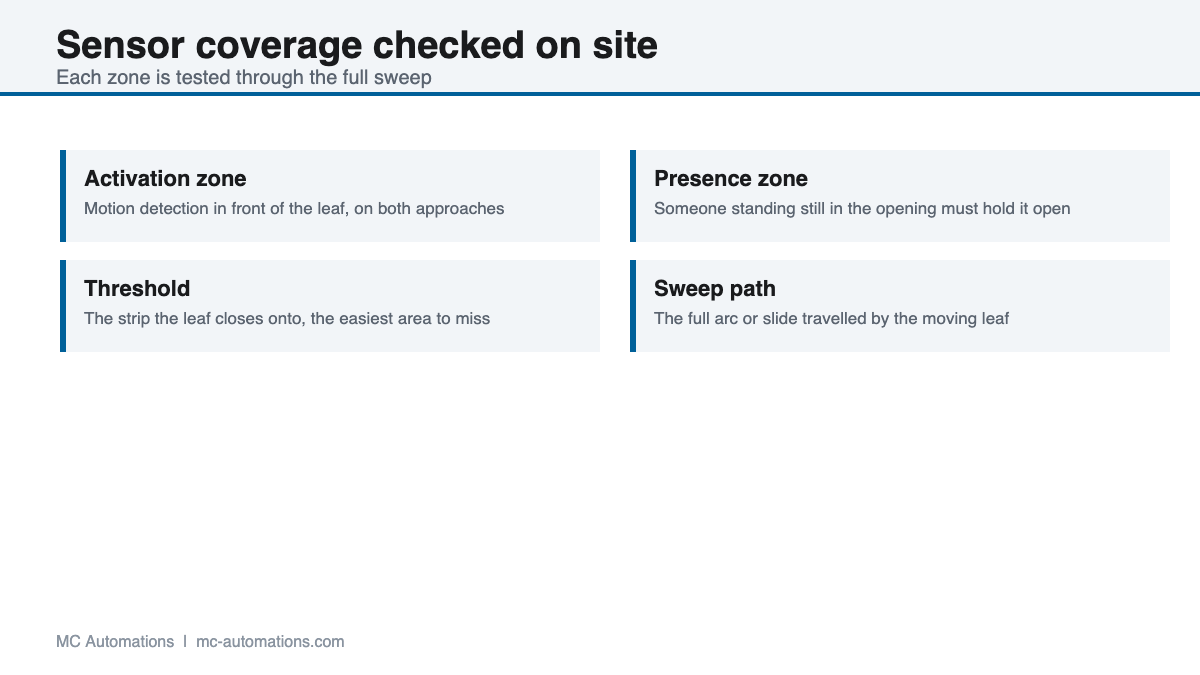
Two detection types work together on automatic door servicing: motion to open on approach, and presence to hold the door for somebody standing in the opening. Add safety beams and a force limit and the leaf reverses rather than pushing through an obstruction.
Speed, hold-open time, force and the sensor layout are recorded at handover, so a later adjustment can be compared against how the entrance was commissioned.
In short
Automatic door servicing at a glance
- Automatic door servicing are quoted against the opening we measured, not a catalogue price.
- Ask about automatic door servicing and we confirm the opening, the head and the power position first.
- Automatic door servicing are installed and commissioned by our own technicians.
- Automatic door servicing carry a 24-month warranty on the operator.
Send us the door as it is
A photograph of the operator housing, the clear opening width and height, and a note on what the door is doing wrong is usually enough for us to say whether it is worth upgrading. If it is not, we will say so.
Choosing the right automatic door servicing for your building
Not every enquiry needs the same thing, and it helps to know which of these you are asking for before you write to us. An automatic door service call is reactive: something has failed or is behaving oddly and needs attention now. A maintenance agreement is planned: the entrance is attended on an interval set against the traffic it carries, before failures happen. A modernisation is neither — it is a decision that an ageing entrance has reached the point where continuing to repair it costs more than replacing the operator.
Buildings frequently ask for the first when what they actually need is the second. If the same entrance has appeared on your callout log three times in a year, an automatic door service contract will almost certainly cost less than continuing to pay for reactive attendance, and the entrance will be out of use far less often.
Emergency, routine and planned work
Most automatic door service work falls into one of three categories, and knowing which yours is helps us respond properly. Emergency work is where an entrance has failed in a way that affects safety or security — a door that will not close on a building that must be locked, or one that has failed in a way that puts users at risk. Routine work is a fault that is inconvenient but not dangerous: a door that is noisy, slow, or opening when it should not. Planned work is everything agreed in advance, from scheduled maintenance visits to a modernisation booked around a tenant’s trading hours.
Planned work is always cheaper per hour than emergency work, in this trade and every other. The purpose of an automatic door service agreement is to move as much of your estate as possible out of the first category and into the third.
Working around your building
An entrance is the one part of a building that cannot simply be closed while it is worked on, which is why timing matters more here than on most trades. Retail entrances are usually attended outside trading hours. Healthcare corridors need coordination with the department rather than the facilities office, because closing a door can affect clinical movement in ways a maintenance schedule does not capture. Office receptions are generally the easiest, but a main entrance out of use during arrival hours is still disruptive.
Tell us the constraints when you first make contact. Automatic door service work planned around a building goes in once; work scheduled without that information frequently has to be rebooked, which costs everybody time.
Automatic door servicing for property managers
Managing entrances across a portfolio is a different problem to looking after one door. The recurring difficulty is visibility: without a single record, an automatic door service history lives in individual invoices and individual memories, and nobody can see that the same entrance has been attended four times this year.
Bringing an estate onto one asset register solves that, and it does not require replacing anything. Each door gets a reference, a location, a type and a measured traffic figure, and the automatic door service interval is set per door rather than per contract. It is the single change that most reliably reduces both cost and downtime across a portfolio.
Automatic door servicing for healthcare and controlled areas
Clinical environments add requirements that a general automatic door service arrangement does not cover. Hermetic doors seal against their frames, and a seal that has hardened stops sealing while the door continues to look and sound perfectly normal. Interlocked door pairs have to be checked as a pair, not as two doors. Cleaning regimes attack seals far faster than cycle count does.
If your estate includes sealed or shielded rooms, say so when you first make contact, because those doors need to be scheduled and inspected differently to the entrance in the main lobby.
What automatic door servicing actually covers
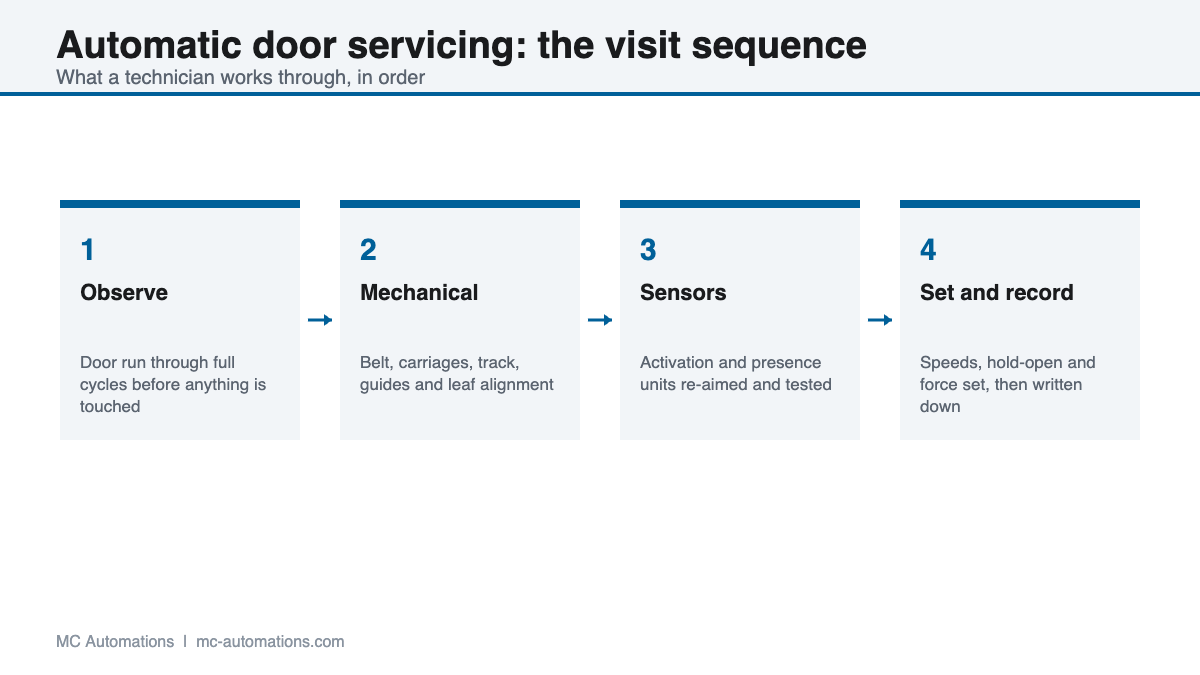
A service visit is not a quick look at the door. Automatic door servicing is a fixed sequence of checks on the operator, the leaves, the sensors and the safety behaviour, and it ends with the settings written down so the next visit starts from a known state.
The automatic door servicing checklist
- Drive and transmission: belt tension and condition, pulleys, motor mountings and the controller’s error history.
- Carriages and track: rollers, anti-riser blocks and the track itself, cleaned and checked for wear that will become noise.
- Leaves and guides: floor guides cleared, leaf alignment and closing position checked against the frame.
- Sensors: activation and presence sensors re-aimed and tested through the full sweep, including the threshold area.
- Safety behaviour: obstruction detection and reversal tested with an object, not assumed from the controller display.
- Speeds and timing: opening and closing speed, hold-open time and low-energy behaviour set for the traffic the entrance actually carries.
- Power and backup: supply checked, and battery backup tested where it is fitted.
- Access control: readers, free-exit devices and interlocks operated to confirm they still release the door as intended.
- Report: every automatic door servicing visit leaves a record of what was set, what was replaced and what is starting to wear.
Automatic door servicing intervals
Intervals are set against cycles rather than the calendar. A shopping-centre entrance can pass more cycles in a month than an office door does in a year, so automatic door servicing on the two cannot sensibly be scheduled the same way. At survey we estimate the cycle count from the traffic pattern, then set an interval and adjust it once the first year of real data exists.
Doors installed by other suppliers
We take over automatic door servicing on entrances installed by other companies. The first visit is longer because it doubles as a condition survey: we record the make, the operator, the sensor layout and the state of the track, then tell you plainly what is serviceable, what is obsolete and what needs replacing before it fails. Spares for the ranges we supply are held in Johannesburg, and the operators we install carry a 24-month warranty.
Are the operators made in South Africa?
The MC-125 and MCW-100 are imported and assembled at our Laser Park facility in Johannesburg, where spares and technical support are held locally.
Do you service other manufacturers equipment?
Yes. Where we take over an entrance somebody else installed, we report its condition before committing to a maintenance interval.
What warranty applies to the operator?
The MC-125 and MCW-100 carry a 24-month (two-year) warranty. The warranty that applies to your installation is the one recorded on your quotation and invoice.
Building a service interval from evidence
The interval is the decision that matters most in automatic door servicing, and it is the one most often taken from a template. An annual visit on every entrance means the busy ones run to failure while the quiet ones are over-attended.
The number that should set it is the daily cycle count. A welfare door at shift change and a boardroom door in the same building can differ by a factor of fifty, and no single interval serves both. Where a controller can report cycles, we read it. Where it cannot, an honest estimate of people through the doorway at its busiest hour gets close enough to be useful.
Three other things pull the interval shorter regardless of traffic. Airborne grit, because track wear arrives on boots and trolley wheels rather than from cycles. Exposure, because sun, driving rain and coastal salt age seals, optics and housings faster than an interior entrance ever sees. And vibration, because racking traffic and compressors shift sensor aim, so drift appears sooner than it would elsewhere.
We set the first interval from those inputs, then adjust it from what the visits actually find. An entrance arriving in good condition three visits running has earned a longer interval; one needing the same adjustment every time has earned a shorter one or a closer look at why.
What we leave behind after a visit
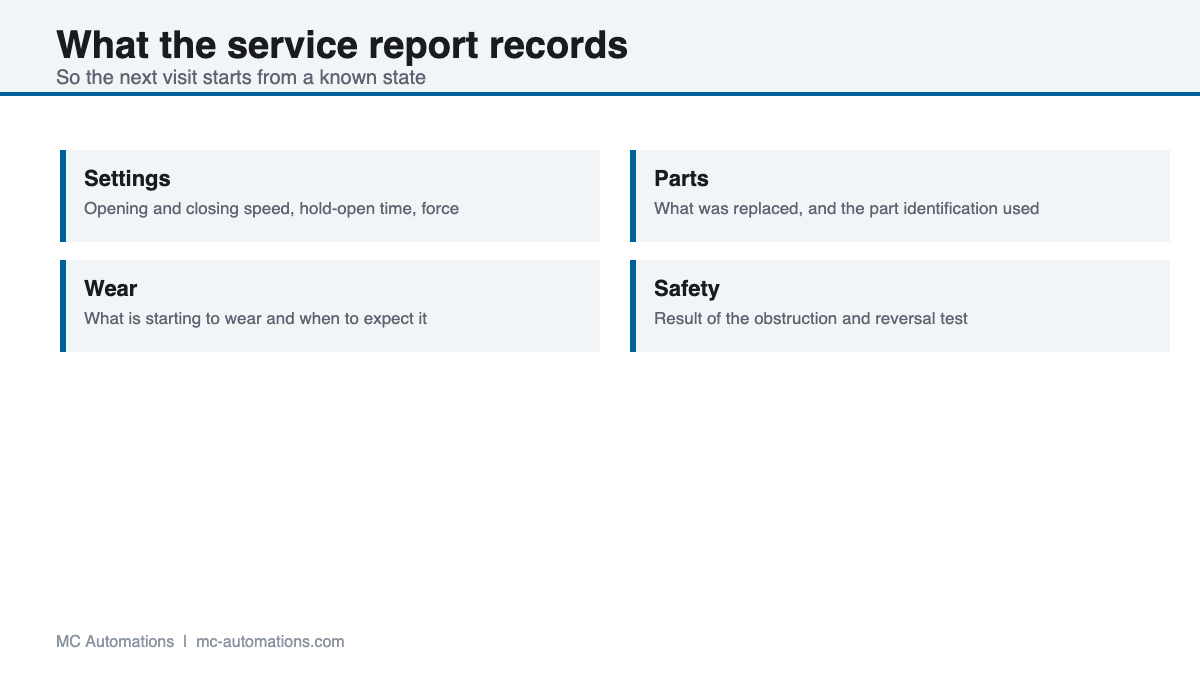
A visit that produces no record is worth less than it cost. Automatic door servicing on our agreements ends with the settings written down: opening and closing speed, hold-open time, force, and the detection zones as they were left.
That record does three jobs. It gives the next technician a baseline rather than a guess. It lets you see whether an entrance is drifting steadily in one direction, which is the earliest warning that something mechanical is failing. And it settles arguments about whether a door was always like that.
We also record condition rather than just work done — track and guide wear, sensor aim, leaf alignment, battery state, and anything that will need attention before the next visit but did not need it today. That list is what turns automatic door servicing from a recurring cost into a budgeting tool, because it tells you what is coming.
Agreements, and what they should and should not promise
A service agreement is worth having when it changes behaviour, not when it simply pre-pays for visits you were going to book anyway.
The parts worth agreeing in advance are the ones that are awkward to negotiate mid-breakdown: which entrances are critical and which can wait, what response applies to each tier, whether out-of-hours attendance is included or chargeable, and who is authorised to approve a part over a given value. Settling those on a quiet afternoon is considerably cheaper than settling them with a doorway coned off.
What an agreement should not promise is a response time we cannot honour. Same-day call-outs are a Gauteng commitment. Outside Gauteng we attend on a scheduled basis, and we would rather write that down than sell a number that sounds better and then miss it.
Automatic door servicing agreements cover any major brand, not only operators we supplied, so a mixed estate does not need separate contractors for different headers.
Inheriting an entrance nobody documented
A good deal of automatic door servicing starts with a door somebody else installed, no paperwork, and nobody left who remembers the installer.
The first visit on that entrance doubles as a survey. We record the operator make and model from the header label, the sensor arrangement, the track and guide condition, the leaf weight where it can be established, and whether the doorway sits on an escape route. From that we can say plainly what is serviceable, what is obsolete, and what should be replaced before it strands the entrance rather than after.
Obsolescence is the finding that changes decisions most. Where parts for an operator are no longer made, continuing to service it is a holding action, and the honest advice is to plan a modernisation rather than wait for the controller to fail on a Friday. We will say which of those two situations you are in.
Quick answers on automatic door servicing
- Automatic door servicing intervals follow the real cycle count, not the calendar.
- Automatic door servicing covers any major brand, not only operators we supplied.
- Automatic door servicing includes proving the safety sensing, not just inspecting it.
- Automatic door servicing visits record the settings, so the next one starts from a baseline.
- Automatic door servicing is shortened by grit, exposure and vibration more than by cycles.
- Automatic door servicing on an obsolete operator is a holding action; plan modernisation.
- Automatic door servicing is same-day in Gauteng and scheduled nationwide.
- Automatic door servicing carries a 24-month warranty on the operator; parts are separate.
For a fault right now rather than planned maintenance, book a technician.
Who does what between visits
Automatic door servicing works better when the building does a small amount of the right thing between attendances, and nothing at all of the wrong thing.
Worth doing on site: keep the track clear, and clear means lifted out rather than swept across. Wipe sensor lenses with a soft dry cloth, because a dusty lens reads as reduced detection long before anyone connects the two. Keep the approach free of anything new inside the detection field — a queue barrier, a seasonal display, a delivery cage parked for an afternoon — since those cause more reported faults than component failure does. And log what the entrance is doing when it misbehaves, with the date, because a pattern is far more useful to a technician than a single description.
Worth leaving alone: the force, speed and hold-open settings, the sensor aim, and anything inside the header. Those are commissioned values, they are set against the traffic the doorway actually carries, and adjusting them informally undoes the part of automatic door servicing that protects people. A door that feels slow is sometimes a door set correctly for a site with wheelchairs and trolleys.
If an entrance starts closing on people, that is not a between-visits item. Take it out of automatic mode and call it in the same day.
Finally, tell us when the building changes. A new tenant, a re-planned entrance lobby, a change in opening hours or a doubling of footfall all change the correct interval, and they are the sort of thing nobody thinks to mention until the following year’s visit finds an entrance three times more worn than expected.
Automatic door servicing in four pictures