
Contact
Automatic door service and installation, Johannesburg and nationwide
We supply, install and commission new entrances and run automatic door service and repairs from Johannesburg, with technical support on call around the clock. Send us an opening size and a photograph and we will come back with a configuration and a price.
Where to find us
Our offices
Head Office — Johannesburg
Automatic door service, Johannesburg
84 Ridge Road, Unit 2, Laser Park
Roodepoort, 2040, South Africa
+27 10 412 0062
info@mc-automations.com
Our operators, sensors, controls and spares are held here, and this is where the MC-125 and MCW-100 are assembled.
Technical support — 24/7
Breakdowns and faults
+27 76 613 4418
marcel@mc-automations.com
If an entrance has failed and the building still has to trade, use this line rather than the office number.
When we are open
Working hours
Monday to Thursday: 08:00 – 16:30. Friday: 08:00 – 14:00. Saturday and Sunday: on call.
Quoting, scheduling and general enquiries run during office hours. Breakdowns do not, which is why the technical support line stays open outside them — an entrance that fails on a Saturday morning in a trading centre cannot wait until Monday.
If you are reporting a fault, it helps to say what the door is doing rather than what you think is wrong: whether it opens but will not close, closes but reopens immediately, moves slowly, or does nothing at all. Those four descriptions point at very different causes, and telling us which one it is often decides whether the technician brings a sensor, a belt or a controller to site.
Photographs of the operator housing and of any error light on the controller are worth sending too. Between those and the door behaviour, we can usually arrive with the right part rather than diagnosing on the first visit and returning on a second.
Before you send it
What helps us quote faster
Most quotes stall on missing information rather than on price. If you can send these four things with your enquiry, we can usually come back with a real configuration instead of a range:
The clear opening width and height. Not the door size — the hole in the wall the door has to cover.
What sits above the opening. A photograph of the head is more useful than a measurement, because it shows whether there is room for an operator.
Whether there is power at the head of the door. If not, that is an electrician on the critical path.
Any access control or locking requirement. Card readers, intercoms, fire interfaces and after-hours locking all change the specification.
Coverage
Automatic door service beyond Johannesburg
Our Johannesburg head office is where the people and the stock sit, but installation and automatic door service work is not limited to those two cities. We supply and install nationwide across South Africa, and travel to site for commissioning and planned maintenance.
For a property group with buildings in more than one province, that matters: one supplier, one set of paperwork and one automatic door service history for the estate, instead of a different contractor in every town.
We also service and repair automatic doors from other manufacturers alongside our own, so a mixed estate does not need to be replaced before it can be maintained properly.
Planned work
Maintenance intervals and what they prevent
In high-traffic areas we recommend an automatic door service every three months. Quieter entrances run longer between visits, because the interval is set against the cycles the door actually carries rather than a date on a calendar.
At each visit our technicians check door movement, activation and safety sensors, mechanical components and alignment. Belts stretch, rollers flatten, floor guides fill with grit and sensors drift, and all of that is cheap to correct on a planned visit and expensive to correct when an entrance fails during trading hours. A well-specified door that gets a regular automatic door service should give around 20 years of service.
Send an enquiry
Ask us about automatic door service or a new entrance
New installations, replacements, spares or a door that has stopped working — including automatic doors we did not supply. There is Requirements for powered pedestrian doors in South Africa are published through SABS.
Who calls us
Buildings that cannot stop
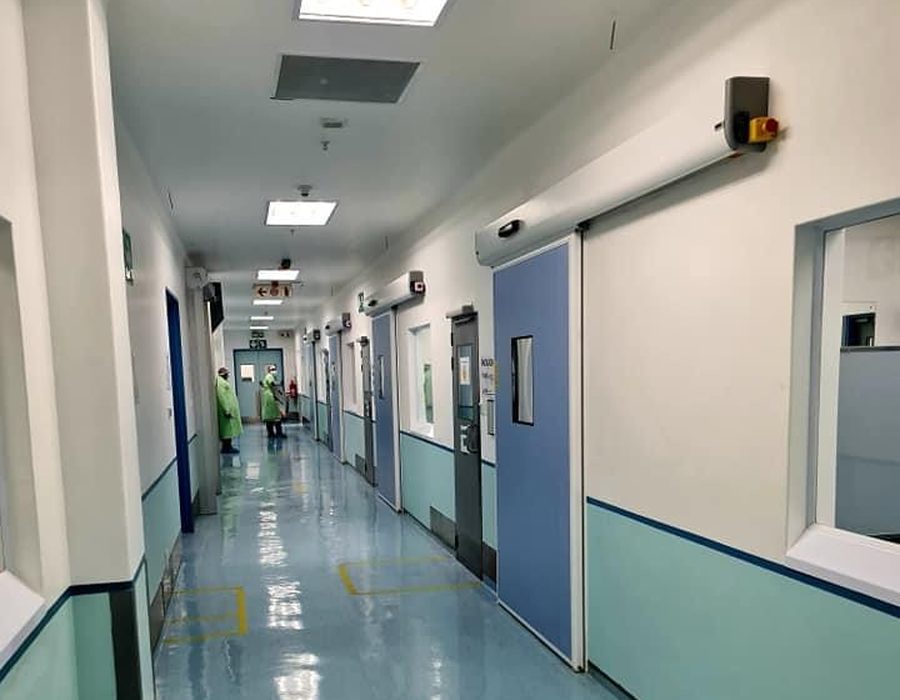
Most of our service calls come from places where a stopped entrance is immediately a problem: shopping centres, hospitals and clinics, hotels, office receptions and controlled-access buildings. Those are the entrances we plan maintenance around most carefully.
Head office
Find us in Laser Park
Prefer we call you?
Send your number and a photograph of the entrance through the form above and one of us will come back to you. For anything urgent, the 24/7 technical support line is the fastest route.
What to include in an enquiry
Automatic door service enquiries get answered faster when the first message carries enough to act on. We do not need a full specification — we need enough to know whether this is a breakdown, a service enquiry, a new installation or a quotation, and to send the right person with the right parts.
- Where the door is. The site address, and which entrance within the building if there is more than one.
- What kind of door it is. Sliding, swing, revolving, telescopic or hermetic. If you are not sure, a photograph settles it immediately.
- What it is doing. Not opening, not closing, opening but not staying open, making a noise, or opening when nobody is there. Each of those points at a different cause.
- How urgent it is. An entrance standing open on a trading floor is a different call to a door that has developed a rattle.
- Whether the entrance is secure. If a door has failed open and the building cannot be locked, say so in the first line.
What happens after you get in touch
For a breakdown we establish what the door is doing and whether the entrance is currently secure, then arrange attendance. For a service or quotation enquiry we usually need to see the entrance, either through photographs or a site visit, before committing anything to writing. We would rather ask a question than assume, particularly on anything to do with opening sizes, leaf weights or safety devices.
Where a quotation is involved, everything we commit to is confirmed in writing before work is ordered. We do not publish certification claims we cannot evidence, and if a figure you need is not something we hold in writing, we will say so plainly rather than estimate it.
Reporting a breakdown
If an entrance has failed, the two things that matter most in your first message are whether anybody is at risk and whether the building can be secured. A door that has failed closed on a fire escape route, or failed open on a building that needs locking, is treated differently to a door that is simply inconvenient.
It is worth knowing that a large share of the faults we attend are not mechanical. Sensors drift out of alignment, settings get knocked, and supply voltage sagging at the bottom of its range causes intermittent behaviour that looks exactly like an operator fault. Describing the symptom accurately often shortens the visit considerably, because the technician arrives expecting the right problem.
Contacting us about a new project
For a new installation, the earlier we are involved the better the outcome tends to be. Most of what decides whether an automatic entrance performs well over its life is settled before the operator is ordered: the header and what it is fixed to, the finished floor level, the clear opening as built rather than as drawn, and the traffic the entrance will actually carry.
Where an architect or contractor is involved, we would rather have that conversation at design stage than at handover. It costs nothing at that point and is expensive to correct afterwards. If you are comparing suppliers, our product brochures set out the published figures for each system so you can compare like with like.
Automatic door service: frequently asked
Do you cover my area?
We supply, install and service automatic doors nationwide from Johannesburg, across all nine provinces. Tell us the site address and we will confirm how we cover it.
Do you work on doors you did not supply?
Yes. We service and repair automatic doors from other manufacturers alongside our own, so a mixed estate can sit under one arrangement.
What information do you need to quote?
For an existing door: the site, the door type and what it is doing. For a new installation: the structural opening measured as built, the clear opening required, the header construction and the expected traffic. Photographs are worth more than a description.
Do you charge for a site visit?
It depends on what the visit is for, and we will tell you before we attend rather than afterwards. We do not quote work of this kind without seeing the entrance.
How quickly can you attend a breakdown?
That depends on the site and the nature of the fault, and we agree it with you rather than publishing a single figure that would be misleading. Tell us whether the entrance is secure and whether anybody is at risk, and we will be straight with you about timing.
Can I get a maintenance agreement instead of calling each time?
Yes, and on a busy entrance it is usually cheaper. See our service level agreement page for what an agreement should cover.
Choosing the right automatic door service for your building
Not every enquiry needs the same thing, and it helps to know which of these you are asking for before you write to us. An automatic door service call is reactive: something has failed or is behaving oddly and needs attention now. A maintenance agreement is planned: the entrance is attended on an interval set against the traffic it carries, before failures happen. A modernisation is neither — it is a decision that an ageing entrance has reached the point where continuing to repair it costs more than replacing the operator.
Buildings frequently ask for the first when what they actually need is the second. If the same entrance has appeared on your callout log three times in a year, an automatic door service contract will almost certainly cost less than continuing to pay for reactive attendance, and the entrance will be out of use far less often.
What we will ask you
Expect a few questions back. They are not administrative — each one changes what we send and what we bring.
- How busy is the entrance? Cycle count drives wear far more than age does, and it sets the correct automatic door service interval.
- How old is the installation, and who fitted it? This tells us what spares are likely to be needed and whether parts are still available.
- Is the entrance on an escape route? That changes what is acceptable during a power failure and what has to be tested.
- Has anything changed recently? New flooring, a new ceiling, a refurbishment or a change of tenant explains a surprising number of sudden faults.
- Is this one door or an estate? A single entrance and fourteen across three sites are different conversations.
Our position on what we will and will not tell you
There is a lot of confident-sounding information in this industry that does not survive scrutiny, and we would rather be useful than impressive. Where we hold a figure in writing, we publish it — our product brochures carry the full specifications for each system. Where we do not hold it, we say so rather than estimating, and we do not publish certification or testing claims we cannot evidence.
The same applies to automatic door service response commitments. We agree those with you against your sites rather than publishing a single headline figure, because a number that sounds impressive on a web page and does not hold on the day you need it is worse than no number at all.
Emergency, routine and planned work
Most automatic door service work falls into one of three categories, and knowing which yours is helps us respond properly. Emergency work is where an entrance has failed in a way that affects safety or security — a door that will not close on a building that must be locked, or one that has failed in a way that puts users at risk. Routine work is a fault that is inconvenient but not dangerous: a door that is noisy, slow, or opening when it should not. Planned work is everything agreed in advance, from scheduled maintenance visits to a modernisation booked around a tenant’s trading hours.
Planned work is always cheaper per hour than emergency work, in this trade and every other. The purpose of an automatic door service agreement is to move as much of your estate as possible out of the first category and into the third.
Working around your building
An entrance is the one part of a building that cannot simply be closed while it is worked on, which is why timing matters more here than on most trades. Retail entrances are usually attended outside trading hours. Healthcare corridors need coordination with the department rather than the facilities office, because closing a door can affect clinical movement in ways a maintenance schedule does not capture. Office receptions are generally the easiest, but a main entrance out of use during arrival hours is still disruptive.
Tell us the constraints when you first make contact. Automatic door service work planned around a building goes in once; work scheduled without that information frequently has to be rebooked, which costs everybody time.
Automatic door service for property managers
Managing entrances across a portfolio is a different problem to looking after one door. The recurring difficulty is visibility: without a single record, an automatic door service history lives in individual invoices and individual memories, and nobody can see that the same entrance has been attended four times this year.
Bringing an estate onto one asset register solves that, and it does not require replacing anything. Each door gets a reference, a location, a type and a measured traffic figure, and the automatic door service interval is set per door rather than per contract. It is the single change that most reliably reduces both cost and downtime across a portfolio.
Automatic door service for healthcare and controlled areas
Clinical environments add requirements that a general automatic door service arrangement does not cover. Hermetic doors seal against their frames, and a seal that has hardened stops sealing while the door continues to look and sound perfectly normal. Interlocked door pairs have to be checked as a pair, not as two doors. Cleaning regimes attack seals far faster than cycle count does.
If your estate includes sealed or shielded rooms, say so when you first make contact, because those doors need to be scheduled and inspected differently to the entrance in the main lobby.
Automatic door service: how to reach the right person quickly
Automatic door service enquiries reach us through the form above, and the more specific the first message, the shorter the exchange that follows. A breakdown, a routine automatic door service visit, a quotation and a maintenance agreement are four different conversations, and saying which one you need in the first line saves a round trip.
If the entrance has failed, lead with whether anybody is at risk and whether the building can be secured. If you are arranging planned automatic door service, lead with the site and how many doors. If you are pricing new work, lead with the opening and a photograph. If you want an agreement across an estate, say how many sites, because automatic door service across a portfolio is priced and scheduled differently to a single door.
We will always tell you what we can evidence and what we cannot. That applies to specifications, to certification, and to automatic door service response commitments, which we agree with you against your sites rather than publishing as a headline figure that may not hold on the day you need it.
Automatic door service: reaching the right person quickly
Automatic door service enquiries reach us through the form above, and the more specific the first message, the shorter the exchange that follows. A breakdown, a routine automatic door service visit, a quotation and a maintenance agreement are four different conversations, and naming which one you need in the first line saves a round trip.
If an entrance has failed, lead with whether anybody is at risk and whether the building can be secured. If you are arranging planned automatic door service, lead with the site and the number of doors. If you are pricing new work, lead with the opening and a photograph. If you want an agreement across an estate, say how many sites, because automatic door service across a portfolio is priced and scheduled differently to a single door.
We will always tell you what we can evidence and what we cannot. That applies to specifications, to certification, and to automatic door service response commitments, which we agree with you against your own sites rather than publishing as a headline figure that might not hold on the day you need it. An automatic door service promise that only works on a web page is worth nothing to a building with an entrance standing open.