
Hotel automatic doors for lobbies, conference wings and back of house
Hotel automatic doors have a harder brief than almost any other entrance we supply. A shopping centre closes. An office building empties. A hotel does neither. The same lobby entrance that handles a coach party at ten in the morning has to be quiet enough at two in the morning that it does not wake the guests on the first floor, and it has to keep working through a load shedding block that nobody scheduled around it.
This page sets out what actually changes when the building is a hotel, lodge or conference property, and how we specify, install and service hotel automatic doors across the hospitality sector in South Africa. If you are specifying a new property, or you have inherited an estate with four different brands of operator on it, the practical parts are in the second half.
A hotel is seven entrances, not one
The single most common mistake in a hospitality brief is treating the property as one door type repeated. It is not. A hotel has a porte-cochère, a lobby air lock, a conference wing, food and beverage outlets, a wellness area, a back of house yard and a staff entrance, and each of those seven has a different reason to exist.
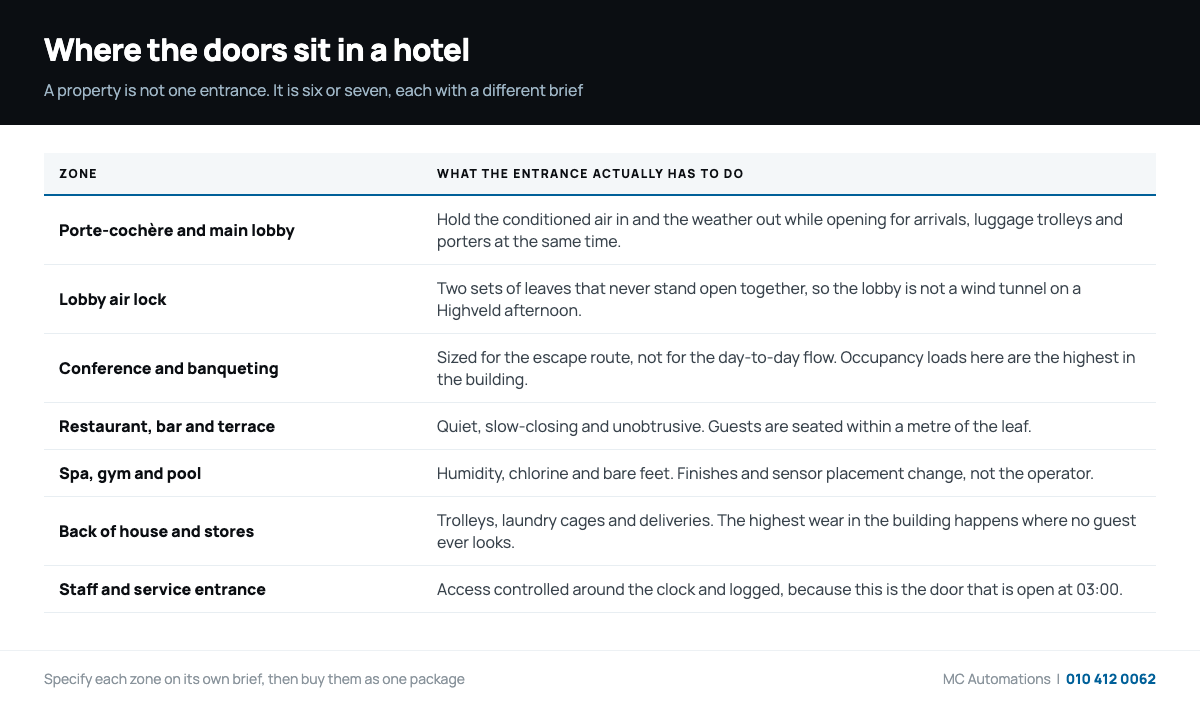
Hotel automatic doors are therefore specified zone by zone. Specify each on its own brief, then buy them as a single package. That is how you end up with one spares holding and one service visit rather than six of each.
The lobby has to hold its air
A hotel lobby is conditioned space that opens directly onto the street. Every second the entrance stands open, the building is paying to heat or cool the pavement. On the Highveld in August, a lobby facing into the prevailing wind will feel like a corridor rather than a reception area, and guests waiting to check in are the ones who notice.
There are two honest answers to this. The first is an air lock: two sets of leaves with enough distance between them that they are never both open at once, so there is no straight path from the street to the reception desk. The second is a revolving door, which by its geometry never opens the lobby fully to the outside at all. Automatic revolving doors earn their place in hospitality for exactly this reason, and they are usually paired with a sliding leaf alongside for luggage, wheelchairs and deliveries.
Where neither is possible because the architecture will not allow it, the levers left on hotel automatic doors are opening width and hold-open time. A sliding entrance that is set to open partially outside peak arrival periods, and to close briskly rather than lingering, will noticeably reduce the draught without anyone noticing a change in service.
Luggage trolleys set the clear opening
Clear opening on hotel automatic doors is not decided by how many people pass through them. It is decided by the widest thing that has to pass through it, and in a hotel that is usually a loaded bell trolley with cases on both tiers and a porter walking alongside rather than behind.
Measure it on your own property rather than working from a standard figure. Take the trolley you actually use, load it the way housekeeping and the bell desk actually load it, and measure across the widest point including the handles. Then add room for a person to walk beside it without turning sideways. That is your clear opening, and it is very often 200 to 300 mm wider than the opening someone would have drawn from the lobby plan alone.
The same logic applies to the conference wing, where the widest object is a stacked chair trolley or a staging cart, and to back of house, where it is a laundry cage. None of those are guest-facing, and all of them are what actually wears the entrance out.
On hotel automatic doors, noise is a specification and not a complaint
In most buildings, door noise is a nuisance. In a hotel it is a revenue problem, because the rooms above and beside the lobby are the ones that get complained about and discounted. A drive that whines, a leaf that thumps into its end stop, or a floor guide that has picked up grit will all carry up a stairwell and along a corridor at night when there is nothing else to mask it.
Three things control this. The first is the operator itself: a brushless drive running a correctly tensioned belt is quiet by design, and the MC-125 sliding door operator is specified on that basis. The second is the deceleration profile, which is a commissioning setting rather than a hardware choice, and which is where most avoidable noise comes from. The third is the track and carriage condition, which is a maintenance matter and the reason hotel automatic doors benefit from a shorter service interval than an office would need.
If a lobby entrance has become audibly worse over a season, it is almost always the third of those, and it is almost always a cheap fix if it is caught before the track is scored.
Night behaviour and the mode switch
Hotel automatic doors need to behave differently at different times of the night, and that behaviour needs to be decided at commissioning rather than improvised by whoever is on duty.
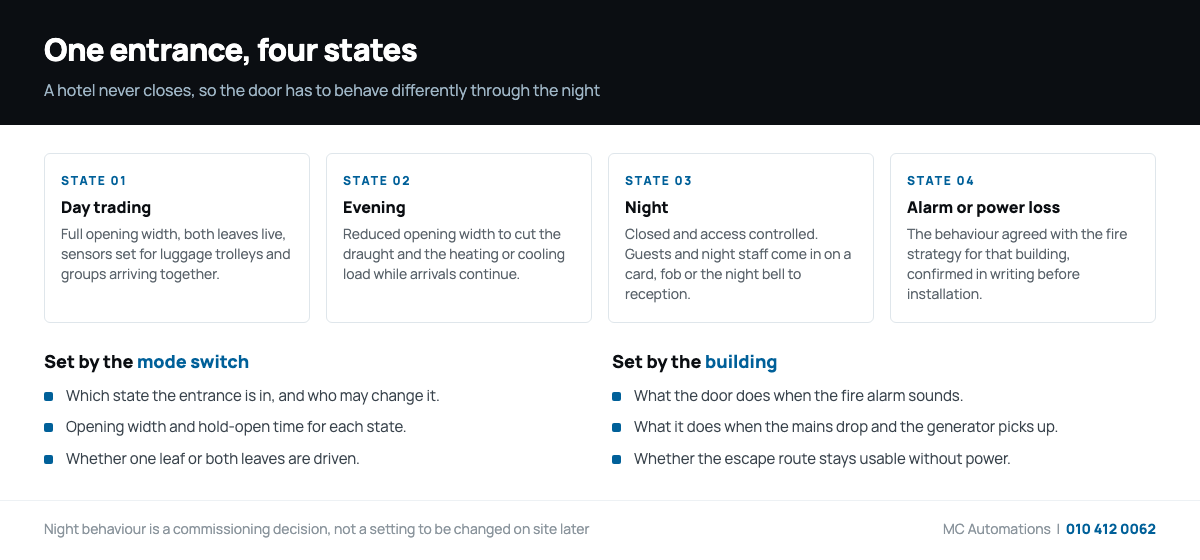
The mode switch is the control that decides which state the entrance is in. On a well set up property it lives behind reception, not on the wall next to the door, and only the duty manager can change it. What it must never do is override the behaviour the building needs in an emergency: the alarm and power-loss responses sit above the mode switch and are not the night manager’s to change.
We commission these states with the property team present, and we write down what each one does, because the person who was there on handover night will not be the person on duty in eighteen months.
Load shedding, generators and the changeover gap
Every hospitality property in South Africa now specifies around interrupted power, and hotel automatic doors are part of that conversation whether or not anyone put them in the brief.
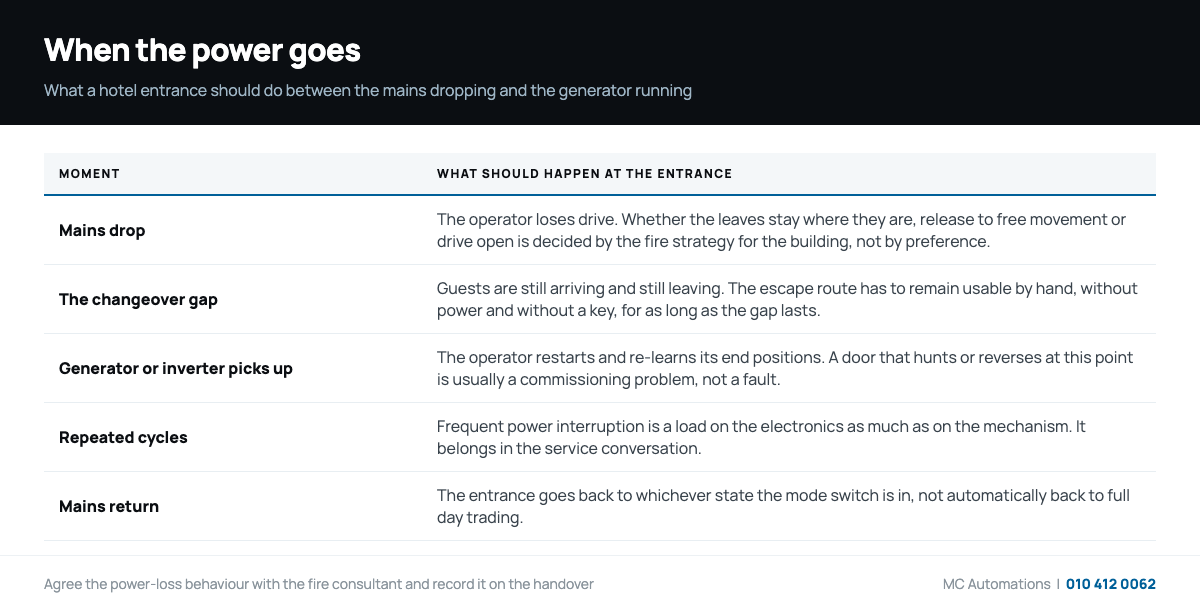
The part that gets missed is the changeover gap. Between the mains dropping and the generator or inverter carrying the load, there is a window in which the entrance has no drive. Guests are still arriving and still leaving during that window. The escape route through that entrance has to remain usable by hand, without power and without anyone hunting for a key, for as long as the gap lasts. That is a requirement of the building, not a feature of the door, and it is agreed with your fire consultant rather than chosen from a catalogue.
Repeated power interruption is also a load in its own right. Electronics that are switched hard on and off several times a day age faster than electronics that are not, and on properties in heavily affected areas we raise that in the service discussion rather than waiting for it to become a call-out.
Conference and banqueting entrances are escape routes first
The doors into and out of a function room are sized by occupancy, not by convenience. A banqueting hall at full seating has the highest occupancy load in the building, and the entrance that serves it is an escape route before it is anything else. That changes the opening width, it changes the breakout behaviour, and it changes what the door has to do when the alarm sounds.
Where a fire-resisting leaf is required on that route, it is specified for that opening and confirmed per project rather than assumed. Our fire-rated automatic doors page sets out exactly what we will and will not state on this, and we would rather have that conversation at design stage than at handover.
The practical failure we see most often is conference hotel automatic doors ordered to the same specification as a lobby entrance because they appeared on the same schedule. They are not the same door and they should not be on the same line.
Back of house does the real mileage
Of all the hotel automatic doors on a property, the one that wears out first is almost never the one in the photographs. It is one of the hotel automatic doors nobody photographs: the one between the service corridor and the yard, or the one into the laundry, or the one the kitchen uses for deliveries at five in the morning. Those doors see cages, pallet trucks, wet floors and people whose hands are full, and they see them all day.
Two things follow from that. The first is that back-of-house hotel automatic doors deserve the same class of operator as the lobby, not a cheaper one, because it is doing more work. The second is that it should be on the service schedule as a priority rather than an afterthought. A failed service door does not embarrass anybody, but it stops the property functioning within an hour.
We do not supply or service roller shutters, and we do not supply, fit or retrofit door closers. What we do on the back-of-house side is pedestrian entrances, including automatic swing doors where a sliding leaf will not fit the corridor.
Spa, pool and gym entrances
Wellness areas change the environment around hotel automatic doors rather than the mechanism inside them. Humidity, chlorine in the air and water on the floor affect finishes, fixings and sensor behaviour long before they affect the drive. Stainless fixings, a finish chosen for the atmosphere rather than the lobby, and sensors positioned so that a wet reflective floor does not confuse them are the whole of the specification difference.
The other change is guest behaviour. People move differently barefoot and in a robe than they do in the lobby, often slower and often carrying something. Sensor coverage on hotel automatic doors in these areas is set conservatively for that reason, and hold-open times are longer than they would be on a trading entrance.
Access control on a hotel entrance
Access control on hotel automatic doors has an unusual shape: the front of the building is deliberately open to people who have no credential at all, while the back of the building is tightly controlled around the clock. Both of those live on the same system.
On the guest side, night access is usually a room key, a fob or a night bell to reception, and the decision worth making early is what happens when a guest’s card fails at two in the morning. On the staff side, the service entrance is logged, because that is the door that is open when nobody is watching. Our automatic door access control page covers the reader and locking options in more detail.
The interface between the access control and the operator is worth specifying explicitly. A reader that unlocks a lock but does not tell the operator to open leaves a guest standing in front of a door that is technically unlocked, which is worse than one that is plainly shut.
Servicing hotel automatic doors in a building that never closes
There is no quiet Tuesday in a hotel, and hotel automatic doors get no recovery period at all. Service work has to happen in the window between the last arrival and the first breakfast delivery, which in practice means between about midnight and five in the morning, and it has to leave the entrance working when the team leaves.
We service hotel automatic doors on a six-month interval as standard on hospitality properties, and more often where a specific entrance is doing conference or back-of-house duty. A visit covers the drive and belt, the track and carriages, the floor guides, every sensor on the opening, the safety arrangement, the breakout behaviour and the emergency and power-loss responses, and the property gets a written record of what was found rather than a signature on a job card.
Where a property is under a service level agreement, response times and after-hours attendance are agreed in advance rather than negotiated during a breakdown. Same-day call-outs are available in Gauteng; outside Gauteng we work to the response agreed in the SLA for that property. If something has failed right now, book a technician and give us the door type and what it is doing.
We service and carry spare parts for our own equipment and for the major brands already installed on South African hotel estates, so a mixed estate does not need a different contractor per property.
Specifying hotel automatic doors for a group rather than a property
Most of the hospitality work we do is not a single door. It is a group standardising, or a refurbishment programme running property by property over two or three years.
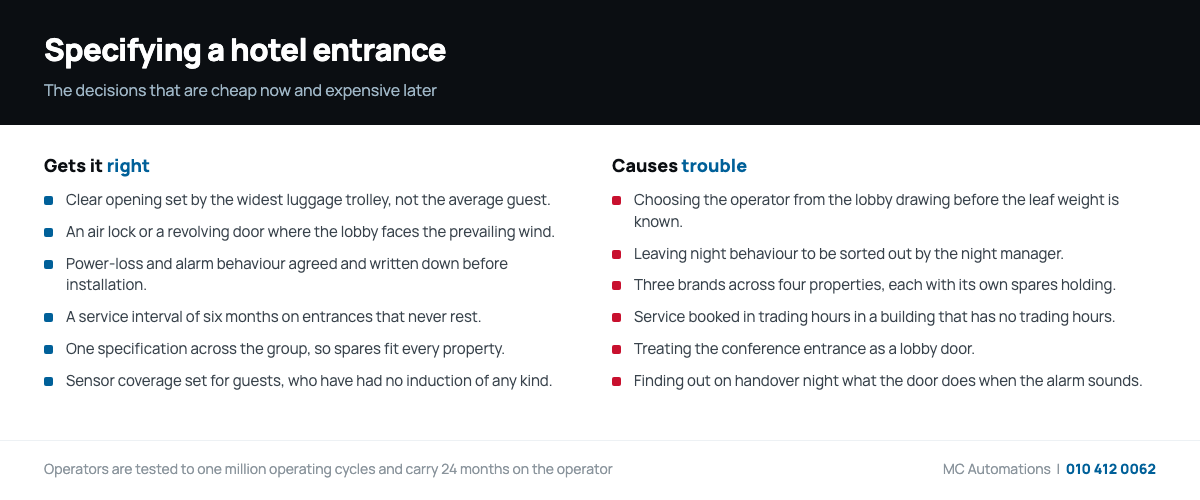
The argument for a single specification across a group is not procurement tidiness. It is that one spares holding covers every property, one training session covers every duty manager, and a technician attending property four already knows what is on the wall. Operators are tested to one million operating cycles and carry 24 months on the operator, and those terms are the same whether the order is one door or forty.
Where a group has inherited a mixed estate, the sensible route is not to rip everything out at once. It is to standardise on replacement: as each entrance comes up for renewal, it goes to the group standard, and within a refurbishment cycle the estate has converged without a capital event.
What we need from you to quote
A hospitality quote comes back quickly and accurately if we have five things: the structural opening width and height, the leaf build and approximate weight, whether the entrance is on an escape route, what the power arrangement is on that property, and a photograph of the existing head detail if there is one.
For a multi-property enquiry, a schedule of hotel automatic doors by property and zone is worth more than a drawing of any one of them. Tell us which are lobby, which are conference, which are back of house, and we will price them as a package rather than as a list.
Our equipment is imported and assembled at our Laser Park premises in Johannesburg, which is where the spares are held, and installation and servicing are carried out by our own teams. You can see recent installations on our projects page, and the wider sector notes on the commercial automatic doors page.
Hotel and leisure groups we work with
Hospitality and leisure groups whose hotel automatic doors we supply and service include Southern Sun, Tsogo Sun, City Lodge Hotels, The Capital Hotel Group, NH Hotels, Peermont Group and Legacy Group, alongside the property funds and facilities managers who hold many of these buildings.
Regulatory requirements for entrances on escape routes derive from the National Building Regulations and the associated standards published by the South African Bureau of Standards. We specify to the fire strategy prepared for your building, and we will say plainly when something falls outside what we can confirm.
Hotel automatic doors: quick answers
What is the best type of automatic door for a hotel lobby?
It depends on whether the lobby needs to hold its conditioned air. Where it does, a revolving door or a two-stage air lock is the better answer because neither opens the lobby fully to the street. Where the architecture will not allow either, a sliding entrance with a reduced opening width outside peak arrival periods is the practical alternative.
How wide should a hotel entrance be?
Wide enough for a loaded bell trolley with a porter walking beside it, not behind it. Measure your own trolley loaded the way your bell desk loads it, across the widest point including handles, then add room to walk alongside. That figure is usually 200 to 300 mm wider than the opening taken from the lobby plan.
What should a hotel automatic door do during load shedding?
Between the mains dropping and the generator carrying the load there is a gap in which the entrance has no drive. During that gap the escape route through it must remain usable by hand, without power and without a key. The exact behaviour is set by the fire strategy for your building and agreed with your fire consultant before installation, not chosen as a product option.
How often should hotel automatic doors be serviced?
Every six months as standard, and more frequently on conference and back-of-house entrances that carry trolleys and cages all day. A hotel entrance never gets a quiet period, so the interval is shorter than it would be on an office building of the same size.
Can you service a hotel entrance without closing it?
Yes. Hospitality service work is done in the overnight window, typically between midnight and five in the morning, and the entrance is left working when the team leaves. Where an entrance has to be taken out of use for longer, we agree a temporary arrangement with the property before the visit rather than on the night.
Do you work on hotel groups with mixed brands of automatic door already installed?
Yes. We service and hold spares for our own equipment and for the major brands already installed across South African hotel estates, so a group with a mixed estate does not need a separate contractor per property. Where a group wants to standardise, the usual route is to convert on replacement rather than in one capital event.
Talk to us about your property or your estate
Tell us whether this is one of your hotel automatic doors or a whole portfolio, which zones are involved, and whether anything is on an escape route. Request a quote for new work or a replacement programme, book a technician if an entrance is down now, or call 010 412 0062 and speak to someone who has been into a hotel plant room.