
Automatic Door Sensor Replacement
Genuine activation and safety sensors, fitted and commissioned on any major brand, with published catalogue prices.
Automatic door sensor replacement is the most common single job on a commercial entrance, and the one most often done twice. A sensor gets swapped, the fault comes back, and the real cause turns out to have been somewhere else entirely.
This page covers what we stock, what the parts cost, and how to tell a genuine sensor failure from the several faults that impersonate one.
Sensors we supply and fit
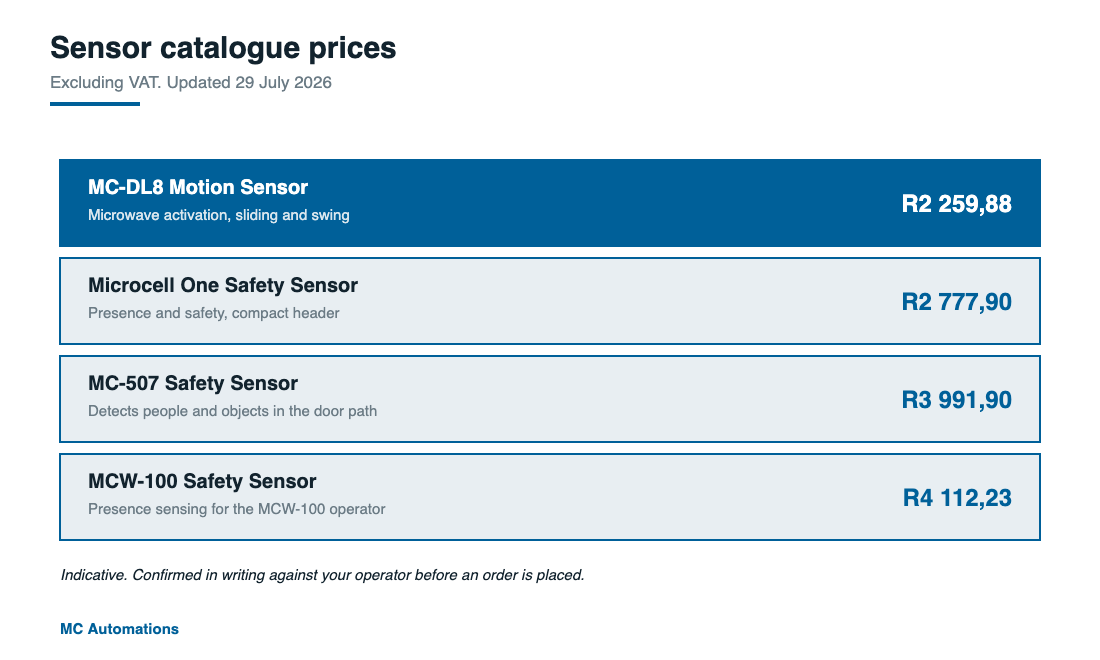
These are the sensors we carry for automatic door sensor replacement. Catalogue pricing was last updated 29 July 2026 and all figures exclude VAT. Prices are indicative and confirmed in writing against your operator before an order is placed.
- MC-DL8 Motion Sensor — R2 259,88 excl VAT. Microwave motion sensor for hands-free activation of automatic sliding and swing doors. This is the activation side: it detects approach and signals the controller to open.
- MC-507 Safety Sensor — R3 991,90 excl VAT. Detects people and objects in the door path to prevent contact. This is the safety side, and it is the one that stops the door closing on somebody.
- MCW-100 Safety Sensor — R4 112,23 excl VAT. Presence sensing matched to the MCW-100 swing door operator.
- Microcell One Safety Sensor — R2 777,90 excl VAT. Presence and safety sensing for automatic doors, where a compact unit suits the header.
Parts are held in Johannesburg and ordered through our sister company’s shop, which is why you will see the same catalogue there. We fit and commission them; the spare parts page covers the wider range.
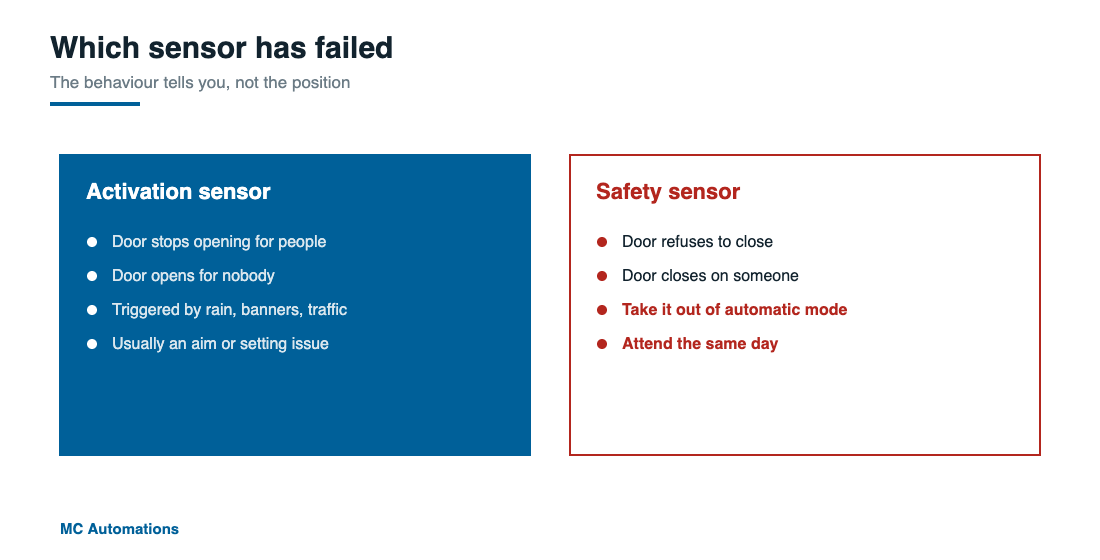
Activation or safety: which one has failed
Getting this right before ordering saves the second visit, because the two do completely different jobs and fail with completely different symptoms.
Activation sensors watch the approach. When one fails, the door stops opening for people, or it opens for nobody. A microwave unit like the MC-DL8 responds to movement, so rain, a flapping banner or traffic passing outside the doorway can all trigger it. An automatic door sensor replacement here is usually prompted by a door that has started opening on its own.
Safety sensors look down into the opening. When one fails, the door either refuses to close, or — far more seriously — closes on someone standing in the leaf path. An entrance doing the second of those should be taken out of automatic mode and attended the same day. This is not an inconvenience fault.
If you are not certain which has gone, describe what the door is doing rather than what you think is broken. The behaviour identifies the sensor far more reliably than the position does.
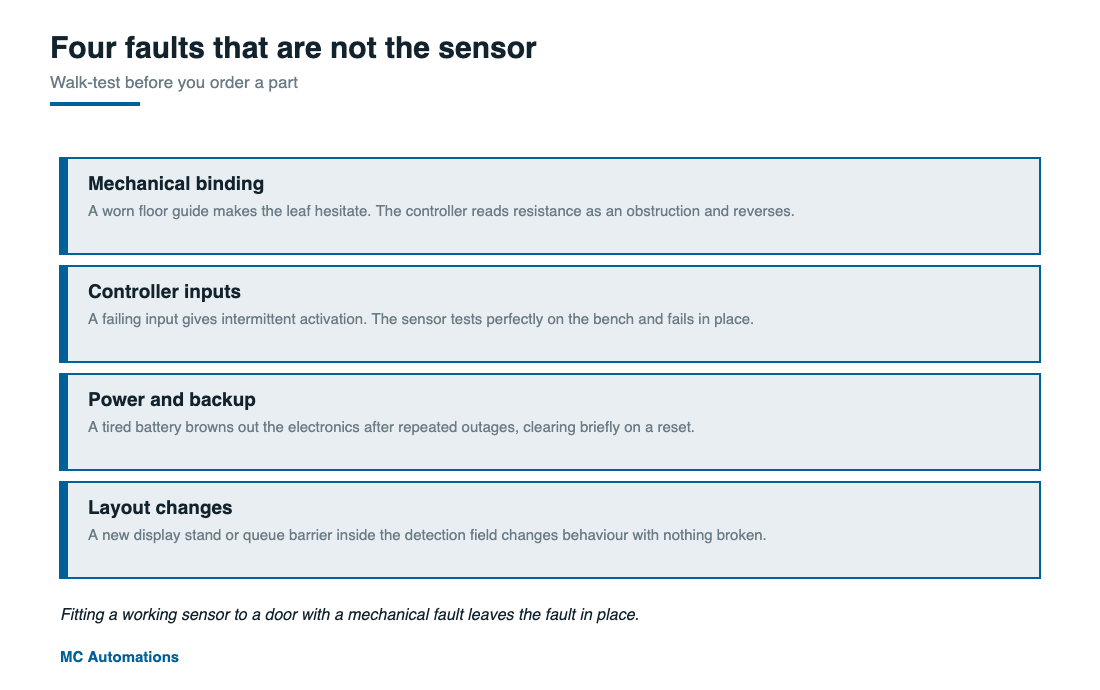
Faults that look like a sensor and are not
A meaningful proportion of automatic door sensor replacement requests turn out to need no new sensor at all. Four causes impersonate a sensor fault convincingly.
- Mechanical binding. A worn floor guide or a gritty track makes the leaf hesitate. The controller reads that resistance as an obstruction and reverses, which looks exactly like a presence sensor holding the door open.
- Controller inputs. A failing input produces intermittent activation that no re-aiming will fix. The sensor tests perfectly on the bench and fails in place.
- Power and battery backup. After repeated outages a tired battery browns out the electronics, giving erratic behaviour that clears briefly on a reset.
- Layout changes. A new display stand, a queue barrier or seasonal stock inside the detection field changes how the entrance behaves without anything having failed.
This is why we walk-test and observe before quoting an automatic door sensor replacement. Fitting a working sensor to a door with a mechanical fault spends money and leaves the fault in place.
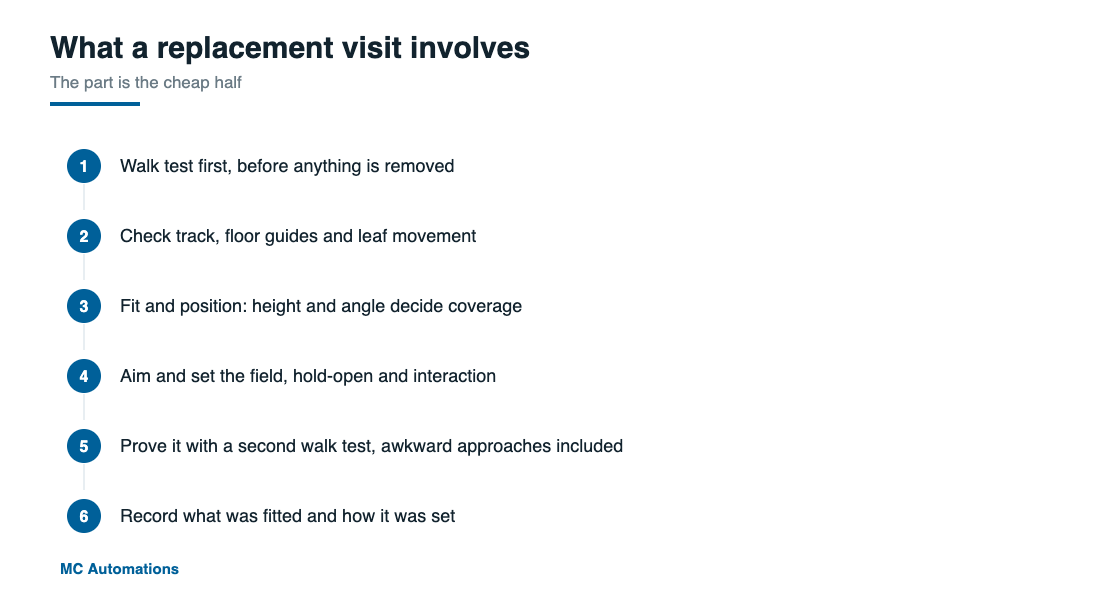
What a replacement visit actually involves
An automatic door sensor replacement is not a parts swap. The sensor has to be positioned, aimed and proven against the real opening, and that is most of the value of the visit.
- Walk test first. We establish what the entrance is actually doing before anything is removed, approaching at different speeds and from different angles.
- Check the mechanics. Track, floor guides and leaf movement, because a binding door produces sensor-shaped symptoms.
- Fit and position. Mounting height and angle decide coverage. The same sensor in two positions gives two different entrances.
- Aim and set. Detection field, hold-open time and the interaction with the activation side, set against the traffic the door actually carries.
- Prove it. A second walk test, including the awkward approaches: slow, oblique, stopping in the opening, pushing something.
- Record it. What was fitted, how it was set and what the coverage looks like, so the next visit starts from a baseline instead of a guess.
Coverage is positioning, not product
Most disappointing automatic door sensor replacement outcomes are positioning problems wearing a product disguise. A correctly specified sensor mounted badly leaves a gap, and the gap is where somebody eventually gets caught.
Three positions cause most trouble. A sensor aimed too far out opens the door for passers-by who never intended to come in, wasting cycles and annoying everyone inside. A sensor aimed too close opens late, so people arrive at a closed door and push it. And a presence field that does not cover the full leaf path leaves a blind spot exactly where the door closes.
Where the entrance is wide, or the approach is oblique, or there is a step or a turn immediately outside, the arrangement matters more than the model. Those are the entrances worth surveying rather than quoting from a photograph.
When replacement is the right answer
Sensors drift before they die, and drift is adjustable. Replacement earns its cost in four situations.
- Physical damage. A cracked lens, a crushed housing or a cable pulled out of a trolley’s way. No adjustment fixes broken.
- Repeated drift. If aim will not hold between service visits, the mounting or the unit is failing rather than the setting being wrong.
- Degraded detection. Age and direct sun both reduce sensitivity. A unit that needs the field opened wider every visit is on its way out.
- Obsolescence. When a sensor cannot be obtained any more, replacing it before it fails beats waiting for a breakdown and a lead time.
Outside those, a service visit with a proper walk test and re-aim usually restores the entrance for a fraction of an automatic door sensor replacement.
Multi-brand, not only our own
We fit and service sensors on any major automatic door brand, not only the operators we supply. Where an entrance was installed by somebody else, the first visit doubles as a condition survey: we record the operator, the sensor layout and the track condition, then say plainly what is serviceable, what is obsolete and what should be replaced before it fails.
That matters for automatic door sensor replacement specifically, because compatibility is decided by the controller rather than by the door. We confirm the correct part against your operator model before anything is ordered, so you are not left with a sensor that fits the header and not the system.
Safety obligations that sit behind all of this
Presence sensing on a powered entrance is a safety function, not a comfort feature. An entrance whose safety sensor has failed is a hazard to the people using it, and that changes the urgency of the response.
Where the doorway sits on an escape route, anything that changes how it behaves is checked against the building’s fire strategy rather than adjusted on the spot. Where accessibility is part of the brief, the activation arrangement and the opening speed belong in the specification and are worth re-checking at any modernisation. Published guidance from the South African Bureau of Standards is a reasonable starting point, but the requirement for a particular entrance is confirmed for that building.
Our warranty terms cover the operator for 24 months. Wear parts and sensors are quoted and warranted separately, and we confirm that in writing before an order is placed.
How each sensor type actually detects
Knowing the detection method explains most of the odd behaviour people report, and it usually tells you whether an automatic door sensor replacement will help.
Microwave units, like the MC-DL8, emit a field and watch for movement within it. They are excellent at catching an approaching person and poor at noticing a stationary one, which is precisely why they are used for activation and never for safety. Because they respond to motion rather than presence, they also respond to rain, moving foliage and vehicles passing outside the doorway. A door that opens for nobody is usually telling you the microwave field reaches somewhere it should not.
Active infrared units emit beams downward and detect what interrupts them. They see a person standing still, which is what makes them the safety technology. They are sensitive to lens contamination and to direct sunlight on the lens, and they lose sensitivity gradually as the emitter ages rather than failing outright.
Combined units carry both functions in one housing, which suits a shallow header where there is no room for two. The trade-off is that a fault in one half means an automatic door sensor replacement for the whole unit.
That difference in failure mode matters commercially. A microwave activation fault is frequently an aim or setting problem; an infrared safety fault that has degraded is genuinely a replacement.
Environments that shorten sensor life
- Direct sun on the lens. A west-facing entrance in a South African summer subjects the optics to conditions no indoor entrance sees. Sensitivity degrades faster.
- Dust and airborne debris. Industrial sites and entrances near construction coat the lens, which reads as reduced detection long before anyone thinks to clean it.
- Vibration. Racking traffic, compressors and heavy doors shift mounting over time, so aim drifts sooner than it would elsewhere.
- Coastal air. Salt attacks housings, fixings and cable glands, and corrosion at the connector is a common cause of intermittent faults.
- Repeated power interruption. Load shedding is harder on electronics than continuous running, and a sensor sharing a failing backup battery behaves erratically without being faulty itself.
None of those change which sensor you should buy. They change how often the entrance should be looked at, and they explain why two identical doors in one building can need very different attention.
Planning replacements instead of reacting to them
On a portfolio of entrances, an unplanned automatic door sensor replacement is the expensive kind: attended at short notice, usually at the worst trading moment, often with the entrance coned off while it waits.
The alternative is to record sensor condition at each service visit rather than only when something fails. A unit whose field has needed widening at consecutive visits is telling you it is on the way out, and replacing it on a planned visit costs a fraction of attending an emergency. Where the same model appears across several sites, holding one spare turns a two-day wait into a same-visit fix.
That is also the argument for keeping a written record. Two call-outs on the same entrance in a season is information; without a log it reads as bad luck.
A short glossary
- Activation sensor. Detects approach and signals the controller to open. The MC-DL8 is one.
- Presence or safety sensor. Detects a person or object in the leaf path and stops the door closing.
- Detection field. The area a sensor actually covers, set by mounting position and aim rather than by the model.
- Walk test. Approaching the entrance deliberately at different speeds and angles to prove coverage.
- Hold-open time. How long the door stays open after activation clears.
- Controller. The unit the sensors report to. It decides compatibility for any automatic door sensor replacement.
Availability and lead time
Sensors are held in Johannesburg, which is the practical difference between an automatic door sensor replacement completed on the visit and one that waits on a delivery.
Where the part is in stock and the operator model is confirmed in advance, the work is normally a single attendance: diagnose, fit, aim and prove. Where the model has to be identified on site first, expect two visits unless you can send us the header label beforehand. That one photograph is the single biggest thing you can do to compress the timeline on an automatic door sensor replacement.
For entrances that cannot be out of service, say so when you book. We will bring the likely part rather than diagnosing first and ordering afterwards, and where an entrance is genuinely critical we will discuss holding a spare on your behalf so the next automatic door sensor replacement is same-visit by default.
What to send us so the right part arrives first time
Four things prevent a wasted visit and a second order.
- The operator make and model, from the label inside the header if you can reach it safely.
- A photograph of the header and of the sensor currently fitted.
- What the door is doing, described as behaviour: opening for nobody, refusing to close, closing on people, opening late.
- Whether the entrance is on an escape route, and whether it must stay usable during the visit.
From that we confirm compatibility against your operator, quote the correct part, and tell you whether an automatic door sensor replacement is actually what the entrance needs.
Quick answers on automatic door sensor replacement
- Automatic door sensor replacement starts at R2 259,88 excl VAT for the MC-DL8 motion sensor.
- Automatic door sensor replacement for safety sensing runs from R2 777,90 to R4 112,23 excl VAT depending on the unit.
- Automatic door sensor replacement prices are indicative and confirmed in writing against your operator before order.
- Automatic door sensor replacement is done on any major brand, not only operators we supplied.
- Automatic door sensor replacement includes positioning, aiming and a proving walk test, not just the part.
- Automatic door sensor replacement is often unnecessary: binding tracks and controller inputs mimic sensor faults.
- Automatic door sensor replacement is urgent when a door closes on people, because that is a safety failure.
- Automatic door sensor replacement compatibility is decided by the controller, not by the door leaf.
- Automatic door sensor replacement on an escape route is checked against the building’s fire strategy.
- Automatic door sensor replacement is warranted separately from the 24-month operator warranty.
- Automatic door sensor replacement outcomes depend more on mounting position than on the model chosen.
- Automatic door sensor replacement parts are held in Johannesburg and fitted nationwide.
Frequently asked questions
How much does an automatic door sensor cost?
The MC-DL8 motion sensor is R2 259,88 excluding VAT. Safety sensors run from R2 777,90 for the Microcell One to R3 991,90 for the MC-507 and R4 112,23 for the MCW-100 unit. Catalogue pricing was last updated 29 July 2026 and is confirmed in writing against your operator before an order.
Can you replace sensors on another brand of door?
Yes. We fit and service sensors on any major automatic door brand. Compatibility is confirmed against your controller model before anything is ordered, because the controller decides what will work rather than the door itself.
My door opens when nobody is there. Which sensor is it?
Almost always the activation sensor. A microwave unit responds to movement, so rain, a banner moving in the wind or traffic passing the doorway can trigger it. That is frequently an aim or setting issue rather than a failure.
My door closed on somebody. What should I do?
Take the entrance out of automatic mode and have it attended the same day. A presence-sensing failure is a safety fault, not an inconvenience, and the door should not stay in service until it has been proven.
Do I need a new sensor or just an adjustment?
Often just an adjustment. Sensors drift before they fail, and a walk test plus a re-aim restores most entrances. Replacement earns its cost where there is physical damage, repeated drift that will not hold, degraded detection or an obsolete unit.
Is the sensor covered by the operator warranty?
No. Our warranty is 24 months on the operator. Wear parts and sensors are quoted and warranted separately, and that is confirmed in writing before an order is placed.
Book a sensor visit
Tell us the operator model and what the door is doing, and we will confirm the correct part and whether it is the part you actually need. Request a technician, book a service visit, or call 010 412 0062. The wider background is covered in our guide to automatic door sensors.
In short
Automatic door sensor replacement at a glance
- Motion sensor from R2 259,88; safety sensors R2 777,90 to R4 112,23, all excluding VAT.
- Activation opens the door; presence sensing stops it closing on people. Different faults, different parts.
- Binding tracks and controller inputs impersonate sensor faults. Walk test before ordering.
- Any major brand; compatibility confirmed against your controller first.
- Positioning and aim decide the outcome more than the model does.