
Office park automatic doors for landlords and managing agents: who owns which entrance, the access states a working week needs, the morning peak that sizes the lobby, standardising across an estate, and why maintenance recovery changes the contract.
Automatic Door Sensors: Motion vs Presence
Almost every automatic door has two kinds of automatic door sensors doing two completely different jobs, and confusing them is the single most common reason a door misbehaves — or hurts somebody.
One opens the door. The other stops it closing on you. If you understand nothing else about automatic door sensors, understand that.
Motion automatic door sensors open the door
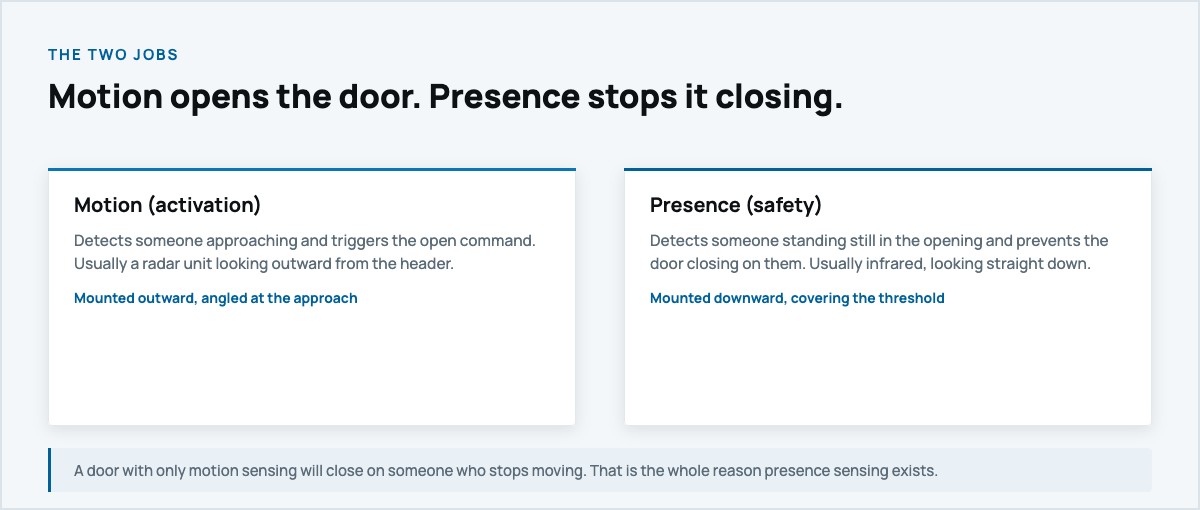
The motion sensor — the activation sensor — is the one people think of. It sits in the header looking outward at the approach, and when it sees movement it issues the open command. Most are microwave radar, which is why they see through rain but can also be triggered by a plastic bag blowing past.
Motion sensing has one blind spot that matters enormously: it only detects things that move. Stand still in the opening and, as far as an activation sensor is concerned, you have ceased to exist.
Presence sensors stop it closing
That blind spot is precisely why the second family of automatic door sensors exists. A presence sensor looks straight down at the threshold and detects that something is there, moving or not. While it sees you, the door will not close.
This is the safety device. A door running on activation sensing alone will eventually close on a person who paused to answer their phone, and that is not a fault you discover gradually — you discover it the day someone is hurt.
Why the two fields overlap
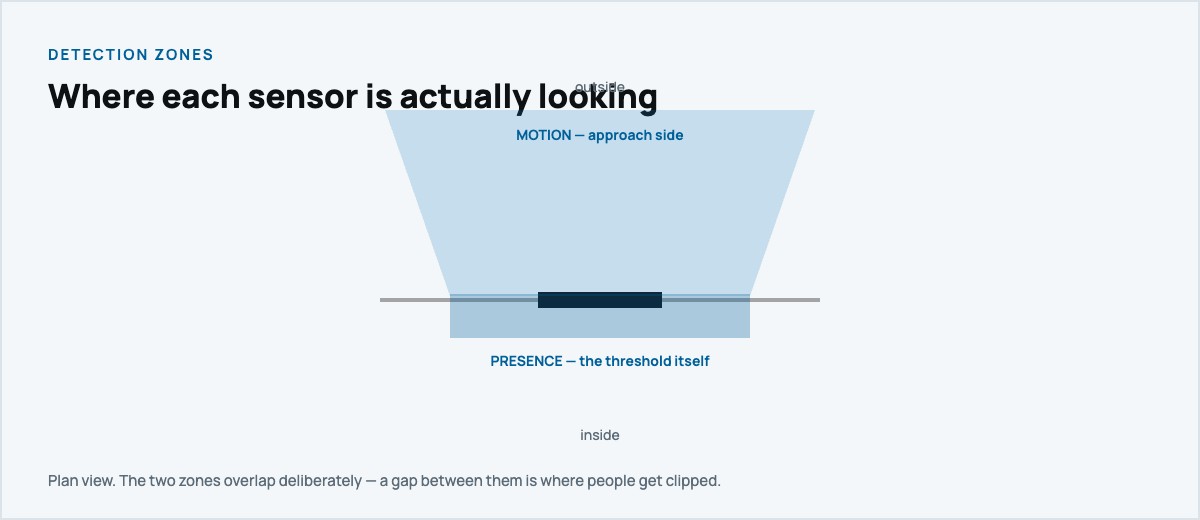
Look at the plan view above and note that the zones are not neatly divided. They overlap across the threshold deliberately. If the activation field stops before the presence field starts, there is a strip of floor where a slow-moving person is invisible to both automatic door sensors at once. Commissioning is largely the work of making sure that strip does not exist.
This is also why sensors are not a DIY adjustment. Nudging a radar head to stop nuisance opening can quietly open a gap in the safety coverage at the same time.
Reading the symptoms
Most faults announce which sensor is responsible, if you know what to listen for.
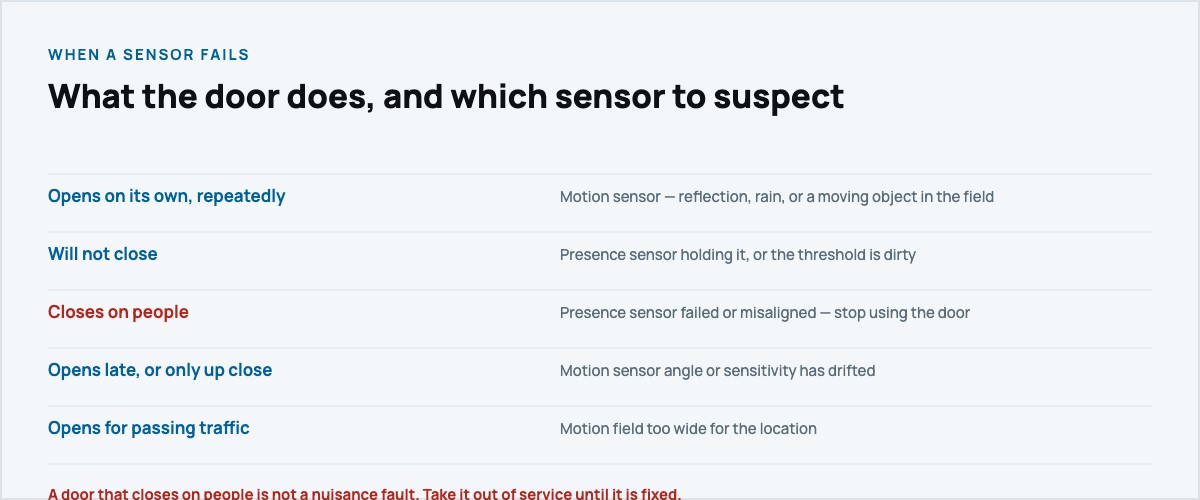
Two of these deserve emphasis. A door that opens on its own repeatedly is usually a motion sensor seeing a reflection, moving rain, or traffic passing outside — irritating and expensive in conditioned air, but not dangerous.
A door that closes on people is a different category entirely. Take it out of service. A failed or misaligned presence sensor is not something to leave until month-end, and any competent technician will treat it as an emergency.
Where automatic door sensors sit in the wider system
Automatic door sensors are one input among several. The same entrance may also take a command from a push plate, a reception release, or a card reader — see automatic door access control for how those integrate. Crucially, none of them override the presence sensor. Being granted access does not make the opening safe; the safety sensing keeps control of the threshold regardless of who was let in.
On our own operators, the MC-125 and MCW-100, activation and safety devices are commissioned together and tested as a set before handover.
Keeping them working
Automatic door sensors drift. Vibration moves them, cleaning knocks them, dust and cobwebs sit in front of them, and sunlight angles change with the season. This is a large part of why planned maintenance intervals exist — a sensor check is quick, and it is the difference between a door that works and a door that is quietly unsafe.
Older entrances are worth a specific mention. Safety expectations have moved on, and an aged presence sensor can pass a functional test while still leaving a gap a modern unit would cover. That is the most common reason we recommend upgrading automatic door sensors rather than repairing them again. Requirements for powered pedestrian doors in South Africa are published through SABS.
Automatic door sensors on an escape route
Sensors and escape-route duty are separate requirements, and it is worth not confusing them.
Automatic door sensors keep people safe while the entrance is powered and working. They do nothing at all once the power is gone.
That is why an opening on a fire escape route must also be passable without power, through break-out panels or a fail-safe release. No sensor package substitutes for that.
If you are not certain which arrangement your entrance has, establish it now rather than during an evacuation. It is a specification detail that is easy to confirm and impossible to improvise.
A reasonable maintenance routine
Wipe the lenses with a soft cloth, never a solvent, as often as the environment demands. Weekly in a butchery or forecourt, monthly in a dry office.
Walk-test the full opening afterwards, including the edges.
Re-check coverage after any change to the area around the entrance, because that is what most often puts a working installation out of adjustment.
If your door is behaving oddly
Tell us what it is doing rather than what you think is wrong — “opens but will not close” and “closes but reopens immediately” point at completely different automatic door sensors, and saying which one usually means the technician arrives with the right part.
Report a fault, or request a quote for a sensor upgrade.
The two jobs automatic door sensors do
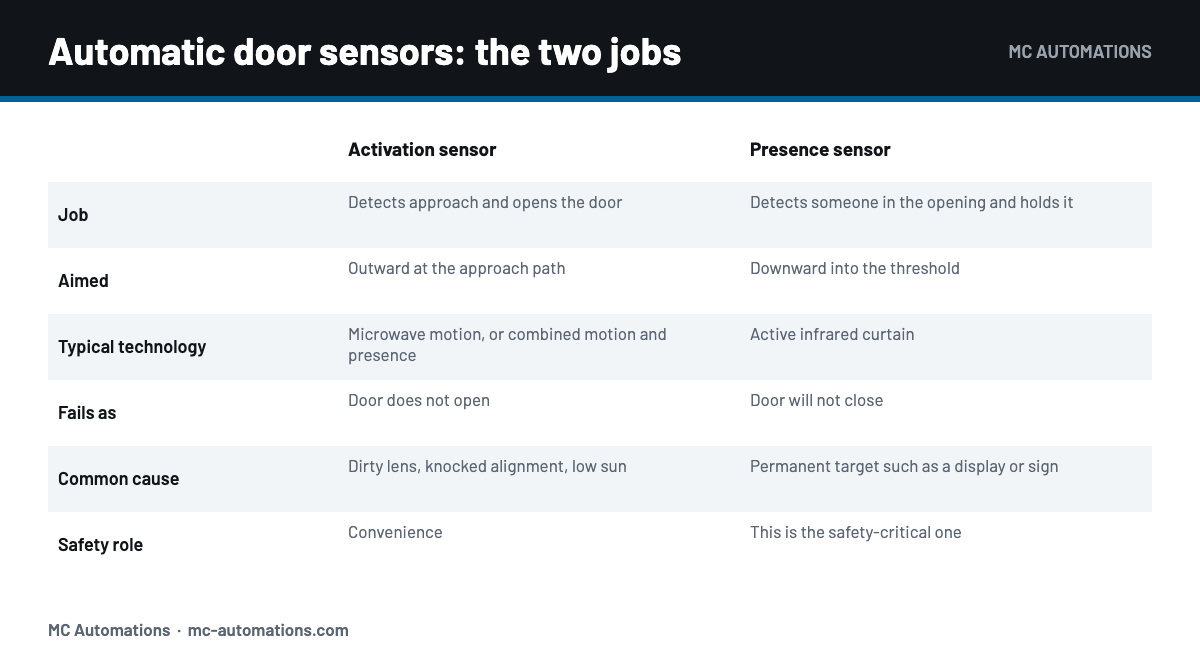
Almost every fault we attend traces back to confusing these two, so it is worth being precise.
The activation sensor is aimed outward at the approach. Its job is convenience: see someone coming and open in time that they never break stride.
The presence sensor is aimed downward into the threshold. Its job is safety: detect a person standing in the opening and refuse to let the door close on them.
They fail in opposite directions, which is the useful diagnostic. A failed activation sensor gives you a door that will not open. A failed or confused presence sensor gives you a door that will not close.
How each technology actually works
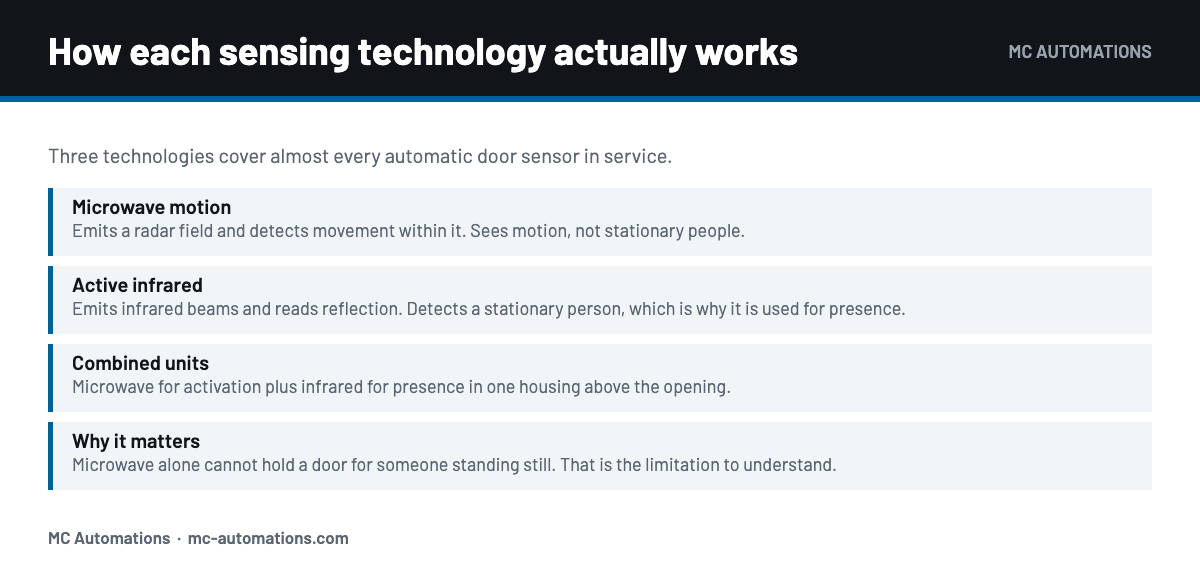
Microwave motion sensing emits a radar field and reports movement within it. It is excellent at seeing someone walking towards the door and blind to someone standing still.
Active infrared emits beams and reads what comes back. Because it detects a stationary object, it is what presence sensing is built on.
Combined units put microwave activation and infrared presence in a single housing above the opening, which is the common arrangement on commercial sliding entrances.
The limitation worth remembering: microwave alone cannot hold a door for a person who has stopped. Any specification offering activation sensing only has left out the safety layer.
Walk-testing automatic door sensors
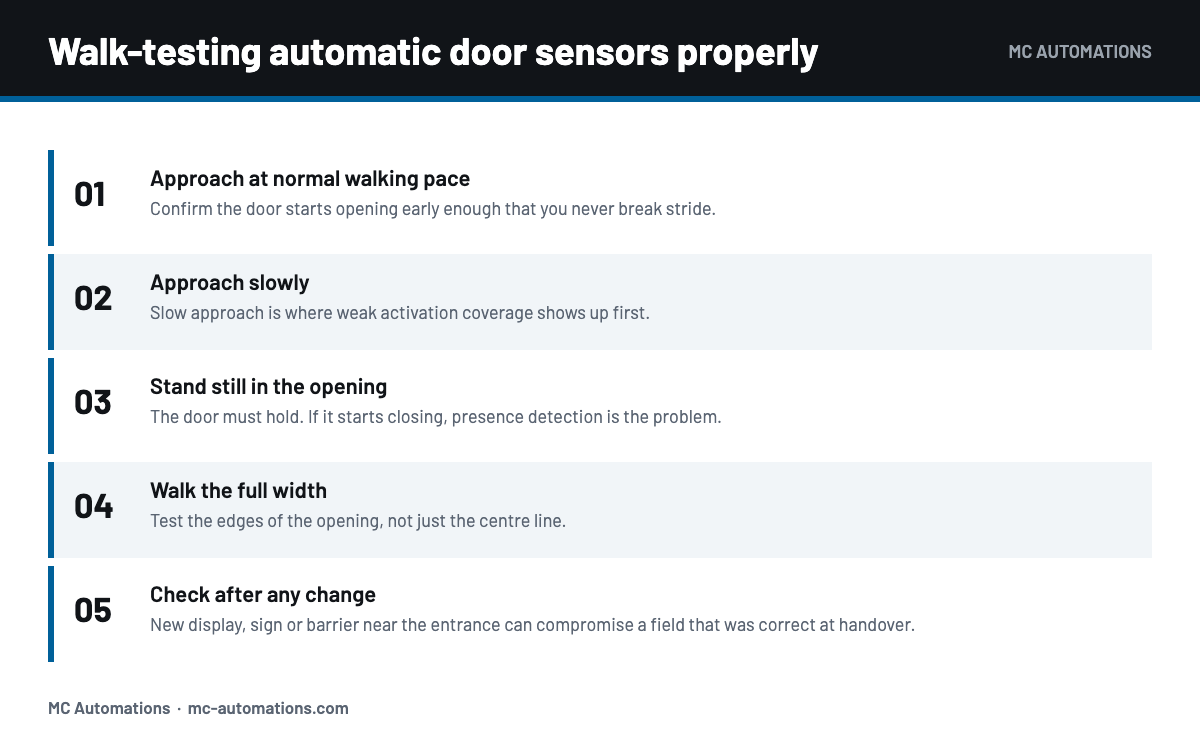
A walk-test takes about a minute and finds most developing faults weeks before they become failures.
Approach at normal pace. The door should start opening early enough that you never slow down.
Then approach slowly, because weak activation coverage shows up on a slow approach first.
Then stand still in the opening. The door must hold. If it begins to close on you, the presence detection is the problem and it is a safety issue rather than an inconvenience.
Then walk the full width, including the edges. Testing only the centre line is how half an opening goes unchecked for years.
Why automatic door sensors drift
Sensors rarely fail outright. They drift, and the drift is almost always environmental.
Dust film, insect nests and cleaning residue on a lens all read as a permanent target. Condensation in chilled areas does exactly the same thing. In butcheries and kitchens, airborne fat films optics faster than dust does.
Physical knocks change alignment, often from a trolley or a ladder rather than anything dramatic.
And shopfitting changes the field. A display stand, a seasonal promotion or a queue barrier placed into a detection zone turns a correctly commissioned entrance into a nuisance one. That is a setting problem, not a fault.
See automatic doors for business for how this plays out in butcheries, forecourts and cold rooms specifically.
What good sensor coverage looks like
Presence detection across the full opening width, not a single beam at the approach.
Activation range set so the door opens early enough for someone walking briskly, without triggering on passing traffic.
Fields re-checked whenever the area around the entrance changes, and cleaned at every service.
And obstacle detection behind both of them as the final layer: a panel that meets resistance should stop and reopen rather than push through.
When a sensor genuinely needs replacing
Clean and re-align first. That resolves the large majority.
Replace when the housing is physically damaged, when water has entered and corroded the board, or when the unit is obsolete and cannot be configured to the coverage the opening needs.
Sensors are generally configurable to most automatic door brands, so a sensor fault rarely forces a whole-entrance decision. See automatic door spare parts.
Related guides
Automatic door sensor not working covers fault-finding in detail. Automatic door not opening and automatic door not closing cover the two symptoms sensors most often cause.
Automatic door sensors, answered
How do automatic door sensors work?
An activation sensor watches the approach and signals the controller to open. A presence sensor looks down into the opening and holds the door while somebody is standing in it. Most entrances use both.
What is the difference between motion and presence sensors?
Motion sensing, usually microwave, detects movement. Presence sensing, usually active infrared, detects a stationary person. Motion alone cannot hold a door for someone who has stopped walking.
Why does my automatic door open on its own?
Something is moving or sitting inside the activation field. Traffic outside, a hanging sign, or a display that shifts in a draught will all trigger it.
Why does my automatic door stay open?
A presence sensor reading a permanent target. A new display stand, a queue barrier or a poster placed in its field is the usual cause.
Can automatic door sensors be adjusted?
Yes. Field width, depth and sensitivity are all adjustable, and they need re-checking whenever the area around the entrance changes.
Why do automatic door sensors fail in winter sun?
Low sun straight into the optics swamps the receiver. A hood or a few degrees of downward tilt usually fixes it.
How often should sensors be cleaned?
At every service, and more often in butcheries, forecourts and cold rooms where fat, dust or condensation films the lens quickly.
Should I ever disable a faulty sensor?
No. Taping over a safety beam to keep an entrance running removes the protection the sensor exists to provide. Isolate the operator instead.
Do automatic door sensors work on other manufacturers doors?
Sensors are generally configurable to most automatic door brands. We service and supply sensors for equipment we did not install.
How do I test my automatic door sensors?
Approach at normal pace, then slowly, then stand still in the opening, then walk the full width including the edges. The door should open early and hold while you stand.
In short
Faults blamed on sensors that are not sensor faults
A good proportion of call-outs booked as a sensor problem turn out to be something else entirely. The symptom points at the sensor because that is the visible part, but the cause sits elsewhere.
- Mechanical binding. A worn floor guide or a gritty track makes the leaf hesitate. The controller reads the resistance as an obstruction and reverses, which looks exactly like a presence sensor holding the door.
- Controller inputs. A failing input on the controller produces intermittent activation that no amount of re-aiming will fix. The sensor tests fine on the bench and fails in place.
- Power and backup. After repeated outages a tired battery can brown out the electronics, producing erratic behaviour that resolves briefly on a reset.
- Layout changes. A new display stand, a queue barrier or a seasonal promotion inside the detection field will change how the entrance behaves without anything having failed at all.
This is why the first step is a walk test and an observation, not a parts order. Replacing working automatic door sensors because the door misbehaved is the most common way to spend money and still have the fault.
Hands-free activation and accessibility
Not every entrance should open for everyone who walks past, and not every user can operate a push plate at waist height. This is where the sensor arrangement stops being a technical detail and becomes an accessibility decision.
Hands-free activation means the entrance opens without anyone touching it. On a normal automatic entrance that is exactly what the motion sensor already does. The phrase usually comes up for doors that are not normally automatic: a swing leaf on a corridor, a washroom lobby, a ward door, where the brief is to remove the pull handle rather than to speed up traffic. There the answer is an operator with a low-energy setting and an activation device chosen for who will actually use it.
Push plates and touchless plates sit alongside the sensors rather than replacing them. A wall-mounted plate gives deliberate activation, which matters where the door should stay shut unless somebody genuinely wants through. A touchless plate does the same job without contact, which is why they became common in healthcare. Mounting height and position decide whether they work for a wheelchair user or a person pushing a trolley, and that is a survey question, not a catalogue one.
Low-energy operation is the other half. A door set to low-energy opens more slowly and with less force, which suits an entrance used by people who need longer to pass. It is a different setting from full-power operation and it is chosen deliberately at commissioning, not left on a default.
Where accessibility is part of the brief, the activation height, the opening speed and the hold-open time belong in the specification and should be re-checked at any modernisation rather than carried forward unexamined. A sensor arrangement that was right for the building five years ago may not match how the entrance is used today. Our guide to automatic doors for disabled access covers the wider requirement.
When to stop adjusting and call a technician
Most automatic door sensors problems are a drift, not a failure, and a walk-test plus a re-aim fixes them. There are four situations where that is not the right answer and the entrance should be attended.
- The door closes on people or objects. Stop using it in automatic mode and get it attended the same day. A presence-sensing failure is a safety fault, not an inconvenience.
- The fault returns within weeks of every adjustment. Repeated drift usually means a mounting, a lens or a controller input that is failing rather than a setting that is wrong.
- The entrance sits on an escape route. Anything that changes how the door behaves there is checked against the building’s fire strategy, not adjusted on the spot.
- Nobody can find the walk-test record. If it has never been documented, the entrance needs a proper baseline before anyone starts changing values.
We attend automatic door sensor replacement on any major brand, not only the operators we supply, and the first visit doubles as a condition survey: we record the sensor layout, the aim and the coverage, then say what is serviceable and what should be replaced before it fails. Request a technician, book a service visit, or call 010 412 0062.
Automatic door sensors at a glance
- Automatic door sensors are quoted against the opening we measured, not a catalogue price.
- Ask about automatic door sensors and we confirm the opening, the head and the power position first.
- Automatic door sensors are installed and commissioned by our own technicians.

This Post Has 3 Comments
Comments are closed.
[…] the sensors for the job. Activation and safety sensing are different functions. Choosing a sensor arrangement that suits the traffic pattern reduces […]
[…] automation sensors and motion sensors for sliding doors are the same components discussed on our sensors guide: one type detects approach, the other watches the […]
[…] are covered in depth in automatic door sensors: motion vs presence, and replacement costs are published on our sensor replacement […]