
Office park automatic doors for landlords and managing agents: who owns which entrance, the access states a working week needs, the morning peak that sizes the lobby, standardising across an estate, and why maintenance recovery changes the contract.
Automatic Door Sensor Not Working: What to Check
An automatic door sensor not working is usually dirty, misaligned or looking at something it should not be. Genuine sensor failures happen, but they are the minority. Before a part is ordered it is worth knowing which of the two sensors is involved, because they fail in opposite directions and the symptoms point straight at the answer.
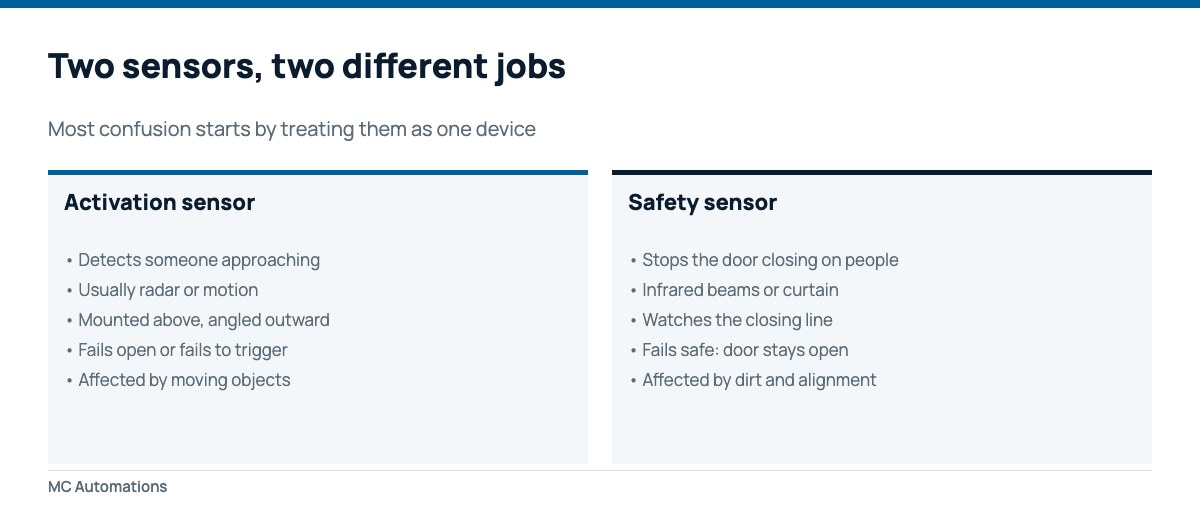
Two sensors, two opposite failures
An entrance has an activation sensor that opens the door and a safety sensor that stops it closing on somebody. An automatic door sensor not working means very different things depending on which one it is.
When an activation sensor fails, the door stops opening. When a safety sensor fails, the door stops closing — it holds open, because failing safe is the designed behaviour. A door stuck open is not proof of a broken motor; it is usually a safety device doing exactly what it should.
What actually goes wrong
Dirt is first. Sensor faces collect dust, insects and fingerprints, and a smeared lens reads movement that is not there. Cleaning solves a surprising share of call-outs logged as an automatic door sensor not working.
Alignment is second. A knock from a trolley or a ladder shifts the bracket a few degrees, and the detection field moves off the opening. Nothing looks broken, but the coverage is wrong.
Environment is third. A polished or wet floor reflects an infrared beam, and rain on a sensor face scatters it. If the fault is weather-linked or time-linked, that is a genuine diagnostic clue.
What you can check without tools
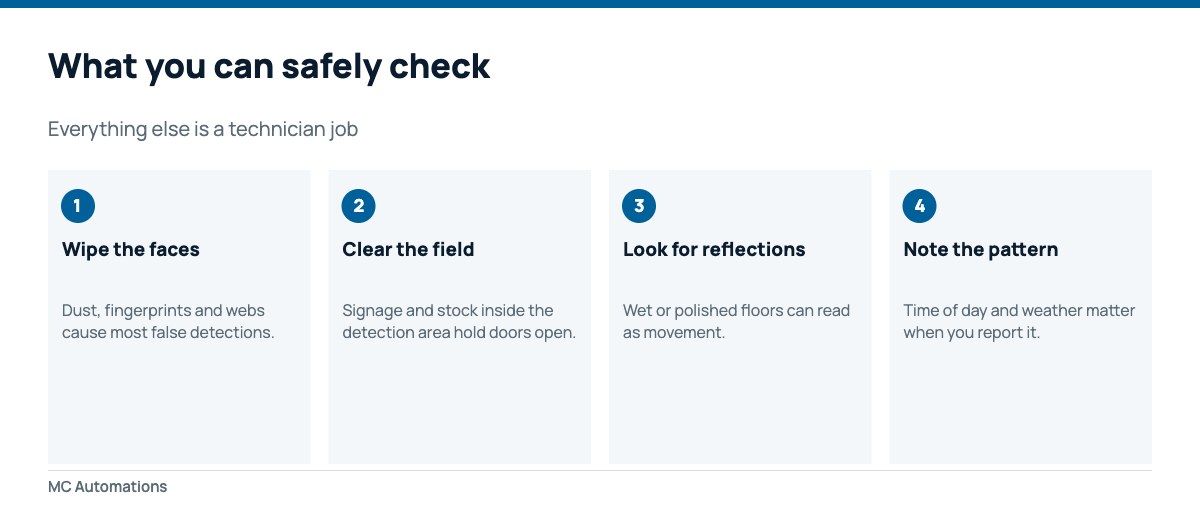
Wipe the sensor faces with a dry cloth. Clear stock, signage and bins out of the detection field. Look at the floor in front of the door for standing water or a new polished finish. Note whether the problem is constant or tied to a time of day.
That is the safe limit. Adjusting sensitivity, angle or detection pattern is not a user setting. A safety sensor turned down until the door closes again is no longer a safety sensor.
Why sensitivity is not the fix
It is tempting to reduce sensitivity when a door keeps reopening. That converts a nuisance into a risk, because the device is there to stop a closing leaf meeting a person. Requirements for powered pedestrian doors in South Africa are published through SABS, and safety devices are tested against the requirement stated for the building.
If an automatic door sensor not working turns out to be a failed unit, it is replaced and commissioned, not tuned around.
When to call
Call when cleaning and clearing have not fixed it, when the fault is intermittent, or when the door is on an escape route. We carry sensors for our own operators and service other brands as well — see automatic door repairs and spare parts.
How the two sensor families actually detect
Activation sensors are usually microwave radar, which senses motion, or active infrared, which senses presence. Radar is excellent at catching somebody walking in and poor at noticing somebody standing still, which is why a door can close on a person who has stopped to answer a phone. Infrared presence detection covers that gap.
Safety sensors on the closing line are a different technology again: a curtain of infrared beams across the opening, or a sensor built into the leaf edge. They are designed to fail safe, holding the door open when in doubt, and that is why a fault so often presents as a door that will not close rather than one that will not open.
Knowing which family is involved narrows the diagnosis immediately. An automatic door sensor not working on the activation side strands people outside; on the safety side it strands the door open.
Why reflective floors cause so much trouble
Polished porcelain, wet tile and new epoxy all bounce infrared. A beam intended to cross the opening reflects off the floor and back into the receiver, and the sensor reports an obstruction that does not exist. The door then holds open, and it is logged as an automatic door sensor not working.
This is why the fault so often appears after a refurbishment or a deep clean rather than after a component failure. Nothing broke; the environment changed underneath a device that was commissioned for the old one.
The correct response is recommissioning, not replacement. Angle, height and sensitivity are set against the floor that is actually there.
Sunlight, heaters and moving objects
Infrared devices can be confused by strong sunlight at a low angle, which is why a west-facing entrance may misbehave only in the late afternoon. Radiant heaters above a door produce a similar effect, and so does steam from a nearby kitchen.
Movement inside the detection field is the other classic. Hanging signage, a ceiling fan, a rotating display or a plastic strip curtain will all be read as a person approaching, and the door cycles endlessly or refuses to close. None of that is an automatic door sensor not working in the sense of a failed part.
What a technician measures that you cannot
Testing goes beyond watching the door. The detection field is walked from several angles to confirm coverage, the safety curtain is obstructed deliberately at different heights to confirm response, and the hold-open and reopen behaviour is timed.
Sensitivity and pattern are then set for the opening rather than left at factory defaults, and the result is recorded. Where an automatic door sensor not working turns out to be a genuine failure, the replacement is commissioned the same way rather than simply plugged in.
Requirements for powered pedestrian doors in South Africa are published through SABS, and safety devices are tested against the requirement stated for the building.
Replacement, compatibility and lead time
Sensors are frequently a different make from the operator, because installers fit what they stock. That matters when a unit fails, since a like-for-like replacement may be discontinued while a modern equivalent needs different wiring or a controller setting changed.
This is where availability decides downtime. We hold common activation and safety devices for the operators we assemble, and we fit equivalents on other manufacturers’ equipment where the original is obsolete. A building with an automatic door sensor not working on a trading day cares far more about that than about the unit price.
When the sensor is innocent
Two faults masquerade as sensor problems. The first is a control board that has lost an input, so a perfectly good sensor reports correctly and nothing happens. The second is a power supply issue, where the sensor works intermittently as voltage sags.
Both are diagnosed by substituting a known-good device or by reading the controller, which is why replacing a sensor on suspicion is an expensive way to test a theory. An automatic door sensor not working is a symptom, and the cheapest visit is the one that confirms the cause before ordering anything.
A sensible order of elimination
Work from cheapest to most expensive. Clean the faces, clear the field, check the floor for reflection, then observe across a full day to establish whether the fault is constant or environmental. Only then is it worth opening a housing.
That order matters because each step rules out a whole class of cause. An automatic door sensor not working that survives cleaning and clearing is genuinely worth a technician; one that does not survive them was never a component failure.
Keep a short note of what you tried and what happened. It is surprising how often the same door is reported three times by three people, each starting from scratch.
Intermittent faults and why they are expensive
A device that fails constantly is cheap to diagnose because it fails while the technician is standing there. An automatic door sensor not working intermittently can pass every test on site and resume misbehaving an hour after the van leaves.
The way to shorten that is evidence. Time of day, weather, whether the shop was busy, whether a delivery had just arrived. A pattern turns a second visit into a targeted one, and it is the difference between replacing a component and understanding a cause.
What good looks like after a repair
After a sensor is replaced or realigned, the door should open before anyone reaches it, stay open while somebody stands in the opening, close smoothly once clear, and reopen immediately if the closing line is obstructed. All four are checked, not assumed.
Ask for that confirmation in writing. A visit that ends with an automatic door sensor not working being declared fixed, with no record of what was tested, is a visit you cannot rely on when it recurs.
Keeping sensors working for longer
Sensors fail early for predictable reasons: they are cleaned with the wrong product, knocked by ladders and trolleys, or mounted where signage is later hung in front of them. None of those is a manufacturing defect and all are avoidable.
Agree who wipes the faces and with what. A dry cloth is correct; solvent cleaners craze some lenses and leave a haze that scatters infrared permanently. That single instruction prevents a share of the cases where an automatic door sensor not working is reported.
Protect the mounting. Where trolleys or pallet jacks pass close to a jamb, a simple guard costs less than the repeated realignment it prevents, and it removes the most common mechanical cause of drift.
Commissioning versus installation
Fitting a sensor and commissioning one are different jobs. Fitting puts it on the bracket and wires it. Commissioning sets the detection field for the actual opening, the actual floor and the actual traffic, then proves it by walking the field and obstructing the closing line.
A large share of cases reported as an automatic door sensor not working are devices that were fitted but never properly commissioned. They work in the middle of the opening and not at the edges, or they cover the approach but not somebody standing still.
This is also why a replacement device should never be plugged in and left. The new unit is commissioned the same way the original should have been.
Cost of guessing
Replacing a device on suspicion is the most expensive way to diagnose an automatic door sensor not working. The part is bought, fitted, and the fault returns a week later because the cause was a reflective floor or a knocked bracket rather than the sensor itself.
A diagnostic visit that ends without a part fitted is not a wasted visit. It is the visit that stopped you buying the wrong thing, and it leaves a written baseline for the next one.
Getting it right at handover
Ask, at handover, for the detection pattern to be demonstrated: somebody walks the field from each side, stands still in the opening, and obstructs the closing line. If all three behave correctly you have a commissioned entrance rather than an installed one.
Most later reports of an automatic door sensor not working trace back to that demonstration never happening.
Automatic door sensor not working, answered
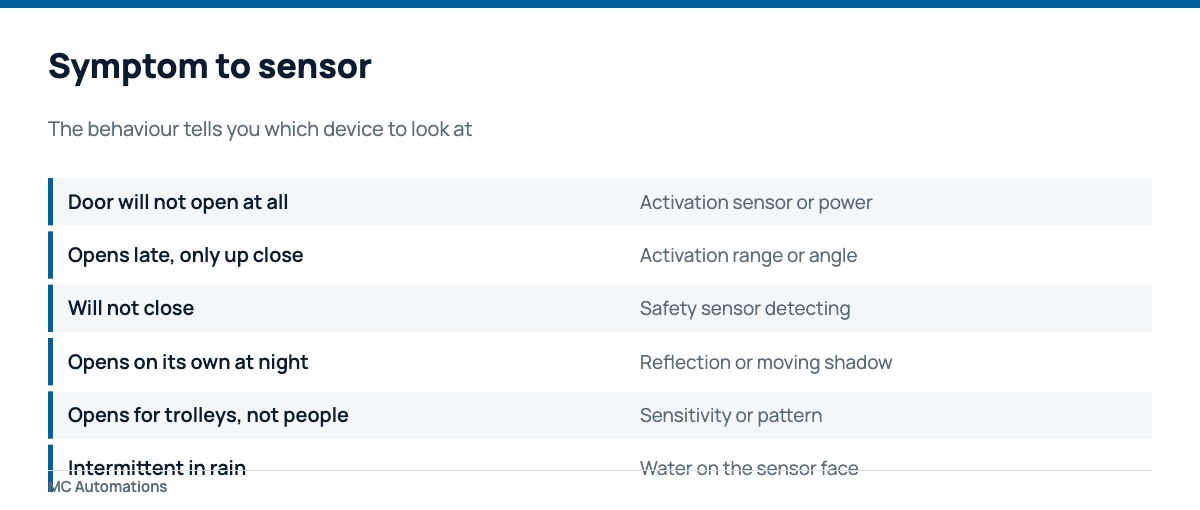
Why does my door open by itself at night?
Usually a reflection on a wet or polished floor, or a moving object such as a fan or hanging sign inside the detection field.
Can I clean the sensor myself?
Yes, a dry cloth on the face is fine. Do not open the housing or move the bracket.
Why does the door open for trolleys but not people?
Detection pattern and sensitivity. That is an adjustment a technician makes, not a fault in itself.
Is a door stuck open a sensor fault?
Often, and usually the safety sensor. It fails safe, so holding open is the designed response.
Do you replace sensors on other brands?
Yes. We service all major automatic door brands, not only our own equipment.
How long does a sensor replacement take?
Usually a single visit, provided the part is a type we hold or can match.
Automatic door sensor not working checklist
Run these before logging a call. They cost nothing and resolve a large share of cases where an automatic door sensor not working is reported.
- Wipe both sensor faces. Dirt is the most common reason an automatic door sensor not working is reported.
- Clear the detection field. Stock, bins and A-frames sit inside it more often than people expect.
- Check the floor. Water and polish reflect beams and cause phantom detection.
- Note the timing. Constant, intermittent or weather-linked changes the diagnosis.
- Leave settings alone. Sensitivity and alignment are safety settings, not preferences.
If an automatic door sensor not working survives those checks, it needs testing on site. Tell us the door, the symptom and the pattern — automatic door servicing covers what a visit includes, or request a quote.
Automatic door sensor not working: quick answers
- An automatic door sensor not working intermittently is most often contamination. Dust film, insect nests and cleaning residue on the lens all read as a permanent target.
- An automatic door sensor not working after rain usually means water has tracked into the header. Dry it, then check the gland and the cable entry before replacing anything.
- An automatic door sensor not working in direct sun is a mounting problem. Low winter sun straight into the optics swamps the receiver; a hood or a few degrees of downward tilt fixes it.
- An automatic door sensor not working on one leaf only narrows it to that head or its loom, not the controller.
- An automatic door sensor not working in cold storage is condensation on the lens as warm air meets a chilled face.
- Do not tape over an automatic door sensor not working properly. Disabling the safety beam to keep an entrance running removes the protection the sensor exists to provide.
- An automatic door sensor not working after a knock has usually lost alignment. Re-aim and re-teach it rather than ordering a replacement.
- An automatic door sensor not working across every mode points upstream to the controller or its supply.
Still stuck? Send the opening size and a photograph to MC Automations and we will tell you what we would do.
