
Office park automatic doors for landlords and managing agents: who owns which entrance, the access states a working week needs, the morning peak that sizes the lobby, standardising across an estate, and why maintenance recovery changes the contract.
Sliding Door Motor or Door Operator
Most people searching for a sliding door motor are looking for what the trade calls an operator. The words matter, because a boxed sliding door motor kit and a commissioned entrance system are priced differently for good reasons. Knowing what sits inside the housing makes the quotations comparable.
What a sliding door motor actually is
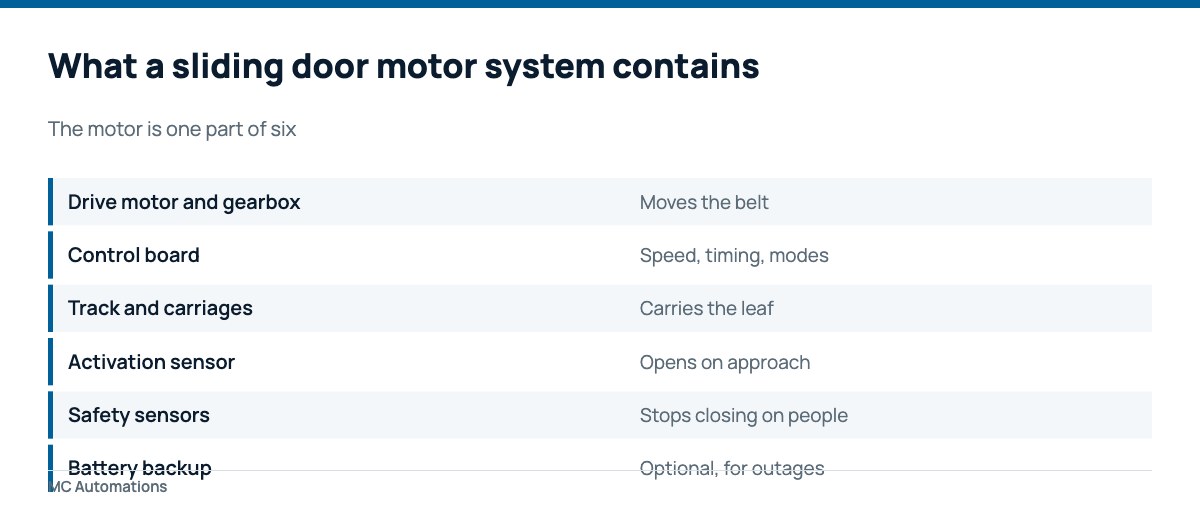
The motor is one component. A working entrance also needs a control board, a track and carriage set, an activation sensor, safety sensors on the closing line and, in South Africa, usually a battery backup so the door behaves predictably during an outage.
When a quotation looks unusually cheap, the difference is almost always in that list rather than in the sliding door motor itself.
Why the trade says operator
An operator is the complete drive assembly: motor, gearbox, controller and belt in one housing, engineered to move a specific leaf weight over a specific span at a controlled speed. Our MC-125 covers clear openings from 1450 to 5000 mm with leaves to 150 kg.
Calling it a sliding door motor is not wrong, it is just narrower than the thing being bought.
Kits versus commissioned systems
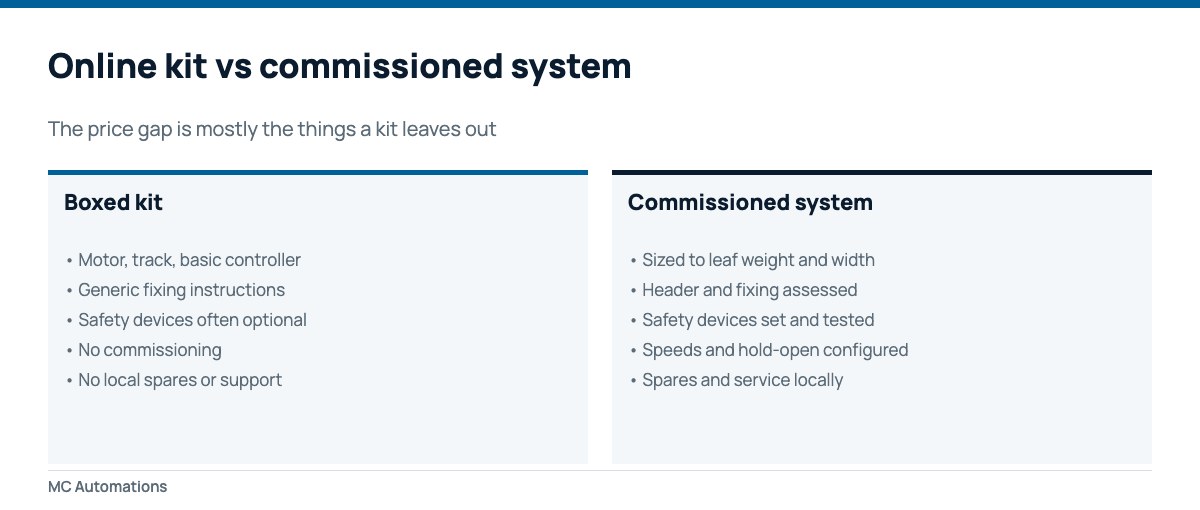
A boxed sliding door motor kit assumes a standard leaf, a sound header and somebody competent to fit it. That is fine on a light internal door in a controlled environment.
On a public entrance it usually is not, because the safety devices, the speed and force settings and the commissioning are the parts that keep the door from injuring somebody. Requirements for powered pedestrian doors in South Africa are published through SABS.
How the right unit is chosen
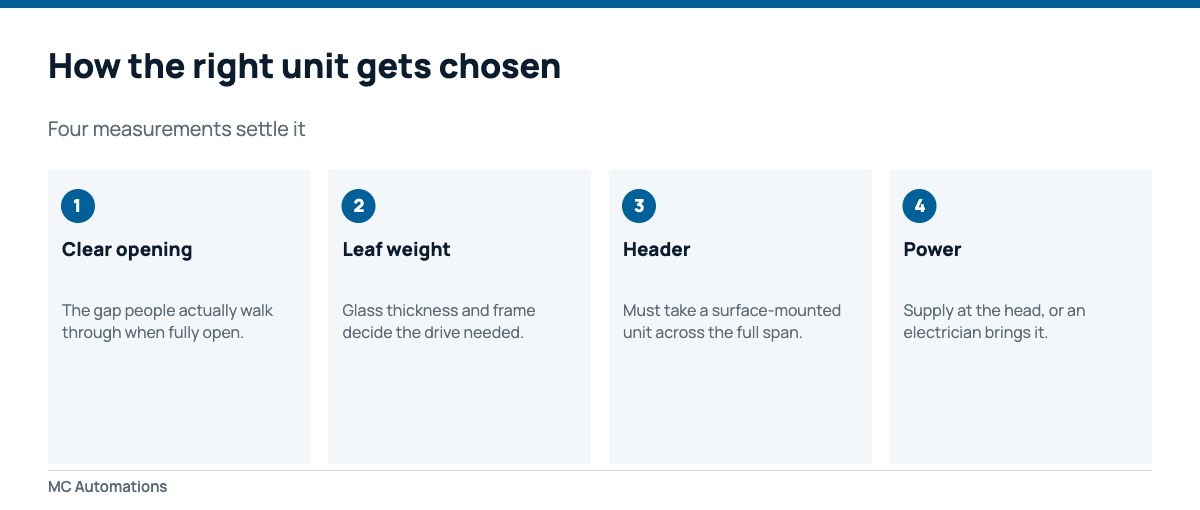
Four numbers decide it: the clear opening, the leaf weight, what the header can carry, and whether power exists at the head of the door. Get those wrong and the sliding door motor either struggles or overshoots, and both shorten its life.
A single leaf and a bi-parting pair behave differently over the same opening, which is why the configuration is settled before anything is priced.
Servicing and spares
Whatever it is called, it wears on cycles rather than years. Belts stretch, rollers flatten and floor guides wear. We hold spares for our own operators in Johannesburg and service other manufacturers’ equipment — see spare parts and servicing.
Single leaf or bi-parting
The same opening can be covered by one leaf travelling the full width or two meeting in the middle. A bi-parting pair clears the opening roughly twice as fast because each leaf travels half the distance, which matters on a busy entrance where people arrive in clusters.
A single leaf needs somewhere to park, and that wall space is often what the facade cannot give. Where it cannot, telescopic is the answer: two leaves a side nesting into a short track. The sliding door motor is sized differently in each case because the mass and the travel differ.
This is why a quotation cannot be produced from a width alone. The configuration changes the drive, the track and the price.
What the controller does that the motor cannot
People buy a sliding door motor and get a control system. The board sets opening and closing speed independently, holds the door open for a set time, slows the leaf near the ends of travel so it does not slam, and decides what happens when resistance is met.
It also carries the modes: automatic, partial open for winter, exit only at closing time, hold open for deliveries, and locked. Those are the functions a building actually uses day to day, and none of them live in the motor itself.
Partial open is worth knowing about in South Africa. It reduces the opening width in cold or windy months without replacing anything, which cuts the heating and cooling load through the entrance.
Power, batteries and outages
A sliding door motor needs a supply at the head of the opening. Where that does not exist, an electrician brings it, and that cost sits outside the hardware quotation rather than inside it.
Battery backup decides what happens when the supply fails. With it, the door continues to operate for a defined period or parks in a chosen state. Without it, behaviour depends on the unit, and discovering that during load shedding is the wrong time.
Requirements for powered pedestrian doors in South Africa are published through SABS, and on an escape route the behaviour on power loss is part of the building strategy rather than a preference.
Installation is most of the risk
A sliding door motor is only as good as what it is fixed to. The header has to be solid and level across the full span, because the track carries the leaf weight for the life of the door. A header that flexes produces a door that binds at one end and wears rollers unevenly.
Floor guides matter as much. A sliding leaf is held at the bottom by a guide in the floor or in the threshold, and if that is worn or misaligned the leaf swings slightly as it travels, which loads the carriages and eventually the drive.
These are the reasons a commissioned installation outlives a boxed kit fitted optimistically, even when the sliding door motor inside is comparable.
Service life and what wears
Wear follows cycles, not years. Belts stretch, carriage rollers flatten, floor guides erode and seals harden. A sliding door motor on a centre entrance may do more cycles in a month than an office door does in a year, and its service interval should reflect that.
The MC-125 is tested to one million cycles, which is a test result rather than a maintenance-free period. It tells you what the mechanism withstood under test conditions; it does not remove the need for servicing.
We hold belts, rollers, guides, sensors and controllers for our own operators in Johannesburg, and we service other manufacturers’ equipment as well. See spare parts.
Comparing quotations fairly
Two prices for the same opening are rarely for the same thing. Ask each supplier to itemise the sliding door motor and controller, the track and carriages, the activation device, the safety devices, the battery backup, the commissioning visit and the warranty.
Once those seven lines are visible the gap usually explains itself. The cheaper quotation is frequently missing safety devices or commissioning, both of which are the parts that keep a public entrance from injuring somebody.
Ask also what is held locally. A sliding door motor supported by spares in the country behaves very differently in a breakdown from one that needs an import, and that difference is invisible at purchase.
Retrofitting an existing sliding door
Automating an existing manual slider is common and often economical, because the leaf, glass and frame stay. What changes is the track, the carriages, the header fixing and the addition of a sliding door motor with its controls and safety devices.
Three things decide whether it is straightforward: the weight of the existing leaf, whether the header can carry a surface-mounted unit across the full span, and whether power exists at the head. Where any of those is uncertain, a survey settles it before anything is ordered.
Where the existing leaf is too heavy or the header cannot be used, replacing the assembly is usually cheaper than engineering around it. See automating an existing door.
Terminology, one last time
If you search for a sliding door motor you will be shown everything from a R2,000 garage-style kit to a commercial entrance system. They are not competitors. The kit moves a light leaf in a controlled environment; the entrance system moves a heavy leaf in a public space with devices that stop it hurting anyone.
Describe the opening rather than the product and the right category becomes obvious. Clear opening, leaf weight, traffic, and whether the public uses it.
Noise, and what it tells you
A healthy sliding entrance is quiet. When a sliding door motor becomes audible the cause is usually mechanical rather than electrical: flattened rollers, a dry or worn floor guide, debris in the track, or belt tension that has drifted.
Noise is useful because it arrives before failure. A door that has started to rumble has weeks of warning in it, and attending then is a wear-item replacement rather than a breakdown.
Juddering is more urgent. It usually means the leaf is binding somewhere in its travel, and the drive is working against it every cycle.
Sizing for the busiest hour
A sliding door motor is selected for leaf mass and travel, but the duty is set by cycles. Two identical openings, one in a quiet office and one at a centre entrance, will consume wear items at completely different rates.
Tell us the traffic at the busiest hour rather than the daily average. It changes the recommended unit and the service interval, and it is the number most often left out of an enquiry.
What to send for a quotation
A sliding door motor cannot be quoted from a photograph of the shopfront alone. Send the clear opening width and height, the leaf weight or glass specification, a photograph showing what sits above the opening, and the traffic at the busiest hour.
With those four we can tell you whether a single leaf, a bi-parting pair or a telescopic arrangement suits, and price it installed rather than estimated.
Warranty and service life
Our operators carry a 24-month warranty on the equipment as supplied and installed. Wear items are replaced through servicing rather than under warranty, which is normal and worth knowing before the first service visit.
A sliding door motor that is serviced on cycles will comfortably outlast one that is attended only when it fails, and the difference is usually years rather than months.
One last word on terminology
If you take one thing from this page, let it be that a sliding door motor on a public entrance is bought as a system. The motor is the part that turns; the system is what makes the entrance safe, quiet, lockable and serviceable for a decade.
Describe the opening and the traffic rather than the product, and the right sliding door motor configuration follows from that rather than from a search result.
A note on how we quote and attend
Everything on this page is written from work we actually do: supplying, installing, commissioning and servicing automatic entrance systems across South Africa, on our own operators and on other manufacturers’ equipment. We do not publish specifications we cannot evidence, and where a figure is a test result rather than a guarantee we say so.
Quotations go out within two working days of receiving the opening size and a photograph. Where a site survey is needed first we say so rather than letting a date slip quietly, and we sometimes charge for a visit depending on what it involves — told beforehand, never afterwards.
The MC-125 sliding operator and MCW-100 swing operator are imported and assembled at our own facility in Johannesburg. That is what keeps belts, rollers, floor guides, sensors and controllers on a shelf locally rather than six weeks away, and it is usually the difference between a same-visit repair and an entrance standing open for a week.
Both operators are tested to one million cycles and carry a 24-month warranty. A cycle test is a measure of what the mechanism withstood under test conditions; it is not a maintenance-free period and not a warranty term, and we are careful never to present it as one.
If you want a second opinion on a quotation, a condition report on doors somebody else installed, or simply a straight answer about whether an opening needs replacing or servicing, send the details through and we will tell you what we would do.
Why the name matters less than the specification
People ask for a sliding door motor and mean anything from the bare drive unit to the whole entrance, and the ambiguity causes real quoting problems.
What actually moves a sliding entrance is an assembly: the drive, the controller that decides what the drive does, the track and carriages the leaves hang from, the belt that connects them, and the sensors that tell the system a person is there. Replacing the motor alone is occasionally the right repair, but far more often a failure attributed to the motor is a belt, a carriage, a controller or simple mechanical drag — and fitting a new drive to a worn assembly buys a few months rather than a few years.
So when an entrance is quoted, it is quoted as an assembly against the opening rather than as a sliding door motor against a catalogue. That is also why a condition report comes first on any entrance we did not install: it establishes whether the drive is the problem or merely the part that finally stopped.
Sliding door motor, answered
Is a sliding door motor the same as an operator?
Practically, yes. The operator is the full drive assembly; the motor is the part inside it that turns.
Can I fit a sliding door motor myself?
On a light internal door, possibly. On a public entrance the safety devices and commissioning are the point, and those are not a DIY step.
Why are quotes so different?
Usually safety devices, battery backup and commissioning. Compare what is included, not the headline figure.
Will it work during load shedding?
Only with a battery backup. See automatic doors and load shedding.
Can an existing manual slider be automated?
Often yes, subject to leaf weight and the header. See automating an existing door.
Do you supply motors only?
We supply and commission complete systems, and we carry spares for units we service.
Sliding door motor checklist
Send these five and any quotation for a sliding door motor becomes comparable.
- Clear opening width and height. The single most important number for sizing a sliding door motor.
- Leaf weight or glass spec. Decides the drive and the carriage set.
- A photograph of the header. Shows whether a surface-mounted sliding door motor can be fixed across the span.
- Power at the head, yes or no. If not, an electrician cost sits outside the hardware price.
- Traffic at the busiest hour. Cycles decide the duty and the service interval.
Send those and we will tell you which sliding door motor configuration the opening needs, and what it costs installed. Request a quote, or read the automatic sliding doors page first.
Sliding door motor: quick answers
- A sliding door motor that hums but does not move has a mechanical obstruction or a failed belt, not an electrical fault.
- A sliding door motor that is noisy is nearly always rollers or track, not the motor itself.
- A sliding door motor that stops mid-travel is reacting to an obstacle detection threshold set too tight for a heavy leaf.
- Replacing a sliding door motor is not always necessary — on most headers the operator can be modernised onto the existing track.
- Our MC-125 sliding door motor is imported and assembled at our Johannesburg facility, tested to one million operating cycles and covered by a 24-month warranty.
Still stuck? Send the opening size and a photograph to MC Automations and we will tell you what we would do.
