
Automatic door troubleshooting: what is your door doing?
Most automatic door troubleshooting goes wrong at the first step, because the conversation starts with a guess about the part rather than a description of the behaviour. “I think the motor has gone” is a diagnosis. “It opens, waits, and then opens again instead of closing” is evidence, and it points almost immediately at a sensor rather than a motor.
This automatic door troubleshooting guide is organised the way a fault actually presents itself: by what you can see from the floor. Find the behaviour, read what it usually means, do the checks that are safe to do, and know the point at which you should stop and call somebody. Everything here applies to pedestrian entrances, which is all we work on. We do not supply, service or repair roller shutters, and we do not supply, fit or retrofit door closers.
Automatic door troubleshooting starts with behaviour, not the part
The table below is the short version of this entire page. It is also the fastest way to give a technician something useful on the phone.
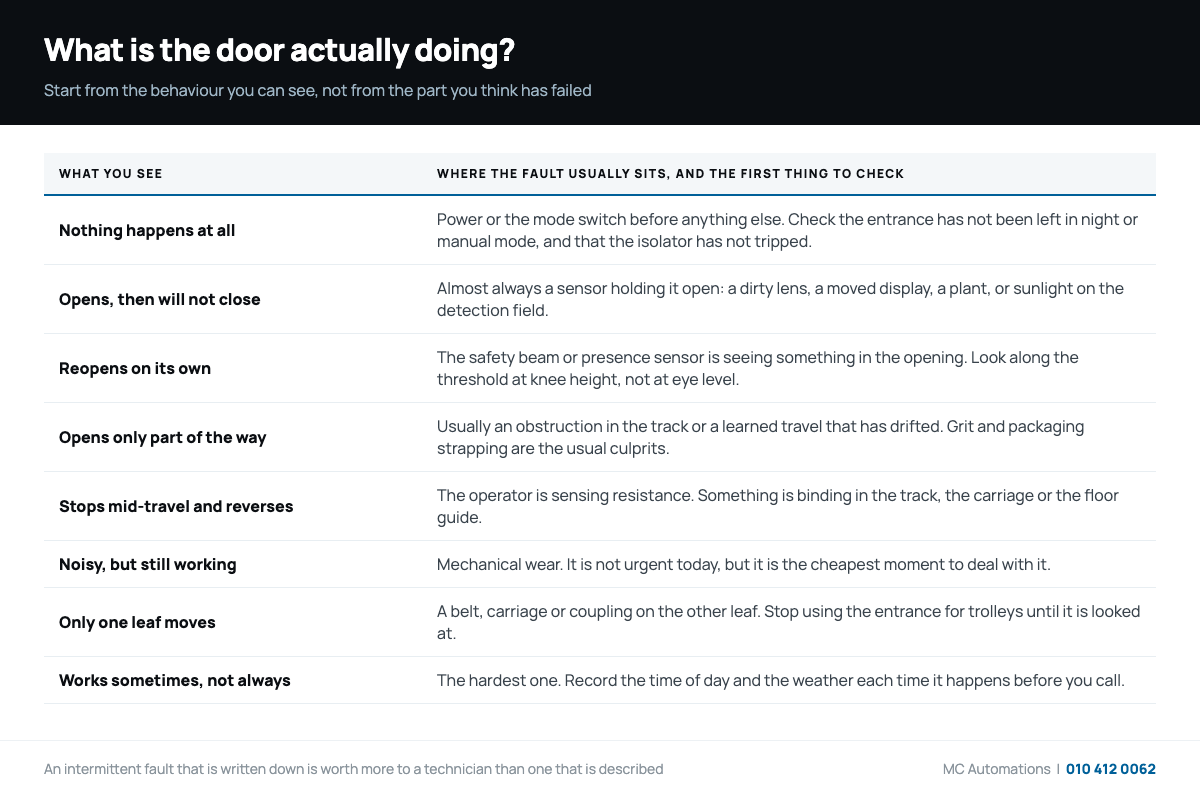
If you take one habit from this page, make it this one: write down what the door did, at what time, and what the weather was doing. Intermittent faults are solved by patterns, not by inspection.
The three places a fault can live
Nearly every fault you will meet in automatic door troubleshooting sits in one of three families, and the three fail in recognisably different ways. Naming the family before you call is the single most useful thing you can do, because it usually decides which parts the technician puts in the van.
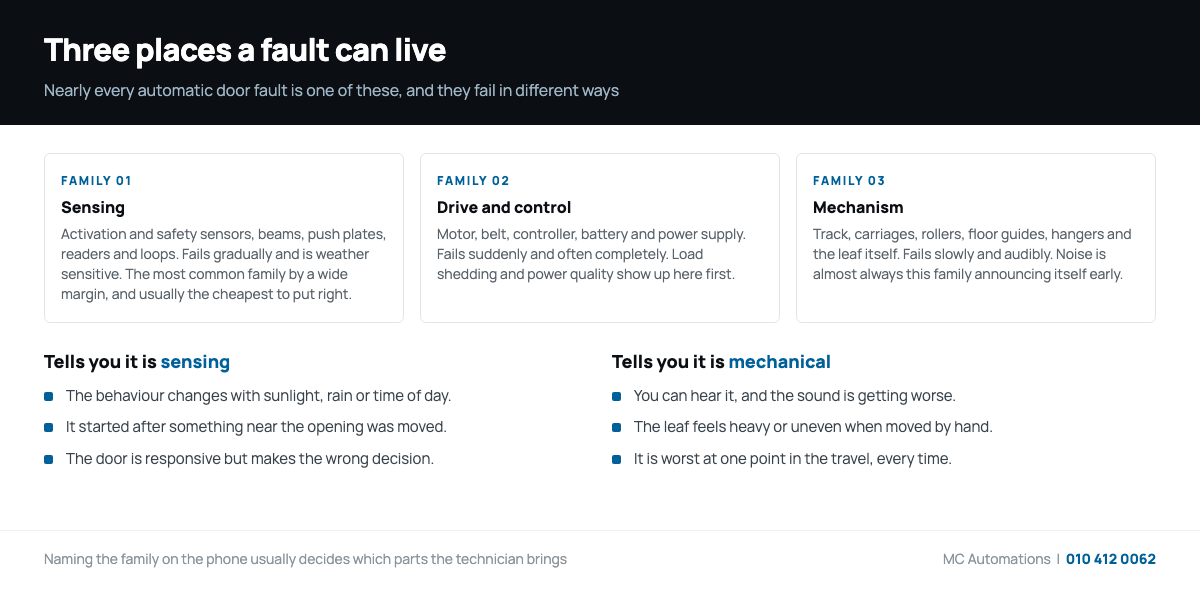
Sensing faults are the most common by a wide margin and usually the cheapest to resolve. Drive and control faults are the most dramatic and the most likely to stop the entrance completely. Mechanical faults are the ones that announce themselves months in advance and get ignored.
What you may safely check, and where to stop
There is a clear line in automatic door troubleshooting between looking and intervening. Looking is safe and often solves the problem. Intervening is not, because there is mains voltage inside the header and because the safety behaviour of an entrance is a commissioned setting, not a preference.
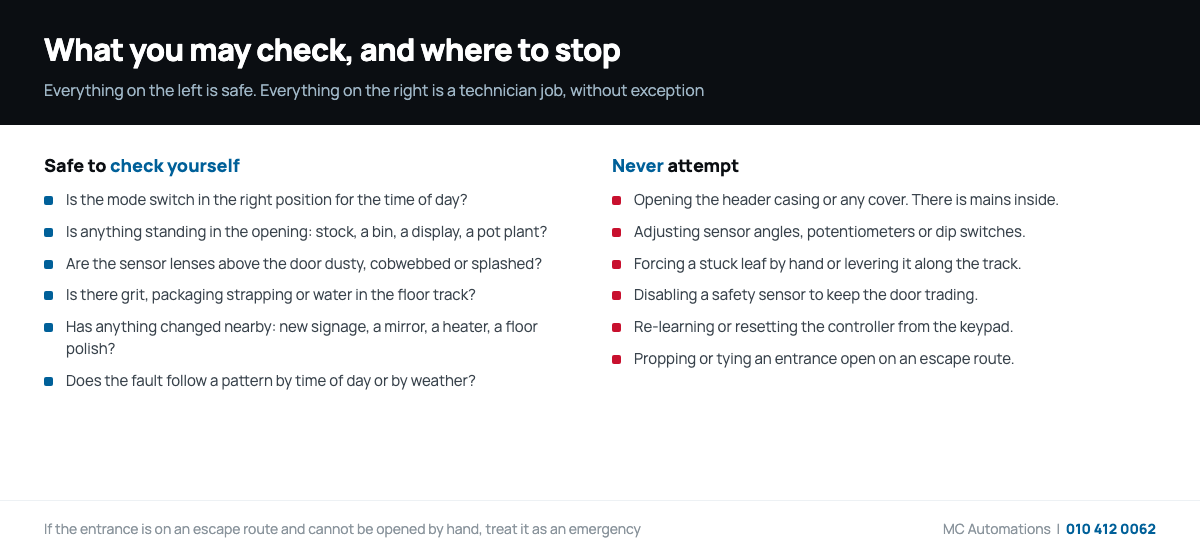
The rule that matters most: never disable a safety sensor to keep an entrance trading. An automatic door with its safety sensing defeated is more dangerous than a door that is out of service, and on an escape route it is a compliance problem as well as a safety one.
Nothing happens at all
Automatic door troubleshooting on a completely dead entrance starts with the two things that account for most of these calls. The first is the mode switch: an entrance left in night mode or manual mode is behaving exactly as instructed. The second is power: check whether the circuit has tripped, particularly if the fault appeared after a power interruption.
If the mode is right and power is present and the door is genuinely dead, it is a drive and control fault and it needs attending. In the meantime, confirm the leaves can be moved by hand so the opening remains usable, and if they cannot and the entrance is on an escape route, treat it as an emergency.
It opens but will not close
This is the most common symptom in automatic door troubleshooting, and it is a sensor nine times out of ten. Something is sitting in the detection field and the door is doing precisely what it was told to do. Look for a new display, a delivery pallet, a bin, a pot plant, a mat that has crept forward, or a lens that has gone dusty or cobwebbed.
Sunlight is the underrated cause. A low winter sun striking the sensor directly, or bouncing off a wet floor or a parked windscreen, will hold an entrance open at the same time every day and then stop by mid-morning. That is why the time of day matters more than the symptom.
We have a full write-up on this one symptom: see automatic door not closing for the detail, including what to do about security overnight.
It reopens on its own
In automatic door troubleshooting, a door that starts to close and then reverses is seeing something in the opening. The mistake people make is looking at eye level. Presence sensing and safety beams cover the threshold, so look along the floor and at knee height: trolley wheels, a doorstop, a cable, a raised mat edge, standing water.
If the opening is genuinely clear and it still reverses, the sensing has drifted or failed and it is a job for a technician. Our automatic door sensor replacement page sets out what the common sensors cost to replace.
It only opens part of the way
Partial travel is one of the few automatic door troubleshooting symptoms that is almost always physical. Grit, packaging strapping, a screw or a stone in the floor track will stop a leaf short every time at the same point. So will a learned travel that has drifted after a power interruption, which is why this one often appears the morning after load shedding.
Look along the track with a torch rather than by eye. If something is visible and loose, it can be lifted out. If the leaf is binding rather than obstructed, stop there — forcing it scores the track, and a scored track turns a cheap repair into a replacement.
It stops mid-travel and reverses
This is automatic door troubleshooting at its most literal: the operator is sensing resistance and protecting itself and whatever it thinks it has hit. That is the system working correctly in response to a mechanical problem. Something is binding in the track, a carriage, a roller or the floor guide.
This one gets worse quickly and should not be left. Each reversal is a load on the belt and the drive, so a mechanism fault left alone becomes a drive fault as well.
It has become noisy
Noise is mechanical wear announcing itself early, which makes it the most valuable symptom in automatic door troubleshooting. A grinding or rumbling sound usually means rollers or carriages. A rhythmic tick that keeps time with the travel usually means a flat spot on a roller or something caught on the belt. A squeal on starting usually means the belt tension.
Nothing here is urgent today, and that is exactly why it gets left until it is. Dealt with at the noise stage it is a service item. Dealt with after the track is scored it is a replacement.
Only one leaf moves
This is the simplest result in automatic door troubleshooting to interpret: on a bi-parting entrance, one static leaf points at a belt, carriage or coupling on that side. Stop putting trolleys and traffic through the opening until it has been looked at, because the working leaf is now carrying the full duty and the opening is narrower than anyone expects it to be.
It works sometimes and not others
Intermittent faults are the hardest part of automatic door troubleshooting to attend because the door will almost always behave while the technician is standing in front of it. The fix is evidence. Keep a note for a few days: time, weather, what the door did, and what was happening in the building. Three entries are usually enough to show a pattern.
Intermittent behaviour that tracks the weather or the time of day is sensing. Intermittent behaviour that tracks the power is drive and control. Intermittent behaviour that happens at the same point in the travel, regardless of anything else, is mechanical.
Automatic door troubleshooting on swing doors
An automatic swing door fails differently from a slider. A swing leaf that has become heavy to push, that slams at the end of its travel, or that no longer holds open where it should, is usually a drive or a hinge issue rather than a sensing one. Push plates and hands-free switches are the sensing equivalent on a swing entrance, and a failed plate looks exactly like a dead door.
One distinction worth making: a door closer is not an operator. We do not supply, fit, retrofit or service door closers, so if the device on your door is a closer rather than a powered operator, we are not the right people to call.
When the fault is the access control, not the door
A surprising share of automatic door troubleshooting ends up at the reader rather than the operator. If an entrance is on a card, fob, intercom or keypad, a credential that is not being accepted looks identical from the floor to a door that has died: somebody presents a card, nothing happens, and the door gets blamed.
Two quick tests separate them. First, does the entrance open on a different credential, or for somebody else? If it opens for one card and not another, the door is fine and the problem is in the access control system. Second, does it open when the mode switch is put into normal trading mode, where no credential is required? If it does, the operator and sensors are working and the fault is upstream of them.
The interface between the two systems is worth understanding, because it is where this gets confusing. A reader that releases a lock but never signals the operator to open leaves a guest or a staff member standing at a door that is technically unlocked and visibly shut. Our automatic door access control page covers how the reader, the locking and the operator are meant to talk to each other.
Who should be logging the call?
In a mall, an office park or a multi-tenant building, the slowest part of automatic door troubleshooting is often not the diagnosis. It is working out whose entrance it is. A shopfront entrance is usually the tenant’s, a mall or lobby entrance is usually the landlord’s or the managing agent’s, and a service or fire door is almost always the landlord’s.
Get that settled before the fault happens rather than during it. The practical arrangement that works is a single named contact per building who logs every entrance fault regardless of who ultimately pays, because two tenants reporting the same mall door on the same morning wastes a visit that somebody is paying for.
Where a portfolio is involved, we would rather hold one schedule of entrances by building and zone than take calls property by property. That is what a service level agreement is actually for: it settles who calls, what counts as urgent, and what happens after hours, before anybody is standing in front of a door that will not open.
If the entrance is stuck open and the building cannot be secured, the related question is what the entrance is meant to do after hours in the first place. Our guide to automatic door security covers the locking arrangements and the escape-route rule that constrains them.
Automatic door troubleshooting: how urgent is it really?
Urgency comes from what the entrance does for the building, not from how irritating the fault is. A noisy door in a back corridor can wait for the next planned visit. A stuck entrance on an escape route cannot wait at all.
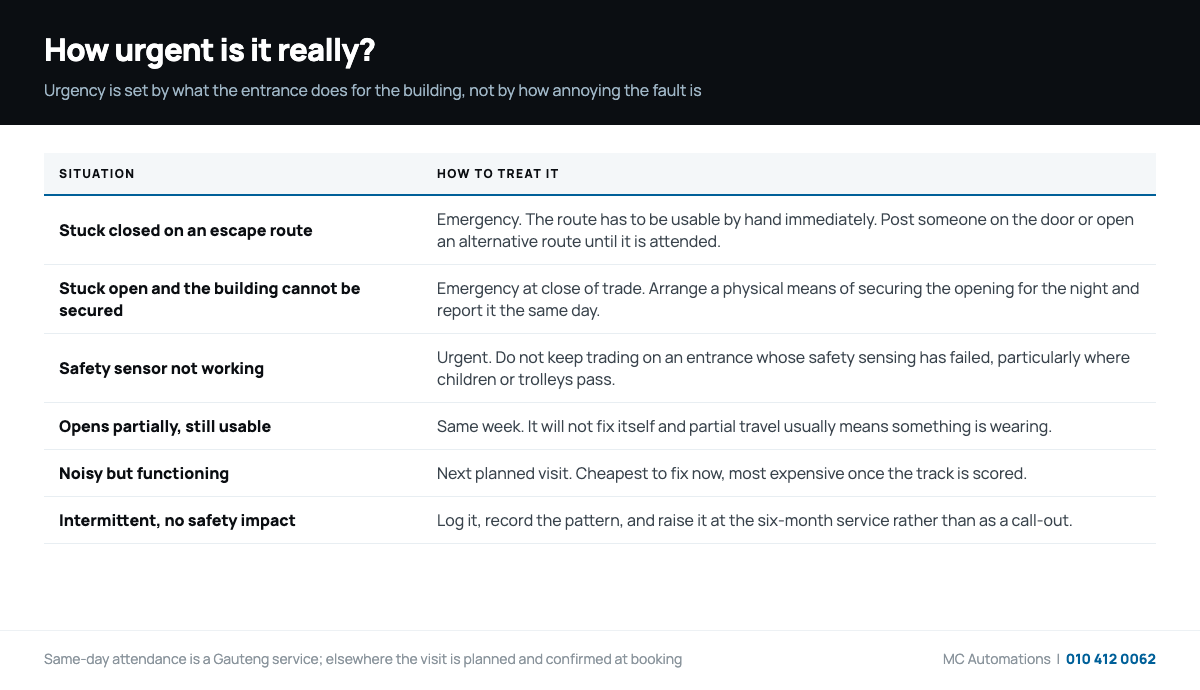
Requirements for entrances on escape routes derive from the National Building Regulations and the standards published by the South African Bureau of Standards, and they are assessed against the fire strategy for your specific building. Where an entrance on an escape route cannot be opened by hand, that is an emergency regardless of what else is working.
What load shedding does to an entrance
Repeated power interruption shows up in automatic door troubleshooting more than almost anything else in South Africa. Three patterns are worth knowing. A door that hunts or reverses immediately after power returns is usually re-learning its travel rather than failing. A door that is dead after an interruption has often tripped a circuit rather than lost its controller. And electronics that are switched hard on and off several times a day simply age faster than electronics that are not.
None of that is a reason to panic, but it is a reason to raise power quality at the service visit rather than treating each incident as a separate call-out.
What to send when you log the call
Five things turn vague automatic door troubleshooting into an attended fault: what the door is doing in your own words, the door type and roughly how old it is, whether it is on an escape route, what changed recently near the opening, and a photograph of the entrance taken far enough back to show the header and the floor.
If you can add the pattern — time of day, weather, which direction of travel — the first visit is far more likely to be the only visit. You can send all of it through book a technician, which takes a photograph with the booking.
When automatic door troubleshooting stops and replacement starts
There is a point where continuing to diagnose an entrance stops being economic. The test is not the age of the operator. It is whether spares are still obtainable, whether the track and carriages are still within adjustment, and whether the same entrance has been attended repeatedly for the same thing.
Where parts are obsolete, the track is scored and fixings have elongated, replacing the operator is usually cheaper over two years than continuing to attend it. The leaf, framing and glass normally stay. Our automatic door repairs page covers how that decision is made and what parts actually cost, and spare parts covers what we hold on the shelf.
The cheapest version of all of this is not troubleshooting at all. Entrances on a six-month interval under a service level agreement generate far fewer of these calls, because noise and drift are caught while they are still adjustments.
Automatic door troubleshooting: quick answers
Why does my automatic door open but not close?
Almost always because a sensor is holding it open. Look for something new in the detection field: a display, a bin, a delivery pallet, a mat that has crept forward, or a dusty or cobwebbed lens. Low sun striking the sensor, or reflecting off a wet floor, produces the same behaviour at the same time each day.
Is it safe to keep using an automatic door that is faulty?
It depends on the fault. A noisy but functioning entrance can keep trading until the next visit. An entrance whose safety sensing has failed should be taken out of use, and one that is stuck on an escape route and cannot be opened by hand is an emergency. Never disable a safety sensor to keep a door trading.
What can I check myself before calling a technician?
The mode switch, the opening itself for obstructions, the sensor lenses for dust and cobwebs, the floor track for grit and water, and whether anything nearby has changed recently. What you must not do is open the header casing, adjust sensors or dip switches, force a stuck leaf, or reset the controller: there is mains voltage inside and the safety settings are commissioned, not preferences.
My door started playing up after load shedding. Is it broken?
Often not. A door that hunts or reverses just after power returns is usually re-learning its travel positions, and a door that appears dead has frequently tripped a circuit rather than lost its controller. Repeated interruption does age the electronics faster, so it is worth raising at the service visit rather than as a separate call each time.
How quickly can somebody attend a faulty automatic door?
Same-day attendance is a Gauteng service. Outside Gauteng the visit is planned and the date is confirmed at booking rather than promised as a response time we cannot hold. Properties under a service level agreement have their response agreed in advance instead of negotiated during a breakdown.
Do you troubleshoot automatic doors you did not install?
Yes. We attend and repair the major brands already installed on South African sites as well as our own equipment, and we hold spares for both. That is a service relationship only — we are not an agent or distributor for any other manufacturer.
Still not sure what it is doing?
Automatic door troubleshooting is easiest over the phone when you describe the behaviour rather than the part. Tell us what you are seeing and we will tell you what it usually means. Book a technician if the entrance is down now, read automatic door servicing if you would rather stop these calls happening, or phone 010 412 0062 and describe what you are looking at.