
Coverage
Automatic door service areas across South Africa
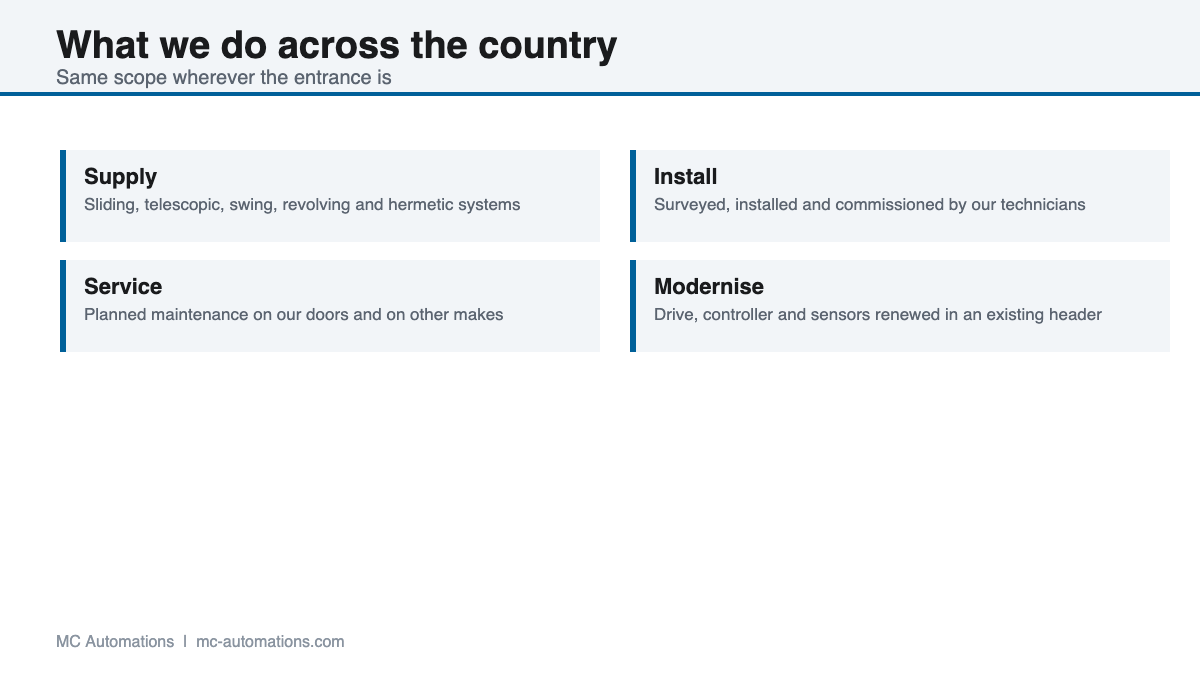
We supply, install, commission and service automatic doors nationwide from our base at Laser Park, Roodepoort. These are our automatic door service areas city by city, with what changes about an entrance in each.
Coverage is nationwide across all nine provinces, but an automatic entrance is not the same job everywhere. Salt, wind, dust, heat and humidity each act on a door differently, and the building stock in a city decides the door type and the traffic. These pages set out what actually changes in each of our automatic door service areas, rather than repeating the same text with a different city name.
Cities we cover
Automatic doors Johannesburg
Gauteng. Our base. Highveld dust, the highest cycle counts we service, and spares held in the city.
Automatic doors Pretoria
Gauteng. Government, campus and academic hospital work, where access control and site permits lead.
Automatic doors Cape Town
Western Cape. Salt air and the south-easter. Exposure decides the specification before leaf weights do.
Automatic doors Durban
KwaZulu-Natal. Heat, humidity and salt together, plus port and freight openings.
Automatic doors Gqeberha
Eastern Cape. Relentless wind, abrasive sand and automotive shift duty.
Automatic doors East London
Eastern Cape. A working port, automotive plants and a mild but corrosive coast.
Automatic doors Bloemfontein
Free State. Healthcare and campus work, a wide temperature range, and no coastal salt.
Automatic doors Polokwane
Limpopo. A provincial hub carrying counts the city size does not explain, plus open-country dust.
Automatic doors Mbombela
Mpumalanga. Lowveld heat and humidity with sharp tourism seasonality.
Automatic doors Kimberley
Northern Cape. The hottest, driest conditions we work in, and dust that never stops.
What is the same everywhere
Across every one of our automatic door service areas, four things hold. The MC-125 and MCW-100 are imported and assembled at Laser Park, so spares ship from South African stock rather than being ordered from overseas. We service and repair automatic doors from other manufacturers alongside our own, so a mixed estate sits under one asset register. Maintenance intervals are set against the cycles an entrance actually carries rather than a fixed annual visit. And we do not publish a single response time — it is agreed against your sites and the consequence of a failure.
What changes between them
Environment is the main variable. On the coasts, corrosion is the primary failure mode and the fixings usually go before the operator does. Inland, dust and heat dominate, and cleaning prevents most of the callouts we would otherwise attend. In wind-exposed cities the published leaf-weight limits matter less than they appear to, because those figures were tested without wind pressure.
Traffic is the second. Regional hubs serve catchments far larger than their population, industrial sites run on shifts rather than trading hours, and tourism-led cities swing hard between peak and quiet. Every one of these automatic door service areas therefore gets a different maintenance interval for the same hardware.
Working beyond the listed cities
These are the cities with their own pages, not the limit of where we work. Coverage runs across Gauteng, KwaZulu-Natal, the Western Cape, Eastern Cape, Free State, Limpopo, Mpumalanga, North West and the Northern Cape. If your site is not in a city listed above, send it anyway — planned work in outlying automatic door service areas is batched with nearby visits so travel is not paid for twice.
Estates across several cities
If your buildings span more than one province, say so at the outset. An estate is surveyed, priced and scheduled differently to a single door, and the single most useful thing a multi-site owner can do is put every entrance on one asset register with its own reference, location, type and measured traffic. That is what lets the interval be set per door rather than per contract, and it is the foundation of our service level agreements.
How environment changes an entrance across our automatic door service areas
The same operator behaves differently depending on where it is installed, and the differences are large enough to change what we specify. Grouping our automatic door service areas by dominant condition is the most useful way to see it.
- Coastal and corrosive — Durban, Cape Town, Gqeberha and East London. Salt attacks fixings, tracks and exposed metalwork continuously. The operator usually outlives its own fixings if those were selected for an inland building, so finish and fixing specification lead.
- Hot and dusty inland — Kimberley, Polokwane, Bloemfontein and Pretoria. Dust in tracks and on sensor lenses causes late opening and hesitation rather than failure, and it gets misdiagnosed as an operator fault constantly. Cleaning prevents most callouts.
- Wind-loaded — Gqeberha above all, with Cape Town close behind. Wind loads a leaf on every cycle, and the published leaf-weight limits were tested without wind pressure, so exposed openings are specified conservatively.
- Humid and warm — Durban and Mbombela. Sustained damp keeps surfaces wet longer and accelerates everything, including on inland sites where salt is not a factor.
- High-cycle metro — Johannesburg most of all. Traffic rather than weather is the dominant wear driver, and intervals are set against measured cycles.
How building stock changes it again
Environment sets how fast an entrance wears; the building decides what kind of door it should be in the first place. Across our automatic door service areas the same handful of patterns recur.
Retail and shopping centres carry the highest cycle counts of any sector and are almost always worked outside trading hours. Healthcare splits into two very different jobs: ordinary corridor doors that simply need to be hands-free, and sealed or shielded rooms where the door is part of the room’s performance rather than its circulation. Industrial and logistics sites run wide openings continuously, frequently with equipment rather than only people passing through. Government and campus buildings put access control, permits and documentation at the centre of the brief. Hospitality wants appearance alongside function, and in windy or air-conditioned lobbies that often points at a revolving entrance.
Knowing which of those a building is tells us more about the right specification than knowing which city it is in — which is why every page in our automatic door service areas covers sector as well as climate.
Choosing a system, wherever the site is
Four questions settle most specifications regardless of location. How wide does the clear opening need to be? Is there wall space beside it to park a leaf, or does that force a telescopic arrangement? How busy will the entrance be, in cycles rather than impressions? And what is the header built of and fixed to? That last one is the largest hidden cost in any installation and the most common cause of a door that never quite runs right.
Published figures for each system are in the brochures: the MC-125 sliding operator, the MCW-100 swing operator, revolving entrances, telescopic sliding doors and hermetically sealing doors. Each prints cleanly as a PDF for a tender pack.
What we will not tell you about our automatic door service areas
We do not publish a response time for any area, and that is deliberate rather than evasive. Response depends on the site, the nature of the failure and what the building needs restored, and a single headline figure that does not hold on the day you need it is worse than no figure at all. We agree it with you against your own sites instead.
We also do not claim installations we cannot evidence. Where a page in our automatic door service areas describes a sector, it is describing the kind of work that sector requires — not asserting a project list. Where a figure is not something we hold in writing, we say so rather than estimating it. That standard applies to specifications, to certification and to coverage claims alike.
Automatic door service areas: frequently asked
Do you really cover the whole of South Africa?
Yes, all nine provinces from our Laser Park base. The cities above have their own pages because conditions differ; they are not the boundary of our automatic door service areas.
Is service slower outside Gauteng?
Travel is longer, which is why planned work is batched. Response commitments are agreed against your sites rather than published as a single figure, and distance is part of that conversation.
Do you charge travel to outlying areas?
Where it applies we tell you before we attend rather than afterwards. Batching planned visits is how we keep it down.
Can one agreement cover sites in different provinces?
Yes, and it is usually cheaper than separate arrangements. One asset register across all your automatic door service areas is what makes an estate manageable.
Do you work on other manufacturers doors everywhere?
Yes. Multi-brand service applies across every area we cover, so a mixed estate does not need multiple contractors.
Tell us where your entrance is
Send the site, the opening and a photograph, and we will confirm the configuration in writing before anything is ordered.
How our coverage works in practice
Distance changes response time, not capability. The way we cover the country is simple: technicians and stock in Johannesburg, planned work scheduled in runs, and breakdown attendance agreed up front so nobody is guessing.
- Gauteng: same-day attendance is normally possible because both the workshop and the spares are in Laser Park, Roodepoort.
- Other provinces: planned installation and servicing is scheduled in runs, which keeps travel off your invoice.
- Breakdowns outside Gauteng: we agree the attendance arrangement in writing before the contract starts rather than implying a response time we cannot hold.
- Spares: parts ship from Johannesburg, and we confirm availability before a technician travels.
- Standards: installation and commissioning are set against the relevant South African standards, published by the SABS.
If your site is not on the list, it does not mean we cannot help. Tell us where the entrance is and what it does, and we will say plainly whether we are the right supplier for it.
Automatic door service areas in four pictures

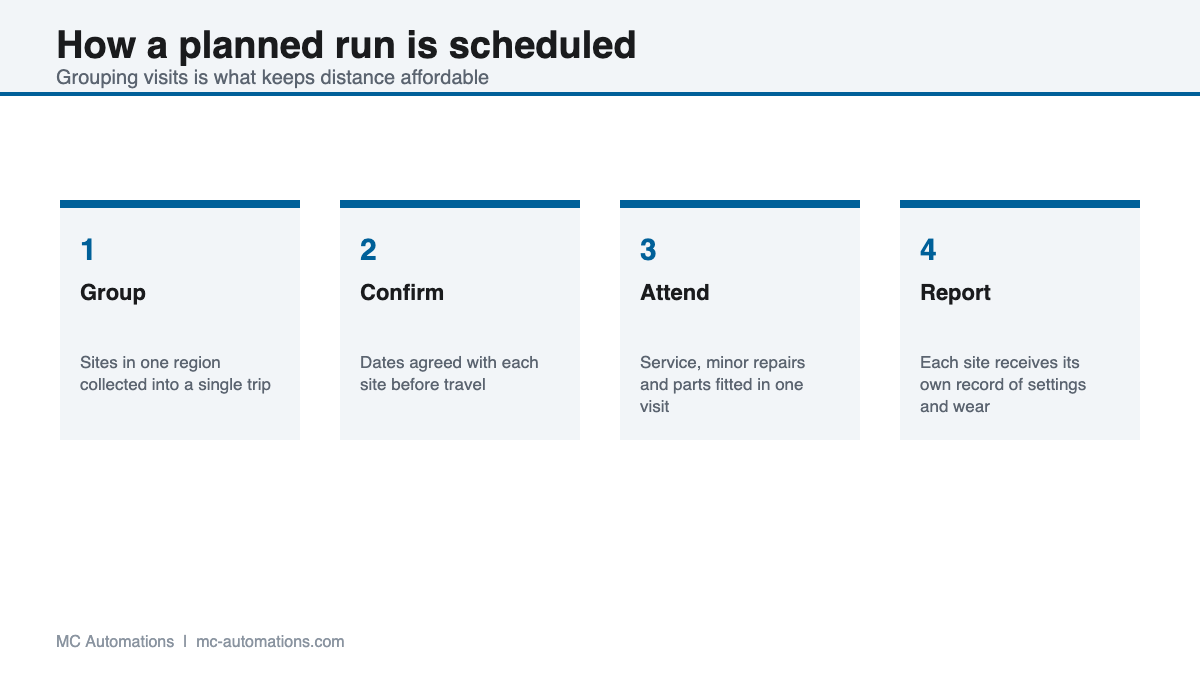
Working beyond the cities we list
The cities named above are where our automatic door service areas are most active, not a boundary. We attend towns and sites outside them regularly, and the honest way to describe the difference is planning rather than availability.
In Gauteng the response is same-day. Everywhere else is scheduled, and the further the site, the more the efficiency depends on preparation. A single doorway three hundred kilometres away is a whole day; four doorways on the same trip is the same day well spent. Grouping is the single biggest saving available to anybody outside the metro.
For a site genuinely off the main routes, the practical pattern is a planned annual or biannual attendance covering every entrance, a written condition record that says what will need attention before the next visit, and one spare held on site for the part most likely to strand a critical doorway. That converts most emergencies into scheduled work done by your own maintenance team under guidance.
What we will not do is quote a response time for a distant town that we cannot honour. If a site needs same-day cover and sits outside Gauteng, the honest answer is a local contractor for emergencies and us for the planned work and the equipment — and we would rather say that than sell a promise that fails on the day it matters.
Multi-site estates across our automatic door service areas
Groups with entrances in several provinces get more from a structure than from a supplier list.
Standardising on one operator family across the estate is the highest-value decision. It gives you one spares list instead of several, technicians familiar with the unit wherever they attend, and controllers that behave identically in every branch. Where a mixture has been inherited, converging at natural replacement points costs nothing extra.
Tiering is the second. A single-entrance store and a back-office doorway do not deserve the same response, and agreeing which is which in advance is far cheaper than deciding it during a breakdown. Our automatic door service areas coverage then maps onto those tiers rather than treating every site identically.
The third is a single register: every entrance, its operator, what it serves, whether it sits on an escape route, and when it was last attended. That register is what turns reactive spending into planned spending, because it shows which sites consume the budget and why.
Quick answers on our automatic door service areas
- Automatic door service areas cover the whole country; we install and service nationwide.
- Automatic door service areas with same-day call-outs mean Gauteng specifically.
- Automatic door service areas outside Gauteng are attended on a scheduled basis.
- Automatic door service areas are served from Laser Park, Roodepoort, with spares held in Johannesburg.
- Automatic door service areas include towns beyond the cities listed; grouping visits is the saving.
- Automatic door service areas cover any major brand, not only operators we supplied.
- Automatic door service areas all carry the same 24-month operator warranty.
- Automatic door service areas differ in detailing and interval, not in the standard of work.
Load shedding across the automatic door service areas
Power interruption is a national condition rather than a regional one, and it affects every entrance we look after. What differs is what the building wants to happen.
Battery backup buys a period of normal operation, which on a retail entrance usually covers the outage and on a busy one may not. Without it, the entrance reverts to its configured fail state: fail-safe releases it so people can get out, fail-secure holds it so nobody can get in. Those two pull in opposite directions and only the people who own the life-safety and security risks can resolve them.
Across our automatic door service areas the pattern we recommend is straightforward. Decide the fail state before the order rather than discovering it during an outage. Where the entrance is a secure line overnight, say so. Where it sits on an escape route, the fire strategy governs and the security preference gives way. And where an entrance genuinely cannot be out of service, specify backup rather than hoping.
Repeated outages are also harder on hardware than continuous running. A tired backup battery produces erratic behaviour that reads as a controller fault, so battery condition is on the service checklist rather than left until something misbehaves.
What to send us to plan a visit
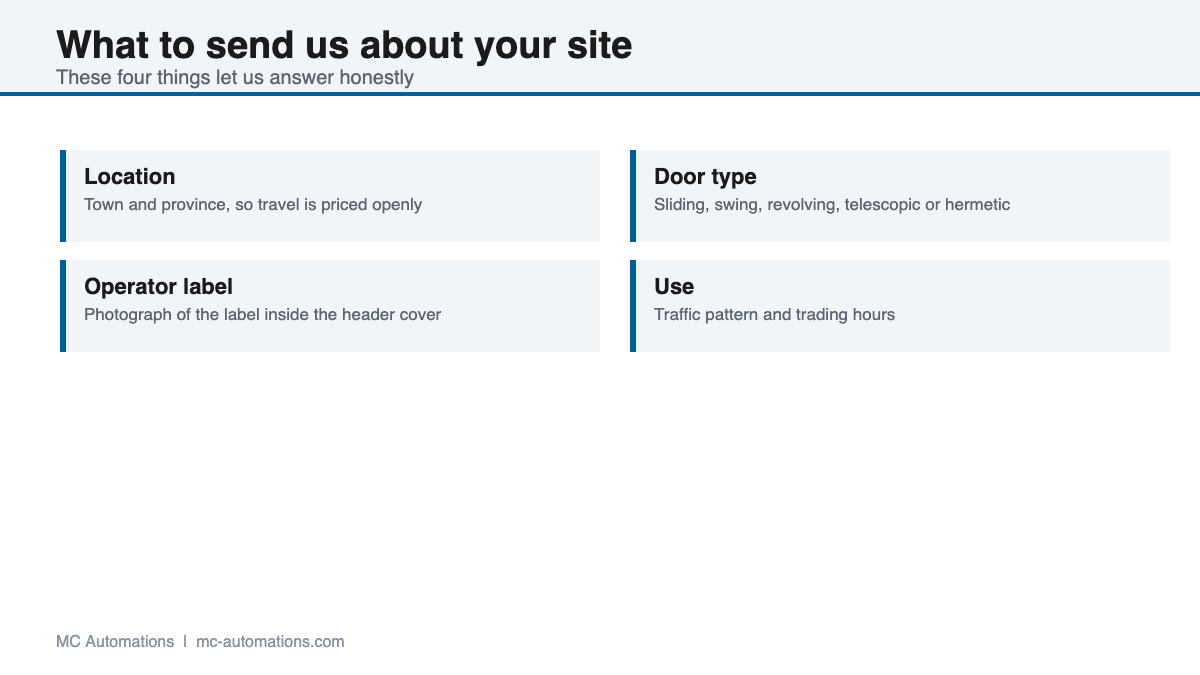
Preparation is worth more the further a site sits from Gauteng, and four answers turn a speculative trip into a productive one anywhere in our automatic door service areas.
- The operator make and model from the label inside the header, photographed if you can reach it safely.
- What the door is actually doing, described as behaviour rather than diagnosis.
- Every entrance on the site, not just the one that failed, so the visit can cover them all.
- Whether the entrance can be taken out of service, and whether it sits on an escape route.
Those four decide whether the right part travels with the technician and whether one trip does the work of three. On a distant site that is the whole difference between a fault cleared this week and one cleared next month.
In short
Automatic door service areas at a glance
- Automatic door service areas are quoted against the opening we measured, not a catalogue price.
- Ask about automatic door service areas and we confirm the opening, the head and the power position first.