
Service
Automatic door service level agreement: what it is and why it matters
An automatic door service level agreement turns entrance maintenance from a series of emergencies into something a building can plan and budget for. This page explains what an SLA does, the seven terms one should define, and how to compare agreements properly.
A service level agreement is a written contract that sets out what maintenance you receive, how often, what happens when something breaks, and what it costs. For an automatic entrance it does something more specific than that: it changes the moment at which work happens. Without an agreement, work happens when the door has already failed. With one, it happens before.
An important note on what follows. This page explains what an automatic door service level agreement should contain and how to judge one. It does not publish our own response times, coverage windows or pricing, because those are agreed per client and per estate. Where you see a term described here, treat it as something to agree rather than as a commitment already made. Ask us and we will put our terms in writing for your specific sites.
What an SLA actually changes
An automatic entrance does not fail randomly. It wears, steadily and predictably, in the places you would expect: carriages, belts, tracks, sensors and the fixings holding the operator to the structure. Left alone, that wear accumulates until something stops working, and the first anybody hears about it is a door standing open in winter or a queue building in a lobby.
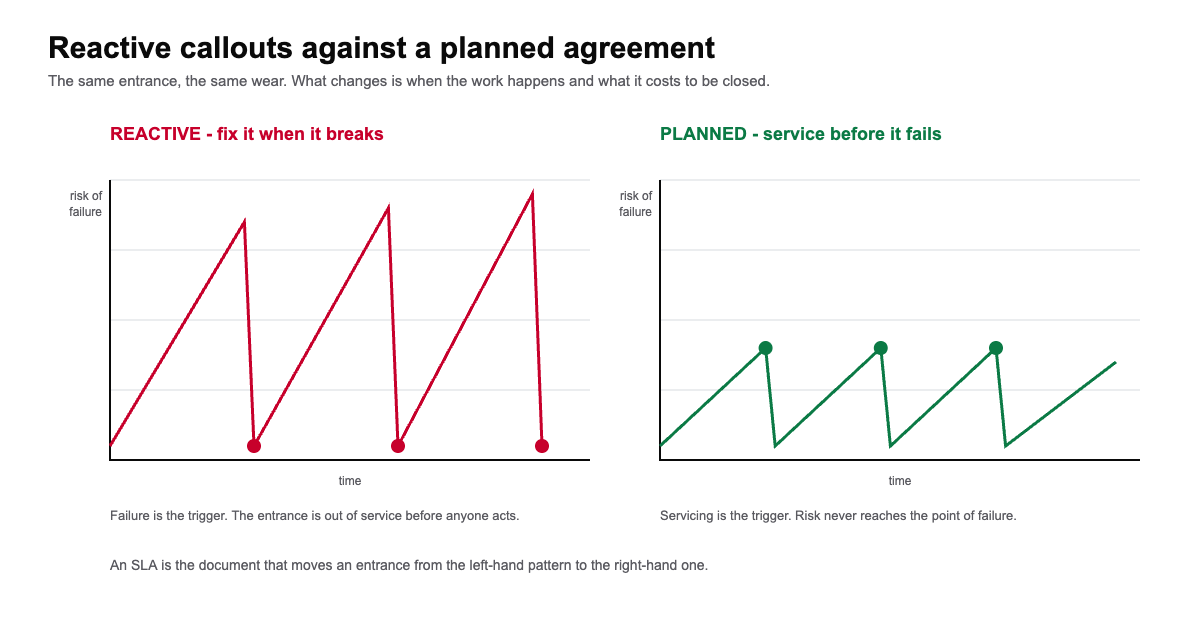
The reactive pattern is expensive in ways that never appear on the maintenance invoice. An entrance out of service on a trading day costs the tenant, not the contractor. A door propped open defeats the air conditioning and, on a controlled entrance, the access control with it. And emergency work is simply more expensive per hour than planned work, everywhere, in every trade.
Seven terms an automatic door service level agreement should define
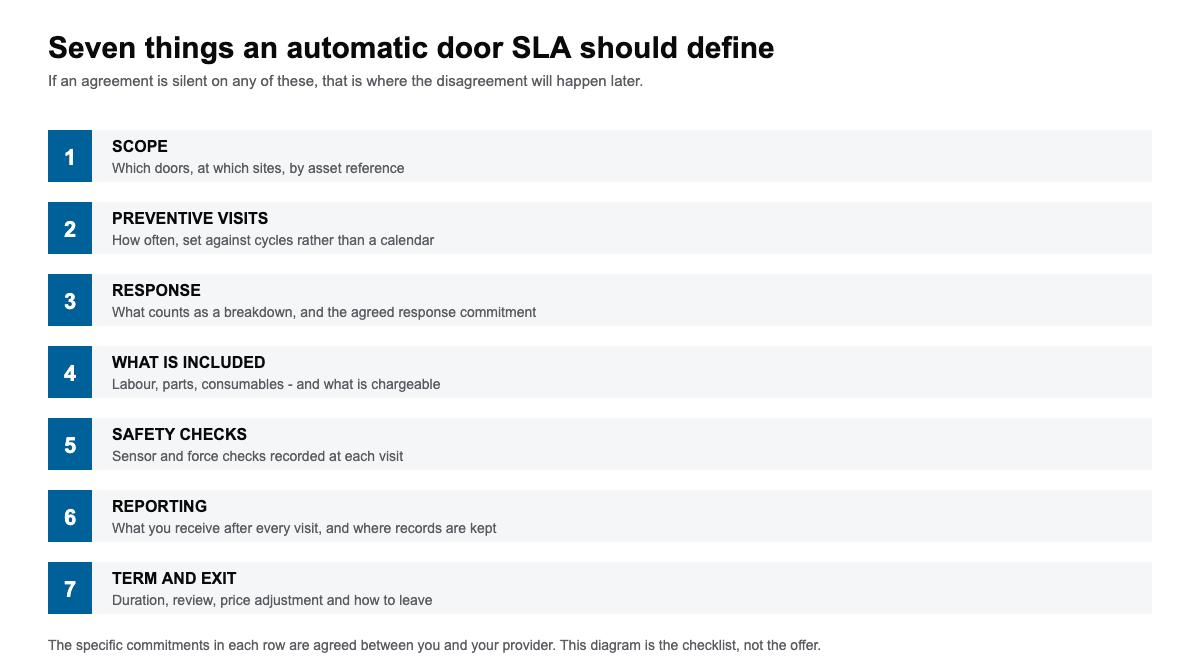
- 1. Scope. Which doors, at which sites, identified by asset reference rather than by description. “The door at reception” is not a scope.
- 2. Preventive visits. How often the doors are attended, and on what basis that frequency was set.
- 3. Response. What counts as a breakdown as opposed to a defect, and what response is committed to for each.
- 4. What is included. Labour, parts, consumables and travel — and, just as importantly, what falls outside and becomes chargeable.
- 5. Safety checks. That sensor function and door forces are checked at every visit, and that the result is recorded.
- 6. Reporting. What you receive after each visit and where the history is kept, so the record survives a change of facilities manager.
- 7. Term and exit. Duration, review points, how price adjusts, and how either party ends the agreement.
The specific commitment in each of those rows is agreed between you and your provider. This is the checklist to hold an agreement against — not a published offer.
Why a fixed annual visit is usually the wrong interval
This is the single most common weakness in the automatic door service level agreement documents we are asked to review. Almost all of them specify a number of visits per year, applied uniformly across every door on the contract. That is administratively tidy and technically wrong, because wear on an automatic door tracks cycles rather than time.
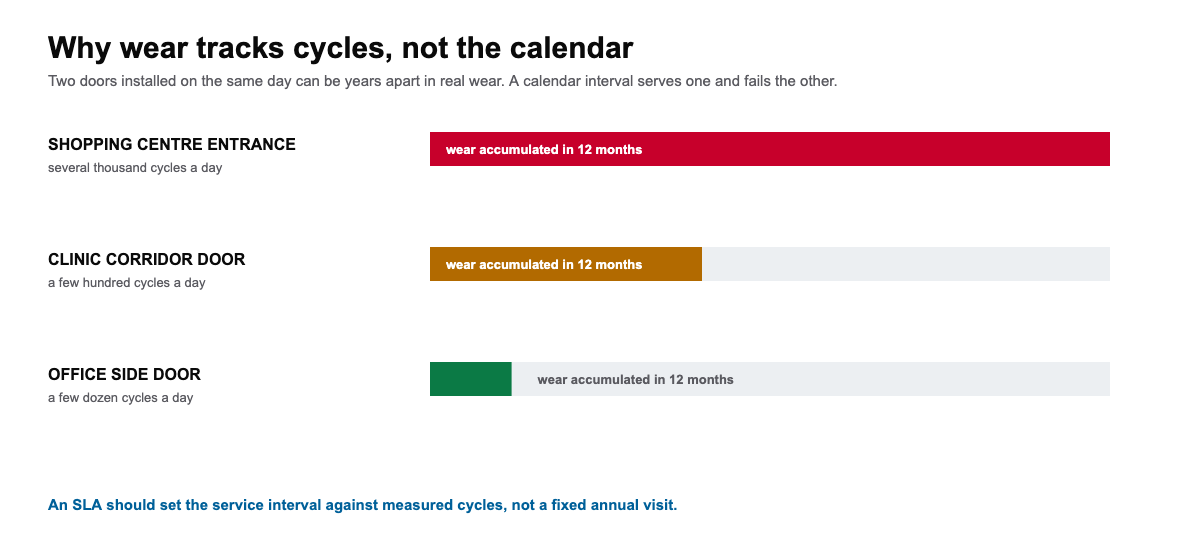
A shopping centre entrance can complete several thousand operating cycles a day. An office side door might manage a few dozen. Both are automatic doors, both were installed on the same date, and after twelve months they are nowhere near the same condition. A single annual interval over-serves one and badly under-serves the other — and the one it under-serves is the busy entrance, where a failure costs the most.
A well-written agreement sets the interval against the traffic each door actually carries. That is why the asset register matters so much, and why we ask about traffic rather than only about door count.
The asset register underneath the agreement
Before any term can mean anything, both parties have to agree exactly which doors are covered. That sounds trivial until a building has fourteen entrances across three sites, several of them from manufacturers who are no longer trading.
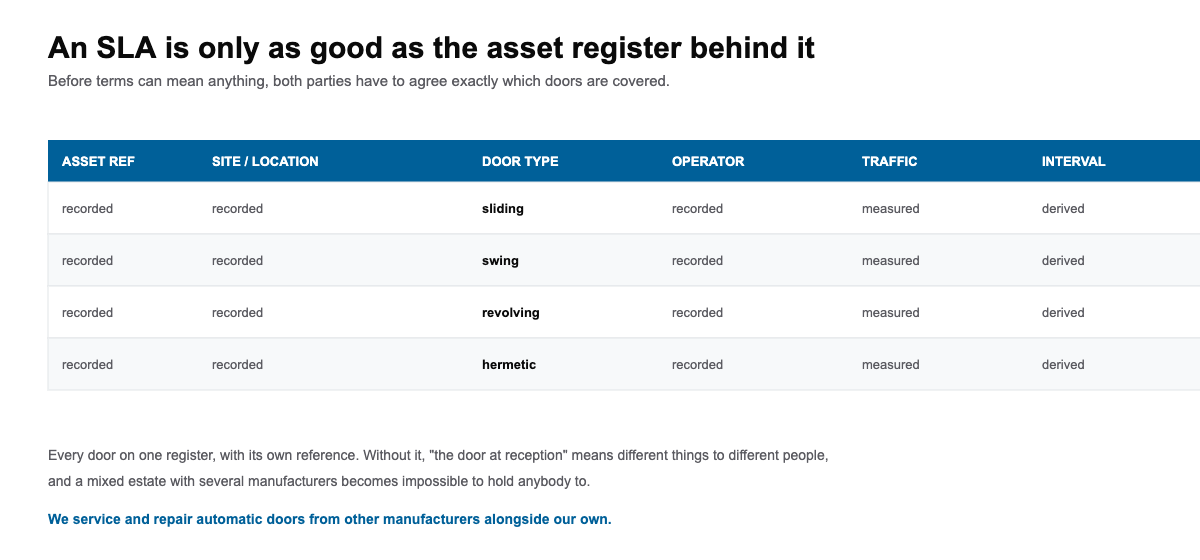
A register that records each door’s reference, location, type, operator and measured traffic does three things at once. It makes the scope unambiguous, it lets the service interval be set per door rather than per contract, and it gives the building a maintenance history that outlives whoever signed the agreement. We service and repair automatic doors from other manufacturers alongside our own, so a mixed estate can sit under one register and one agreement rather than several.
Safety, and why it belongs in the agreement rather than beside it
An automatic door is a powered machine that moves through space occupied by the public, including children, elderly users and people who cannot move quickly. The devices that make that safe — activation sensors, presence detection, force limits — are also the parts that drift quietest. A sensor slowly losing coverage does not announce itself. The door keeps working, and it keeps working right up until it closes on somebody.
That is why an agreement should require safety function to be checked and recorded at every visit, not merely checked. The record is what demonstrates the building was maintaining its entrance properly, and it is the thing nobody can reconstruct afterwards. Automatic entrances in South African buildings are designed against the SANS 10400 series supporting the National Building Regulations; copies are published by the South African Bureau of Standards. We will tell you which requirements apply to your entrances, and we do not publish a certification claim we cannot evidence.
We are not in a position to give you legal advice about your obligations as an occupier, and any provider who offers that from a web page should be treated carefully. What we can do is make sure the maintenance record exists and is complete.
How to compare two service level agreements
Comparing agreements on headline price alone is how buildings end up worse off. Four checks separate a real comparison from a false one.
- Is the scope identical? Count the doors on each schedule. One agreement quietly excluding two doors is not cheaper.
- Are parts included or excluded? A low annual fee with all parts chargeable can cost more over a year than a higher fee with parts included. Ask what a typical carriage or sensor replacement would be billed at under each.
- What is the response commitment, and to what? A fast response to “attend” is not the same as a commitment to restore service, and the distinction matters most on the day you need it.
- Who holds the records? If the history lives only with the contractor, changing contractor means starting the maintenance record from zero.
What an agreement cannot do
It is worth being straight about the limits, because an SLA is sometimes sold as though it removes all risk.
- It does not prevent every failure. Impact damage, vandalism, power problems and building movement are not wear, and no maintenance interval anticipates them.
- It does not fix a bad installation. An operator on a flexing header or an under-voltage supply will keep consuming parts. Maintenance manages that; it does not cure it.
- It does not replace the manufacturer’s warranty, and it does not extend it. The MC-125 and MCW-100 carry a two-year warranty; an agreement runs alongside that.
- It does not make an unsuitable door suitable. A door specified into the wrong application will keep failing on schedule.
What a preventive visit should actually cover
An automatic door service level agreement that specifies visits without specifying content leaves the most important question open. A visit that consists of watching the door open twice and signing a sheet satisfies the letter of most agreements. It achieves nothing.
On a sliding entrance the substantive items are the carriage rollers, the drive belt and its tension, the track, the activation and safety sensors, the fixings holding the operator to the header, and the hold-open and speed settings measured against what the entrance needs. On a swing operator the arm fixings and the coverage of the sweep zone are added to that list. On a revolving entrance the brush seals and the anti-pinch devices matter more than the drive. On a hermetic door the seals are the whole point, and a door that has stopped sealing looks identical to one that has not.
An agreement worth signing names the items rather than the duration. “Two visits per year” tells you nothing about what happens during them.
Downtime, and who actually pays for it
The cost of an entrance being out of service is almost never carried by whoever holds the maintenance budget, which is why it is chronically underweighted when agreements are compared. A failed entrance on a retail site costs the tenant in lost footfall. In a hospital it costs a department in disrupted movement and, on a controlled door, in a broken containment or access regime. In an office it costs the landlord in complaints and, over time, in the tenant’s view of how the building is run.
None of that appears on the line item being compared. It is worth doing the arithmetic once for your own building, because it usually reframes the conversation: the difference between two agreements is frequently smaller than the cost of a single day with the main entrance out of service.
This is also the argument for setting response commitments by consequence rather than by door count. An entrance whose failure closes a trading floor is not the same asset as a rarely used side door, even though both are automatic doors on the same schedule. A sensible agreement grades them.
Records, handover and continuity
Facilities teams change. Contractors change. The building stays. One of the quieter benefits of a properly written automatic door service level agreement is that it forces a maintenance history into existence that survives both.
That history answers questions nobody can otherwise answer: how often this particular entrance has needed attention, whether a recurring fault is actually recurring or just remembered that way, when the safety devices were last verified, and whether a door approaching the end of its economic life should be modernised rather than repeated. Without records, every one of those becomes a matter of opinion, and the building tends to keep paying to rediscover the same fault.
Specify in the agreement that the records belong to you, are provided after each visit, and are handed over in a usable form if the agreement ends. It costs nothing to agree at the start and is close to impossible to obtain afterwards.
Agreements across a mixed estate
Most buildings we take on do not have a uniform set of doors. They have an entrance from one manufacturer, a pair of internal doors from another, something revolving in the main lobby that predates the current facilities team, and a hermetic door in a clinical area with different requirements again. The instinct is to hold separate arrangements with separate specialists for each.
In practice that fragments the record and makes it impossible to compare performance across the estate, because each provider reports differently and none of them sees the whole picture. Bringing a mixed estate under one register and one agreement does not require replacing the doors. It requires a provider willing to work on other manufacturers’ equipment, which is why we do.
When an SLA should trigger modernisation instead of another repair
Every automatic door reaches a point where continuing to repair it stops making sense, and one of the more useful functions of a maintenance record is showing you when that point has arrived. The signal is rarely a dramatic failure. It is a slow rise in the frequency of small ones: the same entrance appearing on the callout log every few weeks, parts being replaced that were replaced eighteen months ago, settings drifting faster after each adjustment.
An agreement that only ever authorises repairs will keep authorising them indefinitely, because each individual repair is cheap relative to replacement. Seen one at a time, every decision is rational; seen across three years of records, the building has quietly spent more than a new operator would have cost and still owns an old door. Ask that the agreement include a review point where the history is looked at as a whole rather than incident by incident.
Modernisation is often narrower than people expect. Where the header, track and leaves are sound, replacing the operator and sensors while retaining the rest is common and considerably cheaper than a full replacement. Our automatic door modernisation page covers what can be retained and what usually cannot.
Getting an agreement in place
The process is short. We need to know which sites and how many doors, roughly what each entrance carries in traffic, and whether anything on the estate is already causing trouble. From that we survey the doors, build the asset register, and put terms in writing against it — scope, intervals, response, inclusions, reporting and term. You then have something specific to compare, rather than a brochure promise.
If you already hold an agreement with another provider and want a second opinion on it, we will read it and tell you what it does and does not commit anybody to. That is a useful exercise even if you stay where you are.
Automatic door service level agreement: frequently asked
What is an automatic door service level agreement?
A written contract setting out which doors are maintained, how often, what happens when one breaks down, what is included in the fee and what is chargeable, how safety checks are recorded, and how long the agreement runs.
Why not just call someone when a door breaks?
Because the failure is the trigger, so the entrance is already out of service before anyone acts. Emergency work also costs more per hour than planned work, and the disruption falls on the building rather than the contractor.
How often should automatic doors be serviced?
Against cycles rather than the calendar. A shopping centre entrance completing thousands of cycles a day needs a materially shorter interval than an office side door. A fixed annual visit applied to every door over-serves some and under-serves the busiest.
Do you publish your response times on this page?
No. Response commitments are agreed per client and per estate, and publishing a single figure would be misleading. Ask us and we will put our terms in writing for your specific sites.
Can one agreement cover doors from different manufacturers?
Yes. We service and repair automatic doors from other manufacturers alongside our own, so a mixed estate can sit under one asset register and one agreement.
Does an SLA replace the warranty?
No. It runs alongside it. The MC-125 and MCW-100 carry a two-year warranty, and an agreement neither replaces nor extends that.
What should I check when comparing agreements?
That the door schedules are identical, whether parts are included or chargeable, what the response commitment actually promises, and who holds the maintenance records if you change provider.
Want an agreement written against your actual doors?
Tell us the sites, roughly how many entrances and what they carry. We will survey them, build the asset register and put terms in writing you can compare properly.
In short
Automatic door service level agreement at a glance
- Automatic door service level agreement are quoted against the opening we measured, not a catalogue price.
- Ask about automatic door service level agreement and we confirm the opening, the head and the power position first.
- Automatic door service level agreement are installed and commissioned by our own technicians.
- Automatic door service level agreement carry a 24-month warranty on the operator.
- Spares for automatic door service level agreement are held in Johannesburg, so a repair does not wait on an import.
- Send the opening size and a photograph and a quotation for automatic door service level agreement usually follows within two working days.
- Service intervals for automatic door service level agreement are set against cycle count rather than the calendar.
- Commissioning of automatic door service level agreement ends with the speed, hold-open and force settings written down.
- We also service and repair automatic door service level agreement supplied by other companies.
- Prices for automatic door service level agreement exclude VAT unless the quotation states otherwise.