
Automatic revolving doors
MC-R30
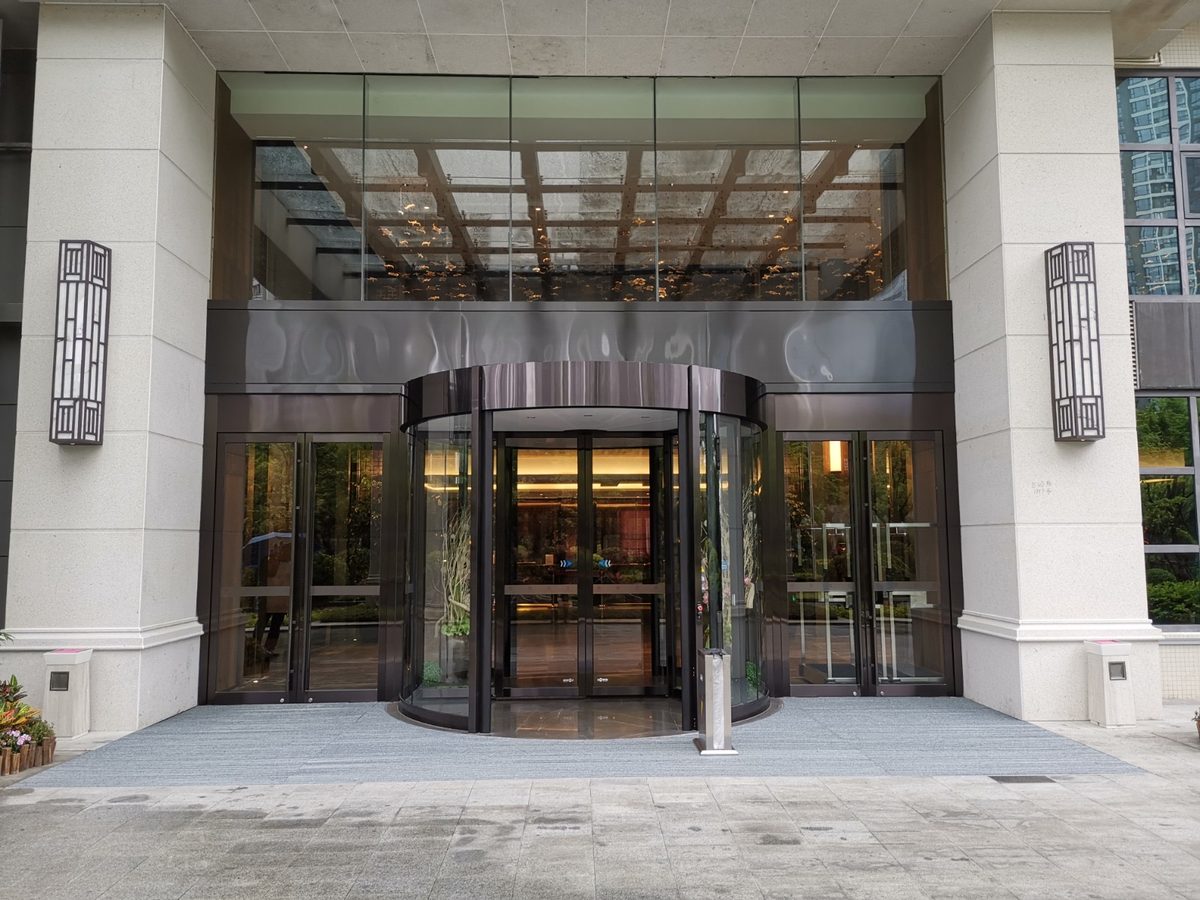
People in and out at the same time, and the lobby never fully open to the street. Diameters from 2000 to 3800 mm, in three or four wings.
Overview
Why automatic revolving doors, and when not to
Automatic revolving doors are the only entrance that is never fully open. That is the whole point of them, and it is why they belong on lobbies where the doors would otherwise stand open all day.
Because the wings always close the opening behind you, conditioned air stays inside and street noise and dust stay outside. On a busy entrance that runs from opening to close, this is where the running-cost argument for automatic revolving doors is strongest.
They are not right everywhere. Automatic revolving doors need floor area, they need a considered approach on both sides, and they should be paired with a swing or sliding leaf alongside for deliveries, wheelchairs, prams and anyone who would rather not use it. We will say so if your opening suits a sliding entrance better.
- Three or four wings — three moves more people, four seals the opening more tightly
- Central control with a combination operation panel
- Rotation program setting speed and behaviour for the entrance
- Anti-pinch sensor device on the moving wings
- Finishes — a range of colour and surface options to suit the lobby
- Heights made to the opening rather than a fixed set
Applications
Where automatic revolving doors earn their floor space
Commercial lobbies
The entrance is the first thing the building says, and it runs all day without letting the lobby out.
Hotels
Arrivals and departures crossing at once, with the foyer temperature held.
Banking and corporate
Controlled, orderly flow through a single opening.
Shopping centres
High-traffic mall entrances where conditioned air is expensive to lose.
Airports and transport
Constant two-way movement with luggage.
Hospital main entrances
Always paired with an accessible leaf alongside for beds, trolleys and wheelchairs.
Technical specification
Terminals are where this argument is strongest: large internal volumes and kerbside wind make pressure difference a daily problem. See airport automatic doors for how that shapes the entrance specification.
MC-R30 automatic revolving doors specification
| Specification | MC-R30 |
|---|---|
| Diameter | 2000–3800 mm |
| Wings | 3 or 4 leaf |
| Height | Made to the opening |
| Control | Central control computer with combination operation panel |
| Rotation | Programmable rotation behaviour |
| Safety | Anti-pinch sensor device on the wings |
| Finishes | Range of colour and surface options |
| Supply | Supplied, installed, commissioned and serviced |
Revolving entrances are quoted per project. Diameter, wing count, height, finish, safety devices and the accessible leaf alongside are all decided against the building and its traffic, so we confirm the specification from a site assessment rather than from a table. Where a figure is not listed here it is because we do not hold it in writing — ask and we will confirm it properly rather than estimate.
Safety and access
A moving wing is a moving wall
Everything about automatic revolving doors is designed around the fact that the wings sweep through space people occupy. Anti-pinch sensing on the wings stops the drive rather than pushing through, and the rotation program sets a speed appropriate to who actually uses the entrance.
An accessible leaf alongside is not optional in our view. Beds, trolleys, wheelchairs, prams, deliveries and anyone uncomfortable with a revolving door all need another way in, and it should sit next to the drum rather than round the corner.
Requirements for powered pedestrian doors in South Africa are published through SABS.
Supply, install, service
One supplier for the whole entrance
We supply, install, commission and service automatic revolving doors across South Africa from our Laser Park facility in Johannesburg, and we service automatic doors from other manufacturers too.
- Our own technicians install and commission the door
- Service intervals set against cycles, not the calendar
- Sensor testing as routine work at every visit
- Access control and the adjacent leaf specified together
See also automatic sliding doors, the MCW-100 swing door operator, or spare parts and multi-brand service.
Questions
Frequently asked
What size automatic revolving doors do you supply?
The MC-R30 covers diameters from 2000 to 3800 mm, in three or four wings, with the height made to the opening.
Three wings or four?
Three wings move more people for a given diameter; four wings close the opening more completely and hold conditioned air better. Which is right depends on whether throughput or sealing matters more at your entrance.
Do I still need another door next to it?
In our view yes. Beds, trolleys, wheelchairs, prams and deliveries need an accessible leaf alongside, and so does anyone who would simply rather not use a revolving door.
What stops it catching somebody?
An anti-pinch sensor device on the wings, with the rotation program set to a speed suited to the people actually using the entrance.
Do you service automatic revolving doors you did not install?
Yes. We service and repair automatic doors from other manufacturers as well as our own.
Integration
Backup power and access control
Fail-open or fail-secure behaviour, battery backup and the manual release are decisions about the building rather than the operator, so they are settled before automatic revolving doors is ordered. Readers, push buttons, intercoms and time clocks are specified at the same time, because the cable route is open while the header is being fitted.
Options
Which configuration suits the opening
For automatic revolving doors the decision follows the opening rather than preference. Single sliding is the everyday answer; bi-parting halves the travel on the busiest entrances; telescopic suits a narrow wall; swing operators automate hinged doors; revolving and hermetic entrances answer particular problems and are never priced unseen.
- MC-125: up to 150 kg single leaf or 2 × 120 kg bi-parting, 1450–5000 mm.
- MCW-100: hinged doors to 1,200 mm / 150 kg (interdependent).
- Imported and assembled at Laser Park, Johannesburg, with a 24-month operator warranty.
Specification
How the job is specified
A survey for automatic revolving doors is short but specific: opening width and height measured to the structure, the condition and support of the head, what runs above the ceiling line, the power position, and how people approach the doorway. Those notes become the specification on your quotation, and the written specification is what governs the job.
Revolving and hermetic entrances are never priced unseen. Where a site visit carries a charge, we say so before attending rather than afterwards.
Who carries out the installation?
Our own technicians, or technicians working under our instruction. We commission the entrance on completion and demonstrate its operation before handover.
Are the operators made in South Africa?
The MC-125 and MCW-100 are imported and assembled at our Laser Park facility in Johannesburg, where spares and technical support are held locally.
What warranty applies to the operator?
The MC-125 and MCW-100 carry a 24-month (two-year) warranty. The warranty that applies to your installation is the one recorded on your quotation and invoice.
In short
Automatic revolving doors at a glance
- Automatic revolving doors are quoted against the opening we measured, not a catalogue price.
- Ask about automatic revolving doors and we confirm the opening, the head and the power position first.
Sizing a revolving entrance to the traffic it carries
Diameter is the decision that governs everything else on automatic revolving doors, and it is set by two things pulling in opposite directions: how many people have to pass through at the busiest moment, and how much floor the lobby can give up.
The MC-R30 covers 2000 to 3800 mm in three or four wings. A smaller diameter suits an office or hotel entrance with steady rather than surging traffic. A larger one is what a lobby needs when a lift bank empties, or when people arrive with luggage, trolleys or cases that will not fit a narrow segment.
Wing count changes the character as much as the size. Three wings give larger segments, which suits luggage and pushchairs and feels more generous. Four wings give a better air seal, because there is always a wing closing off the outside, which matters most where the entrance exists to stop conditioned air leaving the building.
Where the traffic genuinely surges — a stadium, a shift change, an event venue — automatic revolving doors on their own are usually the wrong answer. They meter people at a steady rate by design, and that is a virtue on a lobby and a problem on a crowd.
The energy case, honestly
The reason most buildings specify automatic revolving doors is the air seal, and it is a real effect rather than a marketing one.
A sliding or swing entrance opens a hole in the elevation every time somebody passes, and on a busy doorway that hole is open a large fraction of the day. Heated or cooled air leaves through it and outside air comes in, which the building then has to condition again. A revolving entrance never presents an open aperture: there is always a wing between inside and outside, so the exchange is limited to the volume carried around in the segment.
That matters most where the temperature difference is largest and the traffic is heaviest — a Highveld winter morning, a coastal summer afternoon, a lobby with a lift bank behind it. It matters least on a doorway used twenty times a day, where the saving will never repay the floor space.
The honest test is footfall against floor area. Where both are high, automatic revolving doors pay for themselves. Where footfall is low, a well-specified sliding entrance with a lobby does the same job for less money and less floor.
Safety around a moving wing
A revolving wing is a moving wall, and the safety thinking is different from a sliding or swinging leaf because people are inside the mechanism rather than beside it.
The pinch points are where a wing meets the drum wall and where it meets the centre shaft, and anti-pinch sensing covers those. Vertical sensing on the leading edge detects somebody the wing is about to catch. Presence sensing in the segments stops the door rather than carrying somebody around who has stopped walking.
Speed is a specification decision, not a preference. A drum turning at a comfortable pace for an unencumbered adult is too fast for somebody with a stick, a case or a child, and automatic revolving doors in a building with mixed users are set down rather than up. Push-and-slow and stop functions belong on the specification for the same reason.
Every building with a revolving entrance also needs an alternative for people who cannot use it — wheelchairs, large deliveries, anyone uncomfortable in the drum. That is usually a pass door beside the revolving unit, and it is part of the entrance rather than an afterthought.
Quick answers on automatic revolving doors
- Automatic revolving doors from us are the MC-R30, 2000 to 3800 mm diameter.
- Automatic revolving doors come in three or four wings; four seals better, three carry luggage better.
- Automatic revolving doors never present an open aperture, which is the whole energy case.
- Automatic revolving doors meter traffic steadily, so they suit lobbies and not crowd surges.
- Automatic revolving doors need a pass door beside them for anyone who cannot use the drum.
- Automatic revolving doors carry anti-pinch sensing at the drum wall and the centre shaft.
- Automatic revolving doors are set to the slowest user, not the average one.
- Automatic revolving doors carry a 24-month warranty on the operator; sensors are quoted separately.
What a revolving entrance needs around it
Automatic revolving doors are the most demanding entrance type to site, because the drum has to sit in a lobby that suits it rather than simply in a hole in a wall.
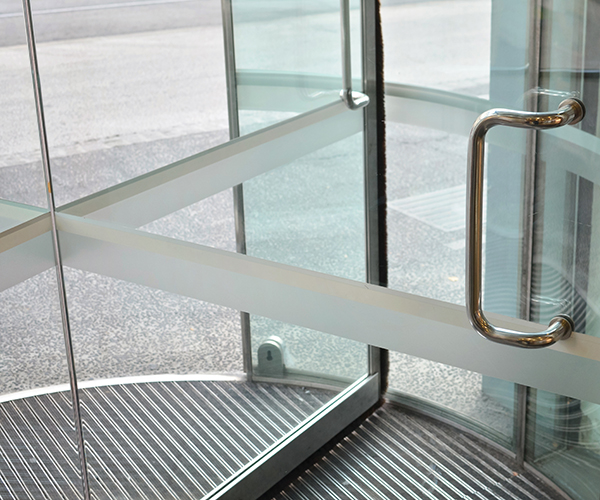
The approach on both sides needs clear run-off. People leaving the drum have to have somewhere to go; a revolving entrance opening directly onto a lift lobby or a stair creates a pinch that has nothing to do with the door. Inside, a mat run long enough to take grit off shoes protects the floor track, which on a revolving unit carries the whole weight of the wings.
The floor itself matters more than on a sliding entrance. The drum is a circle, and the floor within it has to be level and to stay level; settlement that a sliding threshold would tolerate shows up as a wing binding at one point in its rotation.
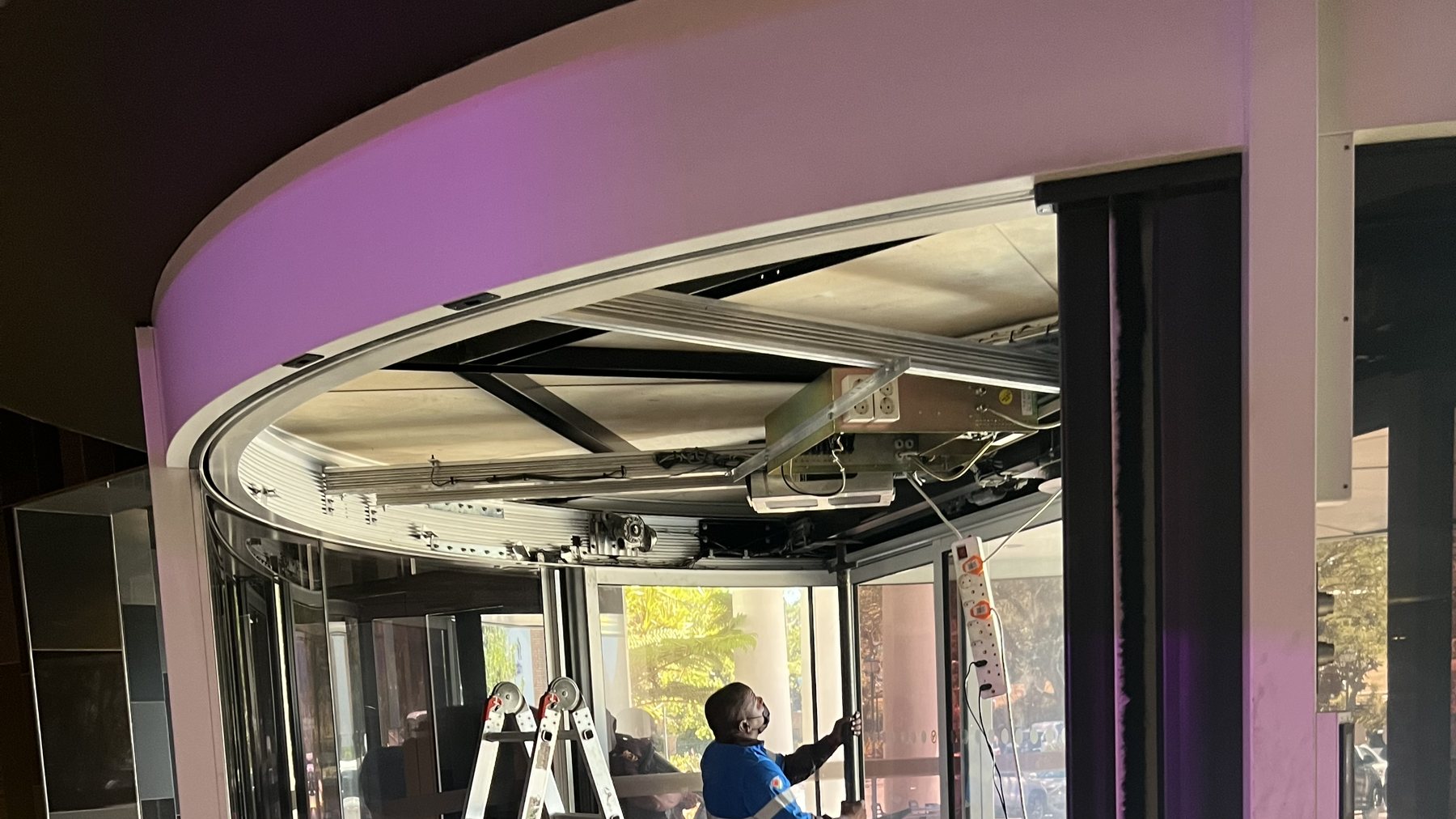
Above the drum, the canopy carries the drive and the sensing, and it needs both structural support and access for servicing. A canopy that cannot be opened without scaffolding turns an ordinary service visit into an event.
Finally, the pass door beside the unit is part of the entrance rather than an extra. It carries wheelchairs, deliveries, prams and anybody who simply will not use a drum, and it needs its own activation, its own locking and its own place in the fire strategy.
Servicing and what wears on a revolving unit
Automatic revolving doors have fewer catastrophic failures than sliding entrances and more slow deterioration, which makes the service interval more important rather than less.
The floor track and the wing bottoms take the grit, and that is where most wear appears. The drive and the speed governor are checked because a drum that has crept faster over a year is a drum that is now too fast for its slowest user. Seals along the wing edges and the drum wall are inspected because they are the entire energy case; a revolving entrance with failed brush seals has become an expensive sliding door.
The safety sensing gets proved rather than inspected. Anti-pinch at the drum wall and the shaft, vertical sensing on the leading edge, presence detection in the segments — each is walk-tested at handover and at every visit, because a revolving entrance that has lost a sensor still turns and still looks entirely normal.
Intervals follow the cycle count rather than the calendar, and everything set is written down so the next visit starts from a baseline. We service automatic revolving doors on any major brand, not only units we supplied.
What to send us to price a revolving entrance
Automatic revolving doors are surveyed more often than they are quoted from a drawing, because the lobby matters as much as the opening. Five things get the conversation to a useful place first.
- The internal diameter you can give the drum, measured to the first obstruction on each side rather than to the corner.
- The floor-to-canopy height available, and whether the structure above will carry the drive.
- An honest count of people through the entrance at its busiest fifteen minutes.
- Whether a pass door sits beside it already, and whether the fire strategy relies on that route.
- What is immediately inside and outside — a lift bank, a stair, a step, a road — since run-off decides whether the entrance is comfortable.
From that we can say whether automatic revolving doors suit the position, which diameter and wing count fit, and what has to be confirmed before an order. Where the honest answer is a sliding entrance with a lobby, we will say so.
Planning a revolving entrance?
Send us the opening, the floor area available and an idea of the traffic the lobby carries, and we will come back with a diameter, wing count and the accessible leaf alongside, quoted with installation and commissioning.