
Product brochure
Automatic revolving door brochure: the MC-R30
This automatic revolving door brochure sets out what the MC-R30 is, what is fixed about it and what is decided per project — diameter, wing count, control, safety and finishes. Written to be printed, saved as a PDF or attached to a tender.
The MC-R30 is the revolving entrance MC Automations supplies, installs, commissions and services in South Africa. A revolving door is different from every other product in this range in one important way: it is not a catalogue item with a fixed size. It is built to the opening. This automatic revolving door brochure therefore separates the figures that are fixed from the decisions that are made per project, so you can specify without guessing.
How to use this automatic revolving door brochure
Read the specification block as an envelope rather than an order form. Diameter runs 2000 to 3800 mm and the door is either 3-leaf or 4-leaf; height is made to the opening. Everything else — finish, safety devices, the accessible leaf alongside, rotation behaviour — is decided against the building and its traffic. We confirm the specification from a site assessment, not from a table.
Use the print button at the top of this automatic revolving door brochure to produce a clean PDF. The print layout strips navigation, buttons and pop-ups, leaving the specification and the diagrams.
What a revolving entrance actually does
Most people assume a revolving door is an architectural gesture. It is really a building services decision. A sliding or swing entrance opens a channel between inside and outside on every single cycle; a revolving door never does. There is always a wing between the lobby and the street, which is why revolving entrances turn up on tall buildings, on air-conditioned lobbies and on any entrance where stack effect makes a conventional door hard to control.
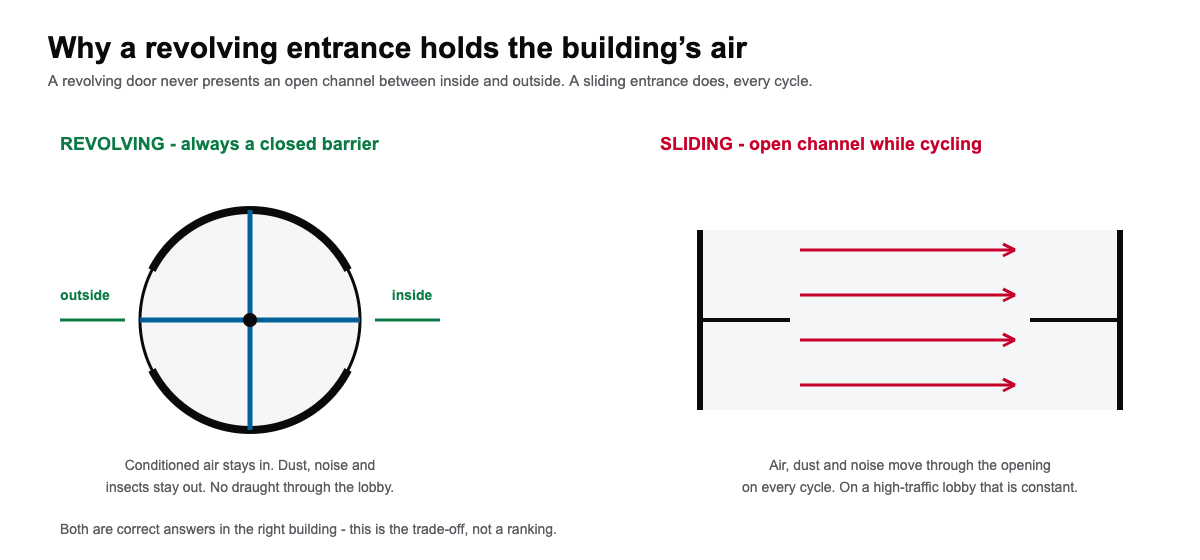
That single property drives the rest of the case for one. Conditioned air stays in the building, which shows up on the running cost of the HVAC plant rather than on the door invoice. Street noise, dust and insects stay out. And the draught that makes a lobby with a busy sliding entrance uncomfortable in winter simply does not occur.
Automatic revolving door brochure: MC-R30 specification
Revolving entrances are quoted per project. Diameter, wing count, height, finish, safety devices and the accessible leaf alongside are all decided against the building and its traffic, so we confirm the specification from a site assessment rather than from a table. Where a figure is not listed here it is because we do not hold it in writing — ask and we will confirm it properly rather than estimate.
Three leaves or four
This is the first real decision and it is a trade-off between throughput and sealing. Both options sit within the same 2000 to 3800 mm diameter range.
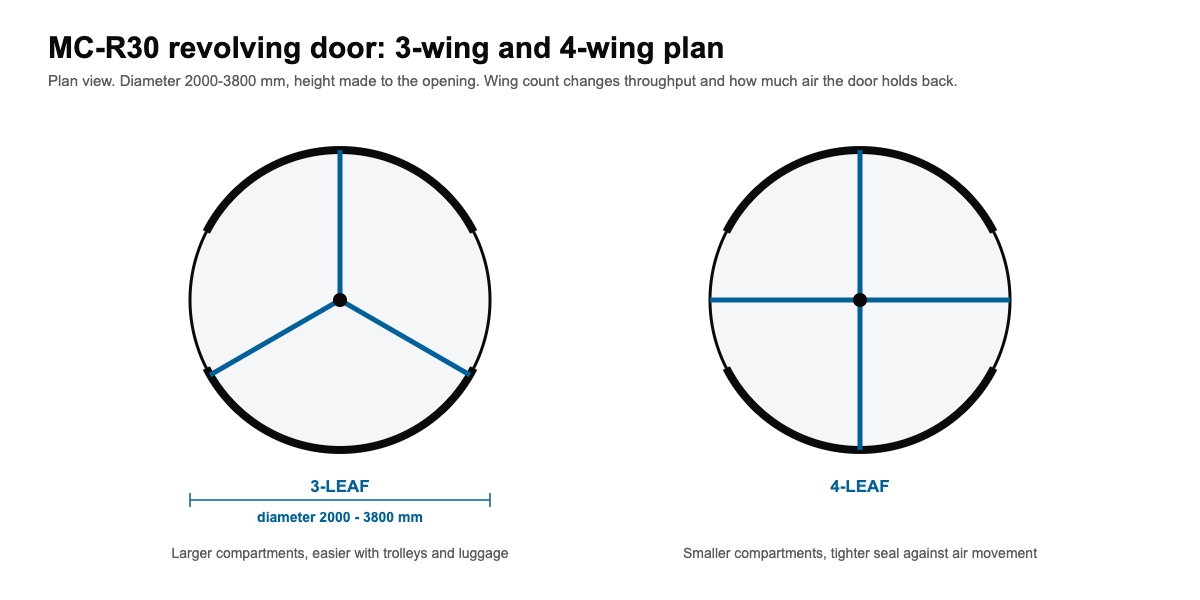
- Three leaves create larger compartments. That suits an entrance where people arrive with luggage, trolleys or prams, because there is simply more room in each segment.
- Four leaves create smaller compartments and a tighter separation between inside and outside, so the air-sealing argument is stronger. It also feels more contained to walk through.
- Diameter then follows from expected traffic and from what the facade can physically accommodate. A larger drum moves more people per rotation but consumes more lobby.
Automatic revolving door brochure: safety and the accessible leaf
A moving wing is a moving wall, and that has to be designed for rather than assumed away. The MC-R30 carries an anti-pinch sensor device on the wings, and rotation behaviour is programmable so speed can be matched to the traffic the entrance actually carries rather than left at a factory default.
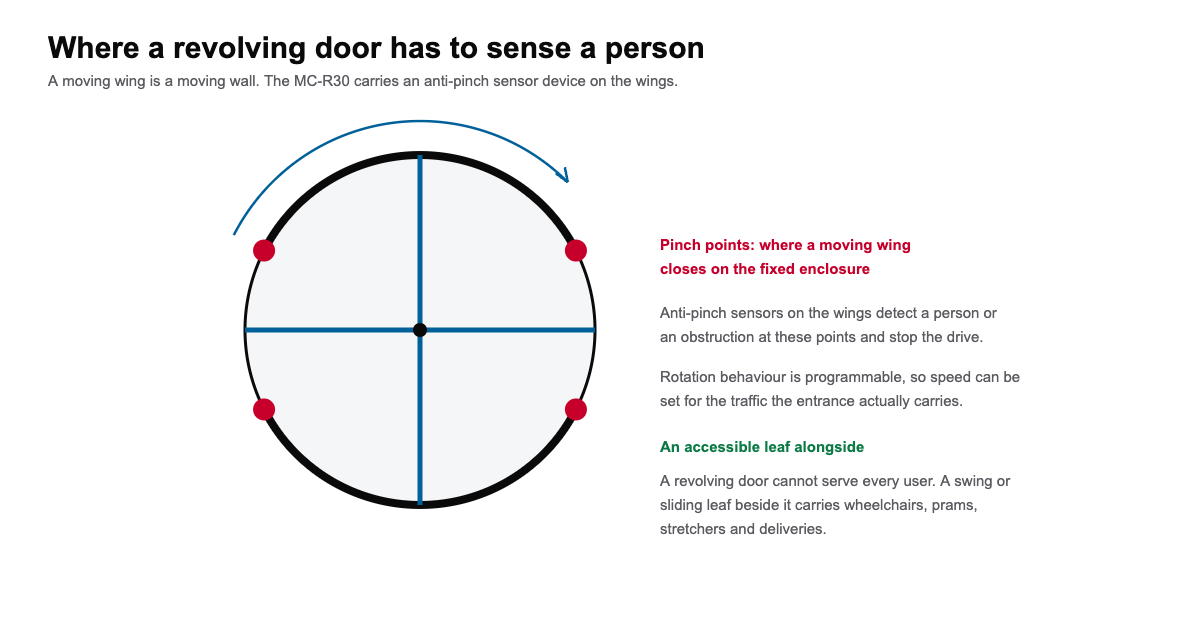
The second half of the safety picture is not a sensor at all. A revolving door cannot serve every user. Somebody in a wheelchair, a parent with a pram, a porter with a stretcher or a courier with a pallet truck needs a conventional leaf, and that leaf has to be beside the revolving door rather than somewhere else on the facade. We treat the accessible leaf as part of the entrance rather than as an accessory, and it is one of the first things we raise at enquiry stage.
When not to specify a revolving entrance
It is worth being direct about this, because a revolving door specified into the wrong building becomes an expensive complaint.
- Where goods move through the entrance. If deliveries, stock or equipment routinely pass through the main door, a revolving entrance will be propped, bypassed or damaged.
- Where there is no room for the accessible leaf. If the facade cannot take a conventional door beside the drum, the revolving door is the wrong answer.
- Where traffic is low. The air-sealing benefit scales with how often the entrance is used. On a quiet entrance the case largely disappears.
- Where the lobby is shallow. A drum needs depth in front of and behind it; dropping one into a tight lobby creates a pinch in the circulation rather than solving one.
Control and rotation behaviour
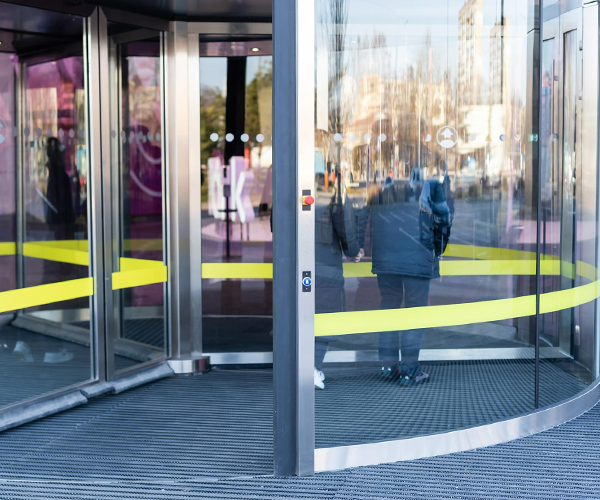
The MC-R30 runs from a central control computer with a combination operation panel. In practice that panel is how a building actually manages the entrance day to day: setting the mode for opening hours, slowing rotation when the lobby is quiet, and stopping the door outside trading hours.
Rotation behaviour being programmable matters more than it sounds. An entrance that rotates at a comfortable speed for an unhurried office arrival is not the same setting that suits a shopping centre at peak. Because it is programmable, the same door serves both without a hardware change — and, importantly, it can be slowed after commissioning if the building tells us the speed is not right for its users.
What we need to quote a revolving entrance
Because the door is built to the opening, a quotation needs the opening. The items that make the difference are the structural opening width and depth, the finished floor level and what the floor is built of, the height available to the underside of the structure, the facade line and glazing arrangement, expected peak traffic, and where the accessible leaf can go. Photographs of the existing entrance are worth more than a description.
Automatic entrances in South African buildings are designed against the SANS 10400 series supporting the National Building Regulations; copies are published by the South African Bureau of Standards. We will tell you which requirements apply to your opening, and we do not publish a certification claim we cannot evidence.
Installation: what the building has to provide
A revolving entrance is a structure, not an appliance. The drum, the enclosure and the canopy above it have to be carried by something, and that load path needs to exist before the door is ordered rather than be discovered during installation. On a new build this is straightforward because it can be designed in. On a retrofit into an existing facade it is the item most likely to change the programme, because the opening usually has to be altered to take it.
Floor condition matters more here than on any other door in this range. The wings sweep close to the finished floor, and the gap between the bottom of the wing and the floor has to stay consistent all the way round. A floor that falls a few millimetres across the drum, or a screed that was poured to a tolerance nobody checked, produces a door that catches at one point of its rotation and runs clear everywhere else. Where floor finishes are still to be laid, the finished floor level has to be agreed and held.
Power and control cabling terminate at the drum, and the control computer needs somewhere accessible to live — not somewhere that will be sealed behind a finish once the lobby is complete. It sounds obvious, and it is still the most common thing we have to correct on site.
Glass, finishes and how the door meets the facade
Finishes are available in a range of colours and surface options, and on a revolving entrance that decision carries more weight than it does elsewhere, because the door is usually the visual centre of the facade. The enclosure, the wings, the canopy and the accessible leaf beside it all read as one assembly from outside, and a finish chosen for the revolving door alone can leave the adjacent leaf looking like an afterthought.
The junction between the drum and the surrounding glazing is the detail worth resolving early. A revolving door dropped into a facade without that junction designed will show it: mismatched sightlines, awkward closer panels and a threshold that does not align with the glazing grid. Where an architect is involved we would rather have that conversation at design stage than at handover.
Night closing and out-of-hours security
An entrance has to be secured when the building is shut, and a revolving door does not lock the way a conventional leaf does. The rotation is stopped and the drum is secured, which is managed from the combination operation panel as part of the daily mode routine rather than by a key in a cylinder.
This is worth thinking through against how the building actually runs. If cleaners, security or early staff need access before the entrance opens, that access comes through the accessible leaf beside the drum, and that leaf therefore needs its own access control and its own locking. Buildings that plan the revolving door carefully and treat the adjacent leaf as an afterthought tend to end up propping something open, which defeats both the security and the air-sealing case for the entrance.
Maintenance: what actually wears
On a revolving entrance the wear items are not the ones people expect. The drive and the bearing carry a constant, well-distributed load and are generally undramatic. What needs attention is the sensing and the seals: the anti-pinch devices on the wings, the brush seals between the wings and the enclosure, and the alignment of the wings relative to the drum.
Brush seals are the quiet one. They are what actually delivers the air separation the door was specified for, and they wear steadily and invisibly. A revolving entrance that has become draughty has usually not developed a fault — its seals have simply worn, and the building notices the symptom long before anybody connects it to the cause. Replacing them is routine maintenance rather than a repair.
Because the door is commissioned on site, service visits also confirm that the settings are still correct for the building. Rotation speed set for a quiet office lobby will be wrong if the tenancy changes and traffic doubles.
Automatic revolving door brochure: terms used above
- Drum — the circular enclosure the wings rotate inside.
- Wing (or leaf) — one of the three or four moving panels that sweep the drum.
- Compartment — the space between two wings that a person occupies while passing through.
- Anti-pinch sensor — the device on the wings that detects a person or obstruction where a moving wing closes on the fixed enclosure, and stops the drive.
- Accessible leaf — the conventional swing or sliding door beside the drum, for users a revolving door cannot serve.
- Brush seal — the seal between wing and enclosure that delivers the air separation. A wear item.
- Combination operation panel — the control interface used to set the door’s mode, speed and night closing.
Service, spares and what this brochure does not claim
A revolving entrance is supplied, installed, commissioned and serviced by us. It is the product in this range where commissioning matters most, because rotation speed, sensor coverage and the interaction with the accessible leaf are all set on site rather than in a factory. Maintenance intervals are set against the traffic the entrance carries.
- No throughput figure, wind-load rating, air-leakage figure or energy saving is claimed anywhere in this automatic revolving door brochure. Those numbers depend on the building, and we do not hold generic ones in writing.
- No certification or third-party approval is claimed. Where a project requires evidence against a standard, ask at enquiry stage and we will obtain it in writing or tell you plainly that we cannot.
- Diameter and wing count are an envelope confirmed by site assessment, not a menu to order from.
How a revolving entrance is priced
There is no list price for a revolving door, and any supplier quoting one from a brochure is quoting a different door to the one your building needs. The cost is driven by four things, roughly in this order: the diameter and wing count, the height to the underside of the structure, the finish specification across the drum and canopy, and the amount of builders work needed to make the existing opening take the assembly.
That last item is the one that varies most and the one most often left out of a comparison. On a new build where the opening was designed for the door, it is minimal. On a retrofit into a facade that was never intended to carry a drum, structural alteration can rival the cost of the door itself. When you compare quotations, check that each one includes the same scope of builders work, because a cheaper door with the structural work excluded is not a cheaper entrance.
The accessible leaf beside the drum should also appear in every quotation you compare. If one supplier has included it and another has not, the two prices are not describing the same entrance.
Automatic revolving door brochure: frequently asked
What size revolving door can you supply?
Diameter runs from 2000 to 3800 mm, in a 3-leaf or 4-leaf configuration. Height is made to the opening.
Three wings or four?
Three leaves give larger compartments, which suits luggage, trolleys and prams. Four leaves give smaller compartments and a tighter separation between inside and outside.
Is a revolving door accessible?
Not on its own. A conventional swing or sliding leaf is required beside it for wheelchairs, prams, stretchers and deliveries, and we treat that leaf as part of the entrance.
How does it stop on somebody?
The MC-R30 carries an anti-pinch sensor device on the wings, and rotation behaviour is programmable so speed can be set for the entrance rather than left at a default.
Why choose revolving over a sliding entrance?
Because a revolving door never opens a channel between inside and outside. Conditioned air, noise and dust are held back on every cycle, which matters most on tall or air-conditioned buildings.
Can you give me a price from this brochure?
No, and we would be guessing if we did. Revolving entrances are quoted per project from a site assessment, because the door is built to the opening.
Specifying from this automatic revolving door brochure?
Send us the opening dimensions, the traffic you expect and where an accessible leaf could sit, and we will confirm the configuration in writing after a site assessment.
In short
Automatic revolving door brochure at a glance
- The automatic revolving door brochure carries no price list: an automatic revolving door is quoted against the opening we measured, not a catalogue price.
- Ask about an automatic revolving door and we confirm the opening, the head and the power position first.
- Automatic revolving doors are installed and commissioned by our own technicians.
- An automatic revolving door carries a 24-month warranty on the operator.
- Spares for every operator in this automatic revolving door brochure are held in Johannesburg, so a repair does not wait on an import.
- Send the opening size and a photograph and we can quote against a real entrance rather than an assumption.
- Service intervals in the automatic revolving door brochure are set against cycle count rather than the calendar.
- Commissioning ends with the speed, hold-open and force settings written down.
- We also service and repair automatic revolving doors supplied by other companies.
- Prices for automatic revolving doors exclude VAT unless the quotation states otherwise.
- Everything in this automatic revolving door brochure comes from the operator documentation we hold; nothing is estimated.