
Breakdowns and faults
Automatic door repairs, on any major brand
Automatic door repairs across South Africa, on doors we installed and on doors we did not. Tell us what the entrance is doing and a technician arrives with the part that fits the fault, not a diagnosis and a second visit.

Diagnosis
Describe what the door is doing, not what you think is wrong
Most automatic door repairs are decided before anyone arrives. Four descriptions cover the majority of call-outs, and each points at a different part of the entrance.
An entrance that opens but will not close is almost never the same fault as one that closes and immediately reopens, even though both look like “the door is broken” from the shop floor. Telling us which one it is, and sending a photograph of the operator housing and any error light on the controller, is usually the difference between a first-visit fix and a return trip.
Parts
Where the entrance is a slider specifically, our write-up on automatic sliding door repair goes through what actually breaks on a sliding entrance — belts, carriages, floor guides and sensing — and what each repair involves.
Automatic door repairs on brands other than ours
We service and repair all major automatic door brands. Our own MC-125 and MCW-100 parts sit alongside third-party spares in Johannesburg, so a competitor’s operator is not a reason to quote a whole new entrance.
Where a part is obsolete and no longer manufactured by the original supplier, we will say so rather than fitting something that does not belong. In those cases replacing the drive and keeping the existing shopfront is usually the cheaper route — see service and modernisation.
Response
How an automatic door repair call-out runs
Breakdowns do not keep office hours, which is why the technical support line stays open outside them.
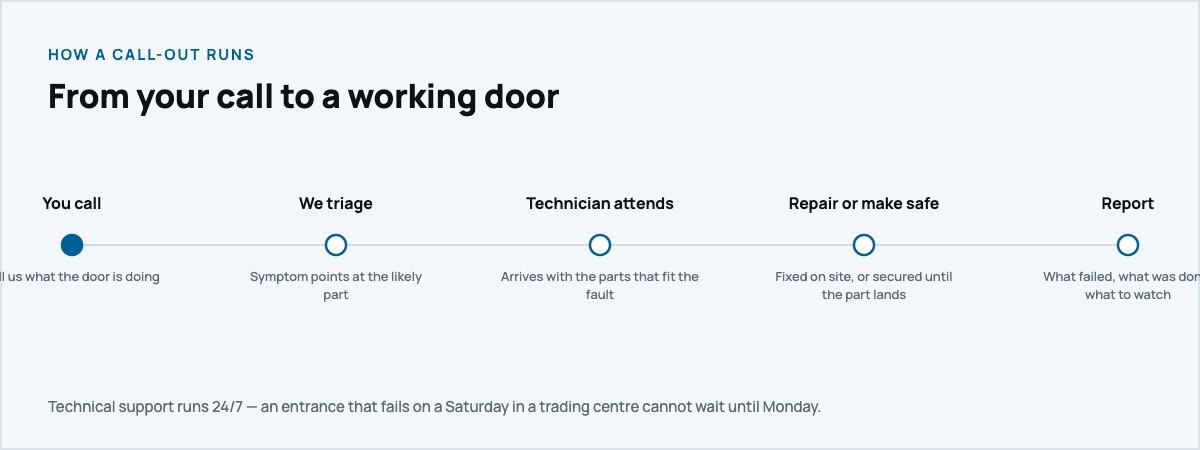
If the entrance cannot be repaired on the visit — a controller on back-order, or damage that needs glass — we make the opening safe and secure so the building can keep trading, and come back with the part.
Judgement
When automatic door repairs stop being worth it
There is a point where repeated automatic door repairs cost more than modernising the entrance. These are the signals we look for.
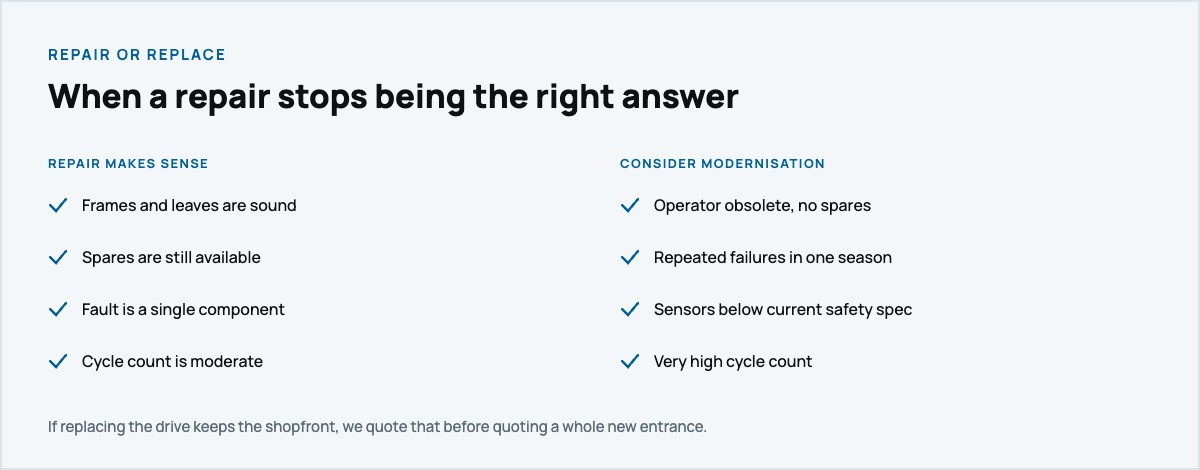
Sensors are the most common reason we recommend an upgrade rather than another repair: safety expectations have moved on, and an old presence sensor can pass a functional test while still leaving a gap a modern one would cover. Standards for powered pedestrian doors in South Africa are published through SABS, and the safety devices fitted to an entrance are specified against the requirement stated for the building.
Automatic door repairs on a trading site also carry a practical constraint that has nothing to do with the door: access. Shopping centres and hospitals frequently restrict work to specific hours, and a repair that would take an hour at 10am can take a night shift instead. We plan around the building rather than the other way round, and where a centre requires contractor onboarding we issue the documentation from our compliance and downloads page before attending.
Common questions
Automatic door repairs, answered
Do you repair doors you did not install?
Yes. Taking over an entrance another company installed is routine work for us, and we quote the repair on its own before suggesting anything larger.
How fast can someone attend?
Technical support runs 24/7 on the breakdown line. Attendance depends on where the building is and what the fault is; telling us the symptom lets us send the right technician first.
Do you carry parts for other brands?
We hold third-party spares alongside our own. Where a component is obsolete we say so rather than improvising a fit.
Can a repair be turned into a service agreement?
Yes. Most buildings that call us once move onto planned maintenance, which sets the interval against the cycles the door actually carries. See service intervals.
Comparing quotes
Reading a quotation properly
Compare the scope rather than the total. A quotation for automatic door repairs should state the opening it was priced against, the equipment it includes and the items it excludes — builders work, structural alteration, electrical supply to the entrance and making good are excluded unless the quotation says otherwise.
Changes after acceptance, to size, configuration, finish, controls or activation, are quoted as a variation before we proceed.
Safety
Sensors, safety and commissioning
Motion sensors open the door as somebody approaches and see movement rather than a standing person. Presence sensors hold it open while somebody is in the opening, which is what stops a door closing on a person who has paused. Safety beams and a force limit reverse the leaf if something is in the way.
We commission the door on completion and demonstrate its operation, including how to release or isolate it. Commissioning ends with the settings written down: opening and closing speed, hold-open time, force and the sensor layout. That record establishes the state the entrance was handed over in.
Maintenance
What planned maintenance covers
Intervals for automatic door repairs are set against the cycles the entrance actually carries. Each visit realigns the sensors, inspects the running gear, re-checks force settings and swaps wear parts. We service and repair other manufacturers equipment as well as our own, and where we take over a door somebody else installed we report its condition before committing to an interval.
Response times and visit frequency are defined in your service level agreement rather than assumed.
Do you service other manufacturers equipment?
Yes. Where we take over an entrance somebody else installed, we report its condition before committing to a maintenance interval.
Does the entrance work during load-shedding?
With a battery backup it keeps operating through a slot. Without one it parks in the fail-open or fail-secure state chosen for the building, and the manual release is demonstrated at handover.
How often should the entrance be serviced?
Against its cycle count rather than a fixed date. Intervals, response times and what is included are defined in your service level agreement.
For a symptom-by-symptom version of this, see our automatic door troubleshooting guide, which also sets out what is safe to check yourself before you call.
The faults we attend most, and what each one means
Most automatic door repairs fall into a short list. Knowing which one you are looking at before you call shortens the visit and often tells you whether the entrance can stay in service until we arrive.
- The door opens for nobody. Usually the activation sensor seeing something it should not — rain, a moving banner, traffic passing the doorway, or a field aimed too far out. Frequently an aim or setting correction rather than a part.
- The door will not open for people. Either the activation sensor has failed or the controller is not receiving its signal. The distinction matters, because one is a part and the other is wiring.
- The door will not close. Normally the presence sensor holding it, either because it has drifted or because something new sits inside its field. A display stand moved over the holidays causes more automatic door repairs than most people would credit.
- The door closes on people. A safety failure. Take the entrance out of automatic mode and have it attended the same day. This is not an inconvenience fault and it should never wait for a scheduled visit.
- The door is slow, noisy or juddering. Mechanical: worn carriages, a gritty track, a failed floor guide, or a leaf that has dropped. The controller often reads the extra resistance as an obstruction and reverses, which looks like a sensor fault and is not.
- The door works, then stops, then works. Intermittent faults are usually power, a failing controller input, or a connector that has corroded. These are the hardest to catch and the most worth describing carefully when you book.
None of that is a diagnosis over the phone. It is a way of making the first visit the only visit.
Making the entrance safe before we arrive
An entrance waiting for automatic door repairs still has people walking through it, and how it is left matters more than most building managers expect.
If the door is closing on people, or closing faster than somebody can clear the opening, take it out of automatic mode. Every operator we work on has a manual or off mode, and the handover documentation records how to reach it. If nobody on site knows how, call us and we will talk you through it.
If the leaf is jammed part-open, do not force it. A leaf that has come off its carriages or dropped in the track can fall, and forcing it converts a repair into a replacement. Cone the opening, use an alternative entrance if the building has one, and tell us the leaf is insecure when you book so the technician brings lifting help.
If the entrance sits on an escape route, its condition is a fire-safety matter rather than a convenience one. Tell us that when you call. It changes the priority of the attendance and it changes what we are allowed to leave behind at the end of it.
And if the door has simply stopped in the closed position on a secure site, that is usually the safest state to leave it in overnight. Say so, and we will plan the attendance rather than treating it as an emergency that needs somebody at midnight.
What parts actually cost
The largest variable in automatic door repairs is not labour, it is whether a part is needed and which one.
Sensors are the most commonly replaced item and their prices are published. The MC-DL8 motion sensor is R2 259,88 excluding VAT; safety sensors run from R2 777,90 for the Microcell One to R3 991,90 for the MC-507 and R4 112,23 for the MCW-100 unit. Catalogue pricing was last updated 29 July 2026 and is confirmed in writing against your operator before anything is ordered.
Wear parts — carriages, belts, floor guides, rollers — are quoted per operator because they are not interchangeable between makes. Controllers are the expensive end, and on an obsolete operator a controller failure is usually the moment the conversation turns from automatic door repairs to modernisation.
What we will not do is quote a part before we know which operator is in the header. A figure given without that is guesswork, and guesswork in a quotation is how a job ends up costing more than the number you were given.
Why the same fault keeps coming back
A repeat fault is information. When the same entrance needs automatic door repairs twice in a season, the second visit is rarely the same problem seen again — it is usually the first problem never having been addressed.
- A sensor replaced on a binding door. The new sensor is fine. The leaf still drags, the controller still reads resistance as an obstruction, and the entrance still misbehaves.
- Aim corrected without fixing the mounting. If vibration or a loose fixing is moving the sensor, re-aiming it buys weeks.
- Grit never dealt with. Track wear that arrives on boots and trolley wheels will keep arriving. A matwell that actually captures it is cheaper than the repairs it prevents.
- Impact damage treated as a one-off. If a trolley or pallet can reach the leaf, it will again. Bollards and guarding cost a fraction of the operator they protect.
- An entrance specified for lighter traffic than it carries. No amount of repair work fixes a specification mismatch. At that point the honest answer is a heavier operator, and we will say so.
This is why our visits record what was found and what was set, rather than just what was replaced. Two call-outs on one entrance in a season is a pattern; without a written record it reads as bad luck, and the underlying cause survives to cause a third.
Repairs on a portfolio of entrances
Managing one door is a maintenance task. Managing forty across several buildings is a different problem, and automatic door repairs on that scale reward a bit of structure.
The single most useful thing is a list: every entrance, what it is, what it serves, which operator is in the header, whether it sits on an escape route, and when it was last attended. That list turns reactive automatic door repairs into planned work, because it lets you see which entrances are consuming the budget and why.
Where the same operator model appears across several sites, holding one spare sensor or controller turns a two-day wait into a same-visit fix. We will tell you which part is worth holding for your particular estate rather than selling you a shelf of stock you will never use.
And where an entrance is genuinely critical — a hospital corridor, a single-entrance retail unit, a controlled area — say so up front. That entrance belongs on a different response tier from a back-office door, and agreeing that in advance is cheaper than negotiating it during a breakdown.
Out of hours, and what counts as an emergency
Not every fault needs somebody that evening, and treating every fault as urgent is expensive. Three things genuinely justify an out-of-hours attendance: a door closing on people, a leaf that is insecure, and an entrance on an escape route that cannot perform its function. Everything else is usually better attended in normal hours with the right part on the van.
Same-day call-outs are a Gauteng commitment. Outside Gauteng we attend on a scheduled basis and we will give you the realistic date rather than the hopeful one, because a technician who arrives without the part has not helped anybody. Spares are held in Johannesburg, which is the practical difference between a fault cleared on the visit and one that waits on a delivery.
When you book, tell us three things: the operator make and model from the label inside the header, what the door is actually doing, and whether the entrance can be taken out of service. Those three answers decide whether the right part travels with the technician.
Quick answers on automatic door repairs
- Automatic door repairs are attended on any major brand, not only operators we supplied.
- Automatic door repairs are same-day in Gauteng and scheduled elsewhere, nationwide.
- Automatic door repairs start with a walk test, because the symptom rarely names the cause.
- Automatic door repairs involving a door closing on people are safety faults and should not wait.
- Automatic door repairs commonly need no part at all: aim, setting and track cleaning fix a great many.
- Automatic door repairs on sensors run from R2 259,88 excl VAT, with prices confirmed before order.
- Automatic door repairs are quoted against the operator in your header, never from a catalogue guess.
- Automatic door repairs that repeat usually mean the first cause was never addressed.
- Automatic door repairs on an obsolete controller are the point to price modernisation instead.
- Automatic door repairs are recorded, so the next visit starts from a baseline rather than a guess.
In short
Automatic door repairs at a glance
- Automatic door repairs are quoted against the opening we measured, not a catalogue price.
- Ask about automatic door repairs and we confirm the opening, the head and the power position first.
- Automatic door repairs are installed and commissioned by our own technicians.
- Automatic door repairs carry a 24-month warranty on the operator.
The fastest route is to book a technician with a photograph of the header and a line on what the door is doing.
Entrance down right now?
Call the breakdown line and tell us what the door is doing. If it is not urgent, send a photograph and we will quote the repair.