
Office park automatic doors for landlords and managing agents: who owns which entrance, the access states a working week needs, the morning peak that sizes the lobby, standardising across an estate, and why maintenance recovery changes the contract.
Automatic Sliding Door Repair: What Breaks and What It Takes
Automatic sliding door repair is usually a smaller job than it feels like when the entrance has stopped working and customers are queueing. Very few faults are a failed operator. Most are a wearing part, a setting, or grit doing damage it has been doing quietly for months.
This guide covers what actually breaks on a sliding entrance, how to read the symptom before anyone attends, and when repair stops being the right answer.
 automatic sliding door repair” />
What actually breaks
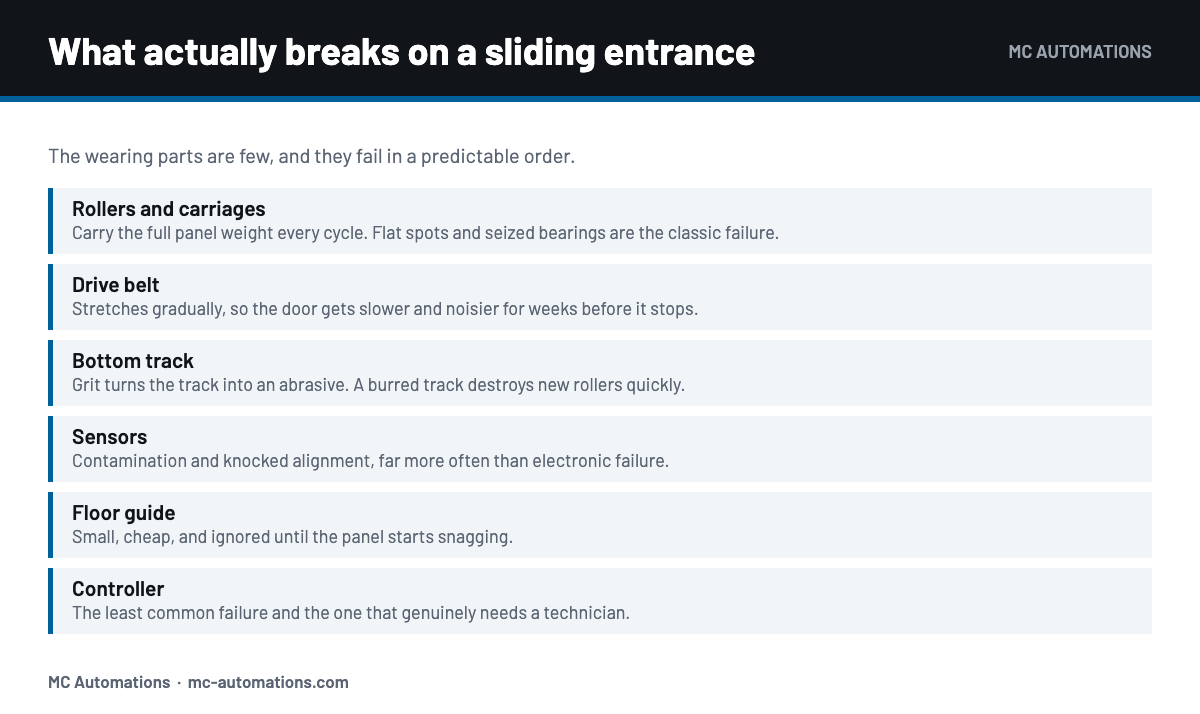
The wearing parts on a sliding entrance are few, and they fail in a fairly predictable order.
Rollers and carriages carry the entire glazed panel weight through every cycle of the door’s life. Flat spots and seized bearings are the classic failure, and you feel them as a regular bump as the panel travels.
The drive belt stretches gradually. That is why a door gets slower and noisier for weeks before it stops altogether, and why the noise is the warning worth acting on.
The bottom track is where grit collects, and grit is abrasive. This is the part most electric sliding door repair visits trace back to.
Sensors fail through contamination and knocked alignment far more often than through electronic failure.
The controller does fail, but it is the least common cause and the one that genuinely needs a technician.
Reading the symptom before anyone attends
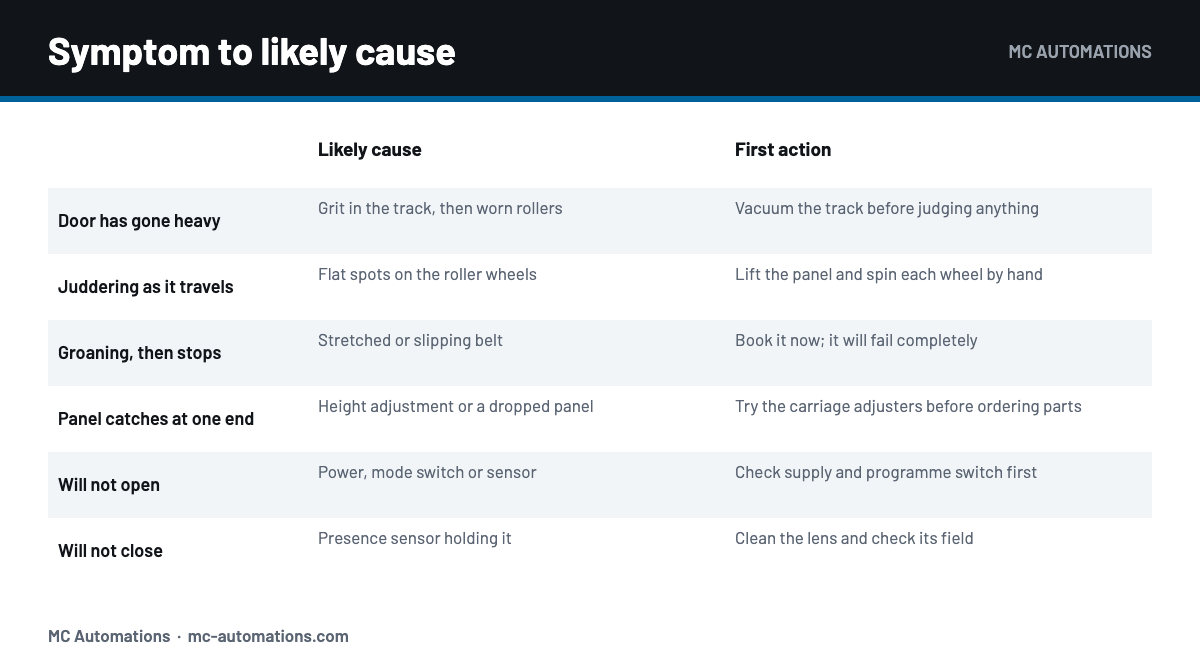
The specific behaviour narrows the cause considerably, and it decides which parts should be on the van.
A door that has gone heavy points at the track first and the rollers second. Juddering points at flat spots on the wheels. Groaning that ends in the door stopping points at the belt.
A panel that catches at one end is often height adjustment rather than wear, and the carriage adjusters are worth trying before ordering anything.
A door that will not open at all is usually power or the mode switch. A door that will not close is usually the presence sensor holding it. Those two are covered in detail in automatic door not opening and automatic door not closing.
Clean the track before you buy parts
This is worth its own section because of how often it is the whole answer.
Sand, leaf litter, packaging and general dust collect in the bottom track, and the door then grinds that material into its own wheels on every pass.
Vacuum the track completely and run the door. A meaningful share of automatic sliding door repair call-outs resolve at this point, and it costs nothing.
If the door is still heavy afterwards, then look at the rollers. And when you do, run a finger along the track itself. A burr, a dent or a section worn into a groove will destroy a new set of rollers as fast as you fit them, which is why some doors get through two sets in a year.
When the door fails during trading hours
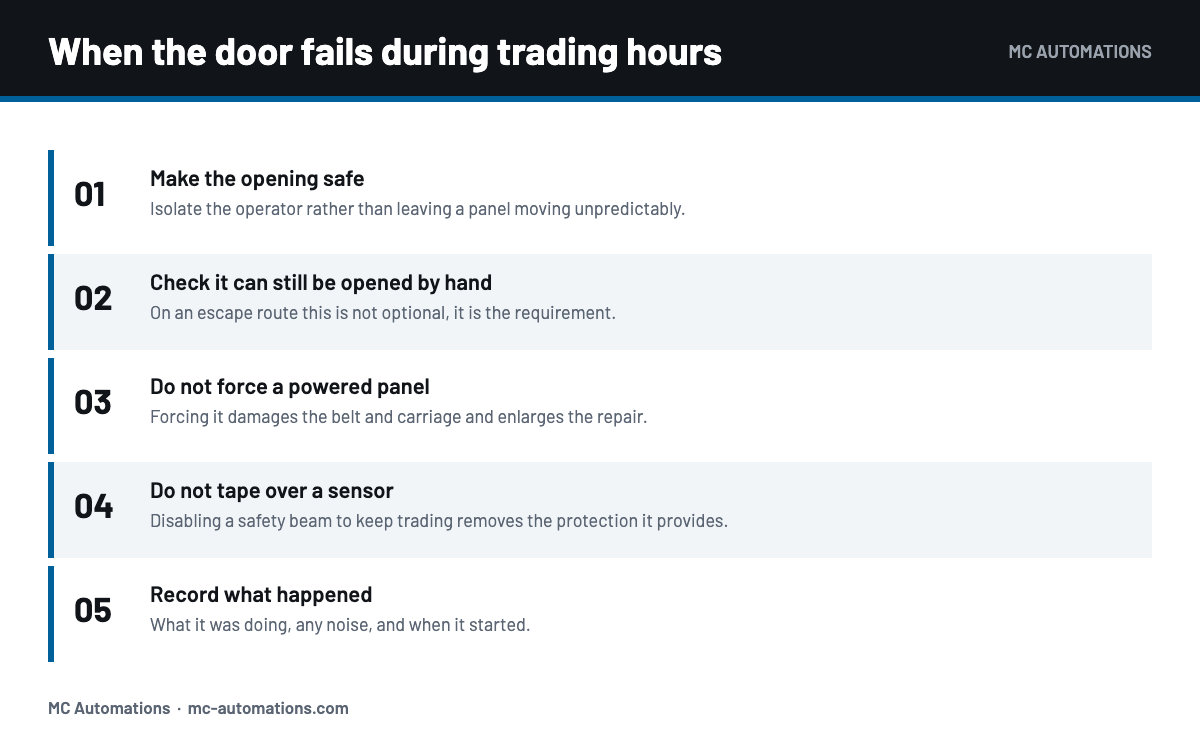
Make the opening safe first. Isolate the operator rather than leaving a panel moving unpredictably with people walking through.
Confirm the opening can still be opened by hand. On a fire escape route that is not a convenience, it is the requirement.
Do not force a powered panel. It damages the belt and the carriage and turns a small repair into a large one.
Do not tape over a sensor to keep trading. Disabling a safety beam removes the protection the sensor exists to provide.
Emergency release and break-out panels
Where an entrance forms part of an escape route it must be passable without power.
That is achieved with break-out panels, which swing clear under pressure, or a fail-safe release that unlocks the entrance when power is lost. Which one applies is a specification decision made at order stage rather than something retrofitted after a failure.
If you are not certain which your entrance has, that is worth establishing before you need it rather than during an evacuation.
Repair, modernise or replace
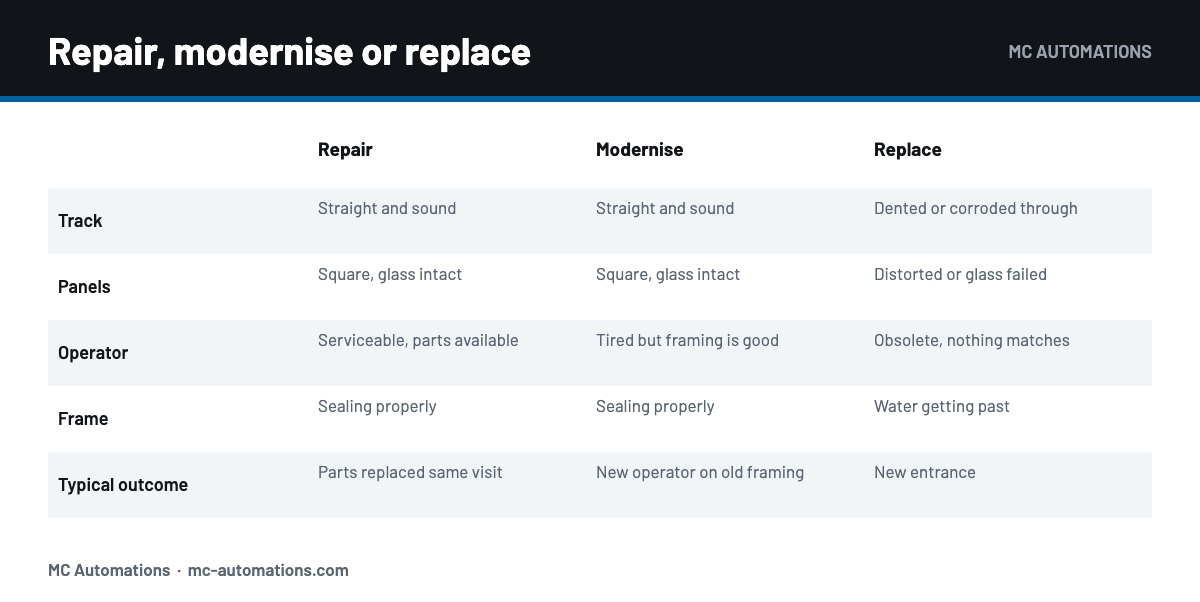
Repair while the track is straight, the panels are square, the frame is sealing and parts are still available. That covers most cases.
Modernise when the mechanism is tired but the header and track are sound. Fitting a new operator to existing framing is usually cheaper and faster than a new entrance, and it is the most common recommendation we make on older doors. See automatic door modernisation.
Replace when the track is dented or corroded through, the framing has moved, water is getting past, or the equipment is obsolete with nothing to match.
Age alone decides none of this. Condition does.
Getting the right parts to site first time
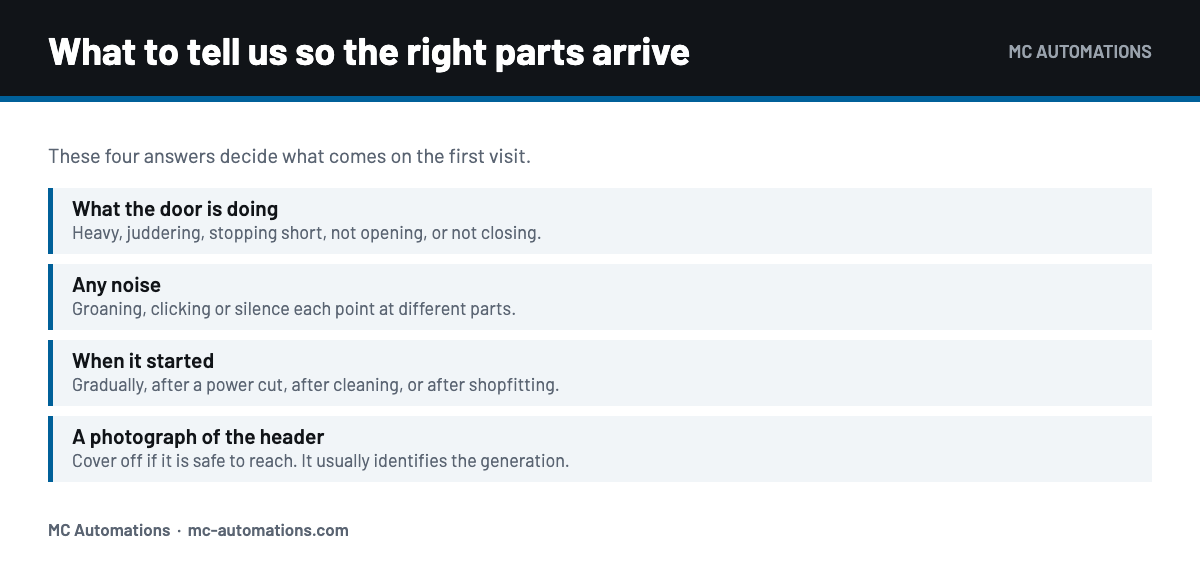
Four answers decide what arrives on the first visit: what the door is doing, any noise it makes, when it started, and a photograph of the header with the cover off if it is safe to reach.
We hold belts, rollers, guides, sensors and controllers locally because the MC-125 sliding operator and MCW-100 swing operator are imported and assembled at our own facility in Johannesburg. That is usually the difference between a same-visit repair and an entrance standing open for weeks.
Both operators are tested to one million operating cycles and carry a 24-month warranty on the operator. A cycle test is a test result, not a maintenance-free period.
Making the next repair further away
Vacuum the bottom track regularly. It is the single highest-value maintenance task on a sliding entrance.
Clean the sensor lenses with a soft cloth and walk-test the full opening width afterwards, not just the middle.
Keep the drainage slots clear so water does not stand in the track and work on the bearings from below.
Do not grease the track. Grease holds grit, which is the problem you are trying to avoid.
Service every six months as standard, with a shorter interval where retail footfall demands it.
Booking a repair
See automatic door repairs for our repair service, automatic door spare parts for components, and automatic door servicing for planned maintenance. Sites that cannot afford downtime should look at a service level agreement.
Request a quote or call 010 412 0062, Monday to Thursday 08:00 to 16:30 and Friday 08:00 to 14:00. We attend across South Africa, on our own equipment and on other manufacturers doors.
For published national standards, SABS, the South African Bureau of Standards is the reference body in South Africa.
Automatic sliding door repair: quick reference
Door heavy or dragging. Track contamination first, rollers second. Most automatic sliding door repair visits start and often end here.
Juddering as it runs. Flat spots on the wheels. Lift the panel and spin each one by hand.
Groaning then stopping. The belt. Book it rather than waiting for the failure.
Catching at one end only. Height adjustment or a dropped panel, not necessarily wear.
New rollers failing quickly. The track is damaged and is chewing them. Inspect its full length.
Emergency automatic door repair during trading. Isolate the operator, confirm the opening still works by hand, and never force a powered panel.
Repeated faults after shopfitting. Sensor coverage has been compromised by something new in its field.
Obsolete equipment. If nothing matches, modernisation onto the existing framing is usually better value than a full replacement.
Why the track matters more than the badge
It is tempting to judge an entrance by which manufacturer made it. In practice, how long a sliding door goes between repairs depends more on how clean its track is kept than on the name on the header.
Two identical entrances in the same centre, one vacuumed monthly and one never, will be in completely different condition after three years. The neglected one will have consumed several sets of rollers and quite possibly a track as well.
That is genuinely good news, because it means the largest single factor in your repair bill is something you control directly and it costs almost nothing.
Servicing versus repair
A repair restores a door that has already failed. A service is what stops that call happening at a time you cannot afford it.
A proper service covers track and rollers, belt tension, sensor cleaning and a full walk-test of the opening, obstacle detection force, and the battery backup where one is fitted.
Ask for the obstacle force to be measured rather than assumed. A leaf you can stop by hand without pain is in a sensible range, and that setting drifts over time.
Keep the dated records too. A service history is what lets you argue wear against defect if a warranty question ever arises.
Planning around trading hours
Some repairs cannot be done with the public walking through the opening, particularly anything involving the track or the panels.
Tell us at booking whether the entrance has to stay open, whether it is on a fire escape route, and whether the building has a facilities contractor who needs to sign off. Those three answers decide whether we attend in normal hours or after hours, and after-hours work carries a different rate that we would rather agree upfront than add afterwards.
When to call for automatic sliding door repair
Call for automatic sliding door repair immediately if the entrance is on a fire escape route and cannot be opened by hand.
Book automatic sliding door repair the same week if the door is groaning, juddering or has become noticeably heavier. Those are the warnings that precede a failure.
Book automatic sliding door repair before peak trading rather than during it, because after-hours attendance is easier to schedule in advance than at short notice.
An emergency automatic door repair is justified when the opening is unsafe, insecure overnight, or the only accessible entrance to the building.
Automatic sliding door repair is rarely urgent when the door is simply slower than it used to be, but that is exactly when it is cheapest to fix.
Automatic sliding door repair cost rises sharply once a worn roller has damaged the track, which is the argument for acting on noise early.
Skip the automatic sliding door repair call entirely if you have not yet vacuumed the bottom track. It resolves a meaningful share of faults at no cost.
Ask about modernisation rather than automatic sliding door repair when parts for your operator are becoming hard to source.
Who we do automatic sliding door repair for
We attend automatic sliding door repair across retail, healthcare, offices, industrial sites and transport buildings throughout South Africa.
That includes automatic sliding door repair on equipment we did not supply. If your original installer has closed or stopped supporting the model, tell us at first contact so we bring the right parts.
It also includes automatic sliding door repair alongside planned servicing, which is usually the cheaper arrangement once a site has more than a couple of entrances.
Send what the door is doing and a photograph of the header, and we will tell you what an automatic sliding door repair on it is likely to involve before anyone travels.
What to check before you call
Two minutes of observation makes an automatic sliding door repair faster and cheaper, because it tells the technician which half of the entrance to look at first.
Note whether the fault is constant or intermittent. A door that misbehaves on a windy afternoon and behaves on a still morning is running at its load limit rather than failing electronically, and that points an automatic sliding door repair at drag, alignment or sizing rather than at the controller. Note whether it varies with traffic: a fault that only appears when the entrance is busy is usually thermal or duty-related.
Then note where in the travel it happens. A door that stops at the same point every time has something mechanical at that point — debris in the track, a worn carriage, a leaf catching. A door that stops at random points is more likely to be sensing or control. A door that opens correctly and closes badly is almost always adjustment.
Finally, listen. A new noise is more informative than an old one. A rhythmic click on every pass is usually a bearing or carriage; a scrape that rises with speed is usually the bottom track or a dropped leaf. Telling us which of these you can hear frequently turns an automatic sliding door repair into a single visit with the right part already on the van.
Repair, or replace the assembly
There is a point where an automatic sliding door repair stops being economical, and the signal is the pattern rather than the age.
An entrance needing consumables — a belt, a set of rollers, a sensor — is a normal entrance being looked after. An entrance where the controller, the drive and the running gear have each been replaced inside a couple of years has reached the end of its useful life, and each further automatic sliding door repair is subsidising an assembly that should be changed. Parts availability is the other signal: where a drive is old enough that spares come from a dwindling supply, a planned replacement at a time the building chooses beats an emergency one.
Modernisation is usually the middle path. The leaves, frame and glass stay; the drive, controller and sensors are replaced. It costs less than a new entrance and normally takes a single shift.
Automatic sliding door repair, answered
What is the most common automatic sliding door repair?
Rollers and the drive belt. Both wear gradually, and both are accelerated dramatically by grit sitting in the bottom track.
Why has my sliding door suddenly gone heavy?
Almost always contamination in the bottom track rather than a failed operator. Vacuum it out before investigating anything else.
How much does automatic sliding door repair cost?
It depends on which part has failed and whether the track is damaged too. Tell us what the door is doing and we will tell you what to expect before we attend.
Can you do an emergency automatic door repair?
Tell us what the door is doing and where it is, and we will give you a realistic time when you call rather than a promise we cannot keep.
My automatic door failed during trading. What do I do now?
Isolate the operator so the panel is not moving unpredictably, confirm the opening can still be opened by hand, and do not force a powered panel.
Do I need an emergency release on an automatic sliding door?
If the opening forms part of a fire escape route it must be passable without power, through break-out panels or a fail-safe release.
Do you repair automatic doors you did not install?
Yes, including other manufacturers equipment and brands whose local support has closed.
Why did my door need new rollers again a year later?
The track is probably damaged. A burred or worn track chews through new rollers as fast as they are fitted.
Is it worth repairing an old automatic door?
Condition decides it, not age. If the track is straight and the panels are square, repair or modernisation is usually the better value.
How do I reduce automatic sliding door repair frequency?
Vacuum the track, clean the sensor lenses, keep the drainage slots clear, and service at an interval matched to your traffic.
In short
Automatic sliding door repair at a glance
- Automatic sliding door repair are quoted against the opening we measured, not a catalogue price.
- Ask about automatic sliding door repair and we confirm the opening, the head and the power position first.
- Automatic sliding door repair are installed and commissioned by our own technicians.
- Automatic sliding door repair carry a 24-month warranty on the operator.
- Spares for automatic sliding door repair are held in Johannesburg, so a repair does not wait on an import.
- Send the opening size and a photograph and a quotation for automatic sliding door repair usually follows within two working days.
- Service intervals for automatic sliding door repair are set against cycle count rather than the calendar.
