
Pharmacy automatic doors serve an open retail shop wrapped around a controlled dispensary. Settings for customers who are unwell or elderly, dispensary access control, consulting room privacy, cold chain areas, queue position and six-month servicing.
Office Park Automatic Doors: Multi-Tenant Buildings
Office park automatic doors are rarely a technical problem. The hardware is the easy part. What makes these buildings difficult is that nobody is entirely sure whose door it is, who pays to maintain it, and who gets called when it stops working at seven on a Monday morning.
This guide is written for landlords, managing agents and facilities managers running multi-tenant buildings. It covers the ownership question, the access states a working week actually needs, and why one specification across an estate beats four good decisions made separately.
Who actually owns the office park automatic doors?
Start here, because with office park automatic doors this is the question that delays repairs more than any technical fault.
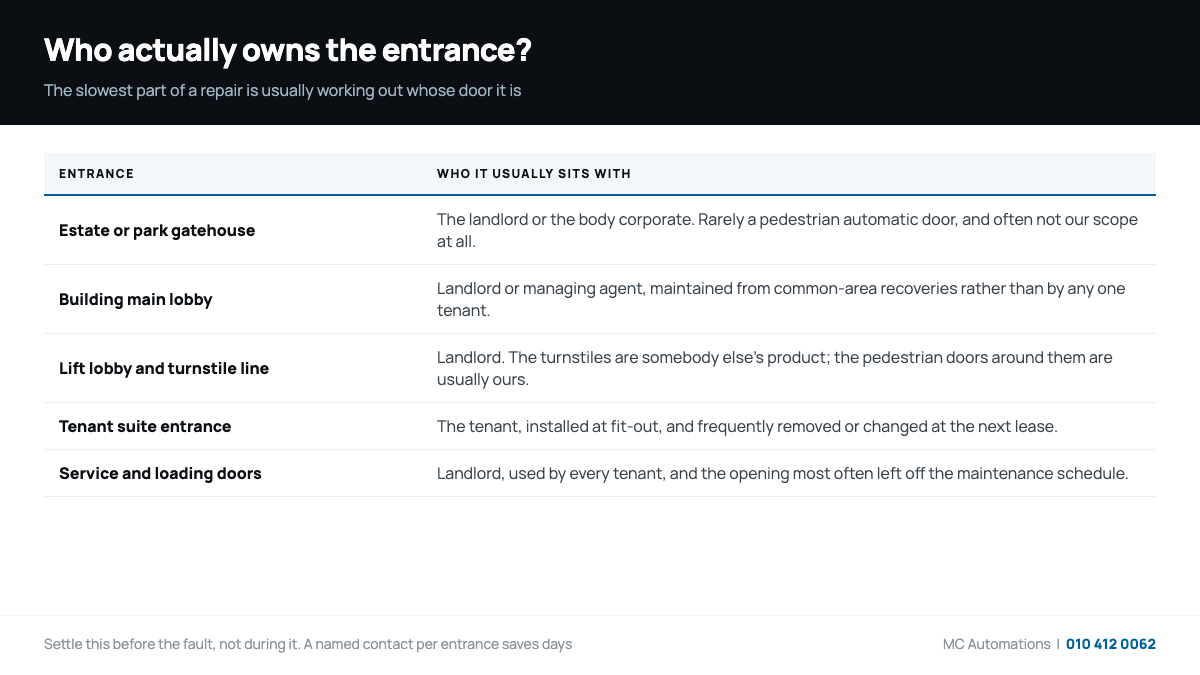
The pattern is usually clean once written down: the landlord owns the lobby, the lift lobby line and the service doors; the tenant owns whatever was installed inside their suite at fit-out. The difficulty is that it is almost never written down, so each failure starts with a round of phone calls establishing whose budget it comes from.
Fix it once. A list of entrances with an owner and a named contact against each, kept with the building file, converts a two-day delay into a same-morning call. It costs nothing and it is the single most valuable thing a managing agent can do about office park automatic doors.
Core hours and everything outside them
Office park automatic doors need more than two states across a working week, and most buildings only ever commission one.
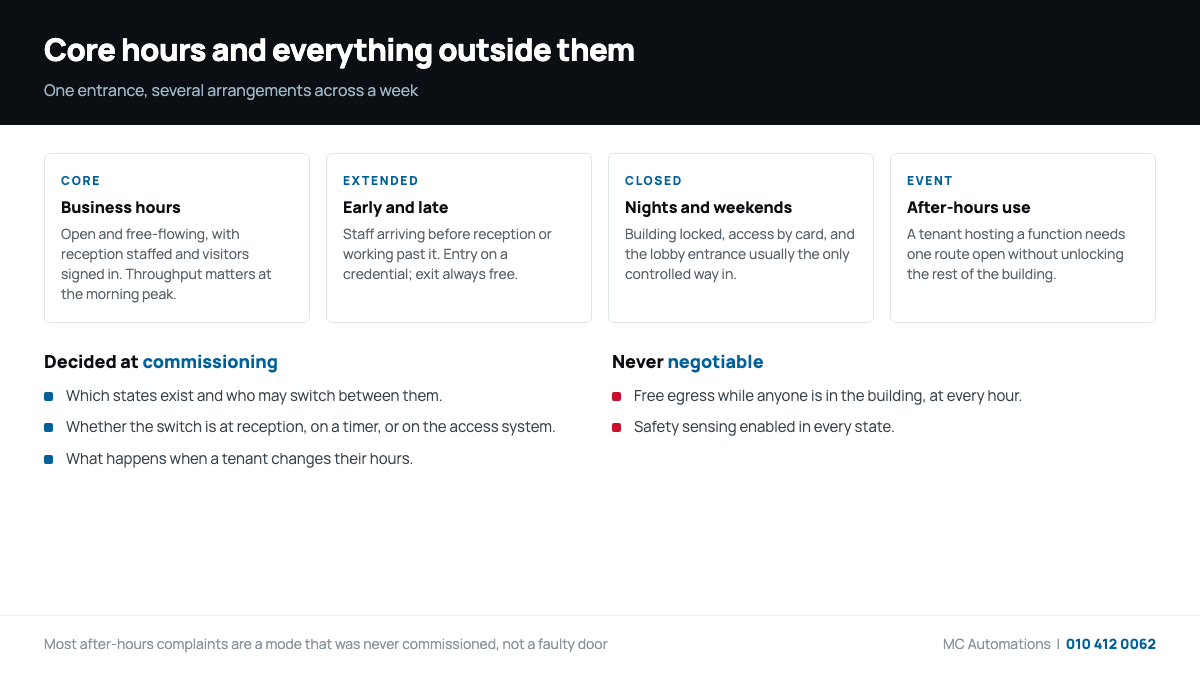
The morning peak is what sizes the lobby entrance. Between about half past seven and nine, an entire building arrives through one or two openings, and throughput there is the only time of day the door is genuinely under load. Size for that, not for the daily average.
The rest of the week is about controlled access rather than flow. Staff arriving before reception, people working late, weekend access for a single tenant, and the occasional after-hours event that needs one route open without unlocking the building. Each of those is a state, and each should be commissioned rather than improvised by whoever is on the front desk.
One rule holds across all of them: entry can be controlled, egress cannot. Anyone inside leaves by hand, without power and without a key, at any hour. Our automatic door access control page covers the reader and locking options.
The access line, and what we do not supply
With office park automatic doors the real security line is rarely the front door at all. It is the turnstile or speed gate between the lobby and the lifts, with the lobby itself deliberately open during trading hours.
That matters for scope. We supply, install and service the pedestrian automatic doors — the lobby entrance, the doors either side of a turnstile line, suite entrances and service doors. We do not supply turnstiles, speed gates, security grilles or roller shutters, and we do not supply, fit, retrofit or service door closers. On most projects we are working alongside whoever does, and the interface between the two systems is worth specifying explicitly rather than assuming.
One estate, many buildings, one specification
Office park automatic doors are where standardisation pays hardest, because the same decision repeats across five or ten buildings.

A mixed estate accumulates by accident rather than by choice. Building one was done at construction, building three during a refurbishment four years later, building five by a tenant who arranged it themselves. Nobody decided to run four brands; it simply happened.
The route out is standardising on replacement rather than ripping out equipment that still works. As each entrance comes up for renewal it moves to the park standard, and within a refurbishment cycle the estate has converged without a capital event. Phasing the purchase is sensible. Phasing the specification is not.
Recoveries, and why that changes the contract
Maintenance on office park automatic doors in common areas is usually recovered from tenants through operating costs, which introduces a requirement most buildings do not have: the cost has to be explicable.
Two things follow. Planned maintenance under an agreement is easier to recover and easier to defend than a series of reactive call-outs, because it is predictable and it is clearly attributable. And consistency across buildings lets you compare one building’s running cost with another, which you cannot do when every lobby carries different equipment on a different arrangement.
A service level agreement across the estate also settles response expectations in advance rather than during a breakdown, which is the conversation nobody wants to have with a tenant whose staff are queuing outside.
Base build or fit-out changes the brief
Whether office park automatic doors are base build or tenant fit-out determines how long it needs to last and who specifies it.
Base build entrances are permanent and should be specified for a fifteen-year view: robust, standard across the estate, serviced under the landlord’s arrangement. Tenant suite entrances are frequently changed at the next lease, so the sensible approach is to let the tenant specify within a defined standard rather than leaving it entirely open — otherwise the building accumulates equipment nobody can service consistently.
Worth agreeing in the lease: what happens to a tenant-installed automatic door at the end of the term. Removed, left in place, or handed over with its commissioning record.
Servicing a building that empties every night
Office parks have an advantage that retail and healthcare do not: the buildings genuinely empty. Service work on office park automatic doors can happen in the evening or at a weekend without disrupting anybody, which makes scheduling straightforward.
We service entrances on a six-month interval as standard. Lobby doors on a large building warrant more frequent attention because the morning peak concentrates wear, and service and loading doors should be on the schedule even though no tenant thinks of them as theirs.
Same-day call-outs are available in Gauteng; elsewhere the visit is planned and confirmed at booking. If an entrance is down now, book a technician, and say which building and which entrance so the right parts travel.
Specifying office park automatic doors for a multi-tenant building
Most of the difficulty with office park automatic doors is settled before anything is ordered.
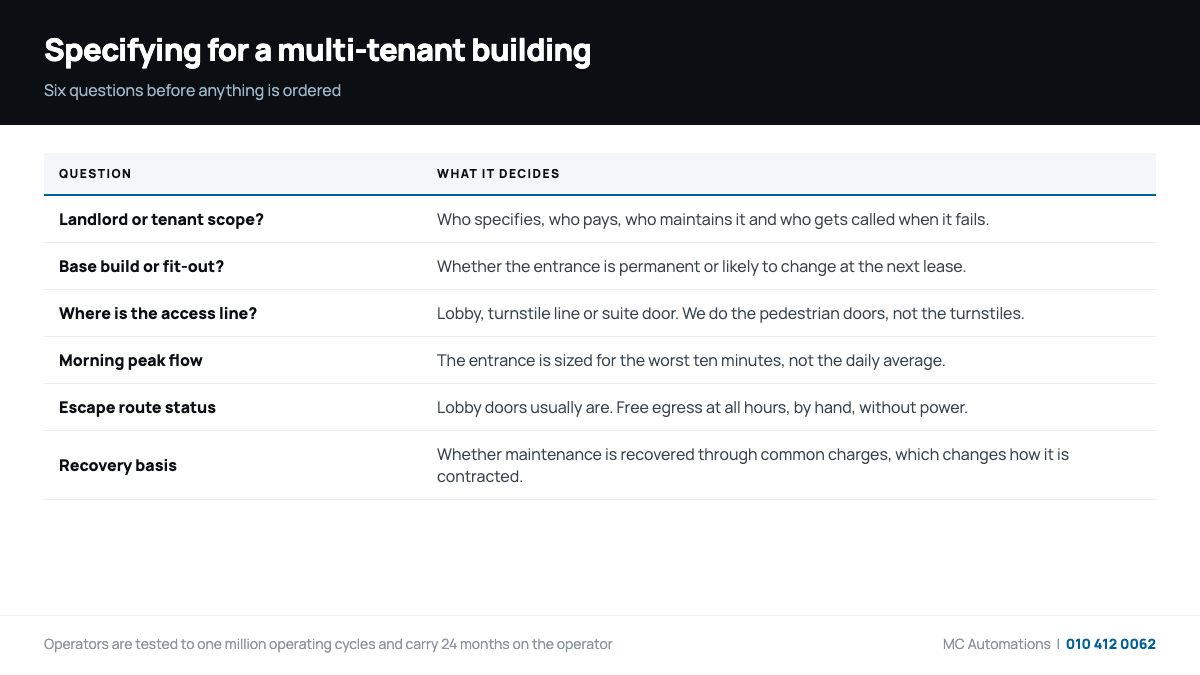
If you are taking over an estate rather than building one, the same list works as a survey. Walk each building, record which entrances are landlord and which are tenant, note what is installed and whether anybody holds the commissioning settings, and find out which are on escape routes. That information is worth having before the next failure.
Requirements for entrances on escape routes derive from the National Building Regulations and the standards published by the South African Bureau of Standards, applied through the fire strategy prepared for each building.
The morning peak is the only load that matters
Office park automatic doors spend most of the day almost idle and then take the entire building inside about ninety minutes. Nothing else in the working week comes close, and it is the only period that should influence the sizing.
Two things make that peak harder than the raw numbers suggest. People arrive in clusters as lifts discharge and as cars park, so the flow is lumpy rather than steady. And almost everybody arriving is carrying a laptop bag, a coffee or a security card they are trying to find, so they are not moving cleanly through the opening.
Hold-open behaviour matters more than cycle speed here, exactly as it does in a terminal. A door that recognises a continuous flow and stays open for it moves a crowd faster than one that closes briskly between people and reopens thirty times, and it wears considerably less doing it.
Where a lobby entrance is genuinely undersized for the building it serves, widening it is a building decision rather than a door decision. Automating a narrow opening produces a narrow opening that moves by itself.
Draughts, pressure and the lobby nobody wants to sit in
Multi-storey buildings develop pressure differences between the lobby and the outside, and a lift shaft running the height of the building makes that worse. The result is a ground floor lobby that is uncomfortable in winter and a reception desk nobody wants to be posted at.
The usual answer is an air lock: two sets of leaves far enough apart that they are never open together, so there is no straight path from the street to the reception desk. Where the architecture will not allow that, reducing the opening width outside the morning peak helps materially without anybody noticing a change in service.
This is worth raising early because it is close to impossible to retrofit elegantly. An air lock designed in is unremarkable; an air lock added afterwards usually looks added afterwards.
What goes wrong in multi-tenant buildings
Four failures account for most of the complaints we attend on office park automatic doors, and only one of them is really about the door.
Nobody owns it. The fault is reported, two parties each believe it is the other’s, and the entrance stays broken for a week. This is the big one, and the fix is a list with names on it.
States that were never commissioned. Staff improvise after hours, usually by propping something, and the building’s access arrangement quietly stops working.
Tenant-installed equipment nobody can service. A suite door fitted at fit-out by whoever was cheapest, on a brand the building’s contractor does not carry parts for.
Service doors off the schedule. Used by every tenant, owned by the landlord, thought about by nobody until the loading bay stops working.
Office park automatic doors: quick answers
Who is responsible for the lobby door, the landlord or the tenant?
Normally the landlord or managing agent, maintained from common-area recoveries rather than by any single tenant. Tenants are usually responsible only for doors installed inside their own suite at fit-out. The problem is that this is rarely written down, so each failure starts with establishing whose budget it is.
Do you supply turnstiles or speed gates?
No. We supply, install and service pedestrian automatic doors — lobby entrances, the doors around a turnstile line, suite entrances and service doors. Turnstiles, speed gates, grilles and roller shutters are somebody else’s product, and we do not supply door closers either.
Can the building be locked after hours if staff work late?
Entry can be controlled on a credential; exit cannot be prevented while anyone is inside. The workable arrangement is a controlled lobby entrance with free egress throughout, and a separate state for after-hours events so one route can open without unlocking the whole building.
How should an estate with several brands of door be handled?
Standardise on replacement rather than all at once. As each entrance comes up for renewal it moves to a single park standard, so within a refurbishment cycle the estate converges without a capital event. That gives you one spares holding, one set of commissioning values and comparable costs between buildings.
Is a service agreement worth it for common-area doors?
Usually yes, and particularly where maintenance is recovered through operating costs. Planned maintenance is predictable, clearly attributable and far easier to defend to tenants than a series of reactive call-outs, and it settles response expectations before a breakdown rather than during one.
When is the best time to do the work?
Evenings or weekends. Office parks genuinely empty, which almost no other commercial building type does, so installation and servicing can happen without disrupting tenants. That makes scheduling easier here than in retail, healthcare or hospitality.
Talk to us about the estate
Tell us how many buildings are involved, which entrances are landlord scope, and whether you are standardising or replacing one at a time. Request a quote and we will work through it building by building, or call 010 412 0062.
