
Office park automatic doors for landlords and managing agents: who owns which entrance, the access states a working week needs, the morning peak that sizes the lobby, standardising across an estate, and why maintenance recovery changes the contract.
Pharmacy Automatic Doors: Front Shop and Dispensary
Pharmacy automatic doors have to do two jobs that pull against each other. The front of the shop is open retail that anybody may walk into. Behind it sits a dispensary holding stock and records that not everybody may reach. One building, two completely different access briefs, and an entrance specification that has to serve both.
Add to that a customer base that is, by definition, unwell or buying for somebody who is, and you have a sector where the entrance matters more than its cost suggests. This guide covers what actually changes.
Pharmacy automatic doors serve two buildings in one
The zones behind pharmacy automatic doors carry genuinely different requirements, and specifying them as one job is how pharmacies end up with a dispensary door that behaves like a shopfront.
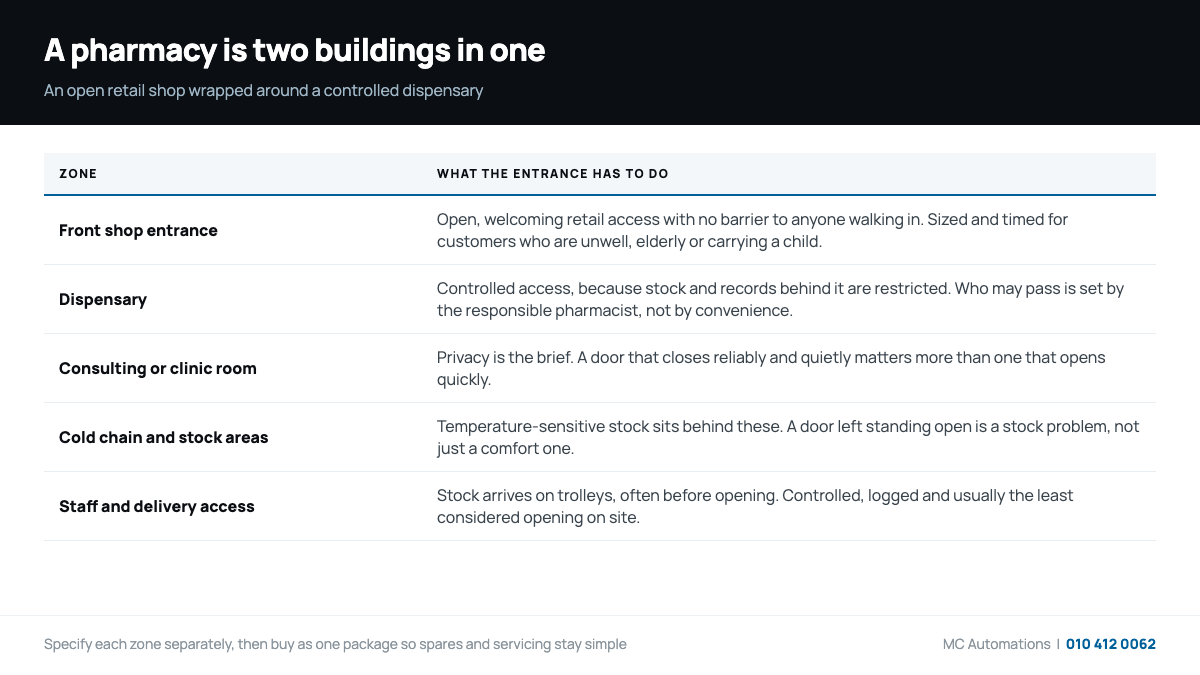
The cold chain area is the one most often forgotten. Temperature-sensitive stock sits behind those doors, so an opening that gets propped during a delivery is a stock problem rather than only a comfort one. Where a door serves a temperature-controlled area, say so at specification stage.
Who actually walks through pharmacy automatic doors
This is the heart of it. Pharmacy automatic doors serve people who are ill, in pain, elderly, or managing a sick child, and almost none of them are moving the way an average retail customer moves.
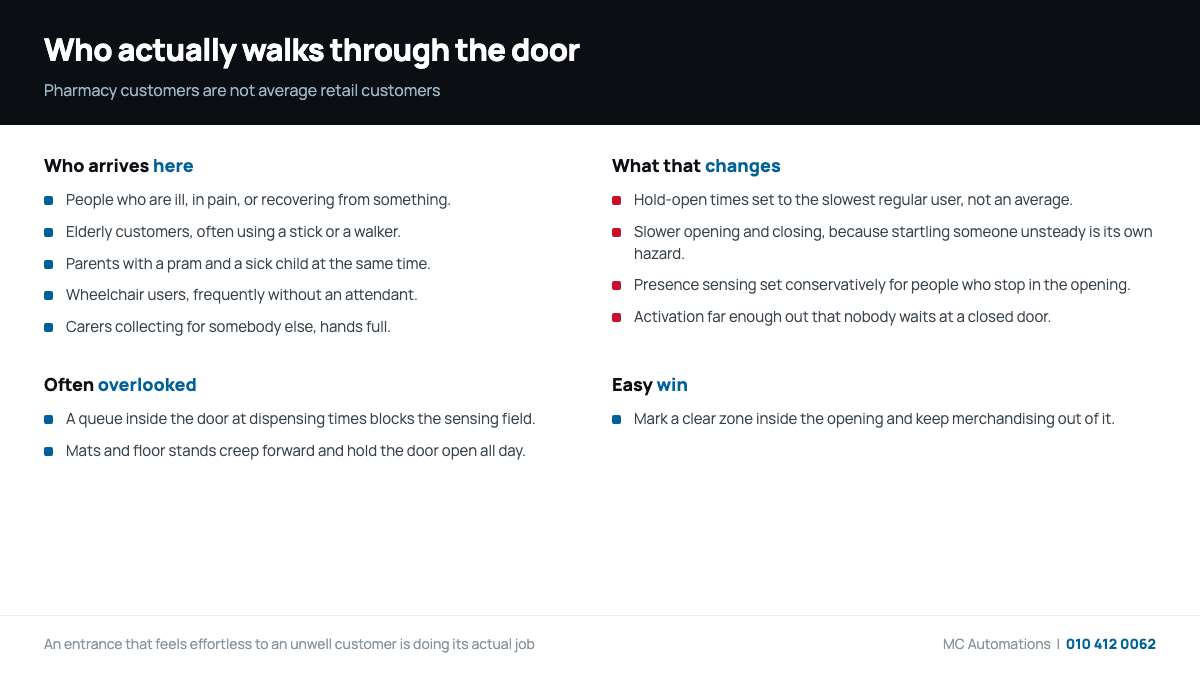
The settings follow from that. Hold-open times set to the slowest regular user rather than an average, slower opening and closing because startling somebody unsteady is its own hazard, and presence sensing set conservatively because people stop in these openings to rest or to check a prescription.
One practical point that costs nothing: watch where the queue forms at dispensing times. In a lot of pharmacies the queue backs up into the doorway, which sits a line of stationary people directly in the sensing field. Marking a clear zone inside the opening and keeping merchandising out of it solves a surprising number of complaints about doors that “stay open all day”.
Security without locking anybody in
Pharmacies hold stock that is worth stealing, and in South Africa that is not a theoretical concern. But the security on pharmacy automatic doors runs inward rather than outward.
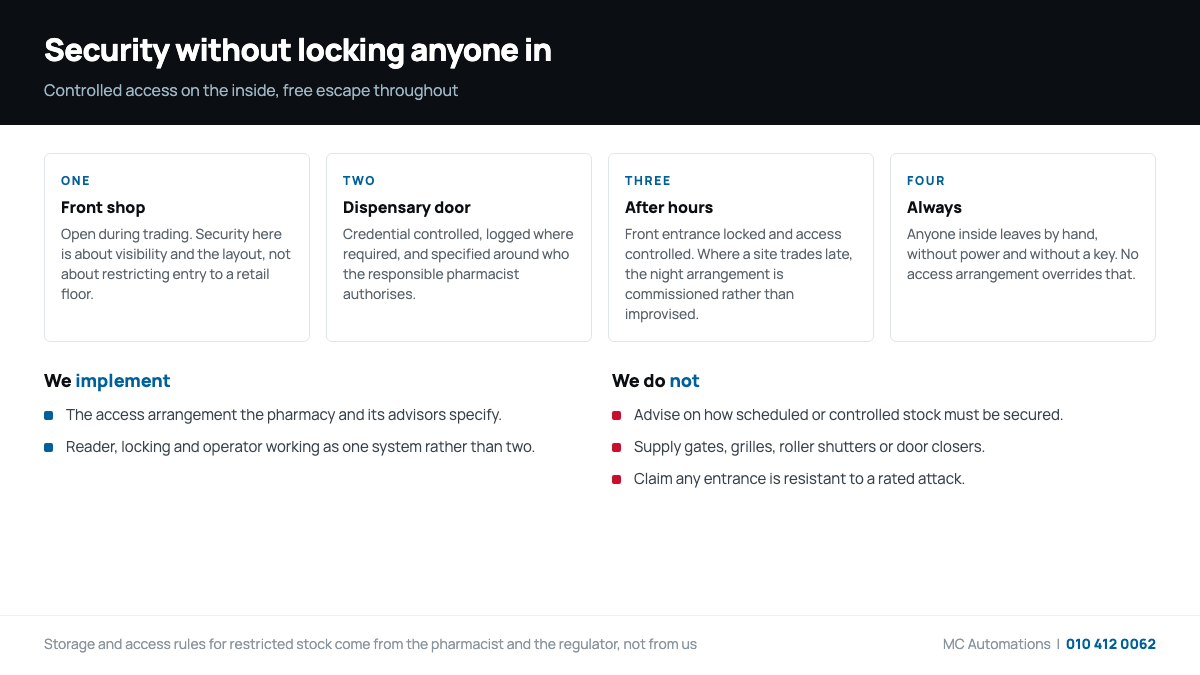
With pharmacy automatic doors the front shop stays open during trading. The control sits on the dispensary, the stock room and staff access, specified around who the responsible pharmacist authorises. And whatever the arrangement, anybody inside leaves by hand, without power and without a key, with safety sensing enabled in every state.
We will be plain about the boundary here. How restricted stock must be stored and who may access it is set by the pharmacist and the regulator, not by us. We implement the access arrangement your advisors specify; we do not advise on what it should be, and we will not describe any entrance as resistant to a rated attack. Our automatic door access control page covers the reader and locking options, and automatic door security is candid about what a glass entrance can and cannot be expected to do.
Consulting rooms need a different brief
Many pharmacies now run a clinic or consulting room for vaccinations, screening and basic primary care. The brief for that door is almost the opposite of the shopfront.
Privacy is what matters: a door that closes reliably and quietly, that does not stand open while somebody is being seen, and that is not so enthusiastic about opening that it reacts to people walking past in the aisle. Activation that requires deliberate intent rather than mere proximity is usually the right answer here, and it is worth specifying explicitly rather than assuming the same sensing as the front door will do.
In a centre or standalone
Whether the pharmacy sits inside a shopping centre or stands alone changes the brief for pharmacy automatic doors more than people expect.
In a centre, the shopfront is subject to the landlord’s rules about what may be installed at the lease line, trading hours are set by the centre, and the centre’s own perimeter does much of the security work overnight. Our write-up on shopping centre automatic doors covers that relationship.
Standalone pharmacies carry the whole job themselves: exposure to weather, their own after-hours arrangement, their own delivery access and their own escape routes. A standalone site trading late needs its night states commissioned properly, because there is no centre closing time doing that work for it.
Deliveries, stock and the pharmacy automatic doors nobody sees
Stock arrives through pharmacy automatic doors on trolleys, often before opening, through an opening that no customer ever sees. That door takes the heaviest, widest loads on site and is almost always the one left off the service schedule.
Size it on the widest cage or trolley actually used, with room for the person pushing it, and put it on the same maintenance arrangement as the front. A failed delivery door does not embarrass anybody, and it stops the dispensary restocking.
Servicing pharmacy automatic doors
We service entrances on a six-month interval as standard. For a pharmacy the sensor check is the part that earns its keep, because the sensing is set conservatively for vulnerable customers and a sensor that has drifted slightly undoes exactly the setting that matters most.
A visit covers the drive and belt, track and carriages, floor guides, every sensor on the opening, the safety arrangement and the power-loss behaviour. Settings are restored to the recorded commissioning values rather than to factory defaults, which is worth stating explicitly to whoever attends.
Same-day call-outs are available in Gauteng; elsewhere the visit is planned and confirmed at booking. If an entrance is down now, book a technician. For a group of pharmacies, a service level agreement across the sites is cheaper than individual call-outs and keeps every store on one specification.
Specifying a pharmacy entrance
Most of the difficulty with pharmacy automatic doors is settled before anything is ordered.

Requirements for entrances on escape routes derive from the National Building Regulations and the standards published by the South African Bureau of Standards, applied through the fire strategy for the building. Requirements for storing and accessing restricted stock are a separate matter entirely, and they come from your own regulatory advisors.
On scope: we supply, install and service pedestrian automatic entrances. We do not supply gates, grilles, roller shutters or door closers.
Accessibility is not optional here
Of all the buildings we work in, a pharmacy has the strongest claim that accessibility is core business rather than compliance. The people least able to negotiate a heavy manual door are precisely the people who need to collect medicine, and a pharmacy that is hard to enter loses exactly the customers it most exists to serve.
That makes the clear opening worth measuring properly. Size it on a wheelchair with an attendant and on a pram, both of which need room for the person pushing, rather than on the single-file width of an average adult. Many older pharmacy shopfronts were built to a width that no longer serves the customer base, and automating a too-narrow opening produces a narrow door that opens by itself.
Where a step or threshold sits inside or outside the opening, deal with that at the same time. An automatic door leading to a step has solved nothing. Our guide to automatic doors for disabled access covers how the route is assessed end to end, and the same thinking applied to residential care is in automatic doors for retirement homes.
Trading late, and trading through the night
A growing number of pharmacies trade well beyond ordinary retail hours, and some operate around the clock. Pharmacy automatic doors on those sites need their night arrangement commissioned rather than improvised.
Where a site moves to controlled entry after a certain hour, the locking applies to getting in and never to getting out. Where a pharmacy serves through a hatch at night, the front entrance may be locked entirely, but staff inside must still be able to leave by hand without power and without a key.
Decide who may change the state and from where. A switch behind the counter that only named staff use is a control; a switch beside the door that anyone can reach is not. And whatever the night arrangement, safety sensing stays enabled — an entrance with its sensing defeated is more dangerous than one that is out of service.
Retrofitting an existing pharmacy
Most work on pharmacy automatic doors is replacement in a trading store rather than new build, and the store usually cannot close while it happens.
Retrofit is normally straightforward because the leaf, frame and glass stay and only the operator above the opening changes, which brings most replacements inside a single overnight window. Three things decide whether it is simple: headroom above the opening, a power supply nearby or a route for one, and whether the existing leaf is within the operator’s weight range.
In a shopping centre, add the centre’s own requirements to that list. Work in a mall usually means a permit, an agreed night window, hoarding, and sign-off before the store reopens. Those arrangements take longer to organise than the installation takes to perform, so start them early.
What goes wrong
Three things account for most of the complaints we attend on pharmacy automatic doors.
The queue in the sensing field. Diagnosed as a faulty door, almost always a layout problem, and fixed by marking a clear zone inside the opening.
Settings reset to defaults. Factory values are tuned for ordinary retail and feel abrupt to an elderly customer. Record the commissioning values per entrance and hand them to whoever attends next.
The delivery door left off the schedule. It carries the heaviest loads and gets the least attention, right up until it fails and the dispensary cannot restock.
Pharmacy automatic doors: quick answers
What is different about pharmacy automatic doors?
Two things. The customers are unwell, elderly or managing a sick child, so hold-open times and speeds are set for the slowest user rather than an average. And the building has two access regimes in one: an open retail shop wrapped around a controlled dispensary.
Can the dispensary door be access controlled?
Yes, and usually it should be. Access is specified around who the responsible pharmacist authorises. What we do not do is advise on how restricted stock must be secured — that comes from the pharmacist and the regulator, and we implement the arrangement they specify.
Why does our front door seem to stay open all day?
Most often the queue. At dispensing times people form a line that backs into the doorway, which puts stationary customers in the sensing field. Marking a clear zone inside the opening and keeping displays out of it usually fixes it without touching the door.
Should the consulting room door be automatic?
Only if it is specified for privacy rather than convenience. That door needs to close reliably and quietly and must not react to people passing in the aisle, so activation requiring deliberate intent is normally right. It is a different brief from the shopfront and should be specified as one.
Does it matter that we are inside a shopping centre?
Yes. The centre sets trading hours and usually has rules about what may be installed at the lease line, and its perimeter does much of the overnight security work. A standalone pharmacy carries all of that itself, including its own after-hours states and weather exposure.
How often should the doors be serviced?
Every six months as standard. In a pharmacy the sensor check matters most, because the sensing is deliberately set conservatively for vulnerable customers and a small amount of drift undoes precisely that setting. Ask for commissioning values to be restored rather than factory defaults.
Talk to us about the pharmacy
Tell us whether you are standalone or in a centre, which internal doors need controlling, and whether there is a consulting room or cold chain area. Request a quote and we will work through it zone by zone, or call 010 412 0062.
