
Office park automatic doors for landlords and managing agents: who owns which entrance, the access states a working week needs, the morning peak that sizes the lobby, standardising across an estate, and why maintenance recovery changes the contract.

Which Automatic Door Suits a Shopping Centre?
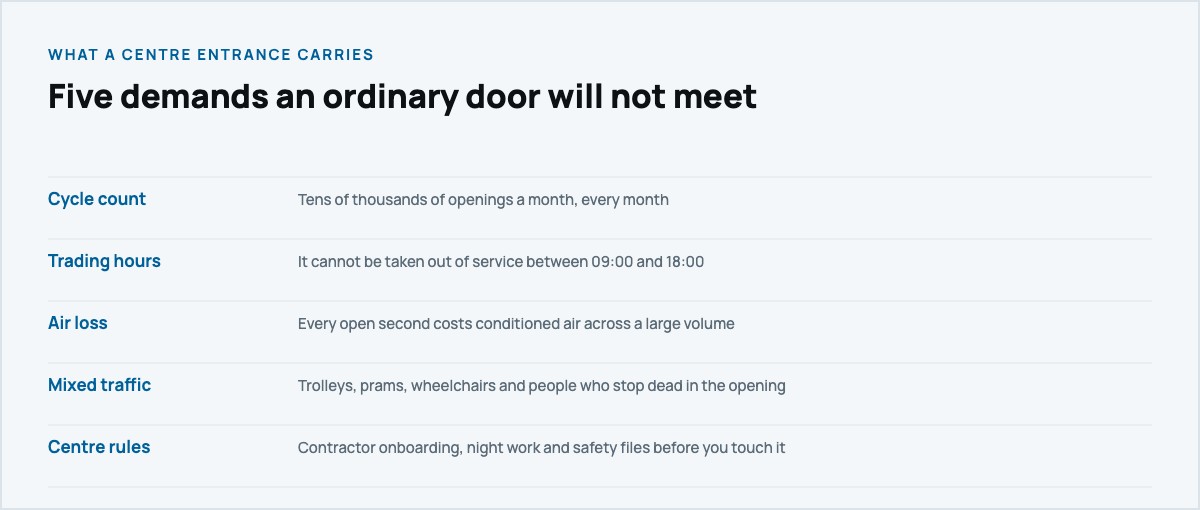
Shopping centre automatic doors are not ordinary automatic doors with more traffic. They are a different specification, because the entrance has to survive tens of thousands of cycles a month, cannot be taken out of service during trading, and is judged by centre management as much as by shoppers.
This is how we specify shopping centre automatic doors: what the entrance actually has to carry, which door type suits which doorway, and what wears out first.
What shopping centre automatic doors actually carry
Cycle count is the obvious one. A main entrance in a busy centre can exceed in a month what an office door does in several years, and every component in the system is consumed at that rate.
The constraint people underestimate is trading hours. You cannot close a mall entrance at eleven on a Saturday to change a belt. Work happens at night or before opening, which shapes not only the price but who is capable of doing it at all.
Then there is air. A large volume of conditioned space behind a door that opens continuously is expensive to keep at temperature, which is why revolving entrances keep appearing in centre lobbies despite costing more to install.
And finally, centre rules. Contractor onboarding, safety files, night-work permits and induction are all prerequisites before anyone touches the entrance — the documentation side is covered on our compliance and downloads page.
Which of the shopping centre automatic doors suits which doorway
Shopping centre automatic doors are not one entrance repeated. Most need three or four different types, chosen by position.
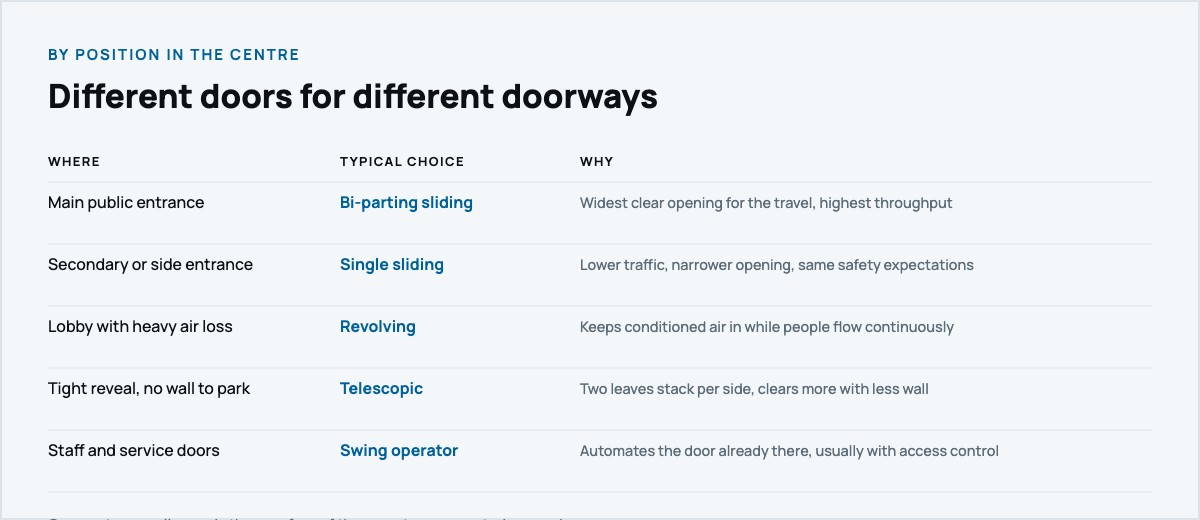
For the main public entrance, bi-parting automatic sliding doors are the default: two leaves each travel half the distance, so you clear a wider opening in the same time. On our MC-125 operator that covers clear openings from 1450 mm to 5000 mm with leaves to 150 kg.
Where the reveal is tight and there is no wall to park a leaf into, telescopic sliding doors stack two leaves per side and clear far more opening than the wall would normally allow. This is common in older centres that have been subdivided.
Revolving doors earn their place in large lobbies where air loss is the dominant cost. And staff, service and back-of-house doors are usually best automated in place with a swing operator plus access control, rather than replaced.
What fails first on shopping centre automatic doors
Shopping centre automatic doors fail in a fairly predictable order, which is useful because it tells you what to inspect.
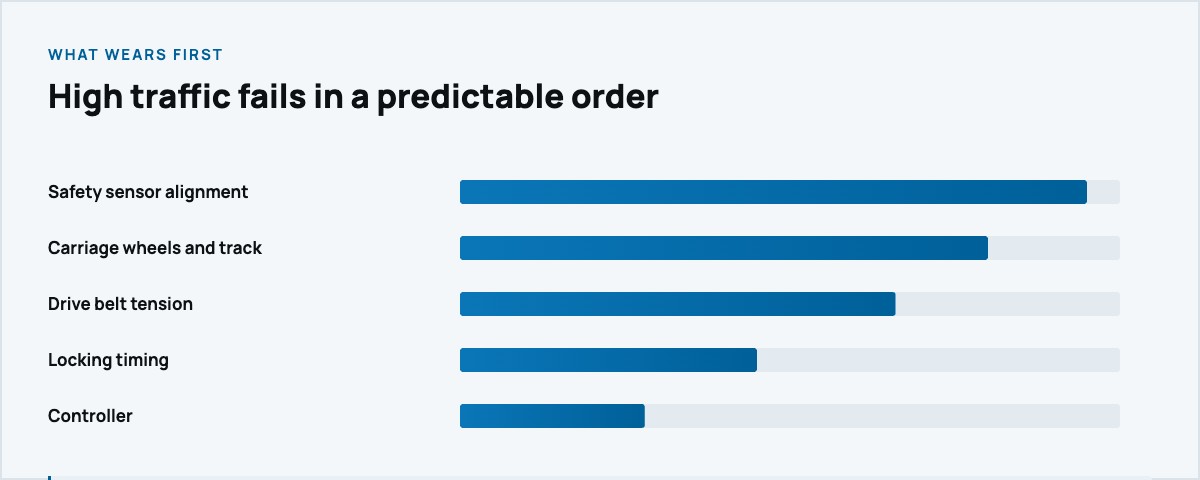
Safety sensor alignment leads by a distance. Trolleys knock heads, cleaning crews nudge them, and vibration through a busy floor slab moves them slowly out of true. Because presence sensing is a safety device, a drifted sensor is not a nuisance — it is the failure mode that closes on somebody. The mechanics are in our guide to automatic door sensors.
Carriage wheels, track and belt tension follow, all straightforward wear items when they are caught on a schedule and expensive when they are not. This is why we set a six-month standard interval and shorten it where retail footfall demands — the reasoning is in automatic door maintenance.
Power, and the South African complication
Shopping centre automatic doors that stop working during load shedding stop the centre trading. Battery backup on the operator and the locking is close to mandatory in South African retail, and the parked state — open, closed, or locked — should be a commercial decision made before installation, not a default someone set on the day. See automatic doors and load shedding.
Requirements for powered pedestrian doors in South Africa are published through SABS, and safety devices are specified against the requirement stated for the building.
Traffic, trading hours and the duty these entrances really see
Centre entrances are the highest-duty pedestrian doors most buildings will ever own, and duty is the number that should drive the specification. Shopping centre automatic doors are not a different product from an office entrance so much as the same product asked to do fifty times the work.
Work it out rather than estimating it. One person through the opening is one cycle. A mid-size centre entrance passing 800 people in a Saturday peak hour, across twelve trading hours, seven days a week, is asking for something in the order of a million and a half cycles a year through that single opening. That is the arithmetic that separates shopping centre automatic doors from everything else in this category, and it is why a drive that is perfectly adequate on a corporate reception becomes a maintenance problem on a mall entrance.
Trading hours matter as much as volume. A centre trading from 09:00 to 21:00 gives a four-hour window for any work that has to happen with the entrance out of service, and that window is shared with cleaning, deliveries and every other contractor. Specifying shopping centre automatic doors without knowing the trading pattern produces a programme nobody can actually execute.
Both the MC-125 and the MCW-100 are tested to one million operating cycles. On a centre entrance that is a comparison figure rather than a service life — what determines how long shopping centre automatic doors last in a mall is how much headroom the drive has over the daily load and how seriously the maintenance interval is kept.
Mall pressure: stack effect, air-conditioning and door behaviour
Air pressure is the reason correctly-specified shopping centre automatic doors sometimes misbehave, and it is almost never on the drawing.
A centre is a large conditioned volume with a small number of openings. The air-conditioning plant runs it at a slight positive or negative pressure relative to outside, and every entrance feels that as a steady load on the leaves. Add a multi-level atrium and stack effect works on top of it: warm air rising through the void draws replacement air in at ground level. Add two entrances on opposite elevations and a through-draught develops whenever both are open at once.
The symptoms are consistent. Leaves that open more slowly than commissioned. Doors that stop part-way and report an obstruction that nobody can see. Entrances that behave impeccably on a still weekday and badly on a windy Saturday. All three are routinely diagnosed as sensor faults, and on shopping centre automatic doors they are usually pressure and load.
The structural answer is a lobby. Two sets of doors with a space between them break the pressure path, which is why most well-designed centre entrances are lobbies rather than single openings. Where an existing entrance is a single opening and cannot become a lobby, shopping centre automatic doors on that opening want a bi-parting configuration, conservative speeds and a drive specified above the static requirement.
Working in a live centre
Replacing or servicing shopping centre automatic doors is as much a logistics exercise as a technical one, and the technical part is usually the easy half.
Centres run contractor onboarding: inductions, proof of insurance, method statements, permits for hot work, and a booking system for the loading bay and the service lifts. None of that is unreasonable and all of it takes time, so it belongs in the programme from the start rather than being discovered on the first morning.
Then there is the hoarding. An entrance being worked on has to be closed off in a way that keeps the public out, keeps the centre trading, and keeps a compliant escape route available — and the last of those is not negotiable. On a major entrance that often means doing the work in halves, so one side of a bi-parting pair stays in service while the other is rebuilt.
Most replacement work on shopping centre automatic doors therefore happens at night, inside that four-hour window, across several nights, with the entrance handed back working each morning. It is slower and more expensive than a single continuous shift, and it is the only version that a trading centre can actually accept. We would rather price that honestly at tender than discover it on site.
Sensors and safety in a crowded opening
A crowded entrance is a harder sensing problem than a quiet one, and shopping centre automatic doors need more safety equipment than their size alone would suggest.
Presence sensing in the door path is the non-negotiable part: motion detection alone will not hold a door open for somebody who has stopped in the opening, and in a centre people stop in openings constantly — to look at a phone, to wait for a child, to shelter from rain. Activation sensing has to reach far enough up the approach to open the leaves for somebody walking at pace with both hands full. On bi-parting shopping centre automatic doors the meeting point of the two leaves needs its own protection, and on telescopic configurations there are two moving edges per side.
Trolleys and prams change the geometry. A sensing field aimed for adults can miss a trolley handle and read the child seat as nothing at all, so fields get set for the real traffic rather than for a commissioning walk-through by two technicians.
Requirements for powered pedestrian doors in South Africa are published through SABS, and shopping centre automatic doors are the application where specifying to the standard rather than to the minimum that passes a glance genuinely matters. The entrance is used by tens of thousands of people who did not choose it and cannot inspect it.
Maintenance intervals, agreements and response
At centre volumes, maintenance is not an optional extra on shopping centre automatic doors — it is the difference between a planned cost and an unplanned closure.
Intervals follow duty rather than the calendar. An entrance cycling well over a million times a year is checked far more often than a service door, and the useful approach is to set an interval against the traffic we were told about, then revise it after six months of real data rather than defending a guess. What gets checked is the drive and its belt and carriages, the leaf running gear, the sensor alignment and fields, the safety devices, and the backup battery — which fails silently and is therefore the one most often found dead.
Response time is the other half. A centre entrance out of service on a Saturday is a trading problem, not a maintenance ticket, which is why response is worth agreeing in writing rather than assuming. Same-day call-outs are available in Gauteng; outside Gauteng we install and service nationwide on a scheduled basis. We would rather state that plainly than imply a national same-day capability we do not have.
Where a centre already has shopping centre automatic doors installed by somebody else — GEZE, dormakaba, ASSA ABLOY, record or TORMAX among them — we service them and can usually supply parts, and we report the condition of what we are taking on before committing to an interval. We are independent of those manufacturers and are not an agent for any of them.
Budgeting for shopping centre automatic doors
Entry pricing for the MCW-100 swing operator starts at R15 900 and for the MC-125 sliding operator at R27 590. On a centre entrance the operator is rarely the largest line. Sensors and safety devices for a wide, busy, bi-parting opening, the header and structural work, the electrical supply, the glass, night-shift labour and the hoarding all sit on top of it, and the ratio is very different from a small commercial door.
The operator carries a 24-month warranty. On shopping centre automatic doors that warranty assumes the entrance is being maintained at the interval its duty requires; an entrance running a million-plus cycles a year without maintenance is outside it. We set that out at quotation for the same reason we set out the trading-hours constraint: both are better understood before the order than after a failure.
What we need to price it is the opening size, the configuration, an honest daily footfall, the trading hours, and whether the centre requires night work and onboarding. With those, shopping centre automatic doors can be quoted against the building rather than against a catalogue.
Escape routes and what the entrance does when the power drops
A centre entrance is usually also an escape route, and that gives shopping centre automatic doors a job beyond moving shoppers.
What the opening must do in an emergency is set by the building’s own fire strategy and by the authority having jurisdiction, not by the door supplier. Our part is to configure the entrance to whatever that strategy requires and to demonstrate it: a fail-open setting so the leaves park clear and the opening stays passable, or a fail-secure setting where the strategy calls for the opening to hold until released. We ask which one applies rather than assuming, because the two are opposites and only one of them is correct for a given opening.
Battery backup changes the picture again. With a backup fitted, shopping centre automatic doors keep operating normally through a load-shedding slot, so the entrance does not enter its fail state several times a week. Without one, it will, and centre management should know which state that is and where the manual release is. We demonstrate the manual release at handover on every entrance, and on shopping centre automatic doors we would rather do it with the centre’s own duty staff present than with a contractor who leaves at the end of the job.
Shopping centre automatic doors, answered
What is the best automatic door for a shopping centre?
Bi-parting sliding for the main entrance, telescopic where the reveal is tight, revolving in large lobbies where air loss matters, and swing operators on staff doors. Most centres need several types.
Can the entrance be replaced without closing the centre?
Usually, by working at night or before trading. It has to be planned into the quotation from the start rather than discovered on site.
How often should a centre entrance be serviced?
Every six months as standard, and more often where the centre is busy. Retail cycle counts consume wear parts far faster than an office entrance, and sensor alignment drifts continuously.
Do you work with centre contractor onboarding?
Yes. COID letters, public liability, SARS status and site-specific safety files are issued per project before attendance.
Do you service doors installed by another company?
Yes, on all major brands. Taking over an existing centre entrance is routine.
What warranty applies to the operator?
The MC-125 and MCW-100 carry a 24-month (two-year) warranty. The warranty that applies to your installation is the one recorded on your quotation and invoice.
Does the entrance work during load-shedding?
With a battery backup it keeps operating through a slot. Without one it parks in the fail-open or fail-secure state chosen for the building, and the manual release is demonstrated at handover.
Specifying for a centre
Send the opening sizes, a photograph of each entrance and the trading hours. For shopping centre automatic doors that is usually enough to come back with a configuration, a price and a plan for doing the work without closing the doorway during trading.
Request a quote, or see the sectors we work in.
In short
Shopping centre automatic doors at a glance
- Shopping centre automatic doors are quoted against the opening we measured, not a catalogue price.

This Post Has 2 Comments
Comments are closed.
[…] cover the main sectors separately: shopping centres, hospitals, hotels, retail, schools and campuses, retirement homes, airports and […]
[…] and the centre’s own perimeter does much of the security work overnight. Our write-up on shopping centre automatic doors covers that […]