
Office park automatic doors for landlords and managing agents: who owns which entrance, the access states a working week needs, the morning peak that sizes the lobby, standardising across an estate, and why maintenance recovery changes the contract.

How Often Should an Automatic Door Be Serviced?
The honest answer to how often automatic door maintenance is needed is: it depends on cycles, not on the calendar. A door in a trading centre can do more work in a month than an office side entrance does in a year, and servicing both annually makes one over-maintained and the other overdue.
Here is how we actually set an automatic door maintenance interval, what a visit covers, and what deferring one turns into.
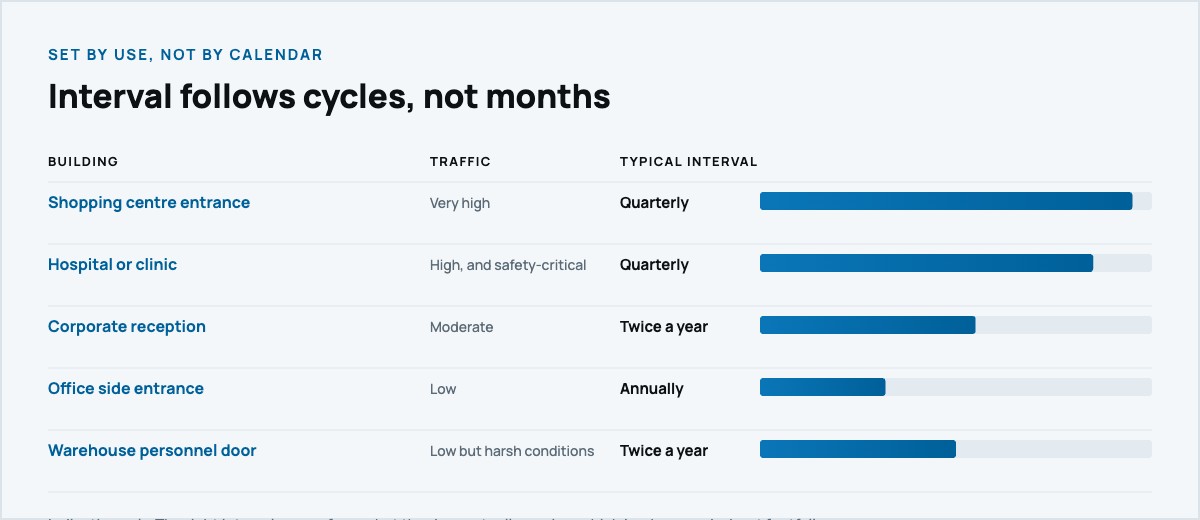
Why automatic door maintenance follows cycles, not the calendar
An automatic door wears through use. Belts stretch, carriage wheels flatten, sensors drift out of alignment and locking mechanisms lose their timing — all as a function of how many times the door has opened, not how many months have passed since somebody looked at it.
That is why we ask about footfall and trading hours before quoting an automatic door maintenance schedule. A pharmacy entrance that cycles every few seconds through a Saturday morning is a different machine from a boardroom door used twenty times a day, even when the operator is identical.
As a rough guide: every six months as standard, and more often for high-traffic retail and healthcare. Harsh conditions — dust, coastal air, forklift traffic — pull the interval shorter regardless of the count.
What an automatic door maintenance visit covers
A service is not a look and a squirt of lubricant. These are the checks that stop call-outs happening.
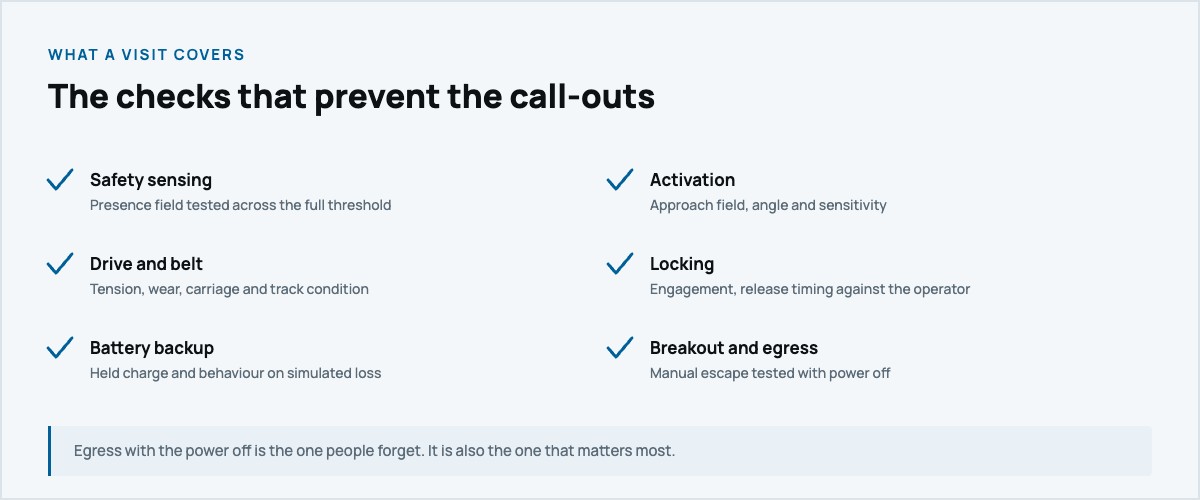
Note the final item. Testing manual escape with the power off is the single most important check on the list and the one most often skipped, because it requires actually killing power to the entrance rather than reading a diagnostic. In a country with the power supply we have, a door that cannot be opened by hand when dead is a serious problem — see our note on automatic doors during load shedding.
Sensor checks are the highest-value part of the visit. Presence sensing drifts quietly and a door can pass a casual glance while leaving a gap in its safety coverage — the detail is in our guide to automatic door sensors.
What deferring automatic door maintenance costs
Deferred automatic door maintenance does not stay deferred. It escalates along a fairly predictable chain.
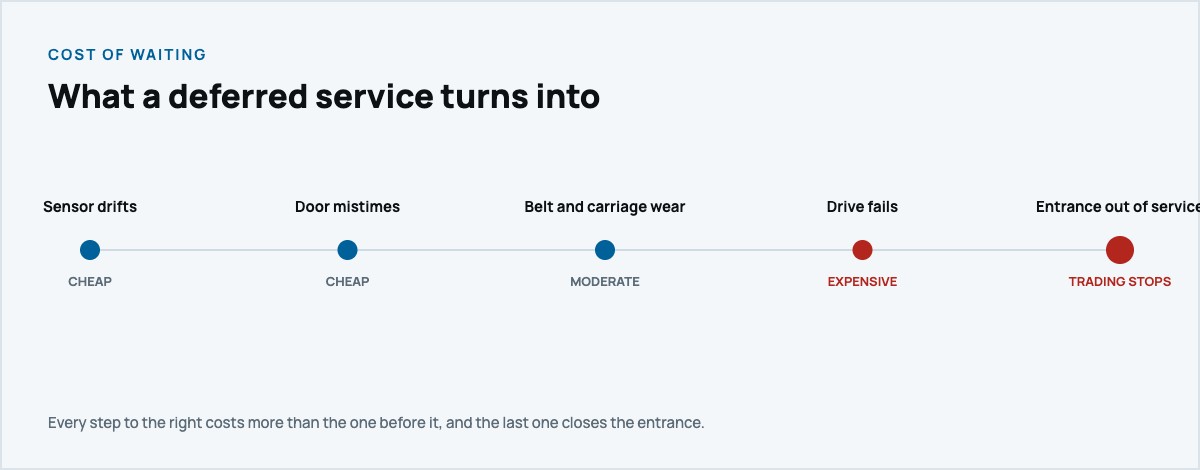
The first two steps are cheap adjustments. By the third, you are replacing wear parts. By the fourth you are replacing a drive, and by the fifth the entrance is out of service during trading hours — which in a retail or healthcare building is the expensive part, not the repair itself.
This is the entire commercial argument for planned automatic door maintenance: it converts an unpredictable, high-cost, badly-timed failure into a predictable, low-cost, scheduled visit.
Automatic door maintenance agreements versus call-outs
Most buildings that call us once for a breakdown end up on a planned schedule, because the maths is not close. A service agreement fixes the interval against the cycles the door actually carries, keeps the spares in stock for that operator, and means the entrance is inspected before the trading season rather than during it.
We service and repair all major automatic door brands, not only our own, so a competitor’s operator is no obstacle to putting an entrance on a schedule. Details are on our service and modernisation page, and breakdown work is covered under automatic door repairs.
Requirements for powered pedestrian doors in South Africa are published through SABS, and safety devices are tested against the requirement stated for the building.
How to count your own cycles before setting an interval
If automatic door maintenance follows cycles, the first useful thing any building can do is find out roughly how many cycles its entrance does. The arithmetic is simple enough to do on the back of an envelope and it is far more use than a generic annual figure.
One person through the opening is one cycle. Count or estimate the people through the entrance in a genuinely busy hour, multiply by the number of busy hours in a typical day, then multiply by the days a week the building operates and by the weeks it operates a year. An office side door used by forty people twice a day is doing something like twenty thousand cycles a year. A busy retail entrance doing six hundred people in a peak hour across ten trading hours, six days a week, is doing well over a million. Those two openings can be physically identical and still need automatic door maintenance on completely different intervals.
Two adjustments are worth making. Hold-open time inflates the count on quiet doors, because a door held open by a queue registers one long cycle rather than ten short ones — so a busy entrance may be gentler on the drive than its footfall suggests. Conversely, delivery traffic, trolleys and prams load the leaves harder than the same number of people walking through unencumbered. Neither changes the order of magnitude, and the order of magnitude is what sets the automatic door maintenance interval.
What the environment does to the interval
Two entrances doing the same cycles can still need different automatic door maintenance schedules, because what the door breathes matters as much as how often it moves.
Dust is the main one. A door onto an unsealed yard, a construction route or a busy street collects grit in the bottom track and on the running gear, and grit in a track is an abrasive paste once it mixes with lubricant. Entrances in those settings need cleaning and inspection more often, and a bottom track that is never cleaned is the most common reason a leaf starts to run heavily.
Coastal air is the other. Salt attacks fixings, carriages and electrical contacts, and an entrance twenty minutes from the sea ages faster than the same entrance inland. Automatic door maintenance on a coastal site is as much about corrosion inspection as about mechanical wear.
Then there is temperature and sun. A west-facing glazed entrance in a Highveld summer runs its controller and motor hot for several hours a day, and heat shortens the life of electronics and belts. Rain-driven entrances collect water at the threshold. None of this is dramatic, but it is why we would rather set an automatic door maintenance interval after seeing the opening than quote a number down a phone.
Signs the interval is wrong
An entrance will tell you when its automatic door maintenance schedule is too long, usually well before it fails outright.
Listen for change rather than for noise. A door that has always been slightly noisy is less interesting than one that has become noisy in the last month. A new rhythmic click on every pass usually means a carriage or a bearing. A rising scrape as the leaf travels usually means the bottom track needs cleaning or the leaf has dropped.
Watch for behaviour that varies by time of day or weather. An entrance that works on a still morning and stalls on a windy afternoon is running close to its load limit rather than failing electronically. A door that stops part-way and reports an obstruction that is not there is the classic case: it gets treated as a sensor problem, and automatic door maintenance records will often show the sensors being adjusted repeatedly while the actual cause is mechanical drag or an undersized drive.
Then watch the closing. A leaf that closes correctly for most of its travel and then hurries the last few degrees is out of adjustment, and it is the condition most likely to catch somebody. Any of these is a reason to bring the next automatic door maintenance visit forward rather than wait for the scheduled date.
Who does the work, and what we check on a takeover
Automatic door maintenance is carried out by our own technicians, or by technicians working under our instruction, and we install and service nationwide. Same-day call-outs are available in Gauteng; elsewhere attendance is scheduled, and we would rather say that plainly than imply a national same-day service we do not operate.
Where we take on an entrance somebody else installed, the first visit is a condition report rather than a service. We record what is fitted, what is worn, what is missing and what has been adjusted out of specification, and we give that to the building before we commit to an automatic door maintenance interval or a price. That protects both sides: nobody inherits a hidden fault, and nobody is charged for one.
That includes equipment from GEZE, dormakaba, ASSA ABLOY, record and TORMAX, which we service and can usually supply parts for. We are independent of those manufacturers and are not an agent for any of them. It also includes our own MC-125 and MCW-100 operators, which are imported and assembled at our Laser Park facility in Johannesburg — the practical benefit of assembling here is that spares for automatic door maintenance sit on a shelf in Johannesburg rather than arriving weeks later.
One thing we do not do: we do not supply, fit, retrofit or service door closers. Automatic door maintenance covers powered pedestrian entrances and their operators, sensors and safety devices.
What automatic door maintenance protects
The operator carries a 24-month warranty. That covers the operator itself, and it assumes the entrance is being maintained on an interval appropriate to its duty — an entrance running a million cycles a year with no automatic door maintenance is outside it, and so are wearing parts, glass and impact damage.
The wider point is that maintenance on an entrance is cheap relative to what it prevents. A cleaned track and a re-aimed sensor are small items. A seized carriage that has been running dry, a belt that has been slipping for months, or a leaf that has dropped far enough to catch the threshold are all several times the cost, and they arrive without notice on the day the building can least afford them.
Requirements for powered pedestrian doors in South Africa are published through SABS. Keeping an entrance to that standard through its life is what automatic door maintenance is for — the opening was compliant on the day it was commissioned, and it stays that way because somebody checks it.
How the cost is structured
There are two ways to pay for automatic door maintenance and they suit different buildings.
A call-out basis means you pay per attendance. It is the right answer for a low-duty entrance — a side door doing twenty thousand cycles a year genuinely does not need a standing agreement, and paying for one is paying for visits the door does not need. The trade-off is that attendance is scheduled against our existing commitments rather than reserved for you, and parts are ordered when the fault is found rather than anticipated.
An agreement means a fixed number of scheduled visits, an agreed response for faults between them, and a known annual figure. It suits entrances where being out of service costs real money: retail, healthcare, anything with a single main entrance. The value is less in the unit price than in the response commitment and in the fact that somebody is looking at the door on a schedule rather than when it breaks.
We price either against the specific entrance rather than from a rate card, because duty, location and what is fitted all move the number. What we need to quote automatic door maintenance is the operator type, the configuration, the traffic, and where the building is.
Records, and why they matter more than people expect
The least glamorous part of automatic door maintenance is the paperwork, and it is the part buildings regret not having.
A service record shows what was checked, what was adjusted, what was replaced and what was flagged and left. Over a few years that becomes a history: which faults recur, whether a leaf keeps dropping, whether a sensor keeps needing re-aiming. Recurring adjustments in the same place are how you find a root cause that individual visits will never reveal — a frame that is moving, a drive at its limit, a threshold that is wrong.
It also matters when responsibility moves. Buildings change managing agents and tenants change hands, and an entrance with no history is an entrance nobody can make a warranty claim on or plan a replacement for. Where we hold the automatic door maintenance record we can say how much life is realistically left in a drive, which is a far better basis for a capital budget than an age in years.
If you are taking over a building and there are no records at all, the sensible first step is a condition report rather than a service visit — establish what is actually there, then set an interval from it.
When replacement beats maintenance
There is a point at which automatic door maintenance stops being the economical answer, and it is worth recognising rather than discovering over three years of call-outs.
The signal is not age. It is the pattern of what is being replaced. An entrance needing consumables — a belt, a set of rollers, a sensor — is a normal entrance being looked after. An entrance where the controller, the motor and the running gear have each been replaced within a couple of years is an entrance that has reached the end of its useful life, and further automatic door maintenance on it is subsidising a drive that should be changed.
Availability of parts is the other signal. Where a drive is old enough that parts come from a dwindling supply, the sensible plan is a scheduled replacement at a time the building chooses rather than an emergency one at a time it does not. We would rather tell a building that its entrance has two years left in it and let that go into a capital budget than keep it limping and bill for the privilege.
Modernisation is often the middle path: the leaves, frame and glass stay, and the drive, controller and sensors are replaced. It costs less than a new entrance, it resets the automatic door maintenance clock, and it usually takes a single shift rather than a programme.
Automatic door maintenance, answered
How often should an automatic door be serviced?
Every six months as standard, and more often for high-traffic retail and healthcare. The interval should follow cycles, not the calendar.
What does a service visit include?
Safety and activation sensing, drive and belt condition, carriage and track, locking timing, battery backup, and manual escape tested with the power off.
Do you maintain doors you did not install?
Yes, on all major brands. Taking over another company’s entrance is routine work.
Is a service agreement cheaper than call-outs?
Almost always, and the saving is rarely the repair itself — it is not having the entrance out of service during trading hours.
What if the door seems fine?
Sensor drift and belt wear are invisible until they are not. A door that seems fine is the normal condition of a door that is one visit away from a fault.
How long does a visit take?
A routine visit on a single entrance is short. Sites with several doors are usually scheduled together to keep disruption and travel down.
Do you service other manufacturers equipment?
Yes. Where we take over an entrance somebody else installed, we report its condition before committing to a maintenance interval.
What warranty applies to the operator?
The MC-125 and MCW-100 carry a 24-month (two-year) warranty. The warranty that applies to your installation is the one recorded on your quotation and invoice.
Does the entrance work during load-shedding?
With a battery backup it keeps operating through a slot. Without one it parks in the fail-open or fail-secure state chosen for the building, and the manual release is demonstrated at handover.
Setting an interval for your building
Tell us the building type, roughly how many people pass through and the trading hours, and we will propose an automatic door maintenance interval that matches the work the door actually does.
Request a quote, or talk to a technician.
In short
Automatic door maintenance at a glance
- Automatic door maintenance are quoted against the opening we measured, not a catalogue price.
If you want the practical version of this rather than the background, our automatic door maintenance checklist sets out exactly what a technician should be checking on each visit, item by item, so you can hold a service provider to it.

This Post Has One Comment
Comments are closed.
[…] This checklist covers what gets checked. For the reasoning behind the intervals, what actually wears out first and how cycle count and environment drive the schedule, see our fuller guide to automatic door maintenance. […]