
Office park automatic doors for landlords and managing agents: who owns which entrance, the access states a working week needs, the morning peak that sizes the lobby, standardising across an estate, and why maintenance recovery changes the contract.
Automatic Door Maintenance Checklist
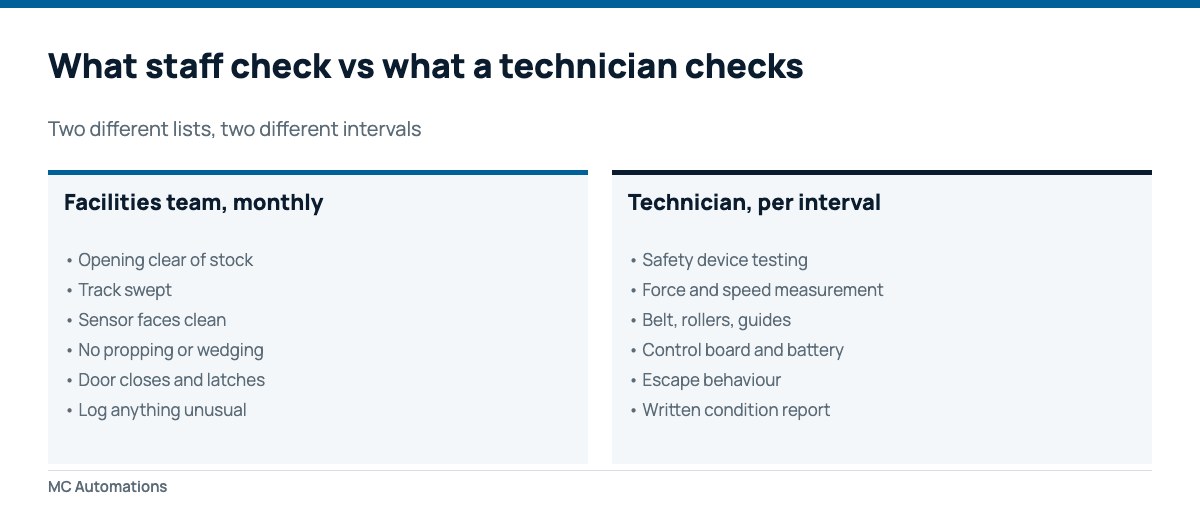
A useful automatic door maintenance checklist has two halves: what your staff can do monthly, and what a technician must do on an interval. Mixing the two is why doors get logged as fine right up until they fail. The monthly half costs nothing and catches most nuisance faults. The technical half is the part that keeps the safety devices honest.
The monthly half, for facilities staff
Walk the entrance. Is the opening clear of stock, bins and signage? Is the track swept? Are the sensor faces clean? Is the door being propped or wedged by anyone?
Then watch one full cycle. Does it open smoothly, hold long enough for a trolley, close under control and latch or seal properly? Anything unusual goes in the log with a date. That is the whole monthly automatic door maintenance checklist, and it prevents most call-outs.
The technical half, for a technician
This is where safety devices are triggered and observed, force and speed are measured, and the belt, rollers, floor guides, control board and battery backup are inspected. Escape and power-loss behaviour is confirmed where it applies.
Requirements for powered pedestrian doors in South Africa are published through SABS, and devices are tested against the requirement stated for the building.
Intervals follow cycles, not months
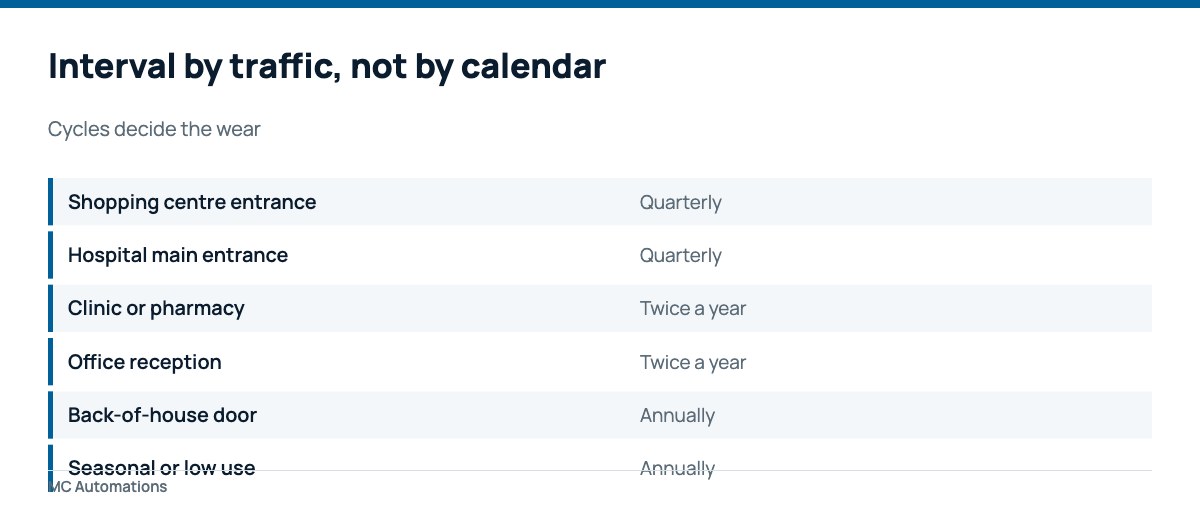
A centre entrance can do more work in a month than an office door does in a year, so a calendar interval flatters the busy door and wastes money on the quiet one.
Every six months is our standard interval, and high-traffic retail and healthcare run shorter. Twice a year suits clinics and reception areas. Annually is reasonable for back-of-house. Traffic at the busiest hour is the number that decides it, not floor area.
What the record should contain
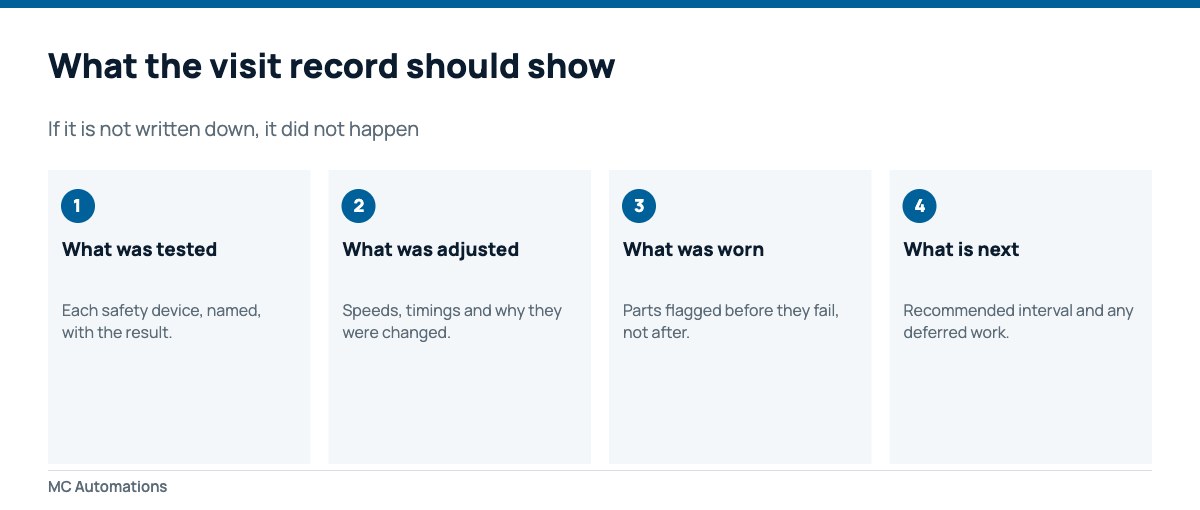
A visit that produces no record is a visit you cannot rely on. The report should name each device tested and its result, what was adjusted and why, what is wearing, and what interval is recommended next.
That record is also what a landlord or an insurer asks for, and it is the difference between maintaining an entrance and hoping about one.
Deferring, and what it costs
Deferred work rarely stays the same size. A worn roller becomes a damaged track; a tired belt becomes a drive failure on a trading day. Breakdown attendance also costs more than planned attendance, and it happens at the worst time.
Our service level agreement page explains what an agreement should define, and servicing covers what a visit includes.
Building the inventory first
An automatic door maintenance checklist is only useful once you know how many doors there are. Most estates discover on the first pass that the number is higher than expected, because back-of-house and secondary entrances were never listed.
Record location, type, what it serves, whether it is on an escape route and who installed it. That inventory is what turns a reactive arrangement into a planned one, and it takes an afternoon.
Photograph each housing while you are there. The label identifies the make, which decides parts availability later.
Seasonal items worth adding
Some checks are worth doing at particular times rather than monthly. Before the rainy season, look at thresholds, drainage and seals. Before the busy trading period, review hold-open times and partial-open settings for the traffic you are about to get.
After any shopfit, walk the entrance again. New display positions, new floor finishes and new signage are the three most common causes of a door that suddenly misbehaves, and all three arrive without anyone thinking about the door.
What to do with what you find
A checklist that produces observations nobody acts on is worse than none, because it creates a record of known faults. Agree in advance what gets fixed in-house, what gets logged for the next service visit and what triggers an immediate call.
Obstruction, propping and a dirty sensor are in-house. Noise, judder, slow operation and anything involving a safety device are for the technician. Anything that leaves the building insecure is immediate.
Agreements, response times and what they buy
An automatic door maintenance checklist covers the routine. What it cannot cover is the breakdown, and that is what an agreement is for: a defined response time, a known interval and a written record each visit.
An agreement does not replace the product warranty and does not extend it. It runs alongside it. Our service level agreement page sets out what an agreement should define.
Requirements for powered pedestrian doors in South Africa are published through SABS, and devices are tested against the requirement stated for the building.
Multi-brand estates
Most buildings accumulate several makes over time. A single automatic door maintenance checklist still works, because the routine checks are the same regardless of manufacturer, and only the technical half varies.
We service all major brands alongside our own equipment, which means one contractor, one schedule and one set of records rather than three. See automatic door brands.
Who does what, and when
Split the work explicitly. The site team owns the monthly walk: opening clear, track swept, sensor faces clean, no propping, one full cycle observed. The contractor owns the technical interval: safety testing, force and speed, wear items, controller and battery.
Writing that split down removes the most common failure, which is each side assuming the other checked. An automatic door maintenance checklist that names an owner per line gets done; one that does not, does not.
Records that survive staff turnover
Keep the checklist and the service reports together, per door, somewhere that is not one person’s inbox. Entrances outlast the people who look after them, and an estate with no history is an estate that starts from zero at every handover.
A simple folder per door with the inventory entry, the photographs, the visit reports and any parts fitted is enough. It is also exactly what an insurer or an incoming facilities manager asks for.
Budgeting from the checklist
Once the automatic door maintenance checklist has run for a year, it produces a budget. You know which doors consume wear items, which are approaching obsolescence and which have never needed anything.
That converts door maintenance from an unpredictable cost into a schedule with a number against it, and it usually reveals that a small number of high-traffic openings account for most of the spend.
The five-minute monthly walk
Done properly the monthly half takes five minutes a door. Stand back and watch one full cycle first, because that shows you speed, hold time and whether the leaf seats. Then look at the detail: track, sensor faces, jambs, threshold.
Write the date and the outcome even when nothing is wrong. An automatic door maintenance checklist with a run of clean months is what makes a sudden change obvious, and it is the record that proves the routine happened.
Photograph anything you are unsure about. A picture of a worn guide or a scuffed jamb tells a technician more than a sentence does, and it can turn a diagnostic visit into a repair visit.
Escalation, and when not to wait
Some findings should not wait for the next scheduled visit. A door that will not secure the building, a safety device that is not responding, a leaf that has been struck and moved, or any burning smell or repeated tripping of a supply are immediate.
Everything else can be logged. The value of an automatic door maintenance checklist is partly that it separates the urgent from the routine, so the urgent actually gets treated as urgent.
Getting the interval right over time
Start with a sensible interval and adjust it from evidence. If a door is consistently clean at every visit, the interval can stretch. If wear items are replaced at every attendance, it should shorten, or the specification is wrong for the traffic.
An automatic door maintenance checklist that never changes the interval is not being used as a tool. The whole point of recording is to let the schedule follow the building rather than the contract.
Adapting the list to your building
The core automatic door maintenance checklist is the same everywhere, but the emphasis changes. A coastal site adds corrosion checks. A dusty industrial site checks tracks and sensor faces more often. A hospital adds noise and cleaning-product compatibility.
Add two or three lines specific to your environment rather than adopting a generic list wholesale. The additions are what make the routine catch what your building actually does to its doors.
Using the record in a dispute
Where a door is shared between landlord and tenant, or where an incident occurs, the maintenance record is the evidence. A completed automatic door maintenance checklist with dates, findings and actions is a far stronger position than recollection.
That is worth the five minutes a month on its own, independent of the faults it prevents.
Making it stick
A checklist fails when it belongs to nobody. Name the person, put it on the same day each month, and review the log quarterly with whoever holds the maintenance budget.
An automatic door maintenance checklist that survives twelve months becomes self-justifying, because by then it has caught something that would otherwise have been a breakdown on a trading day.
A note on how we quote and attend
Everything on this page is written from work we actually do: supplying, installing, commissioning and servicing automatic entrance systems across South Africa, on our own operators and on other manufacturers’ equipment. We do not publish specifications we cannot evidence, and where a figure is a test result rather than a guarantee we say so.
Quotations go out within two working days of receiving the opening size and a photograph. Where a site survey is needed first we say so rather than letting a date slip quietly, and we sometimes charge for a visit depending on what it involves — told beforehand, never afterwards.
The MC-125 sliding operator and MCW-100 swing operator are imported and assembled at our own facility in Johannesburg. That is what keeps belts, rollers, floor guides, sensors and controllers on a shelf locally rather than six weeks away, and it is usually the difference between a same-visit repair and an entrance standing open for a week.
Both operators are tested to one million cycles and carry a 24-month warranty. A cycle test is a measure of what the mechanism withstood under test conditions; it is not a maintenance-free period and not a warranty term, and we are careful never to present it as one.
If you want a second opinion on a quotation, a condition report on doors somebody else installed, or simply a straight answer about whether an opening needs replacing or servicing, send the details through and we will tell you what we would do.
Turning the checklist into a record
A completed automatic door maintenance checklist is only worth what happens to it afterwards, and the value is in the series rather than in any single sheet.
Keep them together and read them across time. The same adjustment appearing on three consecutive visits is not three small jobs — it is one unresolved cause. A leaf that keeps needing re-levelling has a frame that is moving or hinges that are worn. A sensor that keeps needing re-aiming is either mounted on something that flexes or is being knocked. An automatic door maintenance checklist that records only what was done, and never what keeps coming back, hides exactly the pattern worth finding.
Records also matter when responsibility moves. Buildings change agents and tenants, and an entrance with no history cannot support a warranty claim or a sensible replacement budget. Where we hold the completed automatic door maintenance checklist series for an entrance, we can say how much working life is realistically left in the drive — a far better basis for planning than its age.
Automatic door maintenance checklist, answered
How often should we service?
Every six months as standard, and more often for high-traffic retail and healthcare. Cycles decide it.
Can our own staff do the checks?
The monthly half, yes. Safety device testing and force measurement are technician work.
What if the door seems fine?
Most do, right up until they do not. The point of the checks is catching wear before it becomes a failure.
Do you maintain doors you did not install?
Yes, across all major brands. We report condition before committing to an interval.
Does an agreement replace the warranty?
No. It runs alongside it and does not extend it.
What should we keep on file?
The visit reports. They are the evidence that the interval is being met.
Automatic door maintenance checklist checklist
Print this automatic door maintenance checklist and keep it with the site log.
- Opening clear. Stock and signage in the sensor field cause most nuisance call-outs.
- Track swept. Grit is the most common cause of a leaf not seating.
- Sensor faces clean. Dirt reads as movement.
- No propping. A wedged door defeats both the closer and the fire strategy.
- Watch a full cycle. Open, hold, close, latch. Note anything that changed.
- Log it with a date. An automatic door maintenance checklist is only useful if it is written down.
- Book the technical interval. The monthly automatic door maintenance checklist does not replace testing.
If you want the technical half handled on a fixed interval with a written record each time, that is what an agreement is for. Request a quote and tell us the doors and the traffic.
Automatic door maintenance checklist: quick answers
- An automatic door maintenance checklist starts at the track. Vacuum it, check the rollers for flat spots and confirm the floor guide is clear.
- Every automatic door maintenance checklist includes belt tension. A stretched belt shows up as inconsistent closing before it shows up as a breakdown.
- An automatic door maintenance checklist must cover sensors. Clean the lenses, walk-test the full opening and confirm the presence field has not been shadowed by new shopfitting.
- An automatic door maintenance checklist should record force. Measure obstacle detection response rather than assuming the setting has held.
- An automatic door maintenance checklist covers the battery backup where one is fitted — a dead backup is invisible until the power fails.
- An automatic door maintenance checklist for high-traffic sites runs on a six-month standard interval, shortened where traffic is heavy.
- An automatic door maintenance checklist is worth keeping on file. A dated record is what lets you argue wear versus defect on a warranty claim.
- An automatic door maintenance checklist is not a substitute for a fault log. Note every nuisance stop; patterns point at the cause faster than any inspection.
- Run the automatic door maintenance checklist on other manufacturers’ equipment too — we service what we did not install.
- The cheapest automatic door maintenance checklist item is cleaning. Most call-outs we attend are contamination, not component failure.
Still stuck? Send the opening size and a photograph to MC Automations and we will tell you what we would do.
In short
Automatic door maintenance checklist at a glance
- Automatic door maintenance checklist are quoted against the opening we measured, not a catalogue price.
This checklist covers what gets checked. For the reasoning behind the intervals, what actually wears out first and how cycle count and environment drive the schedule, see our fuller guide to automatic door maintenance.
