
Office park automatic doors for landlords and managing agents: who owns which entrance, the access states a working week needs, the morning peak that sizes the lobby, standardising across an estate, and why maintenance recovery changes the contract.
Parts of an Automatic Door, Explained
Understanding the parts of an automatic door makes every quotation and every fault report easier to read. An entrance is not one machine. It is six assemblies that fail in different ways and at different intervals, and knowing which is which tells you whether you are looking at an adjustment, a part or a replacement.
The six assemblies
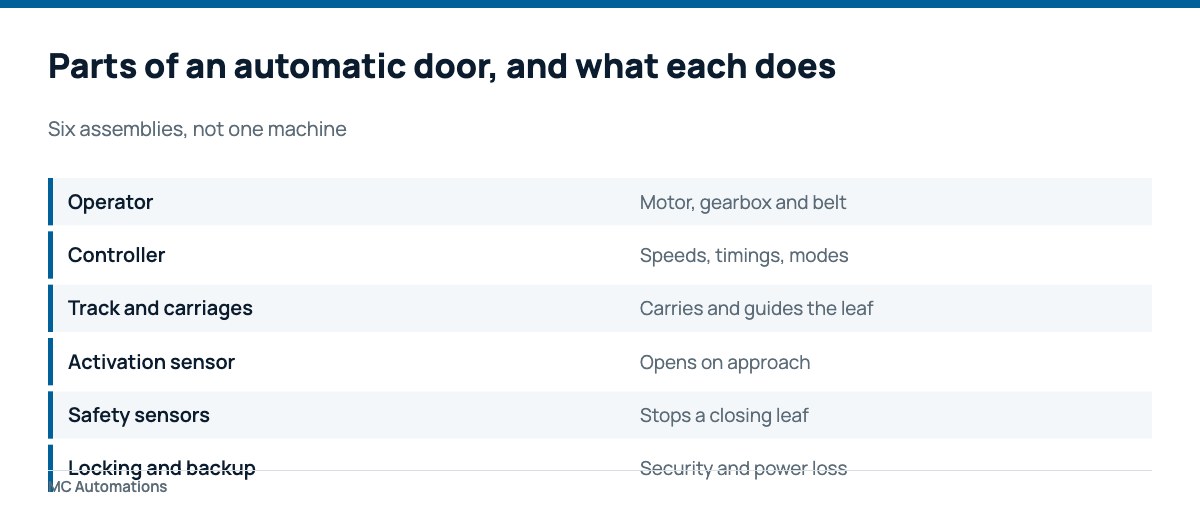
The operator is the drive: motor, gearbox and belt in a housing above the opening. The controller sets speeds, hold-open times and modes. The track and carriages carry the leaf. An activation sensor opens the door, safety sensors stop it closing on somebody, and locking plus battery backup decide what happens at night and during an outage.
Those are the parts of an automatic door that appear on every quotation, whether or not they are itemised.
Which ones actually wear
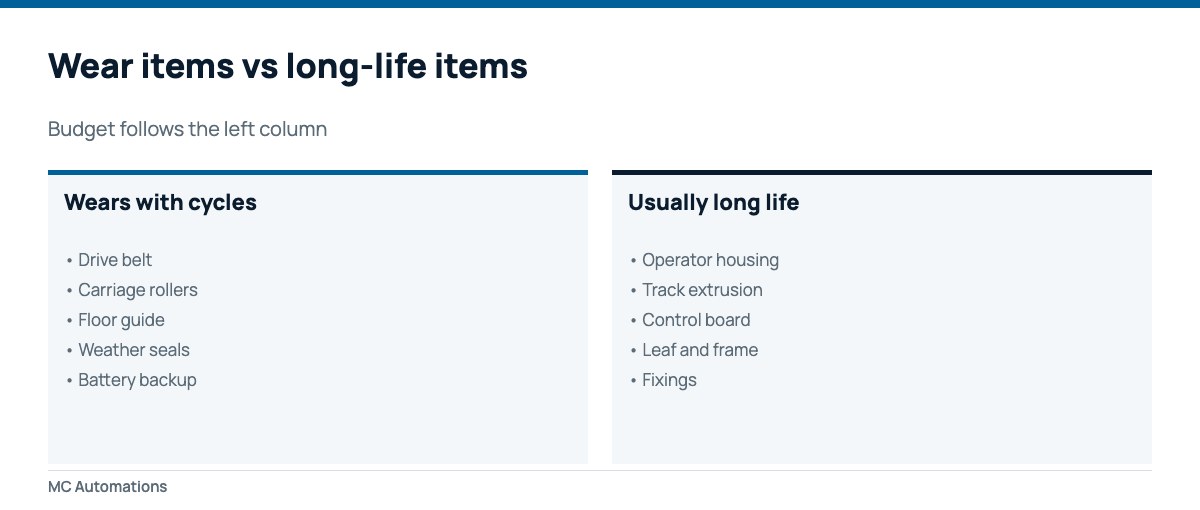
Wear follows cycles. Belts stretch, carriage rollers flatten, floor guides erode and weather seals harden. Batteries have a service life whether or not they are used. Those are the parts of an automatic door that consume a maintenance budget.
Housings, track extrusions, control boards and the leaf itself usually outlast several sets of wear items, which is why replacing an operator wholesale is rarely the first answer.
Reading a fault from the symptom
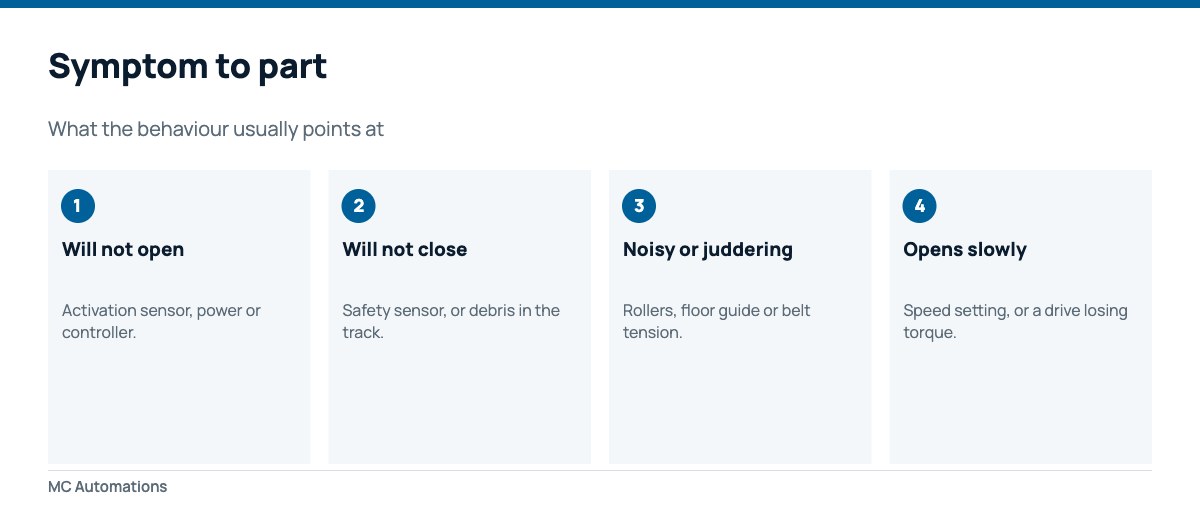
A door that will not open points at activation, power or the controller. A door that will not close points at a safety device or something in the track. Noise and judder point at rollers, the floor guide or belt tension. Slow operation is either a setting or a drive losing torque.
Reporting the symptom precisely shortens the visit, because the technician arrives with the likely part.
Why itemised quotes differ
Two quotations for the same opening often differ because one includes safety devices, battery backup and commissioning and the other treats them as extras. When you know the parts of an automatic door, that gap becomes visible rather than mysterious.
Requirements for powered pedestrian doors in South Africa are published through SABS, and the safety devices are not the place to economise.
Spares and availability
Availability matters more than price on a trading day. We assemble the MC-125 and MCW-100 at our own facility, which is what keeps belts, rollers, guides, sensors and controllers on a shelf in Johannesburg rather than six weeks away. See automatic door spare parts.
We also carry and fit parts for other manufacturers’ equipment through automatic door repairs.
The operator in detail
Inside the housing above the opening sit a motor, a reduction gearbox, a drive pulley and a toothed belt that runs the length of the track. The leaf hangs from carriages that clamp to that belt, so when the pulley turns the leaf travels. It is a deliberately simple arrangement, which is why it lasts.
An encoder or similar feedback device tells the controller where the leaf is and how fast it is moving. That is what allows soft starts, soft stops and the detection of resistance. Among the parts of an automatic door it is the one nobody sees and everybody relies on.
The housing itself matters more than it looks. It keeps dust off the belt and the board, and a cover left off after a service visit shortens the life of everything inside it.
Track, carriages and the floor guide
The track carries the entire weight of the leaf for the life of the door, which is why it has to be mounted to something solid and level. Carriages run along it on rollers, and those rollers are a wear item measured in cycles rather than years.
At the bottom the leaf is held by a floor guide, either set into the floor or into the threshold. It stops the leaf swinging as it travels. A worn guide is one of the most common causes of a noisy door, and one of the cheapest of all the parts of an automatic door to replace.
Debris in the track is the other constant. Grit, packaging and leaves all end up there, and the controller reads the extra resistance as an obstruction.
Controllers, modes and settings
The control board is the part that turns hardware into a usable entrance. It holds opening and closing speeds, hold-open time, partial-open width, and the behaviour on resistance or power loss.
It also drives the mode switch: automatic, partial, exit only, hold open and locked. Those five settings are what a building actually interacts with, and most complaints about the parts of an automatic door turn out to be complaints about how one of them is configured.
Settings are recorded at commissioning so that a later change is visible. A door that has drifted from its commissioned settings is a door somebody adjusted without telling anyone.
Locking, and what happens at night
Sliding entrances are usually secured by an electromechanical lock in the track or a bi-stable lock that holds without drawing current. The choice affects what happens during an outage, because a lock that needs power to stay locked behaves differently from one that does not.
On escape routes there is an additional requirement: the door must be releasable under defined conditions regardless of the locking arrangement. Requirements for powered pedestrian doors in South Africa are published through SABS.
Battery backup as a component, not an extra
In South Africa the battery is not a luxury. It decides whether the entrance keeps working through load shedding, parks open, or parks closed. Among the parts of an automatic door it is the one most often removed at replacement time to save money, and the one most missed afterwards.
Batteries have a service life whether or not they are cycled, so they are replaced on age as well as condition. A backup that has never been tested is an assumption rather than a feature.
Reading a parts quotation
When a repair is quoted, ask which of the parts of an automatic door is being replaced and why. A belt, a set of rollers and a floor guide are wear items and should be inexpensive. A control board or a complete operator is a different order of cost, and worth a second opinion if the symptoms were mechanical.
Ask also whether the part is held locally or imported. Availability decides downtime far more than unit price does, particularly on a trading day.
Activation devices in detail
Among the parts of an automatic door, the activation device is the one users interact with without noticing. Radar units detect motion and are excellent at catching an approach; presence sensors detect somebody standing still and are what stop a door closing on a person who paused.
Push pads and wave sensors are the alternative where a door should not open to passing traffic, such as a corridor crossing. Access control readers do the same job with authorisation attached.
Each choice changes the wiring and the controller configuration, which is why activation is decided before installation rather than added afterwards.
Seals, thresholds and the weather
Brush and blade seals are cheap, wear steadily and are frequently forgotten. They affect draughts, dust ingress and noise, and on a hermetic door they are part of the seal itself rather than a comfort item.
The threshold is where water, grit and trolley wheels all meet. Among the parts of an automatic door it takes the most physical abuse and is the easiest to inspect, which makes it a good early indicator of how hard the entrance is working.
What to keep as spares on site
For a single entrance, none. For an estate with several doors of the same make, a small stock of the fast-wearing parts of an automatic door pays for itself: a floor guide, a set of rollers and a drive belt.
Anything with electronics is better held by the contractor, because it ages on the shelf and needs matching to the controller. Ask what your contractor holds locally rather than duplicating it.
Why this knowledge saves money
Knowing the parts of an automatic door changes three conversations. You can read a quotation and see what is missing. You can report a fault precisely enough that the technician arrives with the right component. And you can tell a wear item from a failure when a replacement is proposed.
None of that requires technical training. It requires knowing that an entrance is six assemblies rather than one machine, and that they fail in different ways at different intervals.
If you are unsure what is fitted on your doors, a condition survey documents the parts of an automatic door across the estate and gives you the baseline to work from.
A note on how we quote and attend
Everything on this page is written from work we actually do: supplying, installing, commissioning and servicing automatic entrance systems across South Africa, on our own operators and on other manufacturers’ equipment. We do not publish specifications we cannot evidence, and where a figure is a test result rather than a guarantee we say so.
Quotations go out within two working days of receiving the opening size and a photograph. Where a site survey is needed first we say so rather than letting a date slip quietly, and we sometimes charge for a visit depending on what it involves — told beforehand, never afterwards.
The MC-125 sliding operator and MCW-100 swing operator are imported and assembled at our own facility in Johannesburg. That is what keeps belts, rollers, floor guides, sensors and controllers on a shelf locally rather than six weeks away, and it is usually the difference between a same-visit repair and an entrance standing open for a week.
Both operators are tested to one million cycles and carry a 24-month warranty. A cycle test is a measure of what the mechanism withstood under test conditions; it is not a maintenance-free period and not a warranty term, and we are careful never to present it as one.
If you want a second opinion on a quotation, a condition report on doors somebody else installed, or simply a straight answer about whether an opening needs replacing or servicing, send the details through and we will tell you what we would do.
What we need from you to be useful
Four things turn a vague enquiry into a firm number: the structural opening width and height, a photograph of the opening from inside and outside, the floor finish, and roughly how many people pass through in a day. Traffic volume is the one most people leave out and the one that changes the specification most, because it sets the duty rating, the sensor layout and the service interval.
Tell us if the entrance has to stay open during the works, whether there is a fire escape route through it, and whether the building has a facilities contractor who needs to sign off. Those three answers decide whether we install in normal hours or after hours, and after-hours work carries a different rate that we would rather quote upfront than add later.
If you are replacing an existing installation, send a photograph of the operator with the cover off if it is safe to reach. Nine times out of ten we can read the manufacturer and generation from that alone, tell you whether the existing track and header can be reused, and quote a modernisation instead of a full replacement — which is usually the cheaper and faster route.
We service what we install and we also take on other manufacturers’ equipment. If your doors came from someone who has since closed or stopped supporting the model, say so when you make contact; it changes what we look for on the first visit and what parts we bring with us.
Parts of an automatic door, answered
What are the main parts of an automatic door?
Operator, controller, track and carriages, activation sensor, safety sensors, and locking with battery backup.
Which part fails most often?
Wear items: belt, rollers, floor guide and seals. Control boards and housings usually outlast them.
Can parts be replaced individually?
Usually yes. Replacing a whole operator is rarely the first answer unless the drive itself has failed.
Do you stock parts for other brands?
We service all major brands and fit parts for them, alongside spares for our own operators.
How long do the wear items last?
It depends on cycles rather than years, which is why service intervals are set on traffic.
Is the battery backup a part or an option?
It is a component with a service life. If the door must work through an outage, it is not optional.
Parts of an automatic door checklist
Use this when reading a quotation or reporting a fault on the parts of an automatic door.
- Ask what operator is fitted. Model and configuration decide which parts of an automatic door are available.
- Confirm the safety devices. These should be itemised, not assumed.
- Ask about battery backup. It changes behaviour during load shedding.
- Report the symptom, not the guess. Will not open and will not close point at different parts.
- Ask what is held locally. Availability decides downtime more than price does.
If you are comparing quotations and cannot tell what is included, send them to us with a photograph of the opening. Request a quote and we will itemise what the door actually needs.
Parts of an automatic door: quick answers
- The operator is the part of an automatic door that does the work — motor, gearbox, encoder and controller in one header unit.
- The track and rollers are the parts of an automatic door that wear first. They carry the full leaf weight through every cycle.
- The belt is the part of an automatic door most often replaced. It stretches gradually rather than failing suddenly.
- Sensors are the parts of an automatic door that keep people safe — activation to open, presence to stop.
- The floor guide is the smallest of the parts of an automatic door and the one most often ignored until the leaf starts snagging.
- The controller is the part of an automatic door that holds your settings: speed, hold-open, latch check, obstacle force.
- Break-out leaves are the parts of an automatic door that matter on escape routes, letting the opening be pushed clear without power.
- Locks and battery backups are optional parts of an automatic door, specified by security and power reliability rather than by traffic.
- Knowing the parts of an automatic door shortens a repair — a photograph of the header with the cover off usually tells us which part to bring.
- We stock the parts of an automatic door locally for the operators we supply, which is what turns a week-long wait into a same-visit repair.
Still stuck? Send the opening size and a photograph to MC Automations and we will tell you what we would do.
In short
Parts of an automatic door at a glance
- Parts of an automatic door are quoted against the opening we measured, not a catalogue price.
- Ask about parts of an automatic door and we confirm the opening, the head and the power position first.
- Parts of an automatic door are installed and commissioned by our own technicians.
- Parts of an automatic door carry a 24-month warranty on the operator.
- Spares for parts of an automatic door are held in Johannesburg, so a repair does not wait on an import.
