
Office park automatic doors for landlords and managing agents: who owns which entrance, the access states a working week needs, the morning peak that sizes the lobby, standardising across an estate, and why maintenance recovery changes the contract.
Automatic Doors for Shops and Retail Stores
Automatic doors for shops are sized by the busiest hour, not by the shopfront width. A door that copes with the daily average and fails at peak is the most common specification error in retail. The entrance is the first queue a customer meets, and it is the one nobody counts.
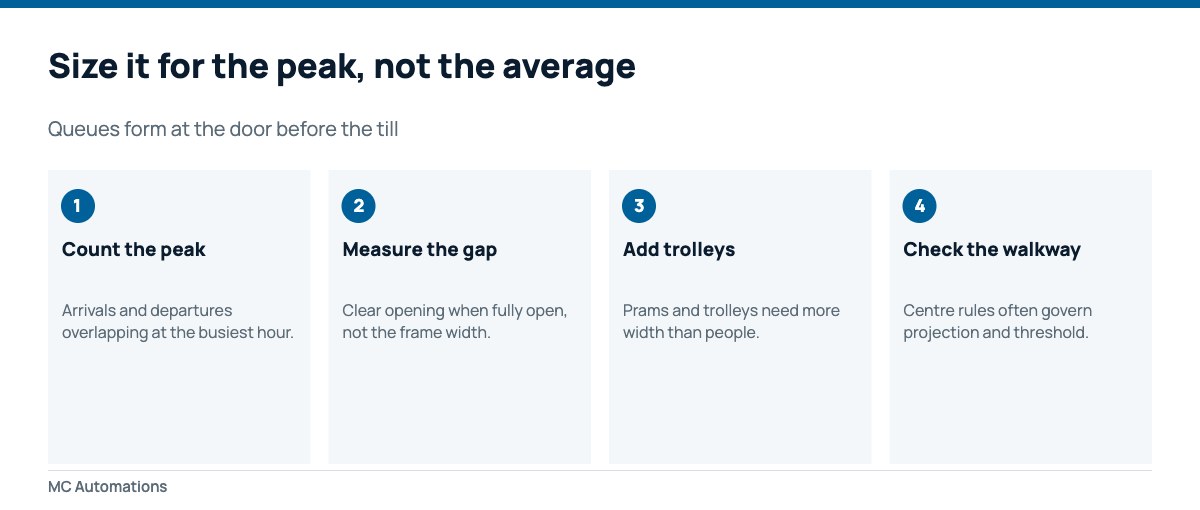
Start with the peak, not the average
Retail traffic is spiky. Automatic doors for shops have to cope with arrivals and departures overlapping at the busiest hour of the busiest day, because that is when the entrance either works or becomes the bottleneck.
Clear opening width is the number that matters — the gap people actually walk through when the door is fully open, not the frame dimension on the drawing.
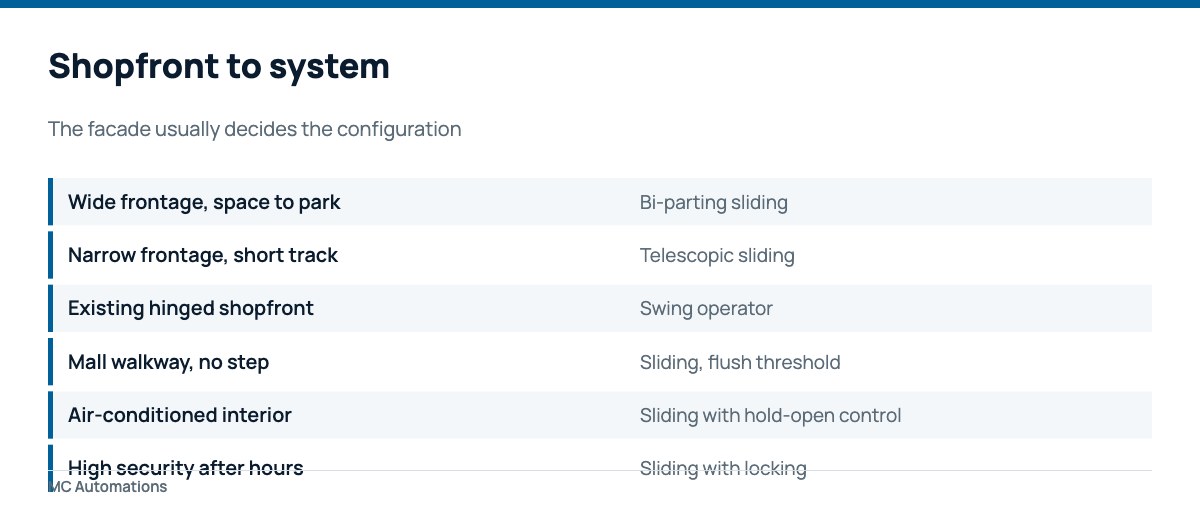
The shopfront usually picks the system
A wide frontage with wall space each side suits a bi-parting slider. A narrow frontage with nowhere for the leaves to park suits telescopic, where two leaves a side nest into a short track. An existing hinged shopfront can often be automated with a swing operator rather than rebuilt.
Our automatic sliding doors page covers clear openings from 1450 to 5000 mm, and telescopic sliding doors covers the short-track case.
Forecourt shops are the most demanding version of retail trading hours, running around the clock in an exposed position. See petrol station automatic doors for how that changes the specification.
Centre rules and landlord requirements
In a shopping centre the landlord usually has a say in threshold height, projection into the walkway, glazing and how the entrance behaves at closing time. Those constraints are cheaper to discover before fabrication than after.
Requirements for powered pedestrian doors in South Africa are published through SABS. Where a requirement applies to your opening we will say which, and what documentation we can provide.
What actually drives running cost
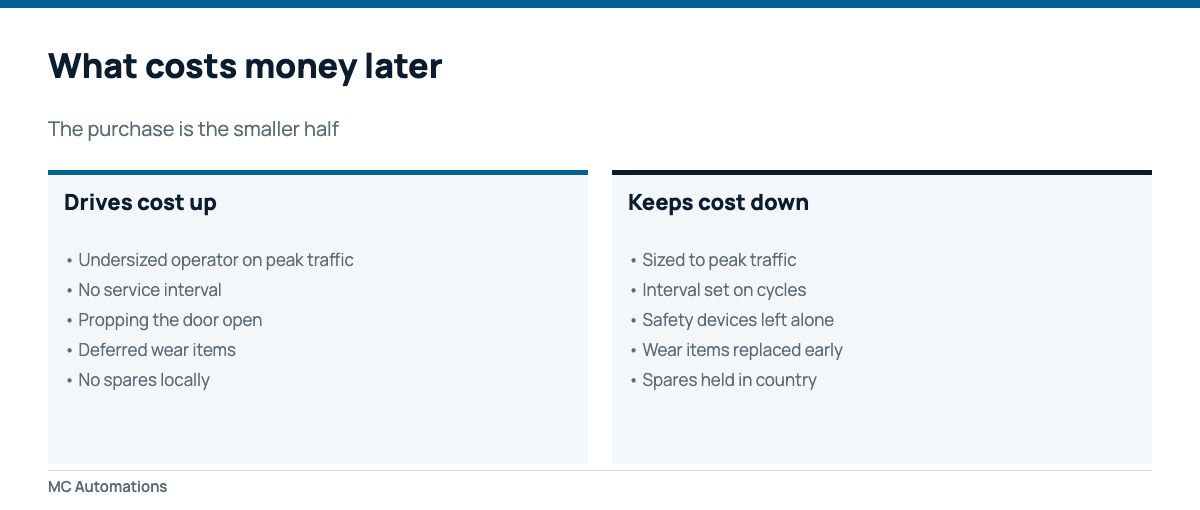
Automatic doors for shops wear on cycles. An undersized operator on a busy entrance does more cycles under more load and consumes belts, rollers and guides faster than a correctly sized one ever will.
Propping is the other quiet cost. A door held open all day in an air-conditioned shop is an energy bill and a defeated safety strategy at the same time.
Service, and who answers on a trading day
Downtime in retail is measured in lost trade, so availability of spares and response time matter more than the last few percent on the purchase price. We hold spares for our own operators in Johannesburg and service other brands too.
See automatic door servicing and service level agreements for how response times are defined.
Threshold, level access and trolleys
A step or an upstand at the entrance undoes much of the benefit of automating it. Automatic doors for shops work best over a flush or near-flush threshold, because that is what lets trolleys, prams and wheelchairs through without a shove.
Drainage is the counterweight. A completely flush threshold on an exposed frontage lets water in, so the detail usually balances a shallow upstand or a channel against the access requirement. It is worth resolving on the drawing rather than on site.
Floor finish matters too, because a polished surface in front of the door can reflect a safety beam and hold the entrance open.
Energy, air-conditioning and partial open
An entrance is a hole in the building envelope for as long as it is open. Hold-open time, opening width and how often the door cycles all show up on the cooling bill in a South African summer.
Partial open is the setting most retailers never use and most would benefit from. It reduces the opening width in quieter months or colder hours without any hardware change, cutting the exchange of conditioned air while keeping the entrance automatic.
Propping is the opposite. A door wedged open all day for convenience is the single largest energy loss an entrance can produce, and it defeats the safety devices at the same time.
Security, closing time and after hours
Automatic doors for shops need a defined end-of-day state. Exit-only lets the last customers leave without admitting new ones, and locked secures the opening once the shop is clear.
Where the shopfront is the only barrier, the locking arrangement and its behaviour during an outage become a security decision rather than a hardware detail. A lock that releases when power fails is fine behind a shutter and unacceptable without one.
Fitting out around a live centre
Most retail installations happen in an operating building, so access windows are usually at night or before trading. That affects programme and cost, and it is better priced than discovered.
Centre management will often require the opening to be hoarded, the walkway kept clear and the work signed off before trading resumes. Those constraints are normal and they are cheaper when they are in the plan.
What we need to quote accurately
Automatic doors for shops are quoted from four things: the clear opening, the leaf weight or glass specification, a photograph showing the header and the surrounding facade, and the traffic at the busiest hour.
With those we can say whether the opening suits a single slider, a bi-parting pair or a telescopic arrangement, and price it installed. Requirements for powered pedestrian doors in South Africa are published through SABS, and where one applies to your opening we will say which.
Peak trading and what actually queues
The entrance is the first bottleneck in a shop and the last one anybody measures. Automatic doors for shops that are sized on frontage rather than flow produce a pinch point exactly when the store is busiest, and the cost of that is invisible because nobody counts the customers who turn away.
Watch your own entrance for ten minutes at peak. If people pause, turn sideways or wait for the leaf, the opening is too narrow or the door is too slow for the traffic it carries.
Branding, glazing and manifestation
Shopfront glass is usually clear and frequently branded. Applied graphics are fine provided they do not sit in a sensor field and provided the leaf remains visible, which is a safety matter rather than an aesthetic one.
Check any rebrand against the door. Vinyl applied across a safety sensor or over the manifestation band turns a compliant entrance into a non-compliant one overnight, and nobody involved in the rebrand is thinking about the door.
Running a multi-store estate
A retailer with many stores benefits from standardising automatic doors for shops on one configuration wherever the frontage allows, because it collapses the spares profile and makes every technician familiar with every site.
Where the estate is already mixed, one contractor across all of it achieves most of the same benefit: a single schedule, a single record and one number to call on a trading day. See automatic door servicing.
Lead time and fitting out
Automatic doors for shops are usually needed on a fixed opening date, and the programme is what catches retailers out. Survey, fabrication, delivery and an installation window agreed with centre management all sit between order and trading.
Book the survey as soon as the frontage is set rather than when the fit-out starts. Most delays we see come from measurements taken late, not from manufacturing.
Warranty and what it covers
Our operators carry a 24-month warranty, which covers the equipment as supplied and installed. It does not cover impact damage from trolleys, misuse, or a door propped open for months and then reported as worn.
Wear items are replaced as part of servicing rather than under warranty, which is the normal arrangement and worth understanding before the first service invoice arrives.
Getting the specification right first time
The costly errors with automatic doors for shops are almost all specification errors rather than product failures: an opening sized on frontage instead of flow, a threshold that defeats trolleys, a missing battery backup, or safety devices treated as an optional line.
Each is cheap to avoid at quotation stage and expensive to correct once the shopfront is fabricated. Automatic doors for shops reward the half hour spent measuring and counting before anything is ordered.
Send us the clear opening, the peak-hour traffic and a photograph of the frontage and we will tell you what the entrance actually needs.
A note on how we quote and attend
Everything on this page is written from work we actually do: supplying, installing, commissioning and servicing automatic entrance systems across South Africa, on our own operators and on other manufacturers’ equipment. We do not publish specifications we cannot evidence, and where a figure is a test result rather than a guarantee we say so.
Quotations go out within two working days of receiving the opening size and a photograph. Where a site survey is needed first we say so rather than letting a date slip quietly, and we sometimes charge for a visit depending on what it involves — told beforehand, never afterwards.
The MC-125 sliding operator and MCW-100 swing operator are imported and assembled at our own facility in Johannesburg. That is what keeps belts, rollers, floor guides, sensors and controllers on a shelf locally rather than six weeks away, and it is usually the difference between a same-visit repair and an entrance standing open for a week.
Both operators are tested to one million cycles and carry a 24-month warranty. A cycle test is a measure of what the mechanism withstood under test conditions; it is not a maintenance-free period and not a warranty term, and we are careful never to present it as one.
If you want a second opinion on a quotation, a condition report on doors somebody else installed, or simply a straight answer about whether an opening needs replacing or servicing, send the details through and we will tell you what we would do.
What we need from you to be useful
Four things turn a vague enquiry into a firm number: the structural opening width and height, a photograph of the opening from inside and outside, the floor finish, and roughly how many people pass through in a day. Traffic volume is the one most people leave out and the one that changes the specification most, because it sets the duty rating, the sensor layout and the service interval.
Tell us if the entrance has to stay open during the works, whether there is a fire escape route through it, and whether the building has a facilities contractor who needs to sign off. Those three answers decide whether we install in normal hours or after hours, and after-hours work carries a different rate that we would rather quote upfront than add later.
If you are replacing an existing installation, send a photograph of the operator with the cover off if it is safe to reach. Nine times out of ten we can read the manufacturer and generation from that alone, tell you whether the existing track and header can be reused, and quote a modernisation instead of a full replacement — which is usually the cheaper and faster route.
We service what we install and we also take on other manufacturers’ equipment. If your doors came from someone who has since closed or stopped supporting the model, say so when you make contact; it changes what we look for on the first visit and what parts we bring with us.
Trading hours and when the work can happen
The constraint that shapes most shopfront jobs is not technical. Automatic doors for shops sit on the one opening a retailer cannot close, and that decides the programme before anything else does.
A shop trading twelve hours a day leaves a short window for work that takes the entrance out of service, and in a centre that window is shared with cleaning and deliveries. In practice this means replacement work on automatic doors for shops happens out of hours, over several shifts, with the entrance handed back working each morning — slower and dearer than a single continuous day, and the only version a trading shop can accept.
Where the opening is wide enough to be bi-parting, the work can often be done in halves so one side stays in service behind a hoarding. That is worth asking about early, because it can be the difference between trading through the job and closing for it.
Automatic doors for shops, answered
What size automatic doors for shops do I need?
It follows the clear opening and the peak-hour traffic, not the frontage width. Send both and we can size it.
Sliding or swing for a shopfront?
Sliding for most retail, because it does not sweep the walkway. Swing suits existing hinged frontages being automated.
Can the door stay open during trading?
It can be set to hold open, but in an air-conditioned shop that is an energy decision and it affects the safety strategy.
What happens during load shedding?
With battery backup the door behaves predictably. Without it, behaviour depends on the operator.
Do centres have their own rules?
Usually yes, on threshold, projection and closing behaviour. Check before fabrication.
How often should a retail entrance be serviced?
Every six months is our standard interval, shortened where retail footfall is heavy.
Automatic doors for shops checklist
Send these six and automatic doors for shops can be quoted accurately rather than estimated.
- Clear opening width and height. The gap people walk through, fully open.
- Peak-hour traffic. Automatic doors for shops are sized on the peak, not the average.
- A photograph of the frontage. Shows the header, the wall space and the walkway.
- Trolleys or prams, yes or no. Changes the width and the hold-open time.
- Centre or landlord requirements. Threshold, projection and closing rules.
- Power at the head. If absent, an electrician cost sits outside the hardware.
Send those and we will specify and price automatic doors for shops that hold up at peak rather than at the average. Request a quote, or see commercial automatic doors.
Automatic doors for shops: quick answers
- Automatic doors for shops are specified by footfall first. Duty rating, not opening width, is what decides which operator survives the year.
- Sliding automatic doors for shops suit narrow pavements because the leaf never swings into the walkway.
- Swing automatic doors for shops suit low-traffic side entrances and cost less to install where the opening allows it.
- Automatic doors for shops need presence sensing across the whole opening, not just an activation beam — prams and trolleys stop in the threshold.
- Automatic doors for shops in a mall usually have to be installed after hours. Say so at quotation stage and the rate is agreed upfront.
- Automatic doors for shops on an escape route must open without power, which means break-out leaves or a fail-safe release.
- Glass choice on automatic doors for shops is a safety-glazing decision before it is an aesthetic one.
- Automatic doors for shops are serviced every six months as standard at retail footfall, with a shorter interval where the door is busiest.
- Modernising automatic doors for shops is usually cheaper than replacing them, because the existing track and header often stay.
- Automatic doors for shops are quoted from four things: structural opening size, a photograph, the floor finish and daily footfall.
Still stuck? Send the opening size and a photograph to MC Automations and we will tell you what we would do.
In short
Automatic doors for shops at a glance
- Automatic doors for shops are quoted against the opening we measured, not a catalogue price.
- Ask about automatic doors for shops and we confirm the opening, the head and the power position first.
- Automatic doors for shops are installed and commissioned by our own technicians.
