
Office park automatic doors for landlords and managing agents: who owns which entrance, the access states a working week needs, the morning peak that sizes the lobby, standardising across an estate, and why maintenance recovery changes the contract.
Hospital Automatic Doors and Clinical Entrances
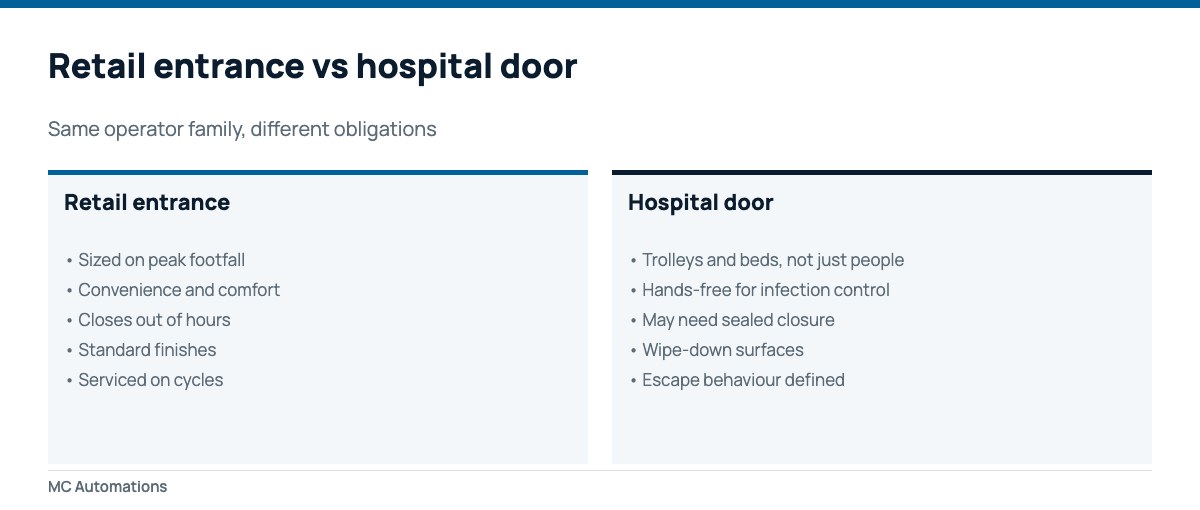
Hospital automatic doors are specified around what moves through them, not around how many people use them. A retail entrance is sized on footfall. A hospital door is sized on a bed, a trolley or a wheelchair with staff either side, and it often has to close against a pressure differential as well. Those are different problems.
Clear opening is set by the widest thing, not the busiest hour
In retail the peak decides the width. In healthcare a single bed with staff walking beside it decides it, and that is usually wider than footfall would suggest.
Get this wrong and the door is technically adequate and practically useless, because porters turn beds sideways or wedge the leaf. Hospital automatic doors that get propped are a sign the clear opening was set from the wrong number.
Hands-free is an infection control requirement
Push plates and handles are contact points. In wards, theatres and isolation areas the reason for automation is usually hygiene rather than convenience, which rules out manual assistance and makes sensor choice and reliability more important.
That is also why a failed sensor in a clinical area is a different severity of fault from the same failure on a shopfront.
Community and retail pharmacies carry a related but different brief — an open shop wrapped around a controlled dispensary. See pharmacy automatic doors.
Where sealing matters
Theatres, isolation rooms and cleanrooms need a door that shuts tight rather than simply shuts. Our hermetically sealed doors page covers that case, including the MCL-165.
Surfaces matter too: finishes have to tolerate repeated cleaning without degrading, which affects both the leaf and the operator housing.
Escape, power and what happens on failure
Behaviour on power loss is a design decision in a hospital, not a surprise. Some doors must fail open, some must hold closed, and on escape routes the release behaviour is governed.
Requirements for powered pedestrian doors in South Africa are published through SABS. We will tell you which apply to the opening, and we do not publish a certification claim we cannot evidence.
Servicing around a live building
Hospital automatic doors cannot be taken out of service at will, so attendance is planned around theatre lists and ward routines. Our standard interval is every six months, and high-cycle openings run shorter.
We service other manufacturers’ equipment as well as our own, which matters in a hospital estate that has been extended several times. See automatic door servicing.
Trolley traffic is the real load
Hospital automatic doors are cycled by porters, cleaners, catering and clinical staff around the clock, and many of those cycles involve something wide and heavy. That is a harder duty than a retail entrance doing a similar number of cycles with pedestrians.
Impact is part of it. Bed frames and trolleys clip jambs and leaves, and a door that has been struck repeatedly drifts out of alignment long before it fails outright. Protection on the jambs is cheap and prevents a recurring realignment cost.
Because the building never closes, servicing has to be planned around clinical activity rather than dropped on a department, which is a scheduling problem as much as a technical one.
Infection control and surfaces
Hands-free operation is the headline, but the surfaces matter too. Housings, leaves and frames are wiped repeatedly with clinical cleaning products, and finishes that tolerate that regime last longer than finishes chosen on appearance.
Detailing counts as well. Recesses and exposed fixings collect soil and are difficult to clean, so a simpler profile is usually the better clinical choice even when a more decorative one is available.
Pressure differentials and sealed rooms
Theatres, isolation rooms and some laboratories are held at a pressure different from the corridor. A door into one of those spaces has to close against that differential and seal when shut, which is a mechanical requirement rather than a finish.
That is what hermetic doors are for, and it is why hospital automatic doors in clinical areas are specified differently from the main entrance. See hermetically sealed doors.
Interlocking is often part of the same conversation: two doors that must not be open simultaneously, so the airlock is maintained. That is a control requirement and it is set at commissioning.
Escape, alarm and power behaviour
What a door does when an alarm sounds or the power fails is a design decision in a hospital, and it varies by area. Some doors must release, some must hold, and some must revert to manual operation without becoming an obstruction.
Requirements for powered pedestrian doors in South Africa are published through SABS. We will tell you which apply to your opening and what documentation we can provide, and we do not publish a certification claim we cannot evidence.
Phased work in an operating building
Replacing hospital automatic doors rarely happens all at once. Work is phased ward by ward, often at night, with temporary arrangements agreed for the opening while the door is out of service.
That temporary arrangement is worth planning carefully, because a corridor held open with a wedge for three days defeats the compartment line the door was there to maintain.
Estates with a mix of ages
Hospitals extend over decades, so the door estate is usually mixed. One contractor across all of it produces a single schedule and a single record, which is what makes the estate auditable rather than anecdotal.
We service other manufacturers’ equipment alongside our own, and take over doors another installer fitted after reporting their condition first. See automatic door servicing.
Residential aged care is a different brief from a clinical one — slower occupants, longer hold-open times and a building that is somebody’s home. We cover that separately in automatic doors for retirement homes and frail care.
Specifying by department
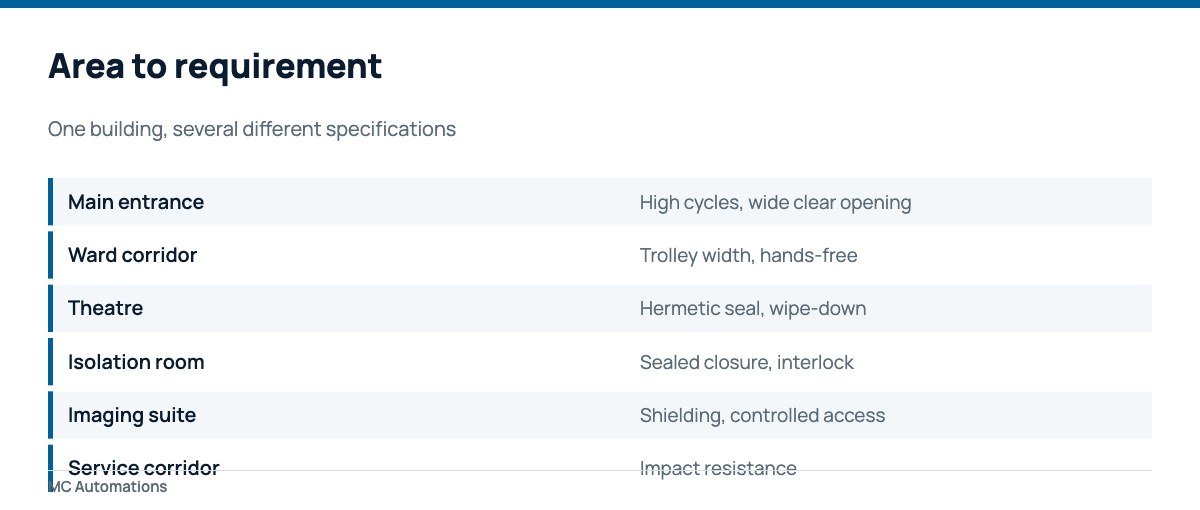
There is no single specification for hospital automatic doors, because a main entrance, a ward corridor, a theatre and an imaging suite are four different problems. The entrance is a high-cycle public door. The corridor is a trolley door. The theatre is a sealing door. Imaging may involve shielding and controlled access.
Treating them as one line item is where most healthcare projects go wrong, because the cheapest adequate door for the entrance is not adequate at the theatre and the theatre specification is wasted on a store room.
Walk the department with the clinical lead rather than the drawing. The people who move beds through a door will tell you in two minutes what the plan cannot.
Noise, privacy and night-time wards
Hospital automatic doors run through the night in spaces where people are trying to sleep. Opening and closing speed, the softness of the stop and the condition of the rollers all affect how much noise a cycle makes.
A door that has become audible is usually a door with worn rollers or a dry floor guide, and on a ward that is a clinical complaint rather than a maintenance nicety. It is another reason the service interval on hospital automatic doors is set by use rather than by the calendar.
Access control in clinical areas
Many hospital automatic doors are not open to everyone. Wards, drug stores, theatres and neonatal units restrict entry, which means the door has to combine hands-free operation for authorised staff with reliable refusal for everyone else.
That combination is a controller and reader configuration rather than a door type, and it has to fail in a defined way: what happens to the lock when the power fails, and what happens under alarm, are decided at specification.
Planning a replacement programme
Hospital automatic doors are usually replaced in phases over several years. Prioritise by risk and traffic: the doors that carry beds, the doors on escape routes and the doors whose parts are no longer available.
Doing that from a written condition survey rather than from complaints produces a programme that can be budgeted, and it stops the estate being driven entirely by whichever door failed most recently.
Where to begin on an existing estate
Start with the doors that carry beds and the doors on escape routes, because those carry the most risk and the most traffic. Survey their condition, record what is fitted and set an interval from the cycles they actually do.
Hospital automatic doors elsewhere in the building can follow on a longer cycle. The point is to stop treating a mixed estate as one undifferentiated list and start treating it as a prioritised one.
We take over hospital automatic doors installed by others after reporting their condition, so the interval is agreed against what is actually there rather than what was assumed.
A note on how we quote and attend
Everything on this page is written from work we actually do: supplying, installing, commissioning and servicing automatic entrance systems across South Africa, on our own operators and on other manufacturers’ equipment. We do not publish specifications we cannot evidence, and where a figure is a test result rather than a guarantee we say so.
Quotations go out within two working days of receiving the opening size and a photograph. Where a site survey is needed first we say so rather than letting a date slip quietly, and we sometimes charge for a visit depending on what it involves — told beforehand, never afterwards.
The MC-125 sliding operator and MCW-100 swing operator are imported and assembled at our own facility in Johannesburg. That is what keeps belts, rollers, floor guides, sensors and controllers on a shelf locally rather than six weeks away, and it is usually the difference between a same-visit repair and an entrance standing open for a week.
Both operators are tested to one million cycles and carry a 24-month warranty. A cycle test is a measure of what the mechanism withstood under test conditions; it is not a maintenance-free period and not a warranty term, and we are careful never to present it as one.
If you want a second opinion on a quotation, a condition report on doors somebody else installed, or simply a straight answer about whether an opening needs replacing or servicing, send the details through and we will tell you what we would do.
What we need from you to be useful
Four things turn a vague enquiry into a firm number: the structural opening width and height, a photograph of the opening from inside and outside, the floor finish, and roughly how many people pass through in a day. Traffic volume is the one most people leave out and the one that changes the specification most, because it sets the duty rating, the sensor layout and the service interval.
Tell us if the entrance has to stay open during the works, whether there is a fire escape route or a compartment line needing fire rated automatic doors through it, and whether the building has a facilities contractor who needs to sign off. Those three answers decide whether we install in normal hours or after hours, and after-hours work carries a different rate that we would rather quote upfront than add later.
If you are replacing an existing installation, send a photograph of the operator with the cover off if it is safe to reach. Nine times out of ten we can read the manufacturer and generation from that alone, tell you whether the existing track and header can be reused, and quote a modernisation instead of a full replacement — which is usually the cheaper and faster route.
We service what we install and we also take on other manufacturers’ equipment. If your doors came from someone who has since closed or stopped supporting the model, say so when you make contact; it changes what we look for on the first visit and what parts we bring with us.
Cleaning regimes and what they do to the hardware
The detail that separates hospital automatic doors from other commercial entrances is not the traffic — it is what gets sprayed on them several times a day.
Clinical cleaning uses agents chosen for what they kill rather than for what they are kind to. Over time those agents attack seals, printed graphics, sensor lenses and the finish on exposed fixings. A sensor lens that has been wiped with an aggressive agent daily for two years scatters light differently from a new one, and hospital automatic doors that develop erratic detection are often suffering from cleaning rather than from electronics.
Two practical consequences follow. Sensor lenses and safety devices on hospital automatic doors need inspecting for clouding and abrasion as a routine item, not only when a fault is reported. And the cleaning specification is worth agreeing with the infection-control team rather than left to whoever is on shift, because the entrance has to survive the regime the hospital actually runs.
Hospital automatic doors, answered
How wide should hospital automatic doors be?
Wide enough for the widest thing that passes, usually a bed with staff either side, rather than sized on footfall.
Why hands-free rather than a push plate?
Contact points work against infection control, which is often the reason for automating the door in the first place.
Do theatres need a different door?
Usually yes. Sealed closure and wipe-down surfaces are the difference, which is what hermetic doors are for.
What happens during a power failure?
It depends on the design decision for that opening. It should be recorded and tested, not discovered.
Can you work around a live ward?
Yes. Attendance is planned around lists and routines rather than dropped on the department.
Do you service other brands in a hospital?
Yes, across all major automatic door brands, which most hospital estates have a mix of.
Hospital automatic doors checklist
Confirm these before hospital automatic doors are specified or priced.
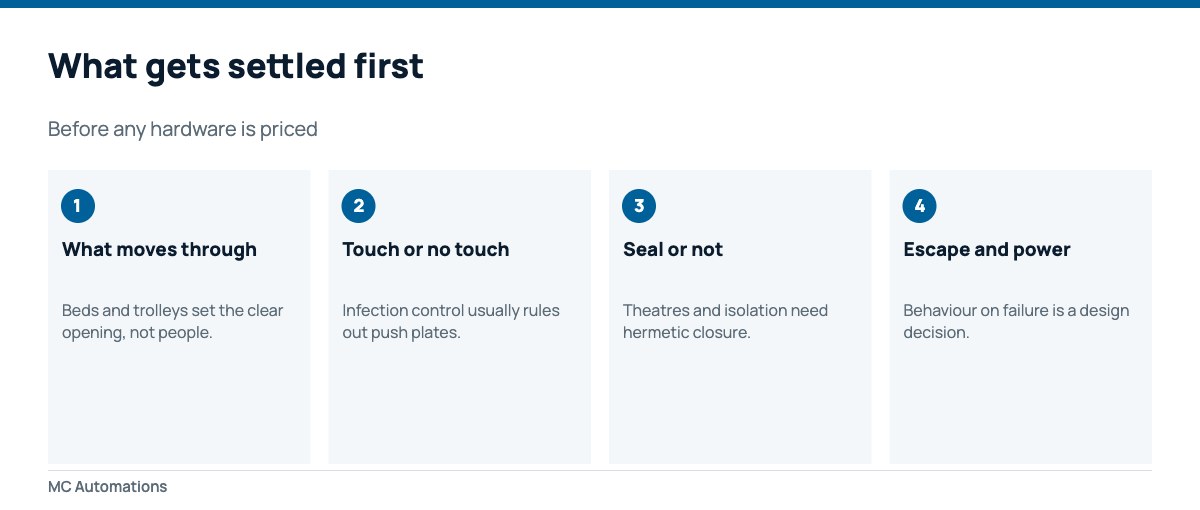
- The widest item that passes. Beds and trolleys set the clear opening for hospital automatic doors.
- Touch or no touch. Infection control usually decides this, not preference.
- Seal required or not. Theatres and isolation rooms need hermetic closure.
- Escape route status. Release and power-loss behaviour are governed.
- Cleaning regime. Finishes must tolerate repeated wipe-down.
- Access windows. When the department can actually release the door for work.
Send the area, the widest item that passes and whether sealing is required, and we will specify hospital automatic doors that suit the clinical use rather than the footfall. Request a quote.
Hospital automatic doors: quick answers
- Hospital automatic doors are specified around bed and trolley clearance, not around pedestrian width.
- Hospital automatic doors in theatre and isolation areas are chosen for seal and cleanability as much as for motion.
- Hermetic hospital automatic doors exist to hold a pressure differential; a standard sliding operator will not do that job.
- Hospital automatic doors need touch-free activation — wave sensors and foot switches reduce hand contact at ward thresholds.
- Hospital automatic doors on escape routes must be passable without power, the same as any other building.
- Hospital automatic doors run continuously, so duty rating and parts availability matter more here than anywhere else.
- Servicing hospital automatic doors has to be scheduled around clinical use. We work to the facility’s access windows, including nights.
- Hospital automatic doors inherited from another supplier are still serviceable — we maintain other manufacturers’ equipment.
- Quiet operation on hospital automatic doors is a real specification in wards, not a nicety.
- Hospital automatic doors are quoted from the opening size, the traffic type and the access window. Tell us if beds pass through and the specification changes immediately.
Still stuck? Send the opening size and a photograph to MC Automations and we will tell you what we would do.
In short
Hospital automatic doors at a glance
- Hospital automatic doors are quoted against the opening we measured, not a catalogue price.
