
Office park automatic doors for landlords and managing agents: who owns which entrance, the access states a working week needs, the morning peak that sizes the lobby, standardising across an estate, and why maintenance recovery changes the contract.
Automatic Door Brands and Multi-Brand Service
Most buildings end up with several automatic door brands, and nobody plans it that way. An entrance is replaced, a wing is added, a contractor changes, and five years later the estate has three controllers, two sensor families and no single record of what is fitted. That is normal, and it is manageable once it is documented.
How to find out what you have
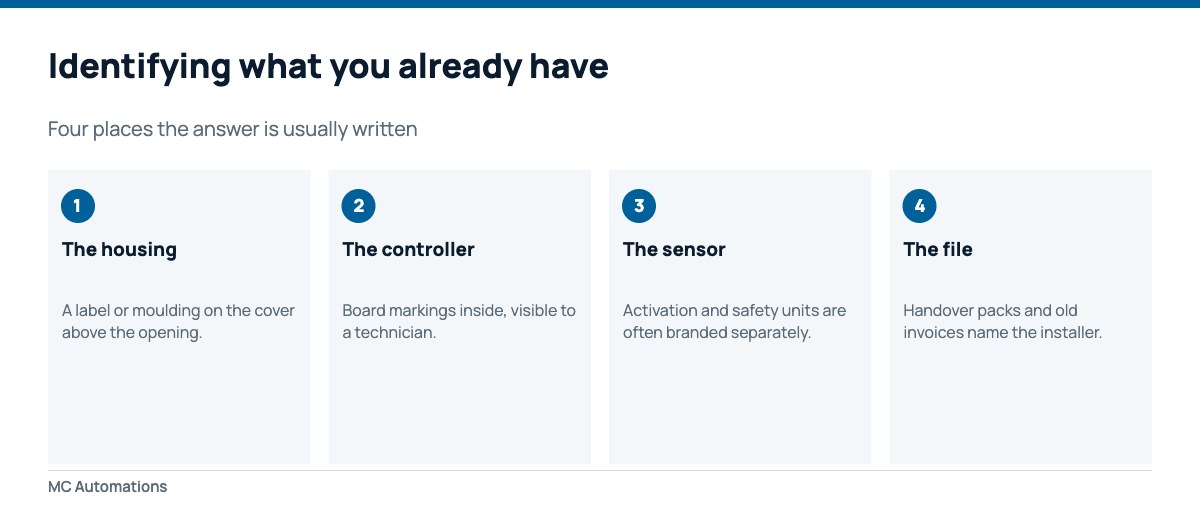
The housing above the opening usually carries a label or a moulded name. Controllers are marked inside, sensors are often a different make from the operator, and the handover pack or an old invoice names whoever installed it.
Knowing which automatic door brands are on site is the first step to costing their upkeep, because parts availability varies enormously between them.
Why a mixed estate costs more
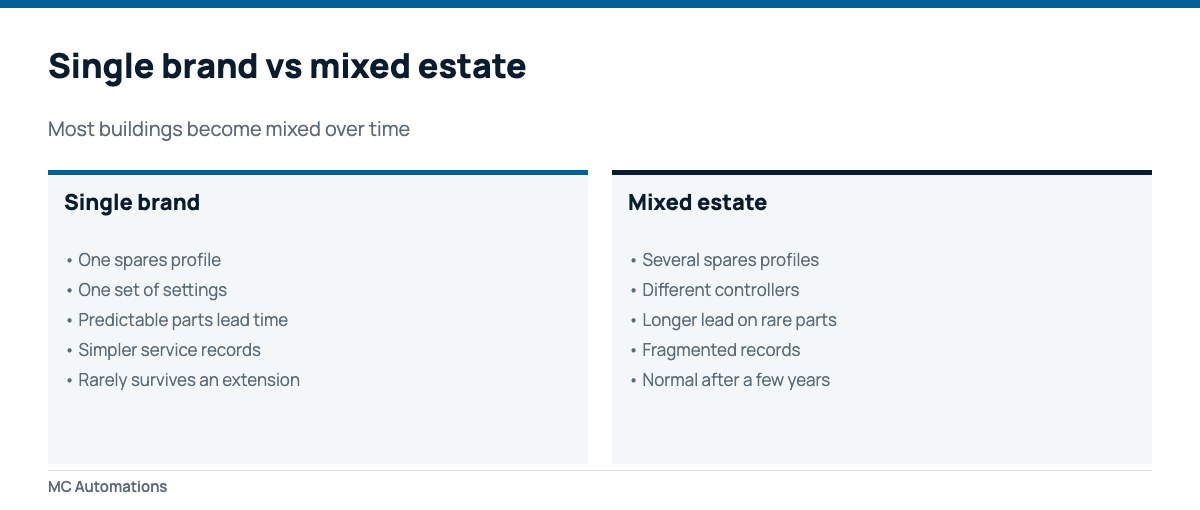
Each make carries its own spares profile, its own controller logic and its own settings. A technician who knows one is not automatically quick on another, and a part that sits on a shelf for one make may be a six-week import for another.
That is the real cost of mixed automatic door brands: not the hardware, but the lead time and the number of people who need to be involved.
What multi-brand service actually means
It means one contractor attends everything, carries the common wear items and tells you honestly when a part for a rarer make has to be ordered. It does not mean every part for every make sits on a shelf, and anyone claiming that is overselling.
We service and repair automatic doors from other manufacturers alongside our own, and we hold spares in Johannesburg for the operators we assemble. See automatic door repairs.
Taking over somebody else’s doors
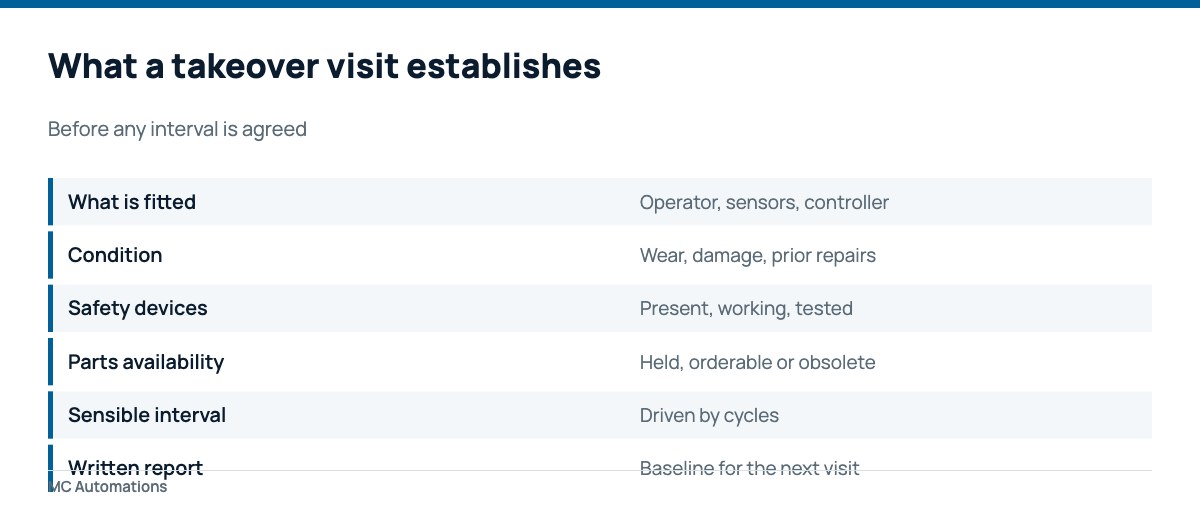
A takeover starts with a condition report rather than an interval. What is fitted, what condition it is in, whether the safety devices are present and working, and whether parts are still available all get established before anything is agreed.
Requirements for powered pedestrian doors in South Africa are published through SABS, and safety devices are tested against the requirement stated for the building.
When replacing beats maintaining
Obsolescence decides it more often than wear. When a controller is no longer supported and the sensors are discontinued, maintaining that door means hoping, and the next failure is an outage of unknown length.
Modernisation usually keeps the frames and the leaves and replaces the drive and controls. See automatic door modernisation.
Why estates become mixed
Nobody sets out to run four makes. A building opens with one, an extension is fitted by the contractor who won that package, a failed door is replaced urgently by whoever could attend, and a tenant fit-out introduces a fourth. Ten years later the automatic door brands on site reflect procurement history rather than any decision.
That is normal and it is not, in itself, a problem. It becomes one when nobody has written down what is where, because then every fault starts with an investigation.
What actually differs between makes
Mechanically they are more alike than marketing suggests: a motor, a belt, carriages on a track, sensors and a controller. The differences that matter operationally are the controller logic, the connector types, the sensor families and the spares position in your country.
Controller logic is the biggest. Setting hold-open time or partial-open width is a different procedure on each make, which is why a technician familiar with one is not automatically quick on another.
Connectors and sensor families decide whether a like-for-like replacement is possible or whether an equivalent has to be adapted.
Obsolescence is the real risk
Hardware rarely becomes unusable. Support does. When a controller is discontinued and the matching sensors are no longer produced, maintaining that door means relying on salvage, and the next failure becomes an outage of unknown length.
This is the point at which automatic door brands stop being a procurement detail and become a budget decision. Modernisation keeps the frames and leaves and replaces the drive and controls, which is usually cheaper than a full replacement. See automatic door modernisation.
What honest multi-brand support means
It means attending any make, carrying the common wear items, and being straight about lead time when a rarer part has to be ordered. It does not mean every component for every manufacturer sits on a shelf, and a contractor who claims that is overselling.
Requirements for powered pedestrian doors in South Africa are published through SABS, and safety devices are tested against the requirement stated for the building regardless of who made the door.
Standardising over time, not overnight
Replacing working doors to unify automatic door brands is rarely justified. Standardising as doors reach end of life is, because each replacement moves the estate toward one spares profile and one set of settings without wasting serviceable equipment.
Write the target make into the specification for future work and the estate converges on its own within a replacement cycle.
Starting the record
List every powered door with its location, photograph each housing and sensor, and note what each serves and whether it is on an escape route. That is the whole exercise, and it converts a set of automatic door brands into a maintainable estate.
Buying decisions that create tomorrow’s problem
The cheapest urgent replacement is how most estates acquire an extra make. A door fails on a Friday, somebody attends who can fit what they have in the van, and the building now runs one more controller family than it did.
That is understandable and sometimes unavoidable. It is worth recording when it happens, because the cost appears years later as a spares problem rather than immediately as a price.
Where there is time, matching an existing make is usually worth a small premium purely for the spares and settings continuity.
Questions to ask any contractor
Ask which automatic door brands they attend routinely rather than which they can attend. Ask what they hold locally for each. Ask what happens when a part is obsolete, and whether they will fit an equivalent or insist on a full replacement.
The answers separate a contractor who genuinely supports a mixed estate from one who services their own product and subcontracts the rest.
Documentation as an asset
An estate record listing automatic door brands, models, install dates, service history and parts availability is worth more than it costs to compile. It shortens every future visit, makes budgets defensible and survives staff changes.
It also changes negotiations. A contractor quoting against a documented estate prices the actual work; one quoting against an unknown estate prices the risk.
When one make across a site is worth it
Standardising pays where there are many similar openings: a retail chain, a hospital wing, a logistics facility with a row of identical entrances. It rarely pays in a mixed building with a handful of doors that all work.
The test is whether the spares and training saving over a replacement cycle exceeds the cost of replacing equipment early. For most buildings it does not, which is why converging gradually beats standardising abruptly.
The practical position
Most buildings will always run more than one make, and that is manageable. What is not manageable is not knowing which automatic door brands are where, which are still supported, and when each was last tested.
Fix the record first and the rest becomes ordinary maintenance. Standardise gradually as doors reach end of life rather than replacing serviceable equipment to tidy the estate.
And choose a contractor who is honest about which automatic door brands they hold parts for, because that answer decides how long your entrance is out of service when something fails.
A note on how we quote and attend
Everything on this page is written from work we actually do: supplying, installing, commissioning and servicing automatic entrance systems across South Africa, on our own operators and on other manufacturers’ equipment. We do not publish specifications we cannot evidence, and where a figure is a test result rather than a guarantee we say so.
Quotations go out within two working days of receiving the opening size and a photograph. Where a site survey is needed first we say so rather than letting a date slip quietly, and we sometimes charge for a visit depending on what it involves — told beforehand, never afterwards.
The MC-125 sliding operator and MCW-100 swing operator are imported and assembled at our own facility in Johannesburg. That is what keeps belts, rollers, floor guides, sensors and controllers on a shelf locally rather than six weeks away, and it is usually the difference between a same-visit repair and an entrance standing open for a week.
Both operators are tested to one million cycles and carry a 24-month warranty. A cycle test is a measure of what the mechanism withstood under test conditions; it is not a maintenance-free period and not a warranty term, and we are careful never to present it as one.
If you want a second opinion on a quotation, a condition report on doors somebody else installed, or simply a straight answer about whether an opening needs replacing or servicing, send the details through and we will tell you what we would do.
What we need from you to be useful
Four things turn a vague enquiry into a firm number: the structural opening width and height, a photograph of the opening from inside and outside, the floor finish, and roughly how many people pass through in a day. Traffic volume is the one most people leave out and the one that changes the specification most, because it sets the duty rating, the sensor layout and the service interval.
Tell us if the entrance has to stay open during the works, whether there is a fire escape route through it, and whether the building has a facilities contractor who needs to sign off. Those three answers decide whether we install in normal hours or after hours, and after-hours work carries a different rate that we would rather quote upfront than add later.
If you are replacing an existing installation, send a photograph of the operator with the cover off if it is safe to reach. Nine times out of ten we can read the manufacturer and generation from that alone, tell you whether the existing track and header can be reused, and quote a modernisation instead of a full replacement — which is usually the cheaper and faster route.
We service what we install and we also take on other manufacturers’ equipment. If your doors came from someone who has since closed or stopped supporting the model, say so when you make contact; it changes what we look for on the first visit and what parts we bring with us.
Automatic door brands, answered
How do I tell which brand my door is?
Look at the housing above the opening, then the sensor. A technician can read the controller markings if the outside is unlabelled.
Do you service automatic door brands you did not install?
Yes, across all major makes, which is what most estates need.
Is a mixed estate a problem?
Not inherently. It is a documentation and lead-time problem rather than a safety one, provided the devices are tested.
Do you stock parts for every brand?
No, and nobody does. We hold common wear items and tell you when a rarer part has to be ordered.
Should we standardise on one brand?
Over time it simplifies spares and records, but it is rarely worth replacing working doors to achieve it.
What if the make is obsolete?
Then maintenance becomes a gamble and modernisation is usually the cheaper answer.
Automatic door brands checklist
Use this to build a picture of the automatic door brands in your building.
- List every powered door. Location, type and what it serves.
- Photograph each housing. The label identifies most automatic door brands immediately.
- Note the sensors separately. They are often a different make from the operator.
- Find the handover packs. Old invoices name the installer and often the model.
- Ask about parts availability. Obsolete automatic door brands change the maintain-or-replace decision.
Send the list and photographs and we will tell you what is fitted, what is still supported and what a sensible interval looks like across the estate. Automatic door servicing covers the takeover process, or request a quote.
Automatic door brands: quick answers
- Automatic door brands differ most in parts availability, not in the mechanism. The question to ask is how fast a belt or controller lands in South Africa.
- Comparing automatic door brands on price alone hides the running cost. Service intervals and part prices dominate over ten years.
- Automatic door brands are not all supported locally. Check that whoever installs yours can still get parts in five years.
- Mixing automatic door brands across a site multiplies your spares holding and your service complexity.
- Most automatic door brands can be modernised rather than replaced — the track and header often stay.
- We service other automatic door brands, including equipment we did not install and brands whose local support has closed.
- Our own automatic door brands are the MC-125 sliding and MCW-100 swing operators, imported and assembled at our Johannesburg facility.
- Both are tested to one million operating cycles and carry a 24-month warranty. A cycle test is a test result, not a maintenance-free period.
- Judge automatic door brands on what happens when one breaks at 08:00 on a Monday — that is the only specification your tenants notice.
Still stuck? Send the opening size and a photograph to MC Automations and we will tell you what we would do.
The automatic door brands we attend
The question behind most enquiries is simple: will you come out to the equipment we already have? For the major manufacturers, the answer is yes.
We service and repair automatic door brands including GEZE, dormakaba, ASSA ABLOY, record and TORMAX, alongside our own MC-125, MCW-100, MCL-165 and MC-R30 units. That covers the overwhelming majority of commercial entrances installed in South African buildings over the last two decades.
Two qualifications, stated plainly.
- Subject to model and parts. Attendance is one thing; a permanent fix is another. Any of those manufacturers has produced units now long out of production, and where a component is no longer made we will say so rather than keep you waiting on an order that will not arrive. That conversation usually turns to modernisation.
- We are independent. MC Automations is not affiliated with, appointed by, or a distributor for any of those manufacturers, and nothing here should be read as implying it. We attend their equipment as an independent service provider. Our own operators are the MC-125, MCW-100, MCL-165 and MC-R30, imported and assembled at our Laser Park premises.
That independence is the point rather than a caveat. A single-brand contractor has an obvious interest in the answer when your operator is ageing. Working across automatic door brands means we can tell you that an eight-year-old unit has years left in it, which is not always what an estate expects to hear.
What a first visit to unfamiliar equipment looks like
When we attend automatic door brands we did not install, the first visit does double duty as a survey, because nobody gains from a technician who arrives, fixes one symptom and leaves knowing nothing about the entrance.
We record the make and model from the header label, the sensor arrangement, the condition of the track, carriages and floor guides, whether the doorway sits on an escape route, and how the entrance is actually used. From that we can say what is serviceable, what is obsolete, and what should be replaced before it strands the doorway rather than after.
Sending us the header label photograph before the visit is the single most useful thing you can do. It tells us which of the automatic door brands we are dealing with and which model, and that decides what travels on the van. Spares are held in Johannesburg; the right part on the first attendance is the difference between a fault cleared today and one cleared next week.
Same-day call-outs are a Gauteng commitment. Elsewhere we attend on a scheduled basis and will give you the realistic date.
In short
Automatic door brands at a glance
- Automatic door brands are quoted against the opening we measured, not a catalogue price.
- Ask about automatic door brands and we confirm the opening, the head and the power position first.
- Automatic door brands are installed and commissioned by our own technicians.
