
Automatic sliding door operator
MC-125
The sliding door operator behind MC Automations entrances across South Africa. Imported, assembled and supported from Johannesburg — so spares sit on a shelf here and the technician who fits it knows it.
Overview
One sliding door operator, from a quiet foyer to a trading peak
The MC-125 sliding door operator drives a single or bi-parting sliding entrance under microprocessor control, with opening speed, closing speed and hold-open time all adjustable on site.
This sliding door operator drives a timber leaf as readily as a glass one within its rating, and a sliding door operator is specified on weight rather than material; wooden automatic sliding doors covers what changes when the leaf is wood.
That adjustability is why one sliding door operator suits a quiet office reception and a shopping-centre entrance at its busiest hour. It is tested to one million cycles and carries a two-year warranty. Half-open mode is worth knowing about on its own: it opens the entrance to a fraction of its full width, cutting heating and cooling losses through a slow afternoon without locking anybody out.
- Brushless DC motor — 24 V, 60–70 W, with an integrated gearbox
- Four operating modes — automatic, hold open, half open and locked
- Power-on self-checking at every start-up
- Two-door interlocking for airlocks and controlled lobbies
- Electric lock support with multiple access-control inputs
- Deceleration mute wheel for a quieter approach to the end of travel
Applications
Where this sliding door operator is specified
Retail and shopping centres
High cycle counts and overlapping arrivals, where the entrance must never become the queue.
Healthcare
Hands-free entry for trolleys, wheelchairs and staff moving at speed.
Hotels and hospitality
A quiet, unhurried arrival, with luggage and guests through the same opening.
Offices and reception
Access control during trading hours, locked and secure outside them.
Industrial and logistics
Wide bi-parting openings that clear fast and take daily traffic.
Public buildings
Accessible entrances that stay usable for everyone arriving.
Technical specification
MC-125 sliding door operator specification
Download the MC-125 brochure (PDF, 3 pages)
| Specification | MC-125 |
|---|---|
| Leaf weight — single slide | max 150 kg |
| Leaf weight — bi-parting | 2 × 120 kg |
| Leaf width — single slide | 750–1600 mm |
| Leaf width — bi-parting | 650–1250 mm per leaf |
| Clear opening — single slide | 1450–3100 mm |
| Clear opening — bi-parting | 2500–5000 mm |
| Opening speed | 150–460 mm/s, adjustable |
| Closing speed | 130–460 mm/s, adjustable |
| Hold-open time | 0–8 s, adjustable |
| Motor | DC 24 V, 60–70 W brushless |
| Power supply | AC 110–220 V ±10%, 50/60 Hz |
| Manual opening force | <40 N single / <50 N bi-parting |
| Operating temperature | −20 °C to +50 °C |
| Service-life test | 1 000 000 cycles |
| Installation | Surface mounted, solid level header required |
| Battery backup | Optional |
| Warranty | 2 years |
Figures are taken from the manufacturer’s documentation. Where a specification is not listed here it is because we do not hold it in writing — ask and we will confirm it properly rather than estimate.
Activation and safety
If you are weighing up terminology on a quotation, our note on sliding door motor or operator explains why the drive unit is specified as an operator rather than a motor, and what that distinction changes on the order.
Setting out the header: structural requirements
The MC-125 is surface mounted, so the opening has to be set out before the operator arrives. The section below is the manufacturer’s detail through the header.
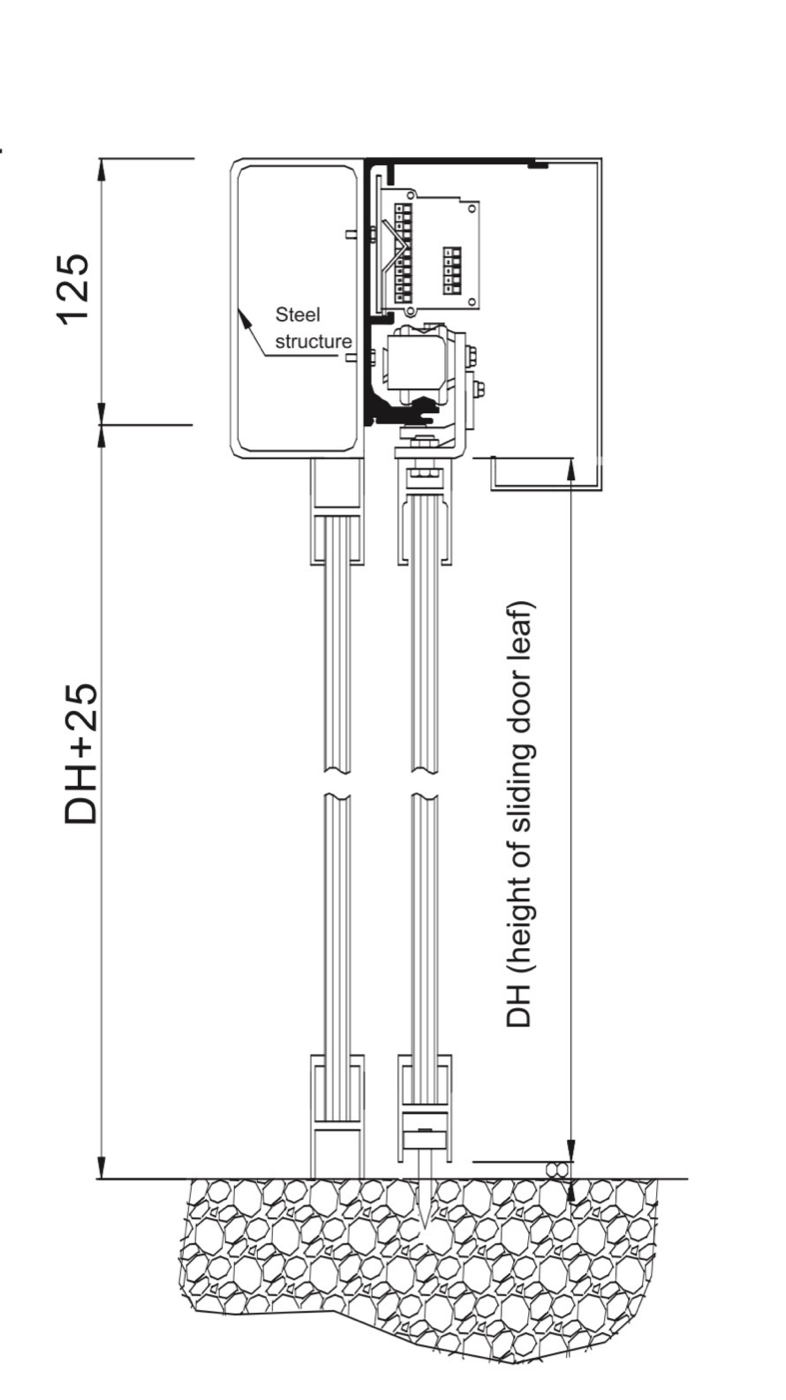
Three things follow from that detail:
- The header casing is 125 mm. That depth has to exist above the opening before anything else is decided, and it is the dimension most often missing when an entrance is drawn late.
- A steel structure carries the operator. The drawing calls it out explicitly. The header is not self-supporting and it will not span off plasterboard or a dropped bulkhead — it needs something structural behind it, level and straight.
- Allow the leaf height plus 25 mm. The drawing sets the distance from the underside of the header to finished floor as DH + 25, where DH is the height of the sliding leaf itself.
Floor condition matters as much as the head. The guide is set into the finished floor, so the threshold has to be level along the full travel, not only across the opening. Send us the measured opening, the head construction and the floor build-up and we will confirm the setting-out in writing before anything is ordered.
What opens it, and what stops it closing
An entrance is only as good as the devices around the sliding door operator. Activation is normally a microwave motion sensor above the opening; safety is a presence sensor or photocell that holds the door while somebody stands in it.
The principle is not negotiable — the door must detect a person in the opening and hold, rather than close on them. Sensors drift, get knocked by trolleys and dust over, so on every MC-125 we service, sensor testing is routine work at each visit rather than something looked at after a fault.
Requirements for powered pedestrian doors in South Africa are published through SABS.

 automatic sliding door entrance driven by the MC-125″ loading=”lazy” decoding=”async”>
Assembled in Johannesburg
A narrower claim than most, and one we can stand behind
The MC-125 sliding door operator is imported and assembled at our Laser Park facility. We do not claim to manufacture the components. What local assembly actually buys you is simple:
- Spares on the shelf — belts, rollers, floor guides, sensors and controllers, not a six-week container wait
- Our own technicians install, commission and service the product
- Support in your time zone, from people who can come to site
- Access control and glazing specified together, in-house
Specifying and service
Four things settle the job before anything is installed
- Clear opening width — size it for how arrivals and departures overlap at your busiest hour, not the daily average
- The header — the operator is surface mounted and needs a solid, level fixing across the full span
- Power at the opening — AC supply at the head of the door; if it is not there, an electrician brings it
- Access control — decide up front, because it changes the wiring rather than bolting on afterwards
Wear tracks cycles rather than the calendar, so a shopping-centre entrance and a back-office door on identical hardware need very different service intervals. We also service and repair automatic doors from other manufacturers, which means one supplier can look after a mixed estate. See spare parts and multi-brand service, automatic sliding doors, or the 2026 price guide.
Questions
For examples of this operator in service, see our completed automatic door projects — twenty-seven MC-125 units across four sites.
Frequently asked
What size opening does the MC-125 sliding door operator suit?
A single sliding leaf covers a 1450–3100 mm clear opening; a bi-parting pair covers 2500–5000 mm. Leaf widths run 750–1600 mm single and 650–1250 mm per leaf bi-parting.
How heavy a door can the MC-125 sliding door operator drive?
Up to 150 kg on a single sliding leaf, or 2 × 120 kg bi-parting. Glass specification and framing usually push the weight up, so confirm the leaf build before ordering.
Is the MC-125 made in South Africa?
It is imported and assembled locally at our Laser Park facility in Johannesburg. We do not claim to manufacture the components.
What happens during a power failure?
With the optional battery backup the entrance keeps operating for a period, or can be set to fail safely open. Without it the door stops and can be moved by hand — under 40 N single slide, under 50 N bi-parting.
Can this sliding door operator work with access control?
Yes. It supports card readers, keypads, remotes and intercoms plus an electric lock, so one entrance can be open during trading hours and controlled outside them.
Comparing quotes
Reading a quotation properly
Compare the scope rather than the total. A quotation for mC should state the opening it was priced against, the equipment it includes and the items it excludes — builders work, structural alteration, electrical supply to the entrance and making good are excluded unless the quotation says otherwise.
Changes after acceptance, to size, configuration, finish, controls or activation, are quoted as a variation before we proceed.
Safety
Sensors, safety and commissioning
Motion sensors open the door as somebody approaches and see movement rather than a standing person. Presence sensors hold it open while somebody is in the opening, which is what stops a door closing on a person who has paused. Safety beams and a force limit reverse the leaf if something is in the way.
We commission the door on completion and demonstrate its operation, including how to release or isolate it. Commissioning ends with the settings written down: opening and closing speed, hold-open time, force and the sensor layout. That record establishes the state the entrance was handed over in.
Aftercare
Servicing, spares and agreements
Service intervals should follow cycles, not the calendar: a mall entrance can do more work in a month than an office door does in a year. A visit checks and realigns sensors, inspects belt, rollers and guides, re-checks opening and closing force and replaces wear parts before they strand the door.
Consumable and wear items, including belts, rollers, floor guides and seals, are replaced as part of servicing rather than under warranty. A service level agreement runs alongside the product warranty; it neither replaces nor extends it.
Does the entrance work during load-shedding?
With a battery backup it keeps operating through a slot. Without one it parks in the fail-open or fail-secure state chosen for the building, and the manual release is demonstrated at handover.
Are the operators made in South Africa?
The MC-125 and MCW-100 are imported and assembled at our Laser Park facility in Johannesburg, where spares and technical support are held locally.
Operator, opener, motor: the same unit
Buyers search for an automatic door opener, a sliding door motor or a door opener. Installers and specifiers say operator. They all mean the drive unit that sits in the header and moves the leaves — on this page, the MC-125. Specifications and tender documents often write automated sliding operator or automated sliding door operator, and that is the same unit again.
The distinction worth keeping is not between the words but between the unit and the entrance. An automatic door opener is one component. A complete entrance also has leaves, glazing, a track, floor guides, sensors and often locking or access control, which is why a price for the opener is never a price for the doorway. The MC-125 is supplied from R27 590 excluding VAT; what the finished entrance costs depends on everything around it.
If an existing door already works mechanically and only the drive has failed, replacing the automatic door opener alone is usually the cheapest route, because the leaves, track and header are retained.
Sizing the opening around a sliding door operator
Most disappointing entrances are sized before anyone checks what the sliding door operator can actually carry. The published envelope is narrow enough to design against, so it is worth working the numbers in the order below rather than starting from the architectural opening and hoping.
Start with the clear opening you need, not the hole in the wall. A single leaf on this sliding door operator covers a clear opening of 1450 to 3100 mm; a bi-parting pair covers 2500 to 5000 mm. The structural opening is always wider than the clear opening, because the leaves have to park somewhere, so a 3 000 mm structural opening does not give you a 3 000 mm walkway.
Then check the leaf width. Single leaves run 750 to 1600 mm and bi-parting leaves 650 to 1250 mm each. Those two ranges are what decide whether an opening is a single or a pair, and the overlap is the reason two buildings with the same opening can end up with different arrangements.
Then weigh the leaf. A single sliding leaf may be up to 150 kg; a bi-parting pair up to 120 kg per leaf. Glass and aluminium leaves rarely trouble those figures. Solid timber and heavily framed leaves do, and the weight has to come from whoever is making the door rather than from an estimate.
Two worked examples
- A 2 400 mm clear opening in a retail unit. Inside the single-leaf range, so one leaf of roughly 1 400 mm parking to one side. That needs 1 400 mm of clear wall beside the opening; where the wall is shorter, a bi-parting pair or a telescopic arrangement gets the same walkway out of less reveal.
- A 4 000 mm clear opening in a hospital corridor. Past the single-leaf ceiling, so a bi-parting pair of roughly 1 150 mm each, comfortably inside both the width and the 120 kg per leaf limit.
Where an opening falls outside the envelope entirely, the answer is usually the arrangement rather than a bigger sliding door operator: splitting a wide opening into a pair, or accepting a narrower clear opening than the structural one allows.
Two further decisions belong in the specification rather than in a conversation on site. Half-open mode is worth asking for where the entrance carries light traffic through part of the day, because opening to a fraction of the full width cuts heating and cooling losses without locking anyone out. And the behaviour on power loss — battery backup, fail-safe or fail-secure, manual release — changes what goes inside the header, so it is decided before the order rather than after.
Send the clear opening you need, the structural opening you have, the leaf weight and a photograph of the head, and we will tell you which arrangement the sliding door operator suits and what has to be confirmed before an order.
In short
Sliding door operator at a glance
- Sliding door operator are quoted against the opening we measured, not a catalogue price.
- Ask about sliding door operator and we confirm the opening, the head and the power position first.
- Sliding door operator are installed and commissioned by our own technicians.
- Sliding door operator carry a 24-month warranty on the operator.
- Spares for sliding door operator are held in Johannesburg, so a repair does not wait on an import.
- Send the opening size and a photograph and a quotation for sliding door operator usually follows within two working days.
Indicative price
From R27 590 excluding VAT
That figure is for the MC-125 sliding door operator supplied, as published on our sister company Coetz™. Installation, glass, framing, sensors and access control are quoted per site, and the figure that applies to your job is the one on your quotation.
Specifying an MC-125 for your building?
Send us the clear opening width and height, what sits above the opening, whether power is available at the head, and any access-control requirement. We will come back with the configuration, installation and commissioning quoted together.
Exported and installed across Africa
The MC-125 is not a South African product only. We export it into Egypt, Nigeria, Kenya, Ethiopia, Tanzania, Algeria, Morocco, Cote d Ivoire, Angola and across SADC and the island markets, and on every one of those projects we install and commission the operator ourselves rather than shipping it and hoping. Cross-border work is quoted per project, in writing, and the published price above is a South African price excluding VAT. See automatic doors Africa for how those projects run, what we are responsible for and what we are not.
Retrofitting an MC-125 to an existing opening
A large share of the work this sliding door operator does is refurbishment rather than new build, and the questions are different. On a new opening we can influence the structure. On an existing one we take the building as we find it, and three things decide whether a retrofit is straightforward or awkward.
The header is the first. A sliding door operator needs a header that can carry both the unit and the leaf weight, and in older buildings that header is frequently the constraint that decides the project. It is checkable in a site survey and it is the single most common reason a retrofit quotation changes after the first visit.
The second is the floor. A threshold that has worn, settled or been re-tiled at a different level will fight a sliding leaf for the rest of its life, and no amount of adjustment at the operator end fixes a floor problem. The third is the parking space: somewhere for the leaf to go when it is open, free of services, columns and signage.
Where those three are sound, retrofitting a sliding door operator to an existing opening is usually a single-visit job. Where they are not, we would rather tell you before you order than discover it on site.