
Automatic door projects: four completed installations
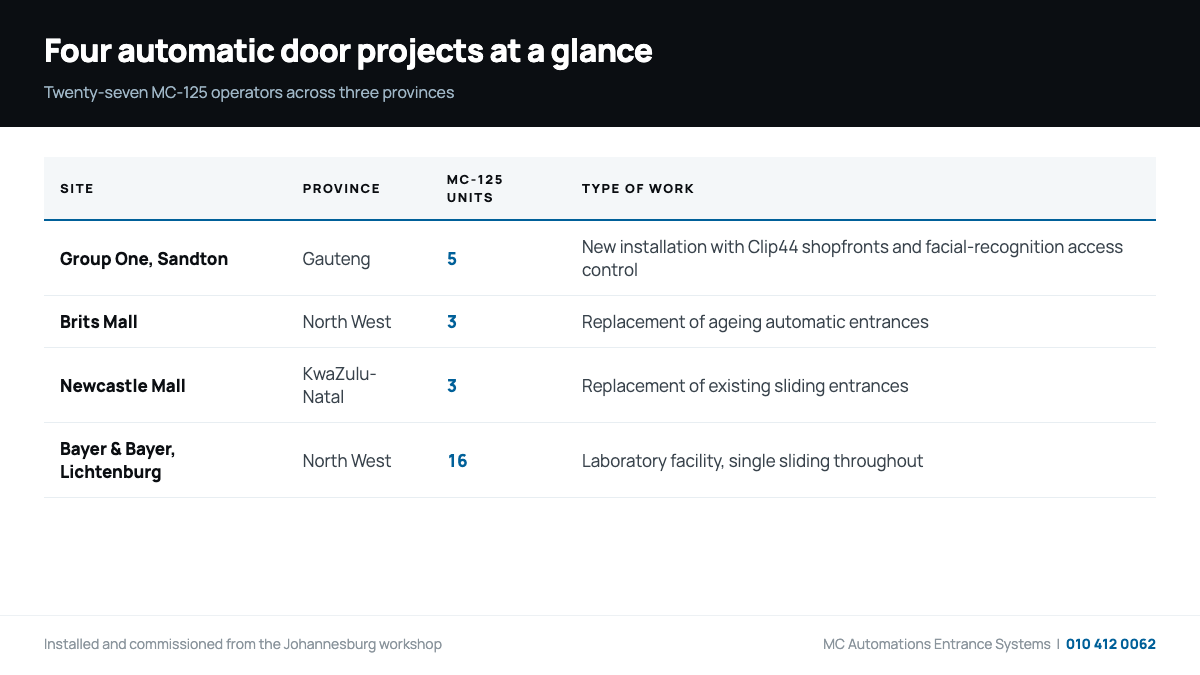
These are automatic door projects we have installed and commissioned. Between them they cover the three jobs that come up most often: a new shopfront built around the operator, a mall entrance where old equipment had to be replaced without closing the doors, and a laboratory where the same unit had to be repeated sixteen times and behave identically every time.
Each of these automatic door projects states what was installed and what the job actually involved. Where a figure is not listed it is because we do not publish it, not because it is unknown.
Group One, Sandton
Five MC-125 sliding operators, Clip44 shopfronts and facial-recognition access control.
A commercial installation in Sandton where the entrances and the access control were specified together rather than bolted to each other afterwards. Five MC-125 operators were installed behind Clip44 shopfront framing, with ZKTeco SpeedFace readers controlling entry.
The technical work on a job like this is the interface, not the door. An operator on a sensor opens for anyone who approaches. An operator on credentials opens for a reader output, and the two behaviours have to coexist: free flow during business hours, credentials outside them, and a defined behaviour if the reader or its power fails. That behaviour is decided before installation and written into the commissioning record, because it is the part nobody can guess at afterwards.
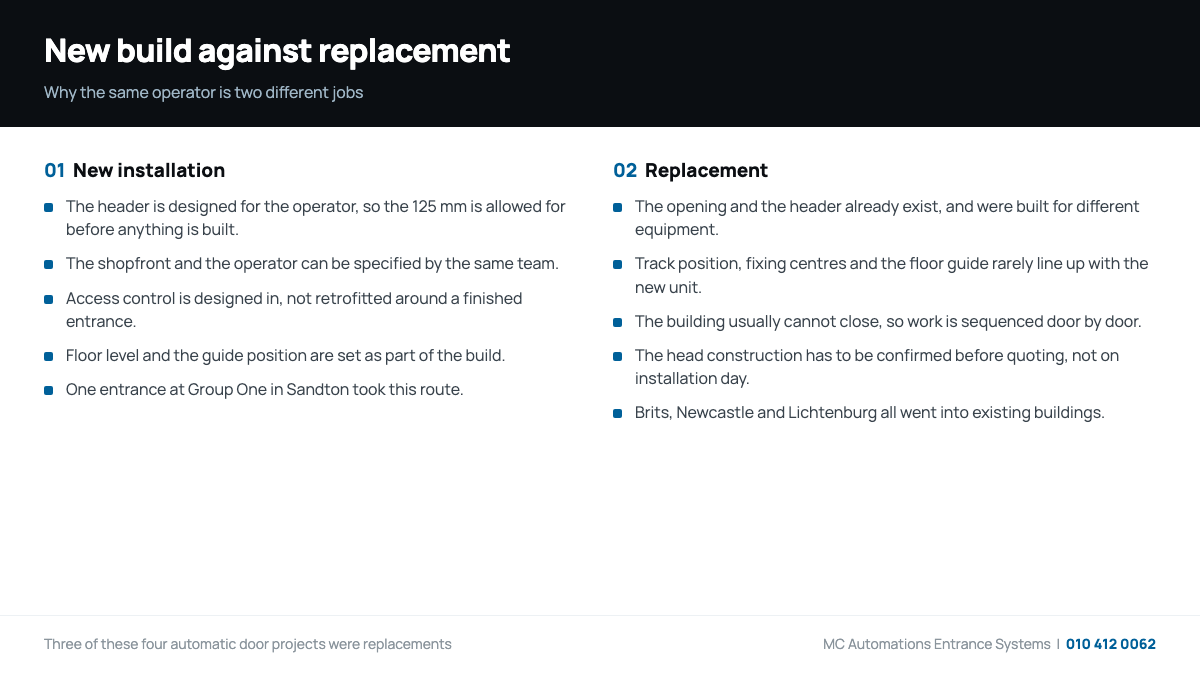
Fitting operators behind Clip44 shopfront framing also settles the order of work. The header has to be structural and level before the operator arrives, and the framing sets the finished opening. Getting the shopfront and the operator specified by the same team removes the usual argument about who owns the 125 mm above the opening.
Brits Mall, North West
Three ageing automatic doors replaced with MC-125 sliding operators.
A replacement job rather than a new build, and the most common shape automatic door projects take. Three existing automatic entrances had reached the end of their working life and were replaced with MC-125 operators.
Replacement work is harder than new installation for reasons that have nothing to do with the operator. The opening already exists, the header already exists, and both were built for different equipment. The track position, the fixing centres and the floor guide rarely line up with what the new unit needs. Before quoting a replacement we measure the structural opening, check what the head is actually made of, and confirm the floor along the full travel rather than only across the opening.
A shopping centre entrance also cannot simply close for a day. Replacement is sequenced so the mall keeps a working entrance throughout, which usually means working door by door rather than stripping everything out at once.
Newcastle Mall, KwaZulu-Natal
Three automatic sliding doors replaced with MC-125 operators.
The same category of work as Brits, in KwaZulu-Natal. Three automatic sliding door entrances replaced with MC-125 units.
Retail entrances earn their service interval faster than any other application. A centre entrance can pass more cycles in a month than an office door does in a year, which is why the replacement conversation usually starts with a door that has been repaired repeatedly rather than one that has failed outright. When the cost of keeping an old operator running approaches the cost of replacing it, and spares for it are no longer held locally, replacement is the cheaper answer over the life of the entrance.
Newcastle is roughly 400 km from our Johannesburg workshop. Installation is nationwide; what changes outside Gauteng is that attendance is planned rather than same-day.
Bayer & Bayer, Lichtenburg
Sixteen MC-125 single sliding operators for a laboratory.
The largest of these automatic door projects by unit count: sixteen MC-125 operators, all single sliding, installed for a laboratory facility in Lichtenburg.
A repeat installation at this scale is a different problem from a single entrance. Sixteen doors have to behave the same way. If opening speed, closing speed, hold-open time and the safety settings drift between units, staff learn to distrust the doors and start pushing them. Commissioning is therefore done to one agreed set of values and recorded, so every door in the building can be returned to the same baseline at service rather than adjusted by feel.
Volume also changes the spares position. Sixteen operators of one type means one parts list, held in Johannesburg, covering the whole facility — which is the practical argument for standardising on a single operator across a site rather than accumulating a mixture.
New installation against replacement
How we scope a replacement before quoting
Most automatic door projects that reach us are replacements, so the survey matters more than the catalogue. Three of the four installations above started as an existing entrance that was no longer worth repairing. What we measure before pricing any of these automatic door projects:
- The structural opening, measured. Not the nominal figure from a drawing. The opening as built is what the operator has to fit, and on older buildings the two differ more often than not.
- What the head is actually made of. The operator is surface mounted and needs a solid, level header behind it. A dropped bulkhead or a plasterboard fascia will not carry it, and finding that out on installation day is how automatic door projects lose a week.
- The floor along the full travel. The guide sits in the finished floor. A threshold that is level across the opening but falls away along the travel will bind the leaf at one end.
- The leaf build and mass. An operator is specified on mass, not on whether the leaf is glass or timber. Glass specification and framing move the weight more than most people expect.
- Honest daily traffic. Cycle count sets the duty and the duty sets the service interval. A mall entrance and an office side door at the same width are not the same job.
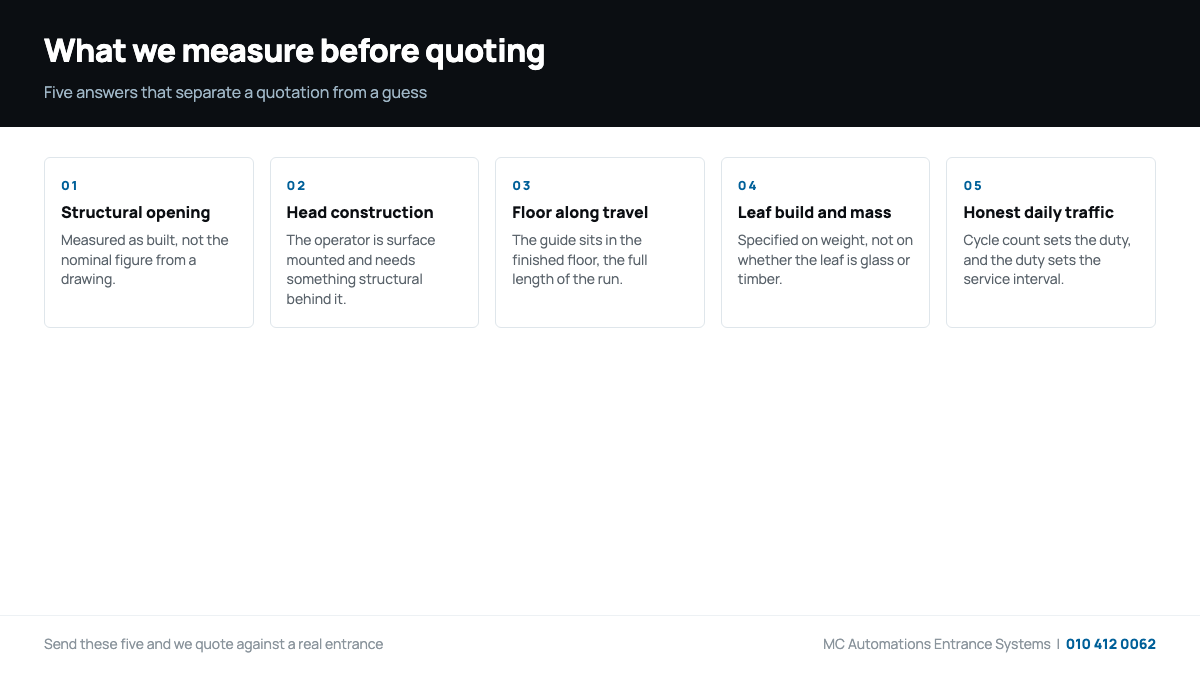
Those five answers are the difference between a quotation and a guess, and they are why we ask for them on every enquiry rather than pricing from a photograph alone.
The 125 mm most automatic door projects forget
The single most common problem on automatic door projects is the space above the opening. The operator is surface mounted, so the header casing has to exist before anything else is decided.
On a new build that is designed in. On a replacement it has to be found, which is why the head construction is the second thing we check on site. See the full MC-125 sliding door operator specification for the setting-out detail.
Access control on an automatic entrance
Only one of these four automatic door projects included access control, but it is the question we are asked about most. An automatic operator and an access control system solve different problems: the operator decides how the leaf moves, the access control system decides who is allowed to make it move.
Three behaviours have to be agreed before installation. What the entrance does during business hours, usually free flow on a sensor. What it does outside them, usually credentials only. And what it does if the reader fails or loses power — which is the one most specifications leave silent, and the one that matters most, because an entrance on an escape route has to permit escape regardless of what the access system is doing.
On the Sandton installation those behaviours were set at commissioning and written down. That record is what lets somebody restore the entrance to a known state two years later instead of adjusting it by feel.
Repeat installations and why they are different
Automatic door projects with one entrance and automatic door projects with sixteen are not the same exercise scaled up. On a single door, commissioning is a conversation with the person who will use it. Across sixteen, consistency is the deliverable.
If opening speed, closing speed, hold-open time and the safety arrangement differ between units in the same building, people stop trusting the doors. They start pushing leaves that are about to open on their own, and that is how force limits get complained about and hold-open times get turned up until the building is heating the car park.
The answer is dull and effective: agree one set of values for the site, commission every unit to it, and record it. At service, each door is checked against the record rather than adjusted to taste. Standardising on a single operator type across a portfolio does the same thing for spares — one parts list, held locally, covering every entrance in the building.
What these automatic door projects say about coverage
Sandton is on our doorstep. Brits is about 100 km away, Lichtenburg roughly 250 km, and Newcastle around 400 km in a different province. All four were installed and commissioned by our own technicians working from the Johannesburg workshop.
That is the honest shape of our coverage. Installation is nationwide and we quote work across the country. Same-day attendance is a Gauteng service; everywhere else the visit is planned, and we would rather say so at quotation stage than promise a response time we cannot hold. Service agreements are available for single sites and for portfolios spread across provinces, which is usually how automatic door projects of this kind end up being maintained.
Repair or replace: how these automatic door projects started
Two of these automatic door projects began as repair conversations. An entrance that has been attended three or four times in a year, where the parts are no longer held locally and each visit costs more than the last, is usually past the point where repair is the cheaper answer.
The honest test is not the age of the operator. It is whether spares are still obtainable, whether the track and carriages are worn beyond adjustment, and whether the safety arrangement still meets what the building needs. An operator with a worn belt and a tired motor is a repair. An operator with a scored track, elongated fixings and obsolete electronics is a replacement, and pretending otherwise just moves the cost into next year.
Where replacement is the answer, the existing opening usually stays. The leaf, the framing and the glass often have years left in them, and a large part of the value in these automatic door projects came from reusing what was already there rather than rebuilding the entrance.
Laboratory automatic door projects against retail
The Lichtenburg facility is the outlier in this set. A laboratory has lower traffic than a shopping centre but tighter requirements on consistency and on what happens between rooms. Doors are often specified for hands-free operation so that people carrying samples do not touch handles, and internal openings may need to be held closed except when actively used.
That changes the commissioning conversation. In a mall the argument is about throughput at the busiest hour. In a laboratory it is about a door that behaves identically every time, opens wide enough for a trolley, and does not sit open long enough to matter. Sixteen units on one site made that consistency the whole job.
It also makes the case for one operator type across a facility. Mixed equipment means mixed spares, mixed settings and technicians relearning each door. One type means one procedure.
How these automatic door projects are maintained afterwards
Installation is the short part of any automatic door projects programme. An entrance runs for years afterwards, and what decides whether it is still working well in year five is whether anybody is looking at it on a schedule.
Our standard service interval is every six months, shortened where traffic demands it. A shopping centre entrance at Brits or Newcastle earns attention faster than a laboratory door in Lichtenburg, even though the operator is identical, because wear follows cycles rather than the calendar. At each visit the settings are checked against the commissioning record rather than adjusted by feel, the safety devices are tested, and consumables are replaced before they fail rather than after.
Spares for every operator in these automatic door projects are held in Johannesburg. That is the practical reason we standardise: a repair on any of the twenty-seven units draws on the same parts list, and does not wait on an import.
What these four automatic door projects have in common
- Twenty-seven MC-125 operators across the four sites.
- Three provinces — Gauteng, North West and KwaZulu-Natal — installed from the same Johannesburg workshop.
- New build and replacement. One was specified from scratch with the shopfront; the other three went into openings that already existed.
- One operator type. Standardising on the MC-125 keeps one spares list and one commissioning procedure across a portfolio.
- Commissioning recorded in every case, so the settings can be restored later instead of guessed at.
What we do not claim about this work
We have not published project values, completion dates or client contact details, and we do not publish photographs of a client’s premises without their agreement. Naming a site is not an endorsement by that client.
These installations are evidence of what we have installed and commissioned. They are not a certification, and they do not make any particular entrance compliant. Fire performance, safety-device arrangement and escape-route behaviour are confirmed in writing per project against the building’s own requirements.
Planning a similar entrance?
Most automatic door projects start the same way. For a new entrance, send the measured structural opening, the leaf build and mass, the head construction and the honest daily traffic. For a replacement, send a photograph of the existing installation as it stands today and tell us what it is doing wrong. Every project is quoted in writing.
Call 010 412 0062 or use the quote form. Requirements for powered pedestrian doors in South Africa are published through SABS.
Automatic door projects: frequently asked
Do you only install in Johannesburg?
No. These four automatic door projects span Gauteng, North West and KwaZulu-Natal, all installed from our Johannesburg workshop. Installation is nationwide. Same-day call-outs are a Gauteng service; elsewhere attendance is planned.
Can you replace an automatic door from another manufacturer?
Yes. Three of these four automatic door projects were replacements of existing equipment. We measure the structural opening, the head construction and the floor along the full travel before quoting, because the old track position rarely matches what the new operator needs.
Can a shopping centre entrance stay open during replacement?
Yes, with sequencing. Replacement is planned door by door so the building keeps a working entrance throughout rather than closing the whole frontage at once.
Do you integrate access control with the operator?
Yes. At Group One in Sandton the operators run with facial-recognition readers. What matters is deciding in advance how the entrance behaves on free flow, on credentials, and if the reader or its power fails, then recording that behaviour at commissioning.
Why standardise on one operator across a site?
One parts list and one commissioning procedure. The laboratory installation at Lichtenburg uses sixteen identical MC-125 units, so every door returns to the same baseline at service and the spares holding covers the whole facility.
Will you publish my project?
Only if you agree to it. We do not publish client names, photographs, project values or completion dates without permission, and we are happy to describe work anonymously instead.