
Office park automatic doors for landlords and managing agents: who owns which entrance, the access states a working week needs, the morning peak that sizes the lobby, standardising across an estate, and why maintenance recovery changes the contract.
Automatic Doors and Load Shedding: What Actually Happens
Automatic doors and load shedding is a South African problem with a South African answer. Most automatic door literature is written for countries where mains power is assumed. Here it is not, and that changes how an entrance should be specified — not just what it costs.
This is what actually happens to an automatic entrance during load shedding, what battery backup does and does not buy you, and the one decision that should never be made on site.
What happens to an automatic door during load shedding
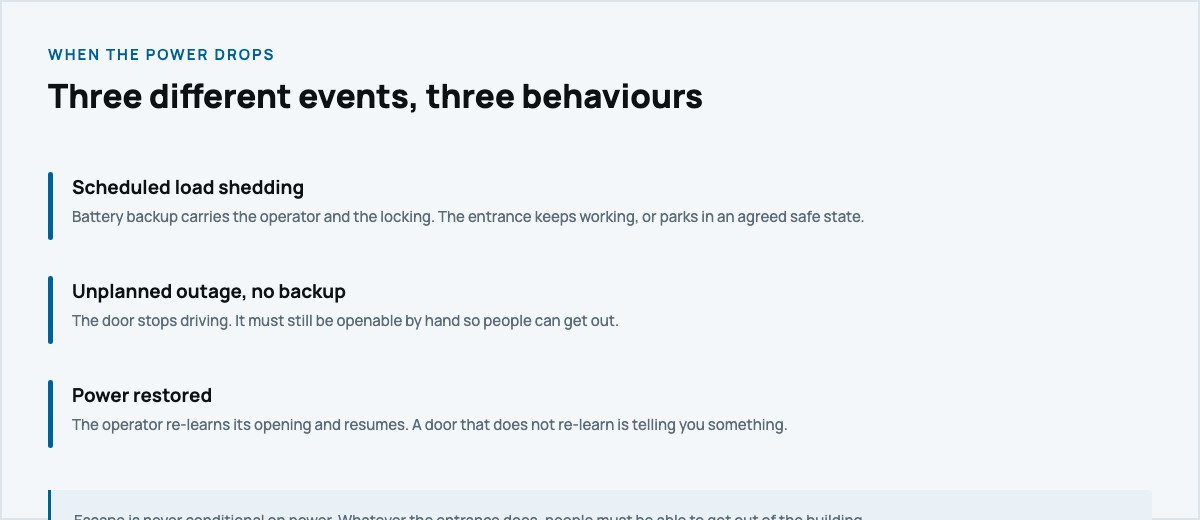
Three different things can happen during load shedding, and they are often confused with each other.
During scheduled load shedding on an entrance with battery backup, the operator and the electric locking keep running. The door behaves normally, or parks in whatever state you agreed when it was commissioned — usually closed and locked out of hours, or held open if the building still has to move people.
During an unplanned outage on an entrance without backup, the operator stops driving. This is the moment that matters: the door must still be openable by hand. A powered pedestrian door that cannot be pushed or broken out when it is dead is not an inconvenience, it is a life-safety problem.
When power returns, the operator re-learns its opening width and resumes. An entrance that repeatedly fails to re-learn after an outage is telling you something about the drive or the controller, and it is worth a service call before it fails properly.
What battery backup buys you during load shedding
Battery backup is the single most useful thing you can specify for a South African entrance, and it is also the most oversold. It is sized to carry the operator and the locking through a load shedding block. It is not a generator, and it is not intended to keep a building trading through a full stage-6 block.
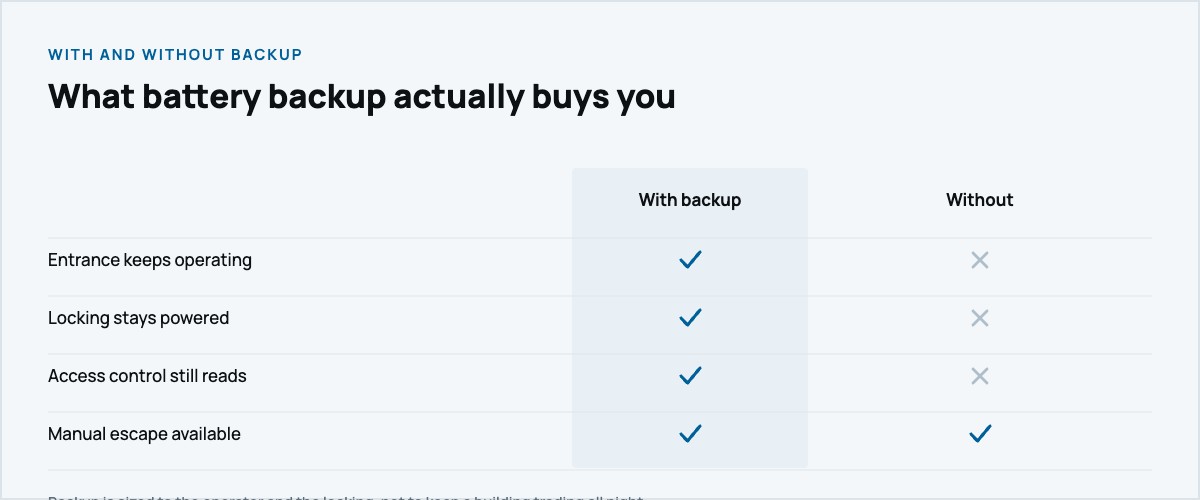
Note the last row. Manual escape is available in both columns. Backup improves convenience, security and access control continuity. It is not what makes the entrance safe — the mechanical breakout does that, and it works whether or not anything is powered.
Where an entrance is on a building management system or an access platform, backup also keeps the door honest through load shedding: readers stay live, schedules keep running, and you do not arrive in the morning to a door that has forgotten who is allowed through it. That integration is covered on our automatic door access control page.
Fail-safe or fail-secure: the decision to get right
Every electrically locked entrance has to answer one question: when the power dies, does the lock release or hold?
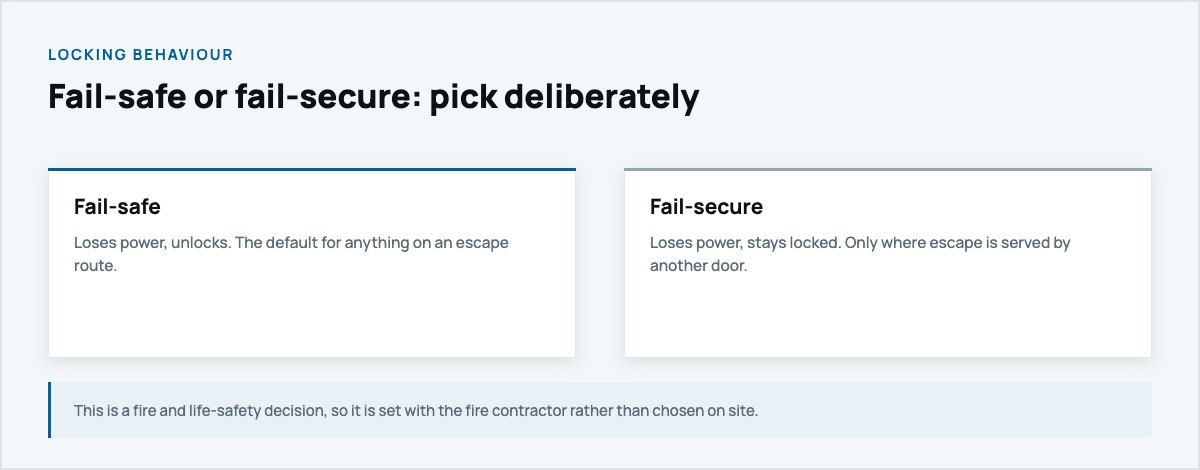
Fail-safe unlocks on power loss and is the default for anything on an escape route. Fail-secure stays locked, and is only appropriate where escape from that area is served by another door. Getting this backwards produces either a building you cannot get out of, or a building that unlocks itself every time the grid drops.
This is a fire and life-safety decision. We set it with the fire contractor and against the requirement stated for the building, rather than picking it on the day of installation. Standards for powered pedestrian doors in South Africa are published through SABS.
Specifying an entrance for load shedding
If you are buying a new entrance in South Africa, four things are worth deciding up front rather than retrofitting later.
Battery backup on the operator. Cheap at the point of specification, awkward and more expensive to add afterwards. Both the MC-125 sliding operator and the MCW-100 swing operator support it.
The parked state. Decide now what the door should do when it goes onto battery: stay live, close and lock, or hold open. It is a business decision, not a technical one, and it differs between a pharmacy and a warehouse.
Locking behaviour. As above — and record the decision somewhere, because the person who services the door in three years will not be the person who specified it.
Surge protection. Repeated load shedding means repeated restarts, and restarts are hard on controllers. This is the failure we see most often on entrances in areas with frequent shedding.
How long a backup lasts, and what actually decides it
The most common question about load shedding is how long a battery backup will keep an entrance running, and the honest answer is that it is measured in cycles rather than hours.
A backup is doing two different jobs at once. It holds the controller and sensors alive, which is a small, continuous draw, and it powers the motor each time the door moves, which is a large, brief one. An entrance that sits untouched for an hour uses very little; the same entrance moving every twenty seconds uses a great deal. That is why a single figure in hours is misleading — a quiet office side door and a busy retail entrance on identical batteries will give completely different results through the same load shedding slot.
So the capacity gets specified against the entrance rather than chosen from a catalogue. What we need to know is how many people realistically pass through during a slot, whether the building stays open through it, and whether the entrance must keep operating normally or simply reach a safe state. A door that only has to let staff out twice in two hours is a much smaller problem than a trading entrance that must behave as though nothing has happened.
Two practical points follow. Batteries degrade, and a backup that was sized correctly three years ago may not hold the same load today — which is why we test them on maintenance visits rather than assume them. And a backup is not a generator: it is sized for the slot, not for an extended outage, and load shedding beyond its design window will still end with the entrance in its fail state.
What repeated power cycling does to the equipment
Load shedding is harder on an entrance than a single long outage would be, because the damage is in the transitions rather than the darkness.
Every restoration brings an inrush as the controller powers up and the motor draws its starting current, and every interruption can leave the controller mid-task. Modern controllers handle this properly and simply re-initialise, but re-initialising is not free: some units re-learn the door’s travel on start-up, which is why an entrance may run a slow opening and closing cycle the first time it moves after load shedding. That behaviour is the door checking itself, not a fault.
The wider risk is on the supply side. Switching events can put surges onto a circuit, and the electronics in an operator are the part least tolerant of them. A surge-protected supply to the entrance is a small item at installation and a sensible one in a building that sees load shedding regularly. Where an entrance has suffered repeated unexplained controller faults, the supply is worth investigating before the operator is condemned.
Mechanically, load shedding changes little — the leaves and running gear do not care where the power came from. What it does change is how often an entrance sits in its fail state, and a door parked open for two hours in a dusty or wet setting collects more of both than one that stayed closed.
Fail-open or fail-secure: whose decision it is
When the power goes and there is no backup, the entrance goes to a predetermined state. There are two, they are opposites, and choosing between them is the single most consequential decision in specifying an entrance for load shedding.
Fail-open parks the leaves clear so the opening stays passable. People can leave and enter without assistance. It is the right answer wherever the opening forms part of an escape route or wherever leaving people unable to exit is unacceptable, and it is the more common choice on public entrances.
Fail-secure holds the opening closed until somebody operates the manual release. It is the right answer where an unattended open doorway during load shedding is itself the risk — a stockroom, a cash area, a building that is closed during the slot.
The decision belongs to whoever is responsible for the building, informed by its fire strategy and by the authority having jurisdiction, not to the door supplier. Our job is to ask the question before installation, configure the entrance accordingly, demonstrate the behaviour, and record which state was chosen. We ask it explicitly rather than assuming, because assuming would mean guessing on a safety matter, and a building that has never been asked usually has not thought about it.
The manual release, and why staff have to be shown it
Every automated entrance we install has a manual release, and it is the single most useful thing the people who work at that door can know about it.
The release lets the leaves be moved by hand when there is no power and no backup. It is not hidden, it is not difficult, and it takes about ten seconds to demonstrate — and it is routinely the thing nobody was shown, so a building goes into a load shedding slot with staff standing at a door they believe is stuck. We demonstrate it at handover, and on maintenance visits we would rather run through it again with whoever is currently on the door than assume the person who saw it two years ago still works there.
It is worth deciding who needs to know. On a retail entrance that is the duty manager and the security staff; in an office it is reception and the facilities contact. During load shedding those are the people at the door, and a one-page note by the entrance is a reasonable belt-and-braces measure.
Adding backup to an entrance that does not have one
Backup can usually be added to an existing entrance, and it is one of the more cost-effective retrofits available on a door that is otherwise sound.
What it involves depends on the operator. Some units take a backup module directly; others need the supply side reworked. Either way the work is a single visit rather than a programme, and it does not touch the leaves, the frame or the glass. Where an entrance is already being modernised — new drive, controller and sensors on existing leaves — adding backup at the same time costs very little on top, and it is the sensible moment to do it.
The one thing worth checking first is the fail state. A building that has been living with an entrance that fails open during load shedding may discover, once a backup is fitted, that it now stays closed and locked through a slot because that is what its configuration says. Backup and fail state are separate decisions, and both should be confirmed rather than inherited.
What to check before the next slot
Most of what goes wrong at an entrance during load shedding is avoidable, and almost all of it can be established in advance without a technician on site.
Establish, in writing, what your entrance is configured to do. Does it hold up on backup, and if so for roughly how many cycles? If it has no backup, does it fail open or fail secure? Those two answers determine everything that happens, and a surprising number of buildings do not know them until the first slot of the month demonstrates it.
Then test rather than assume. A backup battery that has quietly reached the end of its life gives no warning at all — the entrance behaves normally on mains and then does nothing when the power drops. Isolating the supply deliberately, at a quiet time, tells you in thirty seconds what load shedding would otherwise tell you at the worst moment. It is a reasonable thing to ask for on a maintenance visit.
Check that the people on the door know where the manual release is and have used it once. Check that the entrance is not the building’s only exit route if it is set to fail secure. And note how the door behaves on the first cycle after power returns: a slow learning cycle is normal, a stall is not.
None of this requires equipment. It requires somebody to have asked the questions before load shedding asks them, which is the whole of the difference between an entrance that is inconvenient during a slot and one that becomes an incident.
Who this affects most
Not every building feels load shedding at its entrance equally, and knowing which category you are in makes the specification obvious.
Buildings that trade through a slot — retail, food, pharmacies, clinics — need the entrance to behave normally, so backup is not optional and the capacity has to be sized against real footfall. Buildings that close during a slot mostly need a defined, safe fail state and staff who know the manual release. Buildings with a single entrance that also serves as the escape route have the least freedom of all: the fail state is effectively decided for them by the fire strategy, and load shedding simply makes that decision visible several times a week.
Facilities with controlled or secure areas sit in the hardest category, because the safe answer and the secure answer point in opposite directions. That is a building-level decision rather than a door-level one, and it is worth taking before the entrance is ordered rather than after the first slot.
Automatic doors and load shedding, answered
Will my automatic door still open during load shedding?
With battery backup, yes — it keeps driving normally or parks as agreed. Without backup the operator stops, and the door must be opened manually.
Can I get out if the power is off and there is no backup?
Yes. A correctly specified powered pedestrian door can be opened by hand or broken out when unpowered. If yours cannot, that is a fault worth reporting immediately.
Can battery backup be added to an existing door?
Often, depending on the operator. It is one of the more common upgrades we quote under service and modernisation.
How long does battery backup last?
It is sized to carry the operator and locking through an interruption, not to run a building indefinitely. The usable duration depends on the operator, the locking and how often the door cycles.
Does load shedding damage automatic doors?
The outage itself rarely does. Repeated restarts and surges are what shorten controller life, which is why surge protection is worth specifying in high-shedding areas.
Should the door lock or unlock when power fails?
Fail-safe (unlock) on escape routes; fail-secure (stay locked) only where escape is served elsewhere. It is set with the fire contractor, not chosen on site.
How quickly can I get a quotation?
Most quotations go out within two working days of us receiving the opening size and a photograph. Revolving and hermetic entrances are surveyed first.
Do you service other manufacturers equipment?
Yes. Where we take over an entrance somebody else installed, we report its condition before committing to a maintenance interval.
Getting it specified properly
If you are unsure what your current entrance does during load shedding, the fastest way to find out is to ask us to look at it. If you are specifying a new one, send the opening size and tell us what the building has to do during an outage — that single sentence changes the specification more than anything else on the enquiry form.
Request a quote, or read our 2026 automatic door price guide for what a commercial entrance costs in South Africa.
In short
Load shedding at a glance
- Load shedding are quoted against the opening we measured, not a catalogue price.

This Post Has 3 Comments
Comments are closed.
[…] manually, and sliding doors are specified with a low manual opening force for the same reason. Our load shedding guide covers the options in more […]
[…] by the fire strategy and by whether the building is occupied, not by preference. Our write-up on automatic doors and load shedding covers the behaviour in more […]
[…] — which is decided by the fire strategy for the site rather than by preference. Our write-up on automatic doors and load shedding covers that behaviour in more […]