
Office park automatic doors for landlords and managing agents: who owns which entrance, the access states a working week needs, the morning peak that sizes the lobby, standardising across an estate, and why maintenance recovery changes the contract.
Automatic Doors South Africa: The Complete 2026 Guide
Automatic doors South Africa buyers face the same three questions on every project: which door type suits the opening, what the entrance will cost to run, and who answers the phone when it stops working at 07:30 on a Monday. This guide answers all three. MC Automations supplies, installs, commissions and services automatic doors across South Africa from our Laser Park base in Johannesburg, on our own equipment and on other manufacturers systems.
The five door types, and where each belongs
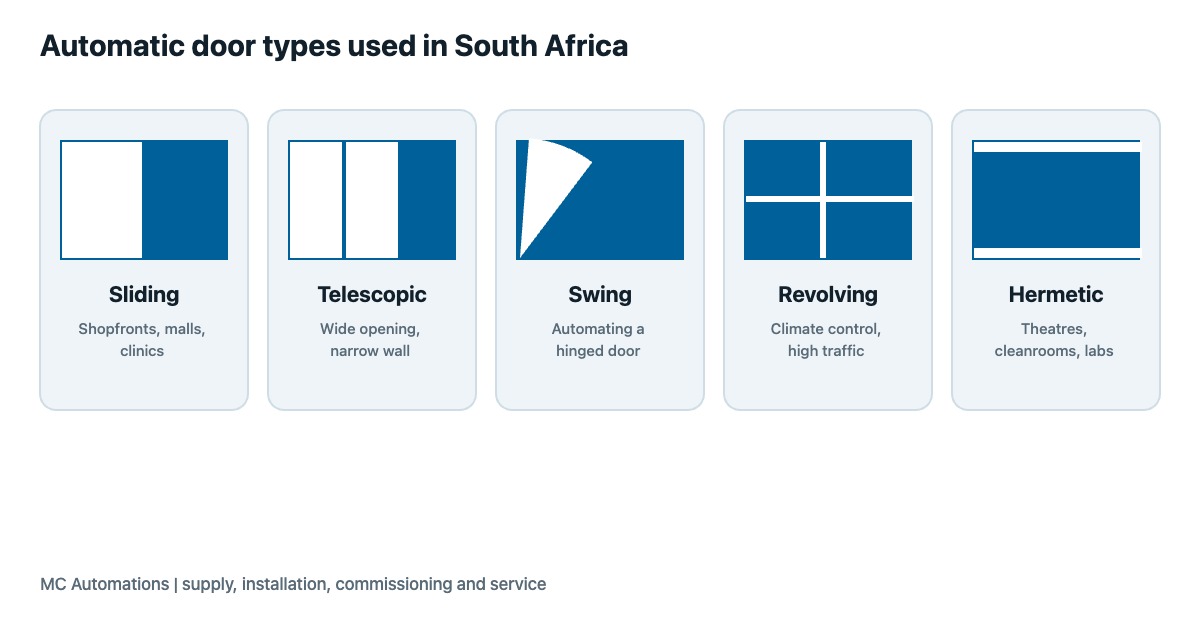
Each type has its own detail page: automatic sliding doors, swing doors, telescopic sliders, revolving doors and hermetically sealed doors.
Almost every powered entrance in the country is one of five layouts, and the automatic doors South Africa specifies most often are sliding. Choosing between them is a question about the wall and the traffic rather than preference.
- Automatic sliding doors — the everyday shopfront, mall and clinic answer. One leaf parks to the side, or two leaves bi-part from the centre.
- Telescopic sliding doors — two leaves per side stack together, giving a wide clear opening where the wall beside the doorway is short.
- Automatic swing doors — an operator on a hinged door you already have, which is the cheapest route to hands-free access.
- Automatic revolving doors — constant separation between inside and outside air on a busy public entrance.
- Hermetically sealed doors — theatres, cleanrooms and laboratories, where the seal itself is the specification.
Across the automatic doors South Africa market these five cover the overwhelming majority of installations. The rest of this guide assumes one of them.
How an operator is sized
Sizing automatic doors South Africa starts with three numbers: the structural opening, the weight of each glass leaf, and the traffic the doorway really carries. One cycle is one open-and-close, so a supermarket entrance can do more work in a month than an office door does in a year.
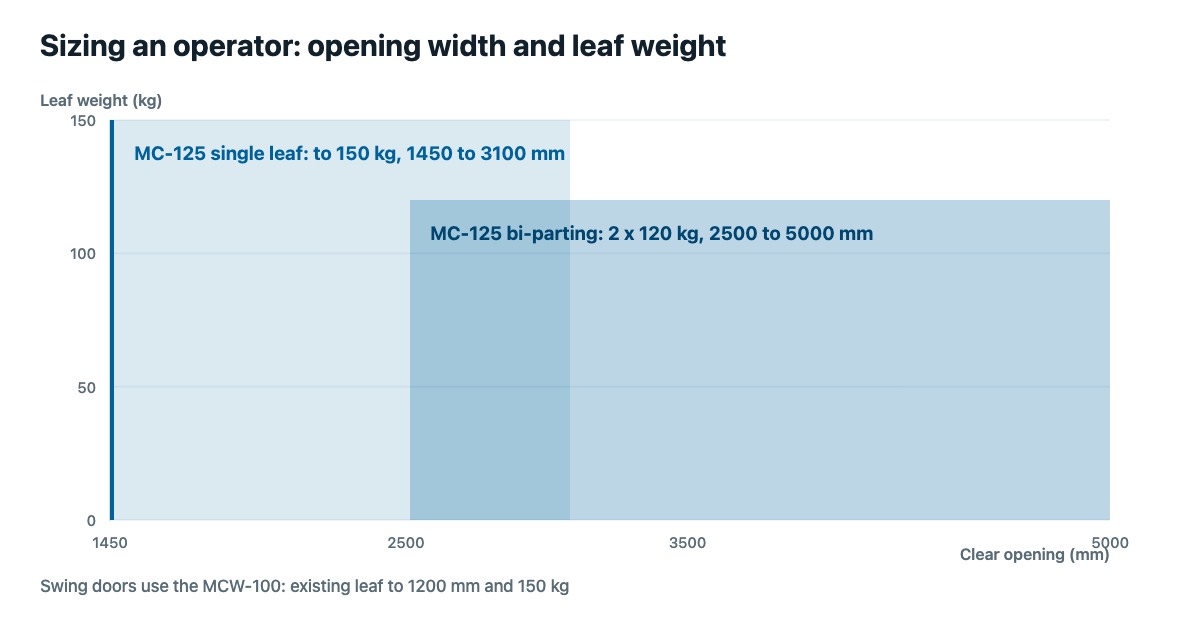
Our own MC-125 sliding door operator carries a single leaf to 150 kg across clear openings of 1450 mm to 3100 mm, or bi-parting leaves of 2 × 120 kg from 2500 mm to 5000 mm. The MCW-100 swing operator automates an existing hinged door to 1200 mm and 150 kg, interdependent, with push-arm and pull-arm options. Both are imported and assembled at our Laser Park facility in Johannesburg and are tested to one million operating cycles. A test result is not a service-life guarantee: real life depends on traffic, environment and maintenance.
Sensors, safety and commissioning
Sensors are covered in depth in automatic door sensors: motion vs presence, and replacement costs are published on our sensor replacement page.
Automatic doors South Africa installations fail far more often on detection than on motors. Two sensor types work together, and a third layer catches what they miss.

- Motion sensors open the door on approach. They see movement, not a standing person.
- Presence sensors hold the door open while somebody is standing in the opening.
- Safety beams and a force limit reverse the leaf when something is in the way.
On automatic doors South Africa sites, commissioning is where those parts become an entrance: opening and closing speed, hold-open time, force, and the detection zones either side. We record the settings at handover so a later adjustment can be compared against how the door was signed off. Our sensor guide and safety requirements article go deeper, and the standards framework sits with the SABS.
What automatic doors South Africa buyers pay
Full cost breakdowns are in automatic door prices in South Africa and automatic door installation cost.
Pricing follows the opening width, the glass, the sensor layout and any access control, so a figure quoted without those is guesswork. As a published starting point, the MC-125 operator is listed from R27 590 excluding VAT and the MCW-100 from R15 900 excluding VAT on our sister company Coetz™. Installation, glass and controls are quoted per site.
Most quotations go out within two working days of us receiving the opening size and a photograph. Where a site survey is needed first, that adds time and we say so; revolving and hermetic entrances are never priced unseen. The automatic door price guide and the installation cost guide break the numbers down further.
Installing automatic doors South Africa wide

We supply, install, commission and service automatic doors South Africa wide with our own technicians, or technicians working under our instruction. Builders work, structural alteration, electrical supply to the entrance and making good are excluded unless the quotation says otherwise. The programme assumes the opening is ready, that power is available at the head where the system requires it, and that we have access to work. Where the site is not ready we re-schedule rather than force an installation that will not commission properly.
The step-by-step version lives in our installation guide, and existing doorways are covered in automating an existing door.
Automatic doors South Africa: power, load-shedding and access control
Decide up front whether the entrance should fail open for escape or fail secure for stock, and whether a battery backup should carry it through a load-shedding slot. Staff need to be shown the manual release either way. Card readers, push buttons, intercoms and time clocks belong in the same scope, because cabling them into a finished ceiling afterwards costs several times what it costs during installation. See automatic doors and load shedding and access control.
Servicing automatic doors South Africa
Service intervals on automatic doors South Africa should follow cycles, not the calendar. A visit checks and realigns the sensors, inspects belt, rollers and guides, re-checks opening and closing force, and replaces wear parts before they strand the door. Consumable and wear items, including belts, rollers, floor guides and seals, are replaced as part of servicing rather than under warranty, and a service level agreement runs alongside the product warranty without replacing or extending it.
We hold spare parts locally and repair other manufacturers equipment as well as our own. Technical support runs on the breakdown line, and our service areas page sets out where attendance is quickest.
Buying automatic doors in South Africa: a checklist
- Measure the structural opening, not the existing frame.
- Count the real daily traffic, including deliveries and trolleys.
- Confirm what sits above the opening — bulkhead, sprinkler line or services void.
- Confirm the power position at the head of the opening.
- Choose sliding, telescopic, swing, revolving or hermetic on the wall you actually have.
- Specify the glass and the frame finish with the building in mind.
- Agree fail-open or fail-secure behaviour and any battery backup.
- Include access control and intercoms in the same scope.
- Ask what the warranty covers and for how long — ours is 24 months on the operator.
- Agree the service interval and who answers a call-out.
Where we install automatic doors South Africa wide
City pages cover local conditions: Johannesburg, Pretoria, Cape Town, Durban, Gqeberha and all service areas.
We are based at Laser Park in Johannesburg and supply automatic doors South Africa wide. City pages cover Johannesburg, Pretoria, Durban, Cape Town, Gqeberha, Bloemfontein, Polokwane and Kimberley. For the full commercial picture, start at automatic doors South Africa or the commercial entrances overview.
Automatic doors South Africa: common questions
What do automatic doors cost in South Africa?
Pricing follows the opening width, the glass, the sensors and any access control. As a published starting point the MC-125 operator is listed from R27 590 excluding VAT and the MCW-100 from R15 900 excluding VAT; installation and glass are quoted per site.
Which automatic door suits the busiest entrances?
Bi-parting sliding doors. Two leaves cover the same opening in half the travel, which is why malls, supermarkets and hospital corridors use them.
What warranty applies to the operator?
Twenty-four months on the MC-125 and MCW-100. Wear items such as belts, rollers, floor guides and seals are replaced through servicing rather than under warranty.
Do automatic doors work during load-shedding?
Only if a battery backup was specified. Without one the entrance parks in the fail-open or fail-secure state chosen for the building, and the manual release is demonstrated at handover.
Can you service a door another company installed?
Yes. Taking over an entrance somebody else installed is routine, and we report its condition before committing to a maintenance interval.
How long does a quotation take?
Most quotations go out within two working days of us receiving the opening size and a photograph. Revolving and hermetic entrances are surveyed first.
Are the operators made in South Africa?
The MC-125 and MCW-100 are imported and assembled at our Laser Park facility in Johannesburg, where spares and technical support are held locally.
Tell us the opening size and send a photograph, and we will specify your automatic doors South Africa project and quote a fixed price. Contact MC Automations or call 010 412 0062.
Why one country is really several climates
Specifying automatic doors South Africa wide is not one problem, it is five or six regional ones, and an entrance that is correct in Johannesburg can be wrong in Durban for reasons that have nothing to do with the building.
- The Highveld. High altitude, large daily temperature swings, dry winter dust and violent summer storms. Clearances are set for the range rather than for handover day, and track grit is the main wear driver.
- The coast, east and south. Humidity and salt together. Corrosion happens at connectors, glands and fixings rather than at visible hardware, and it presents as intermittent faults that test perfectly on a bench.
- The Western Cape. Wind is the specification. Operator ratings are published without wind pressure, so swing arrangements on exposed elevations need margin and reduced speed.
- The arid interior. Heat and fine dust together, which ages controllers in the header and coats sensor optics. A lens cleaned is often a sensor saved.
- The subtropical north-east. Humidity, heavy wet seasons, and insects inside housings producing symptoms that look exactly like sensor failure.
That is why automatic doors South Africa buyers should treat a national specification as a starting point rather than an answer. The operator choice is usually national; the detailing, the service interval and the sensor arrangement are regional.
What is the same everywhere
Some things do not vary by province, and they are the ones worth insisting on regardless of where the building is.
Presence sensing is not optional. Wherever the entrance is, it must detect a person standing in the opening and hold rather than close on them. That is a safety function and no climate or budget argument changes it.
Commissioning is not optional either. Opening and closing speed, hold-open time, force and the detection zones are set against the traffic the doorway actually carries, then written down. Factory defaults suit nobody in particular.
And escape routes are governed by the building’s fire strategy wherever the building stands. What the entrance must do on alarm and on power loss is confirmed with the fire consultant or the local authority, not chosen by the supplier.
Our warranty is 24 months on the operator nationwide, with sensors and wear parts quoted and warranted separately under their own terms.
Coverage, and what it honestly means
We supply and install automatic doors South Africa wide from our base at Laser Park in Roodepoort, Johannesburg, and we service any major brand rather than only the operators we supplied.
Same-day call-outs are a Gauteng commitment. That covers Johannesburg, Pretoria and the surrounding metro. Everywhere else is attended on a scheduled basis, and we will give you the realistic date rather than the hopeful one. Pretending otherwise would waste a trip and your time.
Spares are held in Johannesburg. On a distant site that makes preparation the single biggest lever available: sending the operator make and model from the header label, along with a description of what the door is actually doing, is what gets the right part onto the van the first time.
On estates spread across several cities, the efficient pattern is planned grouped attendances rather than reactive individual ones, and holding one spare of the part most likely to strand a critical entrance. We will tell you which part that is for your particular operators.
Quick answers on automatic doors South Africa
- Automatic doors South Africa are supplied and installed nationwide from Laser Park, Johannesburg.
- Automatic doors South Africa same-day call-outs apply in Gauteng; elsewhere is scheduled.
- Automatic doors South Africa operators start from R15 900 excluding VAT.
- Automatic doors South Africa are serviced on any major brand, not only ours.
- Automatic doors South Africa need regional detailing: wind in the Cape, salt on the coast, dust inland.
- Automatic doors South Africa carry a 24-month warranty on the operator everywhere.
- Automatic doors South Africa means pedestrian entrances; we supply no shutters, gates or garage doors.
- Automatic doors South Africa pricing is confirmed against the opening, never from a catalogue alone.
Specifying for a national estate
A retailer, a bank or a franchise group buying automatic doors South Africa wide has a different problem from a single building: consistency across sites that are not consistent.
The temptation is a single specification issued nationally. It works for the operator and fails for everything around it, because a Cape Town frontage and a Polokwane one are not the same doorway. The better pattern is a national standard for the things that should not vary — operator family, sensing arrangement, commissioning record, warranty terms — with a regional annexe for detailing, service interval and exposure.
Standardising the operator family across an estate is genuinely valuable. It means one spares list rather than nine, technicians who know the unit, and a controller that behaves the same way in every store. Where a group has inherited a mixture through acquisition, converging on one family at natural replacement points costs nothing extra and pays back quickly.
The other estate-level decision is tiering. Not every entrance deserves the same response. A single-entrance store and a back-office door belong on different tiers, and agreeing that in advance is considerably cheaper than negotiating it while a shop is shut.
Budgeting an entrance over ten years
Comparing automatic doors South Africa quotations on purchase price alone is how buildings end up with the expensive option.
The operator is bought once. Sensors are replaced perhaps twice in a decade on a busy entrance. Carriages, guides and belts are wear items on a schedule set by grit and traffic rather than by the calendar. Service visits recur. And the cost nobody budgets is the unplanned attendance — the one at the worst trading moment, with the entrance coned off while it waits.
That last cost is the one a proper interval and a written condition record actually reduce. An entrance attended on evidence gets its parts replaced before they strand it; one attended on complaint gets them replaced afterwards, at a premium, with trade lost in between.
So the useful comparison is scope, not total. A quotation should name the opening it was priced against, the equipment it includes, and what it excludes — builders work, structural alteration, electrical supply and making good are excluded unless stated. Two figures that do not both do that are not comparable.
What to send us, wherever the building is
Five answers get a realistic figure for automatic doors South Africa wide, without a site visit and regardless of province.
- The clear opening you need and the structural opening you have.
- A photograph of the doorway taken far enough back to show the wall either side and the header above.
- An honest cycle count at the busiest hour, not the daily average.
- Where the building is, and whether the elevation is exposed to wind, salt, sun or dust.
- Whether there is power at the header, and whether the doorway sits on an escape route.
That fourth answer is the one people leave out and the one that changes the specification most. An identical opening in Cape Town and Kimberley wants different detailing, a different service interval and sometimes a different arrangement entirely.
From those five we can say which operator suits the opening, what it needs to survive where it stands, and what has to be confirmed before an order. If the doorway does not need automating at all, that answer is free too.
Suppliers, installers, companies: which one do you actually need?
Searches for automatic doors South Africa arrive under several job titles, and they are not interchangeable. Knowing which one describes your requirement saves a wasted enquiry.
- Automatic door suppliers South Africa. Supply of the equipment itself. Automatic doors South Africa wide are bought this way where the contractor is already appointed. If you have your own contractor and need the operator, sensors and controller, this is the transaction.
- Automatic door installers South Africa. Supply plus fitting and commissioning. Most commercial entrances buying automatic doors South Africa need this, because an operator bolted up and left on factory settings is not a finished doorway.
- An automatic door company. The whole relationship — specification, installation, servicing, repairs, spares and eventual replacement. Across a portfolio of automatic doors South Africa wide this is usually the cheaper arrangement, because the same people who commissioned the doorway are the ones maintaining it.
We do all three. What we would say plainly is that price alone is a poor way to choose between them: an operator is one component, and the long-term cost of an entrance is set by how well it was specified, installed, configured and maintained rather than by the line item on the first quotation.
Repairs, fault finding and what gets diagnosed
Work the symptom first with our automatic door troubleshooting guide, then see automatic door repairs for what a call-out involves, or book a technician if an entrance is down now.
Automatic doors South Africa wide fail in the same handful of ways, and the diagnosis matters more than the part.
Automatic door fault finding starts with behaviour rather than components. A door opening for nobody, refusing to close, closing on people, moving slowly or working intermittently each point somewhere different. Replacing parts before establishing which of those is happening is how a repair bill grows.
An automatic door motor repair or automatic door operator repair is frequently not what the entrance needs. A leaf dragging on a worn floor guide or a gritty track makes the operator work harder on every cycle, and the controller reads that resistance as an obstruction. The motor tests fine and the fault returns. The mechanics get checked first for that reason.
Where the fault is genuinely electronic, the automatic door control board is the expensive end. On an ageing operator a controller failure is usually the moment the conversation turns from repair to replacement, because parts for that unit are becoming scarce and money spent on it has a short life ahead of it.
Multi-brand service, maintenance contracts and SLAs
Multi-brand automatic door service is the normal requirement rather than the exception on automatic doors South Africa wide. Most buildings of any age carry equipment from more than one manufacturer, usually because entrances were added at different times by different contractors. We service and repair any major brand, not only the operators we supplied, so a mixed estate does not need separate contractors for different headers.
For businesses running several entrances, an automatic door maintenance contract or automatic door SLA is worth having when it changes behaviour rather than simply pre-paying for visits. The parts worth agreeing in advance are the awkward ones: which entrances are critical and which can wait, what response applies to each tier, whether out-of-hours attendance is included, and who may approve a part over a given value.
What an agreement should never promise is a response we cannot honour. Same-day call-outs are a Gauteng commitment; elsewhere is scheduled. Writing that down beats selling a better-sounding number and missing it.
Automatic door replacement, and when it beats repairing
Automatic door replacement rarely means replacing the whole entrance. On most commercial doorways the shopfront, framing and glazing are sound and only the powered half has reached the end of its life.
Four signals say an automatic door replacement is due: parts lead times stretching, repeat attendances for different faults, a controller that will not hold its commissioning, and a safety requirement the unit cannot meet. Any one of those is a repair. Two or three together and replacing the operator, controller and sensing is the cheaper path.
A site assessment settles it, and on automatic doors South Africa wide that visit is worth more than any figure quoted from a photograph. Where the opening itself is wrong — too narrow for the traffic it now carries, or in the wrong place after a re-plan — no amount of new equipment fixes that, and we will say so rather than sell an upgrade that leaves the real problem in place.
Sector by sector across South Africa
We cover the main sectors separately: shopping centres, hospitals, hotels, retail, schools and campuses, retirement homes, airports and warehouses petrol forecourts, pharmacies and office parks.
Automatic doors South Africa wide behave differently depending on what walks through them, and automatic doors South Africa wide are specified around that rather than around the opening size.
- Shopping centres. Continuous trading-hours traffic with month-end and holiday peaks. Specify for the busiest hour, not the average day.
- Hospitals and healthcare. Trolleys, wheelchairs and staff moving at speed. Presence sensing and hold-open times are set for people who stop in the opening.
- Hotels. Guests with luggage, arriving slowly and often at night. Slower, quieter, held open longer than a retail equivalent.
- Retail stores and supermarkets. Trolleys and bags, and an entrance that is part of the shopfront. Traffic flow and appearance both count.
- Offices and corporate buildings. Usually where access control enters the specification, with the entrance behaving differently across the working day.
- Industrial and warehouse. Dust, grit and forklift impact. Pedestrian entrances only — we supply no roller shutters, gates or garage doors.
- Airports and transport. Traffic arriving in waves set by arrivals and departures rather than spread across the day, so the entrance is specified for the surge. Landside areas mix public access with controlled zones, which brings access control in from the start.
