
Office park automatic doors for landlords and managing agents: who owns which entrance, the access states a working week needs, the morning peak that sizes the lobby, standardising across an estate, and why maintenance recovery changes the contract.
Airport Automatic Doors: Terminals, Landside and Airside
Airport automatic doors are specified for the worst few minutes of the day, not the average. A terminal entrance can stand almost idle for an hour and then take a hundred people and their luggage inside three minutes, because an arrivals bank has landed. Size it on a daily average and it will feel wrong every single time the building is actually busy.
That wave pattern, combined with a building that never closes and a security line running through the middle of it, is what separates airport automatic doors from any other commercial entrance. This guide covers what changes, what to settle before specifying, and what working on a controlled site actually involves.
Airport automatic doors: landside and airside are different jobs
The first question about any of the airport automatic doors in a terminal is which side of the security line it sits on, because the answer changes the access control, the approval path and how anyone is allowed to work on it afterwards.

Landside entrances behave like very busy retail doors with worse weather exposure. Airside entrances behave like controlled access points that happen to be automatic. The hardware can be identical; almost nothing else is.
Get this recorded per entrance in the building file. On older terminals the line has often moved over the years, and an entrance that was landside when it was installed may now sit inside the controlled zone with nobody having revisited its configuration.
Traffic arrives in waves, not evenly
The defining load pattern of airport automatic doors is that demand is concentrated rather than spread.
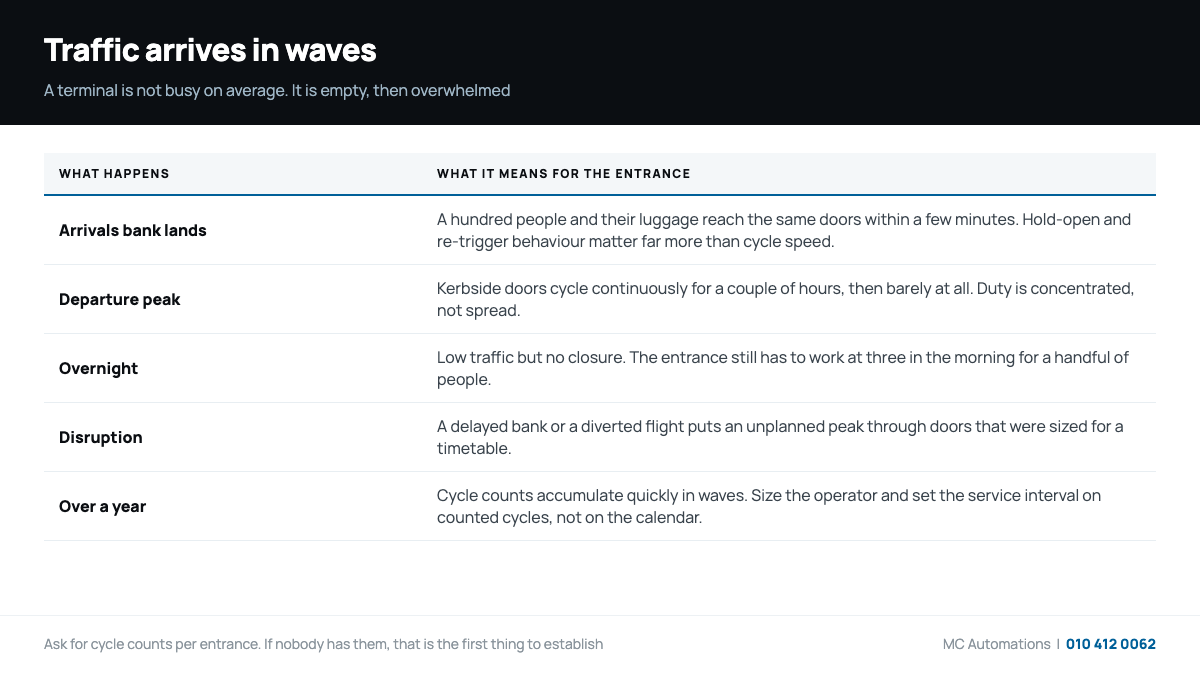
Two practical consequences follow. First, hold-open behaviour and re-triggering matter more than raw cycle speed: when a crowd is crossing, what you want is a door that stays open sensibly rather than one that closes fast and reopens repeatedly. Second, cycle counts accumulate far faster than a calendar suggests, which is why service intervals on these entrances should be set against counted cycles rather than months.
If nobody at the terminal can tell you the cycle count per entrance, establishing that is the single most useful piece of data you can gather. It settles the operator sizing, the service interval and the spares holding in one go.
Clear opening on airport automatic doors: trolleys and groups
Traffic through airport automatic doors is wide. Loaded baggage trolleys, oversize items, wheelchairs with an attendant, families moving as a group and cleaning or catering equipment all pass through the same openings, often simultaneously.
Measure the widest thing that genuinely passes, with the person pushing it, rather than taking a nominal figure from a plan. Crucially, people do not pass through a terminal entrance in single file during a peak — they arrive abreast, which is the real determinant of the opening width.
Where the architecture allows, a wider single opening generally outperforms two narrow ones during a wave, because a crowd self-organises around one clear route more readily than it splits.
Air movement, pressure and kerbside exposure
Airport automatic doors sit in enormous volumes with openings at ground level, which makes them prone to pressure differences between inside and out. Add kerbside wind and vehicle movement directly outside the entrance and you have the conditions that make a single set of doors uncomfortable.
This is why air locks and revolving entrances appear in terminals so often: two sets of leaves that are never open together, or a geometry that never opens the building fully to the outside at all. Our automatic revolving doors page covers where that approach earns its place.
The same pressure that makes a lobby draughty also loads the operator. A door fighting a pressure difference on every cycle works harder than the same door inland, and that belongs in the sizing conversation rather than being discovered through premature wear.
Security integration and direction of travel
On airport automatic doors inside the controlled zone, the question is frequently not only who may pass but which way. One-way flows, alarmed exits and doors that must not permit entry against the direction of travel are routine requirements in a terminal and rare almost everywhere else.
The interface between the access system and the operator is where this gets decided. A reader that releases a lock without telling the operator to open leaves someone standing at a door that is technically unlocked, and in a controlled area that produces exactly the kind of tailgating the system exists to prevent. Our automatic door access control page covers the reader and locking options, and the physical side is in our guide to automatic door security.
Escape routes and crowd egress
Terminals carry high occupancy loads, so airport automatic doors on escape routes are held to a stricter line, and entrances on escape routes have to remain openable by hand, without power and without a key, while anybody is inside. Since a terminal is never empty, that condition is effectively permanent.
No security arrangement is permitted to override it. What the entrance does when the fire alarm sounds, and when the mains drop, is set by the fire strategy for that building and agreed with the fire consultant before installation rather than chosen afterwards. Where a fire-resisting leaf is involved, our fire-rated automatic doors page sets out exactly what we will and will not state.
Working on a live, controlled site
Maintenance on airport automatic doors is as much an access problem as a technical one, and underestimating that is the commonest reason planned work overruns.
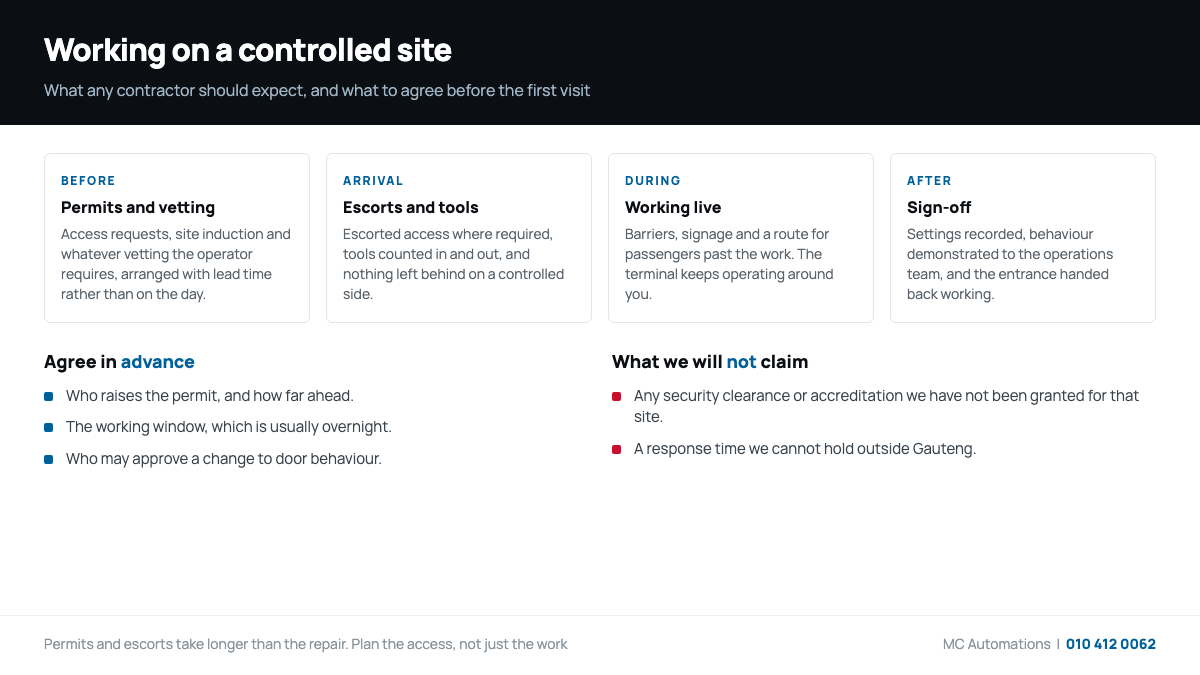
Permits and escorts frequently take longer than the repair itself. A sensor replacement that is forty minutes of work can occupy half a day once access arrangements, escorting and sign-off are counted, and it is better to plan for that honestly than to promise a window that cannot be met.
We will not claim security clearances or site accreditations we have not been granted for a specific site. What we will do is work to whatever the operator requires, arrange it with lead time, and tell you plainly what the access process will add to the timeline.
Servicing airport automatic doors in a building with no closing time
Airport automatic doors get no quiet period, only quieter ones. Work generally happens in the overnight window between the last departure and the first check-in, and the entrance has to be left working when the team leaves.
Service intervals on high-duty terminal entrances should be shorter than our six-month standard, set against counted cycles. A kerbside departures door may accumulate more cycles in a quarter than an office entrance does in several years, and treating them the same under-serves the one that matters.
Spares matter more here than almost anywhere. Downtime on a terminal entrance is not an inconvenience, it is a queue. We hold spare parts for our own equipment and for the major brands already installed on South African sites, so a mixed terminal estate does not need a separate contractor per door type.
Mixed estates and taking over existing doors
Terminals accumulate hardware, so airport automatic doors are rarely all one brand. Different phases of building work bring different brands, and a large terminal can easily carry four or five makes of operator installed across two decades.
We service and repair the major brands already installed on South African sites as well as our own equipment, as an independent service provider rather than as an agent or distributor for any manufacturer. On a mixed estate the sensible route is to standardise on replacement rather than all at once: as each entrance comes up for renewal it moves to a single specification, and within a refurbishment cycle the terminal converges without a capital event.
Baggage halls, back of house and the doors nobody photographs
Most discussion of airport automatic doors concentrates on the public entrances, which is where the architecture money goes. The entrances that fail first are elsewhere.
Baggage hall and handling-area doors take trolleys, cages and tugs all day in an environment with dust, vibration and constant movement. Catering and cleaning routes carry heavy equipment through the same openings dozens of times a shift. Staff access points between landside and airside cycle continuously through shift changes. None of these appear in a terminal photograph and all of them accumulate cycles faster than the arrivals door.
They are also the ones most often left off the service schedule, precisely because no passenger uses them. When a baggage hall door fails, the consequence is not an unhappy traveller at the kerb; it is a handling operation working around a stuck opening, which is both slower and less safe.
Treat back-of-house openings as equal members of the estate when specifying airport automatic doors. Same operator class, same service interval logic, same spares.
What a stuck entrance actually costs
The case for proper specification and servicing of airport automatic doors is easier to make here than in most buildings, because the cost of failure is visible within minutes.
An entrance that stops working at a peak does not simply inconvenience the people in front of it. It pushes a wave of passengers through a narrower route, which backs up into the kerbside or the concourse, which is where crowding problems begin. In a controlled area a failed door can mean a security position has to be staffed manually until it is fixed. None of that appears on the quotation for the door, and all of it is the reason the door matters.
That asymmetry is worth stating plainly when a terminal is comparing quotations. The difference between a well-specified entrance and a marginal one is small against the capital cost of the building and large against the operational cost of the entrance failing in a peak.
Retrofit and phased work in a live terminal
Very little airport work is a new building. Most of it is replacing or upgrading entrances in a terminal that is operating around you, which changes the sequencing more than the engineering.
The leaf, framing and glass usually stay; the operator above the opening is what changes. That keeps the work within a single overnight window per entrance in many cases, which is the difference between a project a terminal can absorb and one it cannot. Where an opening itself has to change, that is a building decision with a different approval path, and it should be separated out in the programme rather than bundled with the door.
Phase by consequence rather than by convenience. The entrance whose failure would cause the biggest operational problem goes first, not the one that is easiest to reach. On most terminals that ordering puts a kerbside departures door or a staff access point ahead of a secondary landside entrance, even though the secondary door may look worse.
Agree the hoarding, the passenger route past the work and the fallback if something overruns, before the first night rather than during it.
Specifying a terminal entrance
Most of the difficulty in specifying airport automatic doors is settled on paper rather than on site.
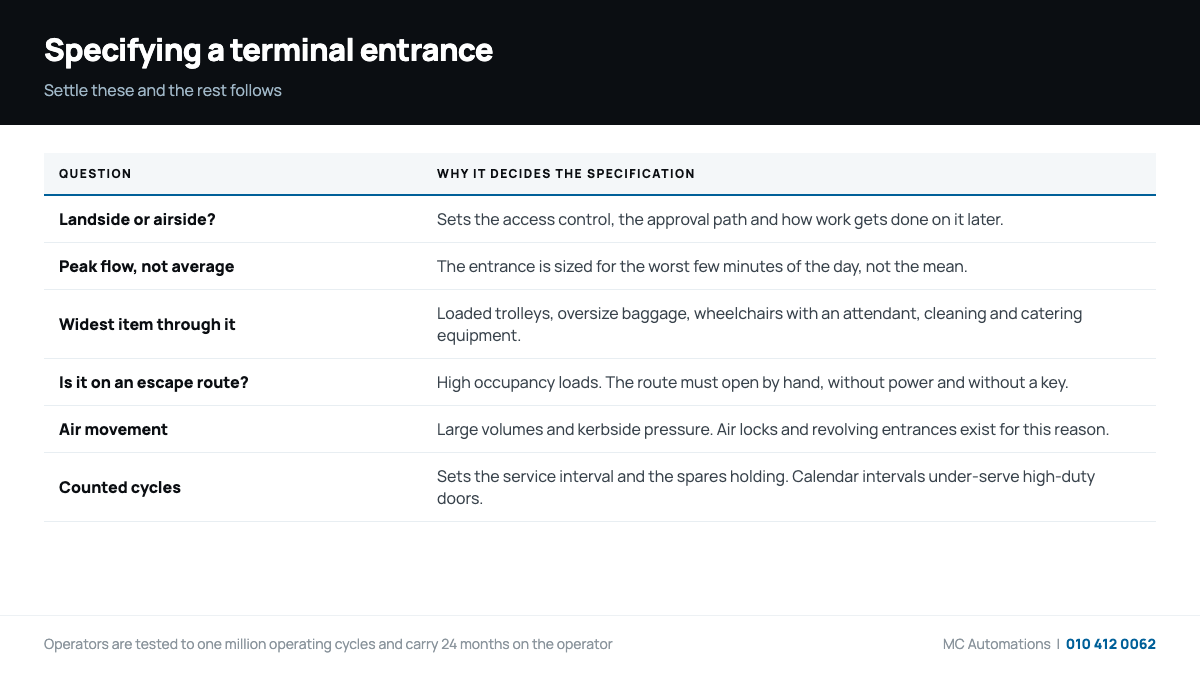
If you are responsible for an existing terminal rather than a new one, the same list works as a survey. Walk each entrance, record which side of the security line it is on, what the widest item through it is, whether it sits on an escape route and what its counted cycles are. That information is worth having before the next failure rather than after it.
Requirements for entrances on escape routes derive from the National Building Regulations and the standards published by the South African Bureau of Standards, applied through the fire strategy prepared for your building.
Airport automatic doors: quick answers
What makes airport automatic doors different from other commercial entrances?
Three things: traffic arrives in concentrated waves rather than spread through the day, the building never closes so there is no natural maintenance window, and a security line runs through it so entrances on the controlled side carry access, approval and permit requirements that landside doors do not.
How should the service interval be set on a terminal entrance?
Against counted cycles rather than the calendar. A kerbside departures door can accumulate more cycles in a quarter than an office entrance does in years, so a fixed six-month interval under-serves it. Ask for cycle counts per entrance; if nobody has them, that is the first thing to establish.
Can you work airside?
We work to whatever access process the operator requires: permits, induction, escorting, tool control and sign-off, arranged with lead time. We will not claim a security clearance or site accreditation we have not actually been granted for that specific site, and we will tell you upfront what the access process adds to the timeline.
Do you work on brands other than your own?
Yes. We service and repair the major brands already installed on South African sites as well as our own equipment, as an independent service provider. We are not an agent, distributor or authorised representative of any other manufacturer, and we hold spares for both.
Why do terminal entrances feel draughty?
Large internal volumes create pressure differences against the outside, and kerbside wind and vehicle movement add to it. That is why air locks and revolving entrances are common in terminals — neither opens the building fully to the outside. The same pressure also loads the operator, so it belongs in the sizing conversation.
Can a terminal entrance be locked for security?
Entry can be controlled, but egress cannot be prevented on an escape route while anyone is inside, which in a terminal is permanent. High occupancy loads make this stricter rather than looser. The exact behaviour on alarm and on power loss is set by the fire strategy for the building.
Talk to us about the terminal
Tell us how many entrances are involved, which sit airside, what the peak flow looks like and whether cycle counts exist. Request a quote and we will work through it entrance by entrance, or call 010 412 0062.
