
Office park automatic doors for landlords and managing agents: who owns which entrance, the access states a working week needs, the morning peak that sizes the lobby, standardising across an estate, and why maintenance recovery changes the contract.
Automatic Doors for Retirement Homes and Frail Care
Automatic doors for retirement homes are specified around the slowest person who will use them, and that single idea changes almost every setting on the operator. A door that works beautifully in a shopping centre can be genuinely unpleasant in a frail care wing, not because the hardware is wrong but because the timings were set for somebody who walks at four kilometres an hour.
This guide covers what actually changes: the commissioning settings, the clear opening, how the zones in a village differ, and the questions worth settling before anything is ordered. It is written for the people who run these buildings rather than for a catalogue.
Automatic doors for retirement homes: the resident sets the settings
On automatic doors for retirement homes the operator is not tuned for throughput the way it would be in a shop. Here it is tuned for the person least able to hurry, and the difference is felt every day.
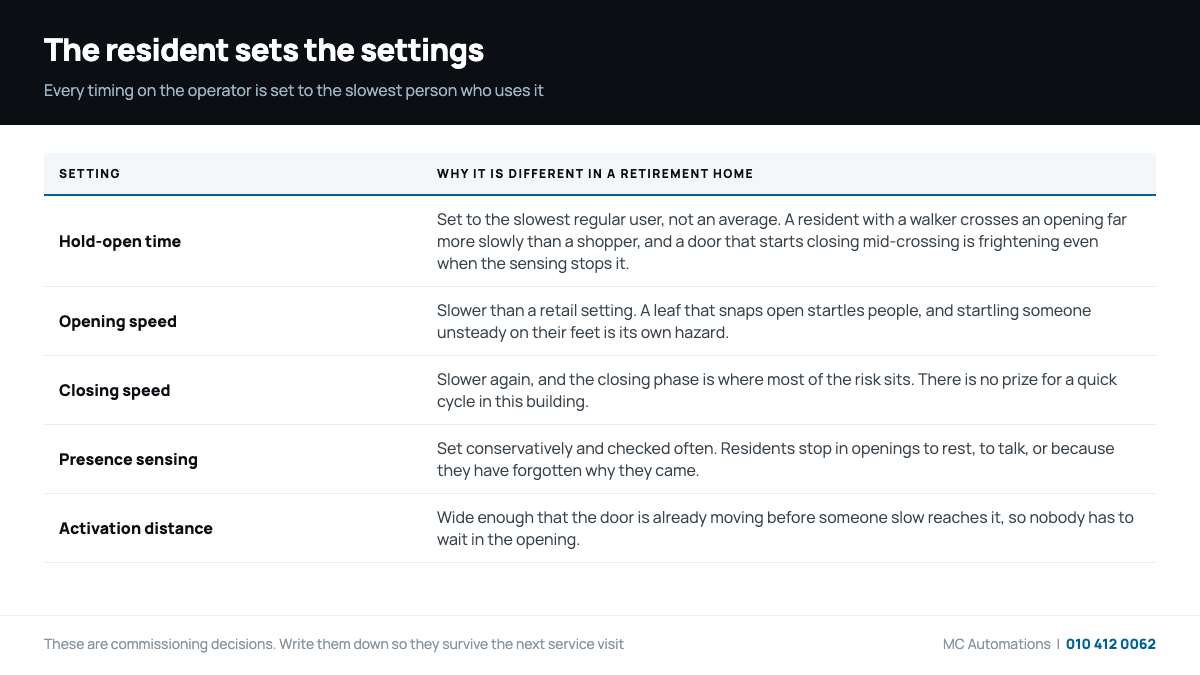
The closing phase matters most. Safety sensing will stop a door before it touches somebody, but a resident who sees a door start to close while they are still in it does not experience that as a near miss handled correctly — they experience it as a door that nearly caught them, and some will avoid that entrance afterwards. Generous timings cost nothing and prevent that entirely.
Write the settings down per entrance at commissioning. The commonest regression we see on these sites is a technician attending a fault two years later, resetting an operator to factory defaults, and quietly undoing every timing decision the building made.
Clear opening is set by the equipment, not the plan
The second thing that separates automatic doors for retirement homes from ordinary commercial entrances is what passes through them.
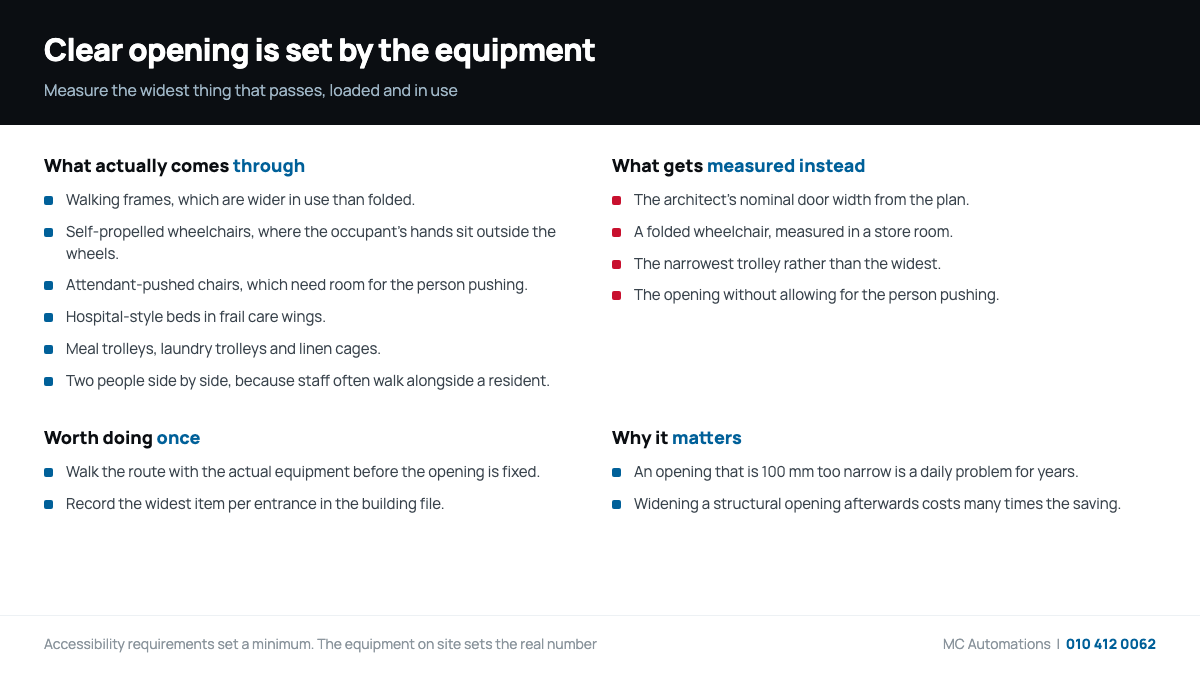
Measure on site with the real equipment, loaded and in use. A self-propelled wheelchair is wider than the chair itself, because the occupant’s hands sit outside the wheels. An attendant-pushed chair needs room for the person pushing. A walking frame is wider in use than folded. And staff very often walk alongside a resident rather than behind them, which is two people wide, not one.
Accessibility requirements set a legal minimum, and our guide to automatic doors for disabled access covers that side. The equipment on your site sets the number that actually matters, and it is usually larger.
Sensing for people who stop
Retail sensing assumes people cross an opening and keep going. In a retirement home they stop: to rest, to talk to someone, to work out which way they were going. Presence sensing has to hold the door open for that comfortably, and it has to do it for someone who may be small, seated, or wearing dark clothing that older sensors read poorly.
This is also why the sensing needs checking more often than the manufacturer’s minimum. A sensor that has drifted slightly is an inconvenience in a warehouse and a hazard here. It is the single most valuable thing on the service visit.
Wayfinding, confusion and doors that behave predictably
Many residents live with some degree of cognitive decline, and entrances are a part of the building they interact with constantly. We are not qualified to advise on dementia care and will not pretend otherwise — that belongs with your clinical and design advisors. What we can say is that from an equipment point of view, predictability helps: a door that behaves the same way every time, opens at the same distance, and does not change its behaviour between day and evening is easier to live with than one that does not.
Where a building wants different behaviour at different times, keep the change at the boundaries of the day rather than through it, and keep the mode switch behind a counter so it is not adjusted casually.
Hands-free where hygiene matters
In frail care wings and clinic areas, hands-free entry stops the door handle being a shared surface, and it lets staff through while carrying something with both hands. That is the same argument as in a hospital, and our hospital automatic doors write-up covers the clinical end of it in more detail.
The residential difference is that a retirement home is somebody’s home as well as a care facility, so the solution has to look domestic rather than institutional. That usually points at a conventional sliding or swing entrance with hands-free activation rather than at anything that looks like a hospital door.
Where automatic doors for retirement homes go in a village
Automatic doors for retirement homes are not one entrance repeated across a village. The zones carry genuinely different briefs.
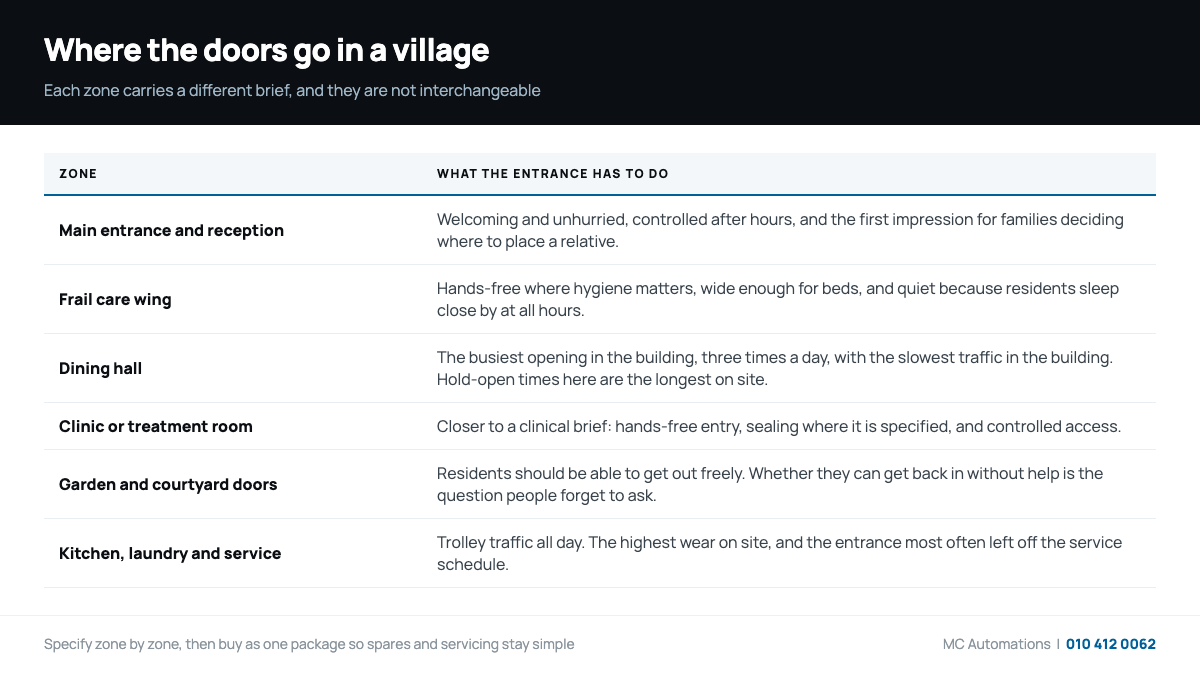
The garden door deserves a special mention because it is the one that gets specified backwards. Residents should be able to get out into a courtyard freely. Whether they can get back in without help, in the rain, with a walker, is the question that often goes unasked until somebody is standing outside.
A building with no closing time
These buildings never empty. There is no quiet period when the entrance can be taken out of service and no hour when nobody is inside, which has two consequences.
The first is that escape routes are always live. An entrance on an escape route has to be openable by hand, without a key and without power, for as long as anybody is in the building — which here is permanently. That constrains what after-hours locking can do, and it is settled with your fire consultant rather than chosen.
The second is that service work has to be planned around residents. Mid-morning is usually worse than it sounds because that is when people move about; early afternoon is often the quietest window. We plan around the building rather than the other way round, and we would rather be told when not to come than discover it.
Access control that lets people out
Security in a retirement home runs in an unusual direction. Visitors and contractors need controlling; residents mostly need to move freely. An access system that treats residents as something to be contained is both unpleasant and, on an escape route, not permitted.
The workable arrangement is usually free egress everywhere, controlled entry at the perimeter, and credentials for staff areas, with the reception entrance carrying the control rather than the internal doors. Our automatic door access control page covers the reader and locking options, and the physical side is in our guide to automatic door security.
Noise, because people sleep nearby
In a frail care wing, residents sleep within metres of the entrance at every hour of the day, not only at night. A drive that whines or a leaf that thumps into its end stop is a bigger problem here than almost anywhere else we work.
Noise is also an early warning. A door that has become louder over a season is telling you the track, carriages or belt tension need attention, and dealing with it at that point is a service item rather than a replacement.
Servicing automatic doors for retirement homes
We service automatic doors for retirement homes on a six-month interval as standard, and more often on dining hall and service doors, which carry the heaviest traffic on site. A visit covers the drive and belt, track and carriages, floor guides, every sensor on the opening, the safety arrangement, and the emergency and power-loss behaviour.
Two things matter more here than elsewhere. Settings must be restored to the recorded values rather than to defaults. And the entrance must be left working when the team leaves, because an out-of-service entrance in this building is not a minor inconvenience.
Same-day call-outs are available in Gauteng; elsewhere the visit is planned and confirmed at booking. If an entrance is down now, book a technician and say that it is a care facility so it is prioritised correctly.
Before you order
Most of the difficulty in specifying automatic doors for retirement homes is avoidable, and it is avoided at specification stage rather than on site.

If you are responsible for an existing village rather than a new one, the same list works as a survey. Walk each entrance with the widest piece of equipment that uses it, note which are on escape routes, and find out whether anybody can still produce the commissioning settings. That information is worth having before you need it.
Requirements for entrances on escape routes derive from the National Building Regulations and the standards published by the South African Bureau of Standards, applied through the fire strategy for your building.
What is different about automatic doors for retirement homes?
Mainly the timings and the opening. Hold-open times are set to the slowest regular user rather than an average, opening and closing speeds are slower, presence sensing is set conservatively because residents stop in openings, and the clear opening is sized on the widest equipment actually in use rather than on the plan.
How wide should the opening be in a care facility?
Wide enough for the widest thing that passes, measured on site, loaded and in use, with room for the person pushing it. That usually means an attendant-pushed wheelchair or a bed in frail care wings, and it is commonly wider than the accessibility minimum or the figure taken from the drawing.
Can the doors be locked at night if residents live there?
Perimeter entry can be controlled, but egress cannot be prevented on an escape route while anyone is inside, which in these buildings is permanently. The workable arrangement is free exit everywhere, controlled entry at the perimeter, and credentials on staff areas. The exact behaviour is set by the fire strategy for your building.
How often should the doors be serviced?
Every six months as standard, and more frequently on dining hall and service entrances, which carry the heaviest traffic. Sensor checks matter more here than in most buildings, because a sensor that has drifted slightly is a genuine hazard rather than an inconvenience.
Will servicing disturb the residents?
It does not have to. Work is planned around the building rather than at a fixed time, and early afternoon is usually quieter than mid-morning. Tell us when not to come and we will plan around it; the entrance is left working when the team leaves.
Do you advise on dementia-specific requirements?
No. That belongs with your clinical and design advisors and we will not pretend to expertise we do not have. What we can do is make the equipment behave predictably — the same activation distance, the same timings, no unexplained change in behaviour through the day — and implement whatever your advisors specify.
Retrofitting an existing village
Most enquiries about automatic doors for retirement homes are not new buildings. They are villages built in the 1990s or 2000s where the population has aged in place, and entrances that were fine for independent residents twenty years ago are now a daily obstacle.
Retrofit is usually straightforward because the leaf, frame and glass normally stay. What changes is the operator above the opening and, sometimes, the opening itself. Three things decide whether it is simple: whether there is headroom above the door for a header, whether there is power nearby or a route for it, and whether the existing leaf is within the weight the operator can handle. A site survey settles all three in an hour.
Where an opening is genuinely too narrow, be honest about it early. Automating a 760 mm door does not make it wide enough for an attendant-pushed wheelchair; it makes a too-narrow door open by itself. That is a building decision rather than a door decision, and it is better raised at survey than discovered after installation.
The sensible order on an existing site is to do the dining hall first, then the main entrance, then frail care, then the garden doors. The dining hall is where the most residents meet the most difficulty three times a day, so it returns the most goodwill per rand spent.
How automatic doors for retirement homes are priced
Pricing splits into the operator, the installation and anything the opening needs. The operator is the part we publish: our sliding operator starts from R27 590 excluding VAT and the swing operator from R15 900 excluding VAT. Those are supply figures for the drive unit, not installed prices.
Installation varies with the site, which is why we survey rather than quote from a photograph. Power availability is the usual variable: an opening with a supply nearby is quick, and one that needs a new circuit run across an occupied building is not. Making good, finishes and any structural work to the opening are quoted separately so you can see what belongs to the door and what belongs to the building.
For a village with several entrances, price it as a package rather than door by door. One survey visit, one specification and one spares holding across the site is materially cheaper over five years than four separate decisions made in four different years, and it means every entrance behaves the same way for residents and staff.
What goes wrong, and how to avoid it
Three failures account for most of the disappointment with automatic doors for retirement homes.
Settings reset on a later visit. Factory defaults are tuned for ordinary commercial traffic and will feel abrupt here. Record the commissioning values per entrance and give them to whoever attends next.
The opening sized from the drawing. It is the most expensive mistake on this list because fixing it means building work. Measure on site, with the equipment.
The service door left off the schedule. Kitchen and laundry entrances carry trolleys all day and wear fastest, yet they are the ones nobody looks at because no resident uses them. When they fail, the building stops working.
Talk to us about the building
Tell us how many entrances there are, which zones they serve, what the widest piece of equipment is, and which sit on escape routes. Request a quote and we will price it zone by zone, or call 010 412 0062 if you would rather talk it through.
