
Office park automatic doors for landlords and managing agents: who owns which entrance, the access states a working week needs, the morning peak that sizes the lobby, standardising across an estate, and why maintenance recovery changes the contract.
Automatic Doors for Disabled Access: A Practical Guide
Automatic doors for disabled access turn a doorway that some people cannot manage into one that everybody can use in the same way. A heavy door is a barrier for a wheelchair user, for someone on crutches, for a parent with a pushchair and for an older visitor with limited grip. This guide explains how automatic doors for disabled access are planned on South African buildings, which door and operator suit which entrance, how people trigger the door, and what to check before you sign off a quotation.
Why automatic doors for disabled access matter
Most entrance complaints are not about the door failing. They are about the door being hard work. A closer set strong enough to shut a heavy leaf against wind is also strong enough to stop a person in a wheelchair from opening it, and a door that has to be pulled towards you while you steer a chair is close to impossible without help.
Automatic doors for disabled access remove that effort. The person approaches, the door opens, it waits while they pass and it closes gently behind them. Nobody has to ask for help, wait for a receptionist or wedge the door open, which also means the building stops leaking cold air and security through a propped door.
There is a wider benefit. The same entrance serves delivery trolleys, cleaning carts, patients on beds, visitors carrying boxes and staff with their hands full. Accessibility is the reason the work gets approved, but convenience is why the whole building ends up using it.
What the building regulations cover
In South Africa, the part of the National Building Regulations that deals with access for people with disabilities is SANS 10400 Part S, published by the SABS. It sets out how buildings must provide for people with disabilities, including entrances, doorways and routes through the building.
We do not quote clause numbers or dimensions from memory in an article, and neither should a supplier in a quotation. The edition that applies, the building’s occupancy class and the approved plans all change what is required. Your architect or the local authority’s building control officer confirms what applies to a specific project, and we design the automation to meet the brief they give.
What we can say plainly: an operator on its own is not a compliance certificate. Automatic doors for disabled access still depend on the opening width, the threshold, the approach route and the ironmongery around them. The operator makes the door usable; the rest of the doorway has to be right too.
Swing or sliding automatic doors for disabled access
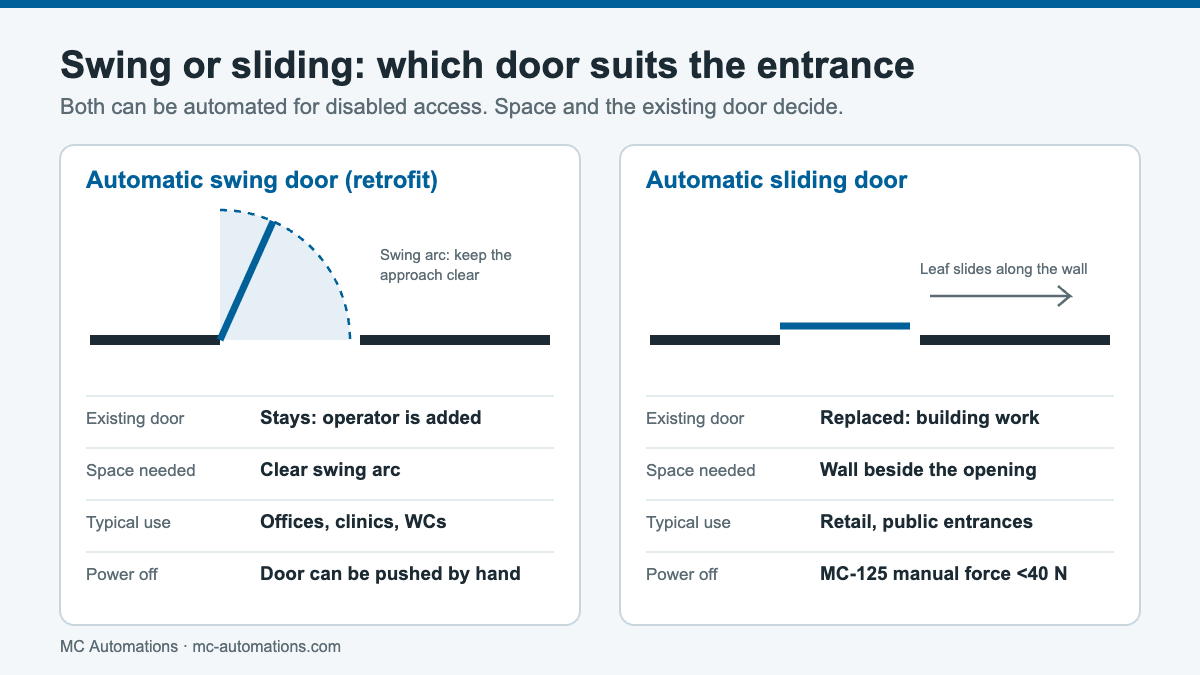
Both sliding and swing doors can be automated for accessible use. The choice usually comes down to the space around the opening and whether the existing door can stay.
Automatic swing doors
A swing operator is fitted to a hinged door that already exists, so the door, frame and glazing stay and only the drive is added. That makes it the most common route to automatic doors for disabled access on offices, clinics, schools and accessible WCs. Our MCW-100 swing door operator drives single or paired doors, inward or outward opening, with a push-arm or pull-arm arrangement. It is rated for leaves up to 150 kg and 1,200 mm wide, with an adjustable opening angle of 60 to 110 degrees.
The trade-off is the swing arc. People waiting on the wrong side of an outward-opening leaf are in its path, so the approach and the sensor layout matter more than on a sliding door.
Automatic sliding doors
A sliding door moves along the face of the wall, so nothing swings into the route. Where there is wall space beside the opening, sliding doors are the easier entrance for wheelchair users and busy public buildings. The MC-125 sliding door operator runs single or bi-parting leaves with opening speed, closing speed and hold-open time adjustable on site. Its manual opening force is listed at under 40 N for a single leaf and under 50 N for bi-parting leaves, which matters when the power is off.
The trade-off is space and cost. A sliding entrance needs somewhere for the leaf to go, and replacing a hinged door with a sliding one is building work, not a retrofit.
In retirement villages and frail care the same accessibility thinking is applied to a building whose residents are permanently on site. See automatic doors for retirement homes for the sector-specific settings and openings.
Low-energy automatic doors for disabled access
Swing operators can be set up in two ways. Full-energy operation opens the door quickly and relies on safety sensors to protect people in its path. Low-energy operation runs the door slowly and gently enough that it suits accessible entrances without a presence sensor covering every approach.
For most automatic doors for disabled access on low-traffic doors, low energy is the sensible choice. The door never surprises somebody approaching it, it is easy to stop by hand, and the installation is simpler. Busy public entrances usually need full-energy operation with proper sensor coverage, because a slow door becomes a queue.
Whichever mode is used, the closing speed, hold-open time and the back-check near the end of travel are set on site against the real users of that door. A door in a frail-care facility should behave very differently from a door into a warehouse office.
How people open automatic doors for disabled access
The trigger is where many automatic doors for disabled access projects go wrong. A door that opens beautifully is no use if the button is behind a bin, at standing height or on the hinge side of the leaf.
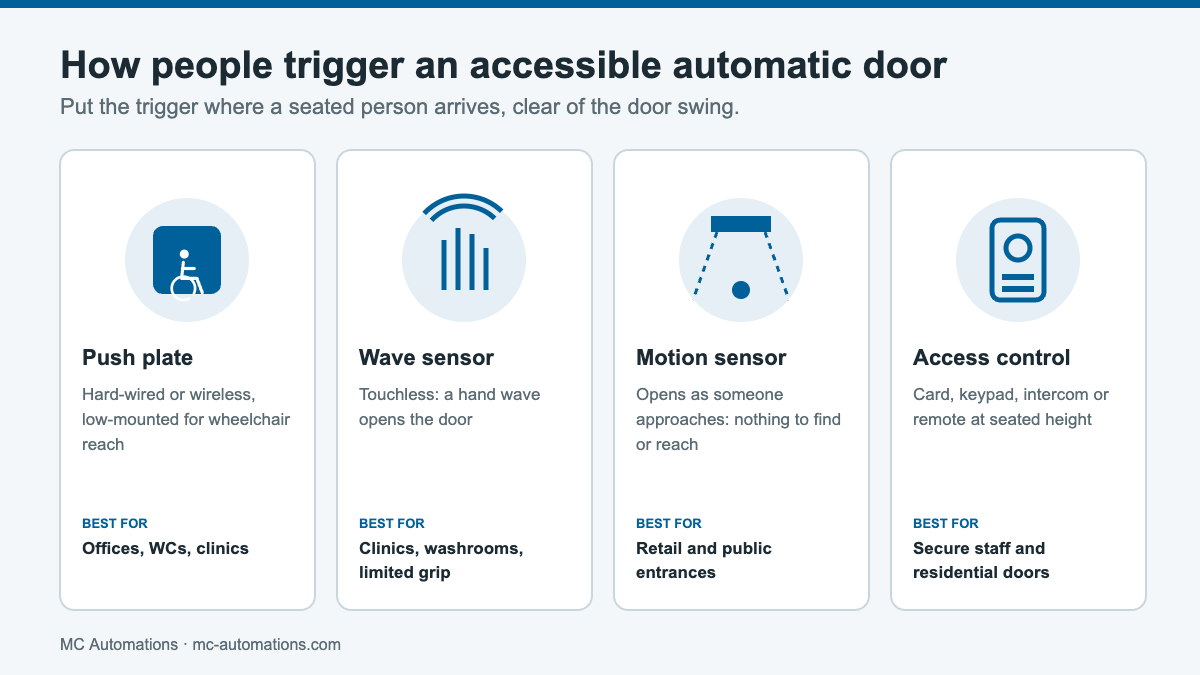
- Push plates. Hard-wired or wireless, including low-mounted plates that a wheelchair user can reach without leaning. The plate should be clear of the door swing so pressing it does not put the person in the leaf’s path.
- Touchless wave sensors. A hand wave opens the door, which suits clinics and washrooms where hygiene matters and suits people with limited grip.
- Motion sensors. The door opens as someone approaches. This is the most inclusive option on a public entrance because nobody has to find or reach anything.
- Access control. Card, keypad, intercom or remote where the door is also a security door. The reader has to be reachable from a seated position, and the door should still open automatically once access is granted. Our access control page covers the options.
Planning the approach and the sensor layout
Automatic doors for disabled access work only if the space around them works. Before we quote, we look at how people actually arrive at the door.
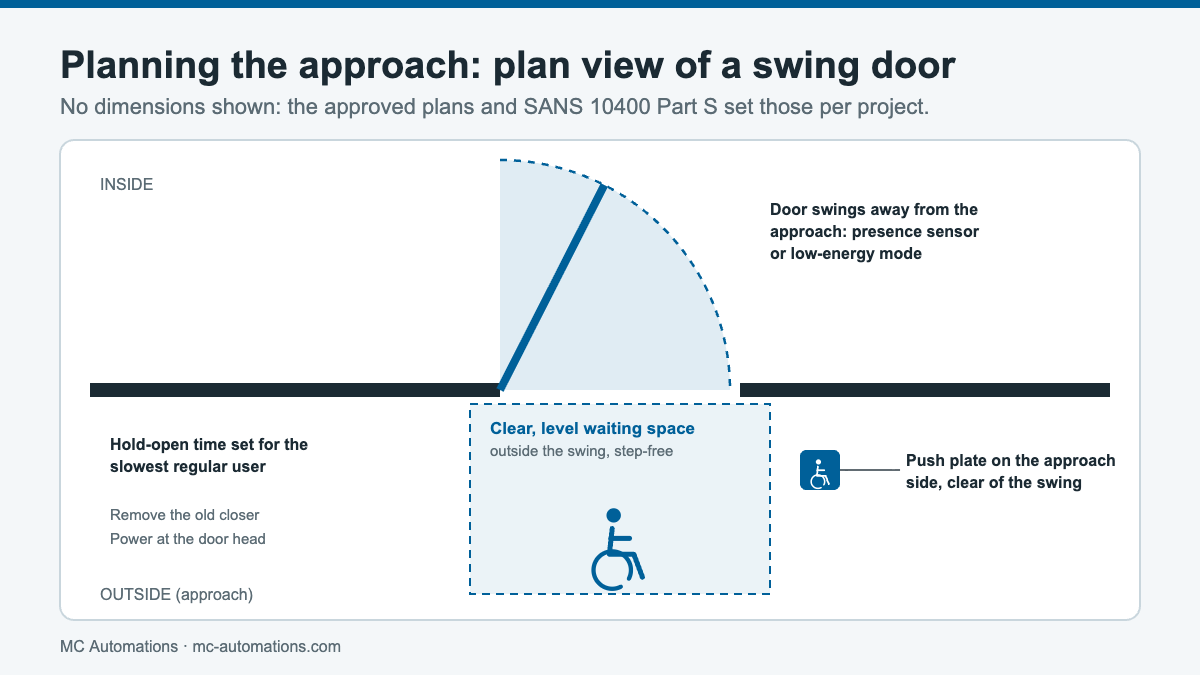
A person in a wheelchair needs a clear, level space in front of the door to stop, trigger it and wait. They should not have to reverse into the swing of the leaf. On a swing door the push plate belongs on the approach side, away from the arc. Where a ramp or step-free threshold leads to the door, the sensor must not trigger so early that the door starts closing before the person reaches it.
Hold-open time is the other setting that decides whether automatic doors for disabled access actually work for their users. Somebody walking with a frame or crutches takes much longer to cross a threshold than an able-bodied adult, so the default factory time is rarely right. We set it after watching the door in use.
Safety sensors and closing force
A door that closes on somebody is worse than a door that does not open. Automatic doors for disabled access need the reversing and presence protection set up for the people most likely to be slow in the doorway.
On full-energy doors that means presence sensors covering the swing or sliding path so the door stops or reverses if someone is there. On low-energy doors the gentle speed does much of that work, but closing force still needs to be checked on site. Our automatic door safety requirements guide goes further into sensor coverage and testing.
Automatic doors for disabled access during load shedding
An accessible entrance that stops working when the power fails is not accessible for several hours a day during load shedding. There are two safe answers, and the right one depends on the building.
With battery backup fitted, the operator and the locking keep working through an outage. Without it, the door should park in an agreed safe state and still be usable by hand. Most swing doors can still be pushed manually, and sliding doors are specified with a low manual opening force for the same reason. Our load shedding guide covers the options in more detail.
Retrofitting an existing door
Most automatic doors for disabled access are retrofits. The building already has a hinged door in the right place, and nobody wants to replace glazing or a frame to make it accessible.
A swing operator can usually be added if the leaf is sound, the hinges can carry the extra cycles and there is a solid fixing across the head of the door. There also needs to be power at the head. Where the door, hinges or frame are already tired, we say so before quoting rather than automating a door that is failing. Our guide to automating an existing door walks through that survey.
The door closer usually comes off, because an operator fighting a closer wears both out and pushes the opening force back up.
Automatic doors for disabled access by building type
- Healthcare. Hands-free entry for wheelchairs, trolleys and beds, with touchless sensors where infection control matters. See our note on hospital automatic doors.
- Offices. Reception doors, boardrooms and staff entrances, usually as a swing retrofit with a low-mounted push plate.
- Retail. Sliding entrances with motion sensors, because shoppers with trolleys and prams need the same easy entry.
- Schools and public buildings. Accessible WCs and main entrances, where low-energy automatic doors for disabled access are often enough.
- Residential estates and frail care. Longer hold-open times, slower closing and battery backup, set for residents who move slowly.
Common mistakes with automatic doors for disabled access
- Mounting the push plate at standing height, or inside the swing of the door.
- Leaving the factory hold-open time, which closes the door on slower users.
- Keeping the old door closer on the leaf alongside the new operator.
- Automating the door but leaving a raised threshold or a step at the opening.
- Treating an operator brochure as proof that the entrance meets SANS 10400 Part S.
- Forgetting what the door does when the power fails.
Quick answers
- Automatic doors for disabled access do not have to be sliding doors. A swing operator on the existing hinged door is often the practical choice.
- Automatic doors for disabled access are only as good as the trigger. Put a reachable push plate or motion sensor where a seated person arrives.
- Automatic doors for disabled access on quiet doors usually suit low-energy operation; busy public entrances usually need full energy with sensors.
- Automatic doors for disabled access need hold-open time set for the slowest regular user, not the factory default.
- Automatic doors for disabled access should keep working, or open easily by hand, during load shedding.
- An operator alone does not make automatic doors for disabled access compliant; the opening, threshold and approach have to be right as well.
Frequently asked questions
Can automatic doors for disabled access be added to our existing door
Usually, yes. A swing operator retrofits onto a sound hinged door with a solid head fixing and power nearby. The door, frame and glazing stay. If the door is already failing, we tell you before quoting.
Does an automatic door make our entrance compliant
Not on its own. SANS 10400 Part S covers the whole doorway and route, including the opening, threshold and approach. Your architect or building control officer confirms what applies, and we design the automation to that brief. We do not issue compliance certificates.
What is low-energy operation
A slow, gentle opening cycle intended for accessible entrances, so the door never surprises someone approaching it. It suits quieter doors. Busy entrances usually run at full energy with safety sensors.
Where should the push plate go
On the approach side, at a height a seated person can reach, and clear of the door’s swing so pressing it does not put anybody in the path of the leaf.
Will the door work during load shedding
With battery backup the operator keeps working. Without it the door parks in an agreed safe state and can be opened by hand.
What warranty applies
Our MC-125 and MCW-100 operators carry a two-year warranty and are tested to one million cycles. Servicing intervals are set from the traffic the door actually carries; see automatic door servicing.
Getting a quotation
For automatic doors for disabled access, send us the door size, a photograph of the doorway from both sides, whether the door opens in or out, and who mostly uses it. We will tell you whether a swing retrofit or a sliding entrance fits, how people should trigger it and what it will cost. Request a quote or call 010 412 0062.
In short
Automatic doors for disabled access at a glance
- Automatic doors for disabled access are quoted against the opening we measured, not a catalogue price.
- Ask about automatic doors for disabled access and we confirm the opening, the head and the power position first.
