
Office park automatic doors for landlords and managing agents: who owns which entrance, the access states a working week needs, the morning peak that sizes the lobby, standardising across an estate, and why maintenance recovery changes the contract.

Can an Existing Door Be Automated?
In most cases you can automate an existing door rather than replace the entrance — and it is usually the cheaper answer by a wide margin. Keeping sound joinery and adding a drive to it is a fraction of the cost of tearing out a shopfront.
The question is whether your particular door is a candidate. Five checks decide it, and the one that fails most often is not the one people expect.
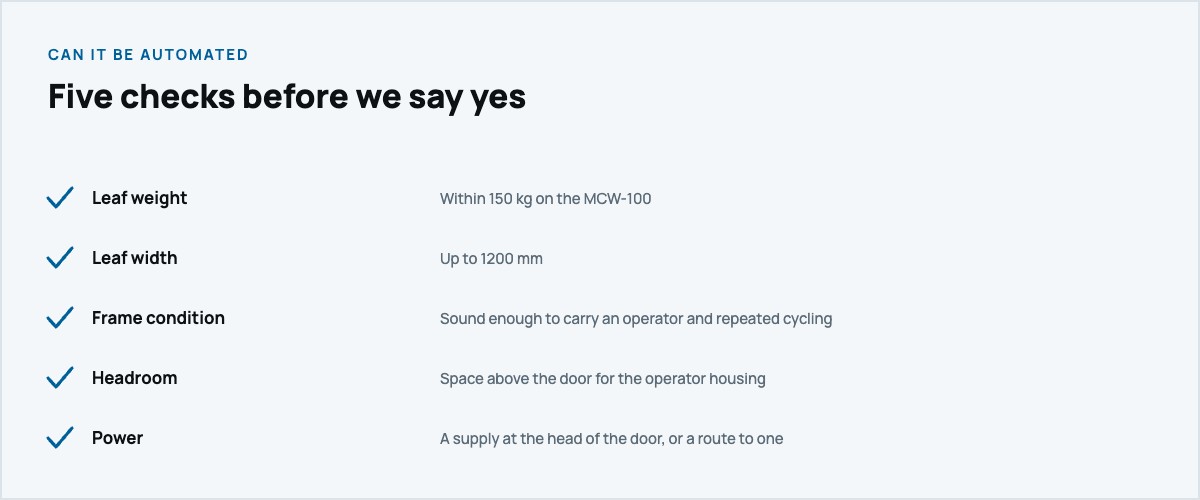
Five checks before you automate an existing door
Leaf weight and width come first, and they are the easy ones. The MCW-100 swing operator handles leaves up to 150 kg and 1200 mm wide, which covers the overwhelming majority of commercial doors already hanging in South African buildings.
Frame condition is the check that actually fails surveys. An operator does not just hang on the frame, it cycles the door thousands of times against it. A frame that is fine for manual use can be too tired to carry powered operation, and fitting a drive to it simply moves the failure somewhere more expensive.
Headroom decides whether the operator housing fits above the leaf. Power is the last: there needs to be a supply at the head of the door, or a sensible route to one. Neither is usually a dealbreaker, but both change the price if they are discovered on installation day rather than at survey.
When to automate an existing door, and when not to
To automate an existing door is the first thing we price, because it is normally the right answer. But it is not always.
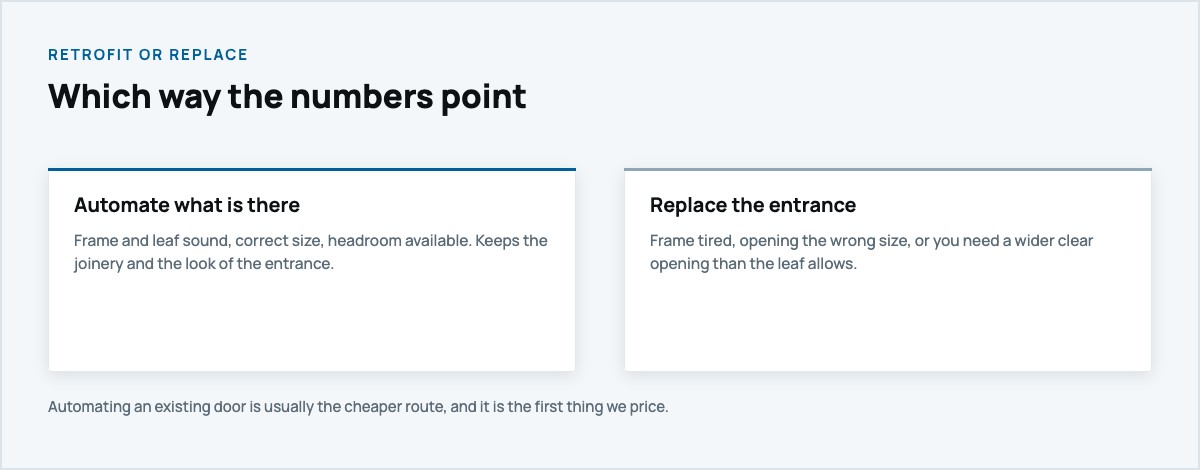
If the frame is tired, or the opening is simply the wrong size for what the building now needs, automating it is money spent on the wrong problem. The clearest example: a doorway that needs a wider clear opening than the existing leaf can give. No operator changes the width of a door — that is a case for automatic sliding doors or a telescopic configuration instead.
Where the entrance is an older automatic door rather than a manual one, the conversation is different again: usually an operator swap that keeps the existing shopfront, covered under service and modernisation.
How we automate an existing door, step by step
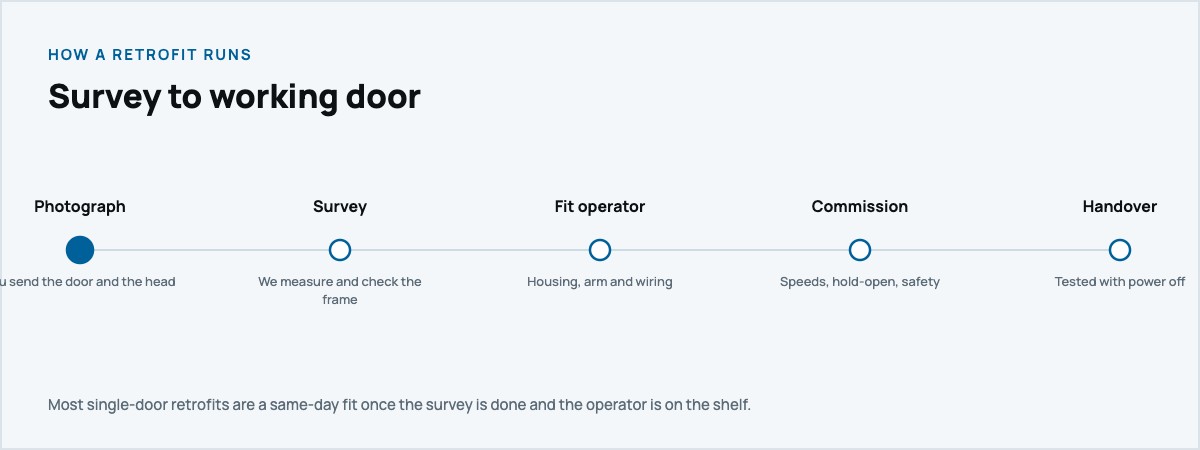
It starts with a photograph. Send the door and the head above it and we can usually tell immediately whether it is a candidate to automate an existing door, before anyone travels.
The survey confirms the frame, the headroom and the power before we automate an existing door. The fit itself is the short part — most single doors are a same-day job once the operator is on the shelf in Johannesburg. Commissioning sets opening and closing speeds, hold-open time and the safety devices, and handover includes testing manual escape with the power off.
What to add when you automate an existing door
The moment you automate an existing door, several things become available that were not before. Access control is the common one — a card reader, keypad or biometric on a door that previously just had a key. Push plates and touch-free activation matter in healthcare. Battery backup keeps it working during load shedding, which is worth deciding now rather than adding later; see automatic doors and load shedding.
Safety sensing is not optional on a powered door, whatever it was before. A manual door that closed slowly on somebody was a nuisance; a powered one is a hazard, which is why presence sensing is commissioned as part of every retrofit — the detail is in automatic door sensors. Requirements for powered pedestrian doors in South Africa are published through SABS.
What the existing leaf has to be able to do
The decision to automate an existing door is really a decision about the leaf. A drive can only move what it is bolted to, and an operator will faithfully reproduce every fault the door already has — only faster, and several hundred times a day.
Start with how the door behaves by hand. Open it slowly to about 45 degrees and let go. A leaf that drifts under its own weight is out of plumb, and automation will fight that bias on every cycle. Push it through its full travel and feel for a tight spot: a door that rubs at one point is telling you the frame has moved, the hinges have dropped, or the leaf has taken up moisture. Fix that before you automate an existing door, not afterwards, because the drive will read the tight spot as an obstruction and stop.
Then check the leaf for warp. Sight along the closing edge from top to bottom against the frame rebate. A leaf twisted more than a few millimetres over its height will never seal evenly, and once automated it will either stop short of closed or slam the last few degrees. Timber doors in a dry Gauteng winter and a wet summer move more than people expect.
Finally look at the glass. Where a leaf is glazed, we need to know what with. Annealed glass in a door that is about to be cycled mechanically is a replacement item, not a judgement call — the standard we work to is 6.38 mm clear laminated safety glass. If the existing pane is not safety glass, the cost to automate an existing door includes replacing it.
Hinges, frames and the loads automation adds
Automation changes the load case. A door opened by hand is opened gently, inconsistently, and at a speed the person chooses. A door opened by a drive is opened to the same angle, at the same speed, at the same acceleration, every single time — and that regularity is what finds the weak point.
Hinges carry the leaf and take most of it. Two hinges are common on older internal doors and are rarely enough once you automate an existing door; three is the practical minimum on anything substantial, and heavy leaves want four or a purpose-made pivot set. Worn knuckles show as a leaf that has dropped at the closing edge, and a dropped leaf is what makes an automated door catch on the threshold.
The frame has to be rigid enough to take the reaction. The operator pushes the leaf open by pushing back against its own mounting, so a frame that flexes turns some of that effort into movement in the wrong direction. On timber frames fixed into masonry this is usually fine. On a light partition frame, or a frame packed out from a wide reveal with softwood, it is not, and packing it properly is part of the job.
One thing we do not do, and will not quote: we do not supply, fit, retrofit or service door closers. Where a leaf currently has a closer on it, that device comes off when we automate an existing door — the operator controls both the opening and the closing, and a closer working against it is a fault, not a backup.
Timber, aluminium and glass leaves: what changes
The substrate changes the fixing, the preparation and occasionally the answer.
Timber. We automate wooden doors, and they are the substrate most often asked about on heritage and residential entrances. Timber takes a fixing well, but it moves seasonally and it needs the operator arm bolted through to something solid rather than screwed into a hollow core. A hollow-core leaf is not a candidate; a solid-core or framed leaf is. Where the door is a feature we would rather automate an existing door than replace it, and that is usually the point of the exercise.
Aluminium. Aluminium leaves and frames are supplied by Coetz Glazing and installed by us, so where the existing door is aluminium and needs sections replacing, both halves of that work sit with people who talk to each other. Existing aluminium is generally straightforward to automate provided the section is deep enough to take the arm fixing.
Frameless glass. This is the one where the answer is sometimes no. A frameless toughened leaf has no section to bolt to — the fixings are in the patch fittings at top and bottom, and those have to be rated for it. Where they are not, the honest answer is a new leaf rather than an attempt to automate an existing door that cannot carry the drive.
Power, backup and the electrical work
An operator needs a supply, and the supply is the part most often left out of a budget. We need a dedicated switched spur near the head of the door. Running it is electrical work, and where the building does not already have a point there it is a real line item in the cost to automate an existing door.
Then decide what the entrance does when the power is off. With a battery backup fitted, the operator keeps working through a load-shedding slot and the entrance behaves normally. Without one, it parks in whichever state the building needs — fail-open, so people can get out and in, or fail-secure, so the opening stays closed until somebody uses the manual release. That choice belongs to whoever is responsible for the building, not to us, and we ask the question at quotation rather than assuming.
The manual release is demonstrated at handover in either case. It is the single most useful thing for the people who work at that entrance to know, and it is routinely the thing nobody was shown.
What it costs to automate an existing door
Entry pricing for the MCW-100 swing operator starts at R15 900. What a specific job costs on top of that follows the condition work the leaf needs, the sensors and safety devices the setting requires, the electrical supply, and whether any glass has to be replaced. We quote against a door we have looked at, because the whole point of a retrofit is that the existing conditions decide the price.
The operator carries a 24-month warranty. That covers the operator; it does not cover the existing leaf, frame or hinges, and it does not cover an entrance that was automated over faults we flagged and were asked to leave. This is why the condition report comes first — it separates what we are responsible for from what the building brought to the job.
Installation is by our own technicians, or technicians working under our instruction, nationwide, with same-day call-outs available in Gauteng. Where the existing entrance carries somebody else’s equipment — GEZE, dormakaba, ASSA ABLOY, record or TORMAX among them — we service it and can usually supply parts for it. We are independent of those manufacturers and are not an agent for any of them.
Done properly, the decision to automate an existing door keeps a door the building already likes and adds the one thing it lacked. Done as a bolt-on over a tired leaf, it produces a powered version of a door that was already annoying.
Access control, and why it is easier on a retrofit than people assume
One of the better reasons to automate an existing door is that it gives you somewhere to put access control. A hand-operated door can be locked, but it cannot be scheduled, logged or released remotely. Once there is an operator on it, all three become configuration rather than construction.
The usual pattern is a reader on the approach side and free egress from the inside, with the operator taking its release signal from the access system. Time profiles then do the rest: open on request during business hours, reader-only after them, locked down outside trading. Where a building already runs a system, we take a signal from it rather than replacing it, which is normally the cheapest way to automate an existing door and bring it onto the same credentials as everything else.
Interlocks are the other common request. Two automated leaves can be made to refuse to open at the same time, which is how clean areas and secure lobbies work. That is straightforward when you automate an existing door on both sides of a lobby, and impossible with manual leaves.
What changes about maintenance afterwards
A retrofit brings the door onto a maintenance schedule, and that is a change worth planning for rather than discovering.
The operator wants checking on an interval set by its duty, and so do the things it now drives. Hinges that were tightened once a decade by hand get loaded on every cycle. Sensors drift and need re-aiming. Batteries in a backup have a finite life and fail quietly, so a backup nobody tests is a backup nobody has. When we automate an existing door we set the interval against the traffic we were told about, and we would rather revise it after six months of real use than guess once and leave it.
Where we take over an entrance somebody else automated, the same applies with one addition: we report its condition before committing to an interval, so the first invoice is not the first anyone hears of a worn carriage.
The three questions we ask first
Every enquiry to automate an existing door comes down to three things, and a photograph usually answers two of them.
How does the leaf behave by hand, and what is it made of? How much space is there above and beside the opening for the drive and its header? And how many people go through it on a busy day? With those three answers we can say whether the door is a candidate, roughly what it will take, and whether it would be cheaper to automate an existing door than to replace the entrance outright — which is not always the answer people expect, and we would rather say so early than at the end of a site visit.
Send a photograph of the opening as it stands, the structural size, and an honest description of the traffic. That is enough to tell you whether we can automate an existing door in your building, or whether the money is better spent on a new one.
Automating an existing door, answered
Can any door be automated?
Most commercial doors within 150 kg and 1200 mm can. Frame condition, headroom and a power route decide the rest.
Is it cheaper than a new entrance?
Usually by a wide margin, because you keep the frame, the leaf and the glazing. It is the first option we price.
Will it look like an add-on?
The operator sits in a housing above the leaf. On most commercial doors it reads as part of the frame rather than as equipment bolted on.
How long does the installation take?
Most single-door retrofits are a same-day fit after the survey. Multiple doors are scheduled together.
Can I add access control to it?
Yes, and that is one of the main reasons people automate a staff door. Reader, locking and operator are commissioned as one system.
What if my door is too heavy or too wide?
Then a swing operator is the wrong answer and we would quote a sliding or telescopic entrance instead, rather than fitting something marginal.
How often should the entrance be serviced?
Against its cycle count rather than a fixed date. Intervals, response times and what is included are defined in your service level agreement.
Do you service other manufacturers equipment?
Yes. Where we take over an entrance somebody else installed, we report its condition before committing to a maintenance interval.
Finding out about your door
Send a photograph of the door and the space above it, with the leaf width and roughly how heavy it is. That is normally enough to say whether you can automate an existing door, and what it would cost.
Request a quote, or talk to a technician.
In short
Automate an existing door at a glance
- Automate an existing door are quoted against the opening we measured, not a catalogue price.
- Ask about automate an existing door and we confirm the opening, the head and the power position first.

This Post Has 3 Comments
Comments are closed.
[…] value than replacement, and we will tell you when that is what you are looking at. Our post on automating an existing door covers the retrofit decision in more depth, and the sliding door automation kit article explains […]
[…] already tired, we say so before quoting rather than automating a door that is failing. Our guide to automating an existing door walks through that […]
[…] are often still sound. Replacing only the operator and sensors is frequently the cheaper path, and automating or upgrading an existing door is often viable, and it is worth asking for both options priced separately rather than accepting a […]