
Office park automatic doors for landlords and managing agents: who owns which entrance, the access states a working week needs, the morning peak that sizes the lobby, standardising across an estate, and why maintenance recovery changes the contract.
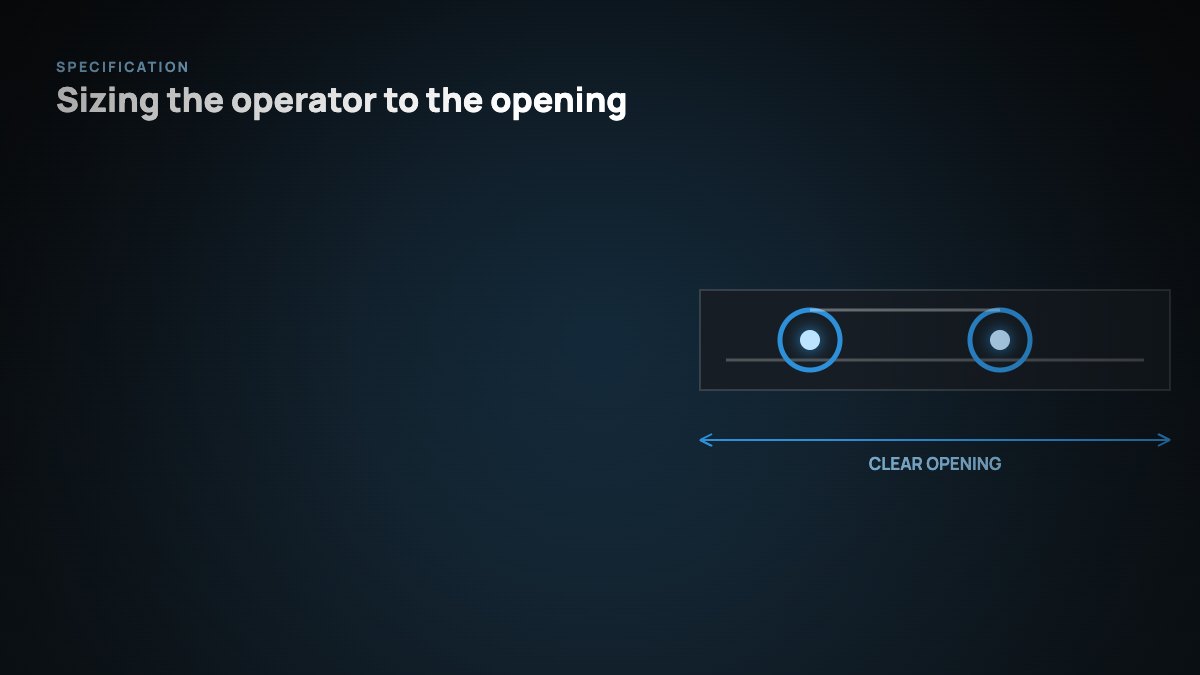
What Size Automatic Door Operator Do I Need?
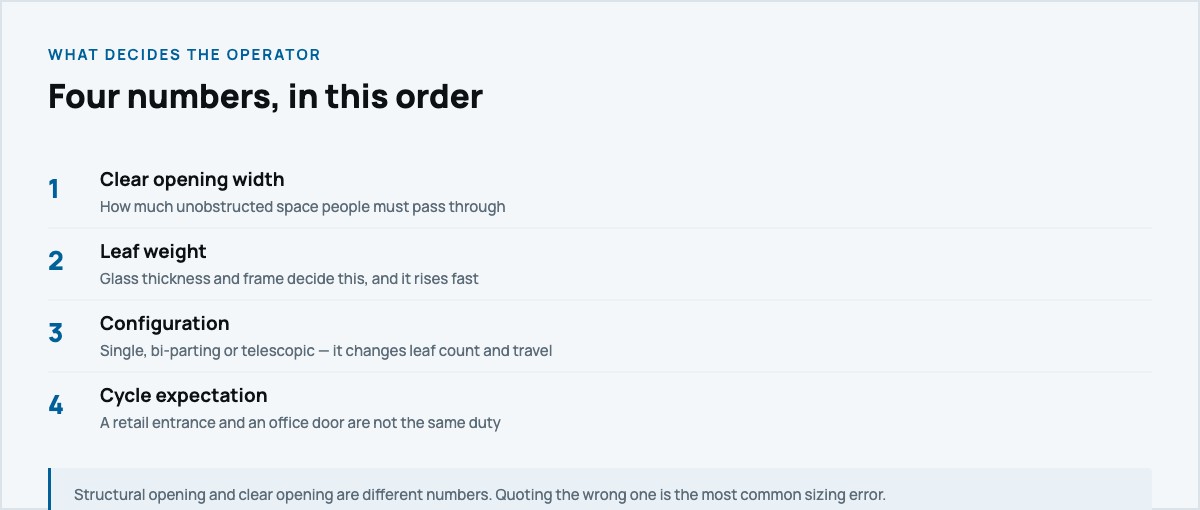
Choosing an automatic door operator is a sizing exercise, not a shopping decision. Four numbers decide it, and getting one of them wrong produces an entrance that works on the day and disappoints for years.
This is how we size an automatic door operator to an opening, what the two units in our range cover, and what an undersized drive actually does to a building.
The four numbers that size an automatic door operator
Clear opening width comes first, and it is where most enquiries go wrong. The structural opening in the wall and the clear opening people walk through are different measurements — the frame, the parked leaf and the tracks all take from it. Quote us the structural size and we will confirm the clear one; quote us a clear size that is actually structural and the entrance will be narrower than you expected.
Leaf weight rises faster than people expect. Glass thickness, lamination and frame section all add, and a modest increase in size can push a leaf into a different bracket entirely. This is the figure worth being precise about, because an automatic door operator is specified against it directly.
Configuration changes the arithmetic. A bi-parting entrance splits the travel between two leaves, so each moves half the distance in the same time. A telescopic configuration stacks two leaves per side, clearing more opening where there is no wall to park into.
Cycle expectation is the one that never appears on a drawing. A retail entrance and an office side door can be identical in size and completely different in duty, and duty is what determines whether the drive is comfortable or working at its limit every day.
Which automatic door operator our range covers
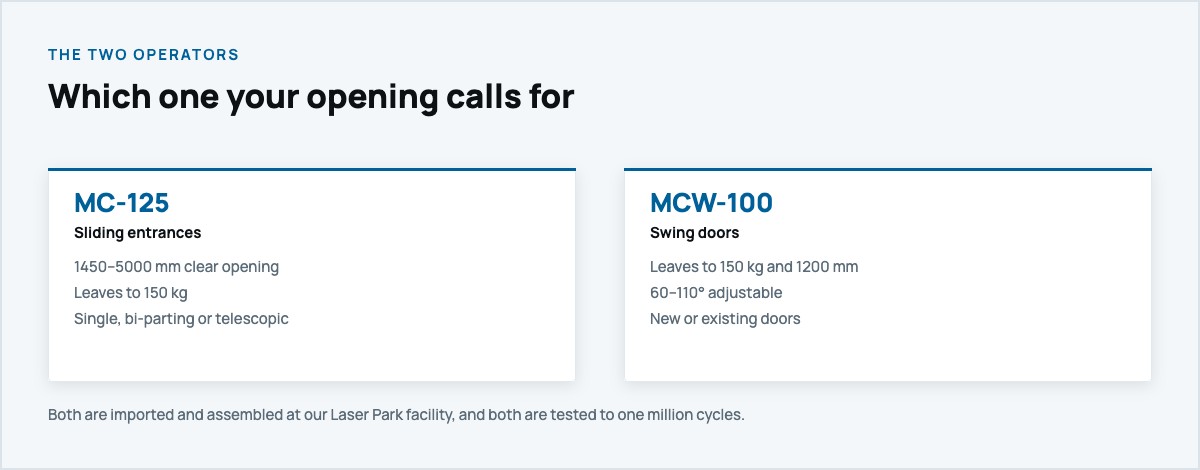
The MC-125 drives sliding entrances from 1450 mm to 5000 mm of clear opening with leaves to 150 kg, in single, bi-parting or telescopic configurations. The MCW-100 automates swing doors to 150 kg and 1200 mm wide, adjustable from 60 to 110 degrees, on new or existing leaves.
Both are imported and assembled at our Laser Park facility in Johannesburg, and both are tested to one million cycles. Assembling locally is also why spares sit on a shelf here rather than arriving weeks later, which matters more to a building than any specification on a data sheet.
What an undersized automatic door operator does
An undersized automatic door operator rarely announces itself. The entrance works at handover and then quietly costs you.
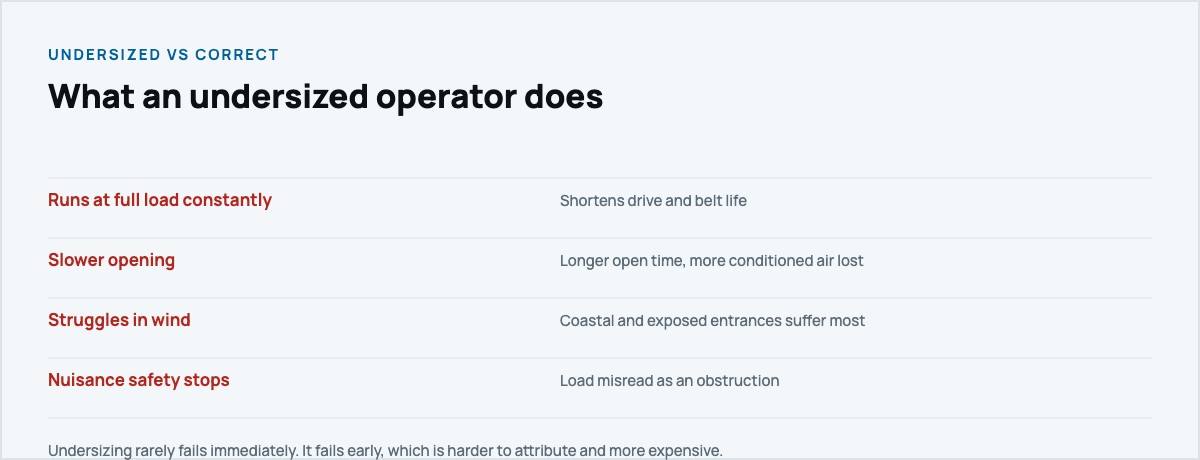
A drive running at full load on every cycle wears its belt and carriage faster than one with headroom. It opens more slowly, which means the door stands open longer and the building loses more conditioned air — a real cost in a large volume. On exposed or coastal entrances it struggles against wind pressure, and it can read that extra load as an obstruction and stop, which presents as a safety fault when it is really a sizing fault.
That last symptom is worth recognising, because it gets misdiagnosed constantly. A door that stops part-way for no visible reason is often assumed to be a sensor problem — see automatic door sensors — when the drive is simply at its limit.
What we need to size an automatic door operator
Send the structural opening size, a photograph of the opening as it stands, roughly how many people pass through and what the building does. That is enough to specify an automatic door operator properly, and it is the same information on our quote form.
If the entrance already exists and you are adding a drive to it, the checks are slightly different — see can an existing door be automated. Requirements for powered pedestrian doors in South Africa are published through SABS.
Measuring the opening before you specify an automatic door operator
Most sizing errors start with a tape measure rather than a specification sheet. Before an automatic door operator can be matched to an entrance, the opening has to be described in a way that does not change depending on who measured it.
Measure the structural opening at three heights — just above floor level, at mid-height, and immediately under the head — and record the smallest of the three figures. Openings are rarely square, and a reveal that is 30 mm tighter at the bottom than the top decides where the frame can sit. The same applies across the head: measure the height on both jambs and in the centre, because a sagging lintel shows up as a door that binds at one end of its travel and nowhere else.
Then record what the opening is made of. A masonry reveal, a steel portal and an existing aluminium shopfront each give a different fixing condition, and the fixing condition affects how much of the structural opening survives as clear opening. Shopfronts are supplied by Coetz Glazing and installed by us, so where an automatic door operator is going into new aluminium we can co-ordinate both sides of that job directly.
Finally, note the floor. A threshold that steps, ramps or changes material across the opening matters, because sliding leaves run to a fixed bottom clearance. A floor that falls 15 mm across a 3 m opening either gets levelled or the clearance gets set to the worst case, and a large clearance is how draughts and dust get in. None of this is exotic, but an automatic door operator specified without it has been specified against a drawing rather than a building.
Side room, headroom and the configuration they force
Two dimensions outside the opening decide the configuration, and the configuration decides which automatic door operator applies.
Side room is the clear wall either side of the opening that a leaf can park against. A single sliding leaf needs side room at least equal to the clear opening plus an overlap, so a 2 000 mm clear opening wants a little over 2 000 mm of uninterrupted wall to one side. Buildings very often do not have it — a return wall, a column or a second doorway lands in the way.
Bi-parting halves the problem. Two leaves each travel half the distance, so the same 2 000 mm clear opening needs only a little over 1 000 mm of side room per side, and it opens in half the time because each leaf covers half the travel. Where side room exists on only one side and is short, telescopic stacks two leaves per side, clearing more opening from less wall. All three configurations are driven by the same automatic door operator; what changes is the track, the carriages and the belt run.
Headroom is the depth available above the opening for the header that carries the drive, the track and the carriages. If the soffit sits close to the opening head, the header has to be recessed or the opening head lowered, and both are decisions worth making before anything is ordered rather than on installation day.
The fixing behind the header matters as much as the space in front of it. A header fixed to masonry, to a steel beam or to a suspended ceiling grid are three different jobs, and only two of them are acceptable. An automatic door operator transfers real load into whatever it is fixed to, on every cycle, for years.
Duty cycle: matching an automatic door operator to real traffic
Cycle expectation decides whether an entrance is comfortable or permanently working at its limit, and it is the number almost never supplied with an enquiry.
Counting it is straightforward. One person walking through is one cycle. Estimate the people through the entrance in a busy hour, multiply by the busy hours in a day, then by trading days in a year. A single retail entrance doing 600 people in a peak hour across ten trading hours is not unusual, and at six days a week that entrance is asking for well over a million cycles inside four years. An office side door with forty people through it twice a day is asking for a small fraction of that over the same period.
Both the MC-125 and the MCW-100 are tested to one million operating cycles. That figure is a test result — not a service life, and not a maintenance interval. It describes what the unit withstood under test conditions, and its use is comparison rather than prediction. What determines service life in a building is how close to its limit the automatic door operator runs day to day, and whether the entrance is maintained.
This is where duty and sizing meet. Two entrances with identical leaf weights can need different answers, because one cycling fifteen times a minute in summer heat is a different problem from one cycling fifteen times an hour. Where duty is high we would rather specify an automatic door operator with headroom and set its speeds down than specify to the limit and rely on the door being gentle with itself.
Wind, pressure and exposed entrances
Air pressure is the load nobody puts on a drawing, and it is the most common reason a correctly-sized entrance behaves badly.
A tall building with a single entrance at the bottom develops stack pressure: warm air rising through the core draws air in at ground level, and the leaves feel it as a steady push. A building with opposing entrances on two elevations can develop a through-draught that loads the leaves whenever both are open. Exposed sites, coastal sites and entrances at the end of a long approach add wind pressure on top of that.
Two things follow. First, the drive needs margin: an automatic door operator running at its limit in still air has nothing left when the wind is against it, and the usual symptom is a door that reverses or stops part-way and reports an obstruction that is not there. Second, a lobby fixes what a bigger motor cannot. Two sets of doors with a space between them break the pressure path, which is why entrances in tall or exposed buildings are so often specified as lobbies rather than single openings.
Where a lobby is not possible, the answer is usually a bi-parting configuration with conservative speeds and an automatic door operator specified above the static requirement — not a heavier leaf or a stiffer sensor setting.
Sensors, safety and what they add to the specification
An automatic door operator is only half of a compliant entrance. The safety devices around it are the other half, and they change the specification more often than the drive does.
Presence sensing in the door path stops a leaf closing on somebody standing still, which motion detection alone will not do — a person waiting in the opening stops being a moving target within a second or two. Activation sensing on the approach opens the door in time for somebody walking at pace. Safety beams or a monitored presence field protect the closing edge. On bi-parting entrances the meeting point needs covering; on telescopic configurations there are two moving edges per side to account for.
Wider openings and higher speeds both push this upward. A 5 000 mm bi-parting entrance running quickly for a busy retail floor needs more sensing than a 1 600 mm single slide on an office corridor, and the sensor package is a real part of what the entrance costs.
It is also why a door that stops part-way should never be assumed to be a sensor at fault. An automatic door operator at its load limit and a misaligned safety beam present almost identically, and the two are fixed in completely different ways.
What an automatic door operator costs, and what the warranty covers
Pricing follows the same four numbers. Entry pricing for the MCW-100 swing operator starts at R15 900 and for the MC-125 sliding operator at R27 590. The figure for a specific entrance depends on the clear opening, the leaf weight and configuration, the sensors and safety devices the setting requires, and what has to happen to the existing structure. We quote an automatic door operator against an opening we have measured rather than against a catalogue line.
The operator carries a 24-month warranty. That covers the operator itself; wearing parts, glass, and damage from impact or misuse sit outside it, as does an entrance that has not been maintained. We would rather set that out plainly at quotation than discover a difference of understanding at the point somebody needs a repair.
Installation is carried out by our own technicians, or technicians working under our instruction, nationwide, and we commission the entrance and demonstrate its operation before handover. Same-day call-outs are available in Gauteng. Where an existing entrance was installed by somebody else — including equipment from GEZE, dormakaba, ASSA ABLOY, record or TORMAX — we service it and can usually supply parts for it, and we report its condition before committing to a maintenance interval. We are independent of those manufacturers and are not an agent for any of them.
Specifying an automatic door operator well is unglamorous work: four numbers, a photograph, and an honest description of the traffic. It is also the difference between an entrance nobody thinks about and one that appears on the maintenance budget every year.
Automatic door operator sizing, answered
What size automatic door operator do I need?
It follows the clear opening width, the leaf weight, the configuration and the expected cycles. Send the opening size and a photograph and we will specify it.
What is the difference between structural and clear opening?
Structural is the hole in the wall. Clear is what people actually walk through once the frame, tracks and parked leaf are accounted for. They are never the same number.
How wide can a sliding entrance be?
From 1450 mm to 5000 mm of clear opening on the MC-125. Bi-parting clears more in the same travel because each leaf moves half the distance.
Can one operator drive very heavy glass?
Up to 150 kg per leaf on our range. Beyond that the answer is a different configuration rather than a bigger motor on the same setup.
Does an oversized operator cause problems?
Far fewer than an undersized one. Headroom in the drive generally means longer life and steadier speeds.
Why does my door stop halfway?
Often read as a sensor fault, but frequently a drive at its load limit reading the effort as an obstruction. Worth checking the sizing as well as the sensors.
Who carries out the installation?
Our own technicians, or technicians working under our instruction. We commission the entrance on completion and demonstrate its operation before handover.
Does the entrance work during load-shedding?
With a battery backup it keeps operating through a slot. Without one it parks in the fail-open or fail-secure state chosen for the building, and the manual release is demonstrated at handover.
Do you service other manufacturers equipment?
Yes. Where we take over an entrance somebody else installed, we report its condition before committing to a maintenance interval.
Getting it specified
An automatic door operator that is right for the opening is invisible for years. One that is marginal is a recurring line on your maintenance budget.
Request a quote, or see the full range of automatic door systems.
In short
Automatic door operator at a glance
- An automatic door operator is quoted against the opening we measured, not a catalogue price.

This Post Has One Comment
Comments are closed.
[…] duty headroom, not the minimum. An operator sized exactly at the expected traffic has no margin for a busier year, a new tenant, or a change of […]