
Office park automatic doors for landlords and managing agents: who owns which entrance, the access states a working week needs, the morning peak that sizes the lobby, standardising across an estate, and why maintenance recovery changes the contract.
Automatic Door Closer vs Door Operator
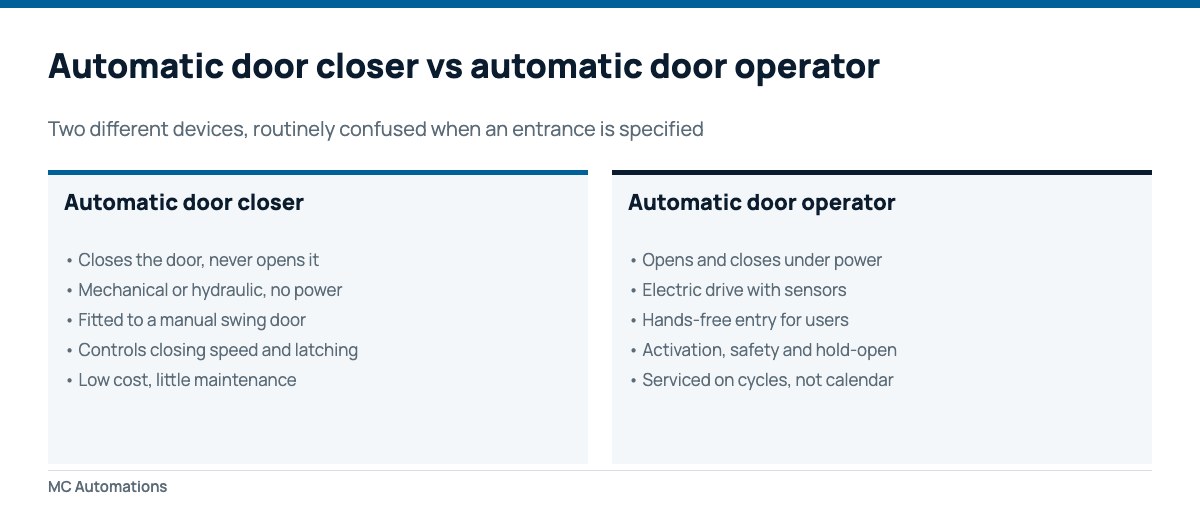
An automatic door closer and an automatic door operator are not the same device, and the difference decides your budget. A closer controls how a door shuts after somebody has pushed it. An operator opens the door under power so nobody has to push at all. Both get called “automatic” in enquiries, and specifying the wrong one is the most common mistake we see on a drawing.
One scope note before anything else, because it saves a wasted enquiry: we do not supply, fit or service door closers. A closer is builders’ hardware and comes from a hardware supplier. What we do is the powered side — automatic door operators, supplied, installed, commissioned and serviced. This page exists because the two get confused constantly, and because knowing which one your opening needs is worth more than a quotation for the wrong device.
What an automatic door closer actually does
An automatic door closer is a mechanical or hydraulic arm fitted to a manual swing door. It stores energy when the door is pushed open and releases it in a controlled way so the leaf returns to the frame and latches. There is no motor, no sensor and no electrical supply. Closing speed, latching action and back-check are set with adjustment valves on the body.
Because it has no power, a closer works during an outage, which matters in South Africa. It also fails quietly: a worn unit still closes the door, just badly, so nobody reports it until the leaf slams or stops latching.
What a powered operator does instead
An operator drives the leaf. A radar or push pad tells it somebody is approaching, the drive opens the door, a hold-open timer keeps it open, and safety sensors stop it closing on anyone still in the opening. Our MCW-100 swing door operator does this on a new or existing leaf; the MC-125 does it on sliding entrances.
That capability is the reason for the cost difference. You are buying a drive, a control board, activation, safety devices and a commissioning visit, not a spring in a box.
Which one your door needs
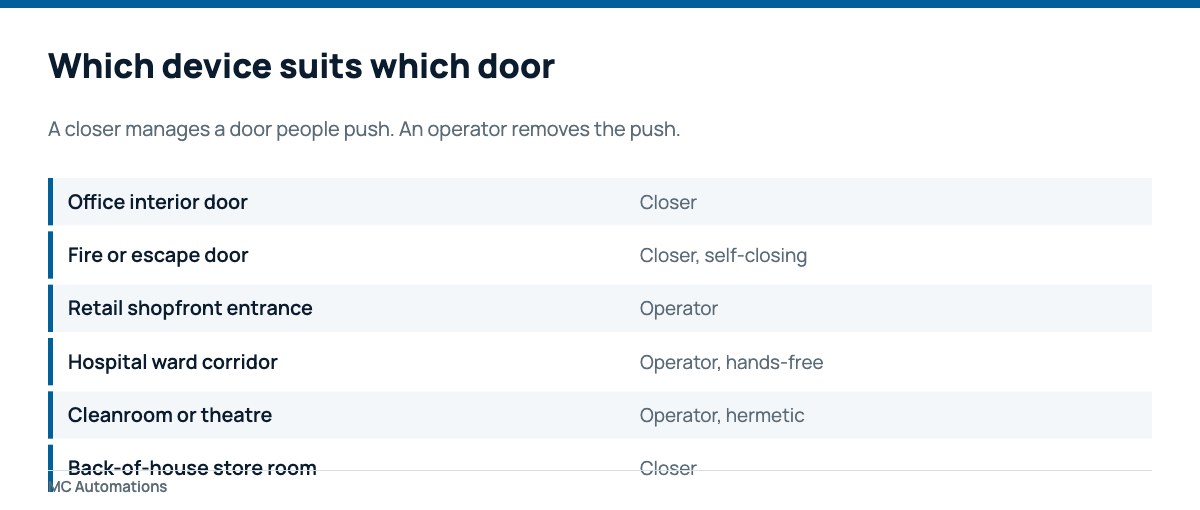
The test is not the door. It is the person using it. If arrivals have hands full, push a trolley, use a wheelchair or must not touch the door for hygiene reasons, an automatic door closer cannot help them — it only controls the return stroke. That is an operator job.
If the door is an internal office door, a store room or a fire door that simply has to be shut reliably, a closer is the correct and far cheaper answer.
Where the confusion costs money
Two expensive patterns recur. The first is an operator specified on a low-traffic internal door, where a closer would have done the same job for a fraction of the price and without a service commitment. The second is a closer fitted to a main entrance that genuinely needed hands-free access, which then gets propped open permanently — defeating both the closer and the building’s fire strategy.
Requirements for powered pedestrian doors in South Africa are published through SABS, and closing behaviour on an escape route is governed. Confirm which applies to your opening before hardware is ordered.
What an automatic door closer costs to own
A closer is bought once and adjusted occasionally. There is no control board to fail, no sensor to align and no battery to replace. When it wears out it is swapped, usually in under an hour, and the door keeps working in the meantime because the leaf still shuts — badly, but it shuts.
A powered operator carries a different cost profile. The hardware is higher, installation involves electrical supply and commissioning, and it needs servicing against cycles rather than the calendar. In exchange you get an entrance that works for people who cannot pull a door, and one that can be locked, held open or released from a control system.
Neither is expensive in the wrong place. A closer on a main retail entrance is cheap hardware that costs you customers. An operator on a store-room door is money spent on capability nobody uses.
How to tell which one is already fitted
Look above the door. A closer is a compact body with a single jointed arm, mounted on the leaf or the frame, and it never moves on its own. An operator is a longer housing spanning the head of the opening, usually with a removable cover, and the door moves without anyone touching it.
If the door opens when you approach and there is a small dark panel above it, that panel is an activation sensor and the unit is an operator. If you have to push and the door then closes itself smoothly, it is a closer. On a sliding entrance it is always an operator — a sliding leaf cannot be returned by a spring arm.
Knowing which you have matters when something fails. A door that will not open is an operator fault. A door that opens fine but slams, sticks or will not latch is almost always a closer adjustment, and that is a far smaller job.
Retrofitting from one to the other
Going from a closer to a powered operator is common, particularly in healthcare and in buildings that have had an accessibility review. The leaf usually stays. What changes is the header fixing, the electrical supply and the addition of activation and safety devices.
Three things decide whether it is straightforward: the weight and width of the existing leaf, whether the header can take a surface-mounted operator across the full span, and whether power is available at the head of the door. If power has to be brought in, an electrician does that, and it is not part of the hardware price.
How an automatic door closer is sized
Closers are graded by the size and weight of the leaf they control. A unit that is too small will not pull a heavy door shut against a latch or a seal; one that is too large slams it, wears the frame and makes the door hard for children and elderly visitors to open. Both failures get reported as a broken automatic door closer when the unit is working exactly as specified.
Width matters as much as weight, because a wide leaf gives the door more leverage against the arm. A door in a windy lobby or a pressurised corridor is effectively heavier again, since the closer has to work against air movement every cycle. Those conditions are worth mentioning when a unit is specified rather than discovering them afterwards.
Adjustment is not the same as sizing. Most bodies offer separate control over the main closing sweep, the final latching action and, on better units, a back-check that stops the door being flung open into a wall. Those valves tune a correctly sized automatic door closer; they cannot rescue the wrong one.
Where a closer and an operator work together
The two devices are not always alternatives. On a pair of doors it is common to automate the leaf people use and fit a closer to the second leaf that only opens for deliveries. The entrance behaves as an automatic door day to day, and the wide opening is still available when a bed, a pallet or a piece of furniture has to pass.
Fire compartment lines are another case. A powered door on a compartment line may still need defined closing behaviour when an alarm sounds, and the release arrangement is part of the building strategy rather than a hardware preference. An automatic door closer on the adjacent leaf has to match that behaviour rather than contradict it.
What goes wrong, and what it means
A door that slams has usually lost its latching adjustment, or the unit has aged and the internal fluid no longer damps as it did. A door that stops short of the frame is often a closer that is undersized for a seal that has stiffened with age. A door that drifts shut slowly and never latches is the same fault seen from the other side.
A door that has become heavy to open is more interesting, because it is frequently not the automatic door closer at all. Hinges settle, frames move and floor coverings get replaced at a greater thickness, and any of those adds drag the closer then has to fight. Replacing the unit in that situation buys a few months at most.
Leaking fluid is terminal. Once a hydraulic body weeps there is no adjustment that restores control, and the unit is replaced rather than serviced. It is a small job and rarely worth deferring, because the door in the meantime is either slamming or not securing.
Accessibility and who the door excludes
A correctly adjusted automatic door closer still requires somebody to pull or push the leaf. That is the whole question when a building reviews accessibility, because the people most affected are the ones least able to report it: wheelchair users, people carrying a child, staff pushing a trolley and anyone with limited grip strength.
This is where the cheaper device stops being cheaper. A closer that meets the specification on paper and excludes a proportion of visitors in practice is a false economy, and it is usually discovered through complaints rather than inspection.
Requirements for powered pedestrian doors in South Africa are published through SABS. Where an opening is on an escape route or serves a public building, we will tell you which requirements apply and what documentation we can provide.
Budgeting for an entrance over ten years
Compare the two devices over the life of the entrance rather than at purchase. An automatic door closer is bought, adjusted occasionally and replaced perhaps twice in a decade on a busy internal door. There is no service contract, no sensor to align and no battery to renew.
An operator carries hardware, installation, commissioning and a service interval driven by cycles. In exchange it removes the push entirely, integrates with access control, can be locked or held open centrally, and keeps working through an outage if a battery backup is fitted.
Neither number is meaningful on its own. The question is what the opening has to do. An automatic door closer on a store room is correct and inexpensive; the same automatic door closer on a hospital corridor is a barrier that somebody will eventually prop open, defeating both the device and the fire strategy at once.
Specifying for a mixed estate
Most buildings end up with both. A practical estate list records, for every door, whether it carries an automatic door closer or a powered operator, what it serves, whether it sits on an escape route and when it was last adjusted or tested.
That single list changes how a building is maintained. Closers can be walked and adjusted in a batch at low cost, while operators are attended on an interval set by traffic. Without it, both get attended only when somebody complains, which is the most expensive pattern available.
We service powered operators, on our own equipment and on other manufacturers’. Closers we do not touch: they are builders’ hardware, so a mixed estate keeps its hardware contractor for the doors that push and uses us for the doors that drive.
Automatic door closer, answered
Is an automatic door closer the same as an automatic door?
No. A closer only shuts the door. An automatic door opens under power. The words overlap in everyday use, which is exactly why quotations get compared that should not be.
Can an automatic door closer be added to any door?
Most swing doors, yes, provided the leaf and frame can take the fixing. Weight, width and whether the door is on an escape route all affect which unit suits.
Does a closer need power?
No, and that is its advantage during an outage. A powered operator needs supply at the head of the door, and a battery backup if it must keep working through load shedding.
Why does my door slam?
Usually the closing speed or latching valve has drifted, or the unit is worn. It is an adjustment or a replacement, not a rebuild of the door.
Can you convert a closer to an operator later?
Often yes. Automating an existing leaf is routine work, subject to the leaf weight, the header and power. See automating an existing door.
Who maintains them?
We service powered operators, on our own equipment and other brands. We do not supply, fit or service door closers — those are builders’ hardware, maintained by whoever looks after the building’s ironmongery. Intervals for powered doors are set by cycles, not the calendar — see automatic door servicing.
Getting it specified correctly
Send the opening width and height, a photograph of what sits above the door, the traffic it carries at its busiest hour and whether the door is on an escape route. That is enough for us to say whether you need an automatic door closer or a powered operator, and to price an operator where that is what the opening needs. Request a quote and we will tell you which, rather than quoting the more expensive option by default. Where the honest answer is a closer we will say so and you order it from a hardware supplier, because we do not sell them.
Automatic door closer checklist before you order
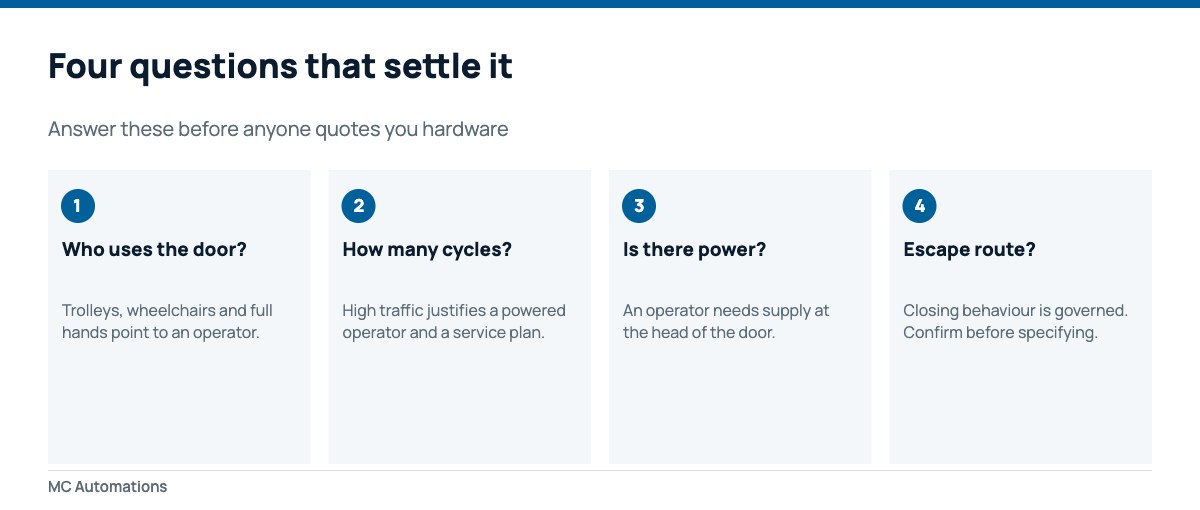
Run through these before an automatic door closer or an operator is priced. Each one changes the answer.
- Leaf weight and width. An automatic door closer is sized to the leaf. Oversize it and the door slams; undersize it and it will not latch.
- Escape route or fire door. Closing behaviour is governed. An automatic door closer on an escape route has to hold its function, so confirm the requirement first.
- Who walks through. Trolleys, wheelchairs and full hands mean no automatic door closer will solve the problem. That is operator territory.
- Power at the head. An automatic door closer needs none. An operator does, and bringing supply in is an electrician cost outside the hardware price.
- Cycle count. A busy entrance wears an automatic door closer quickly. High cycles argue for a powered operator on a service plan.
- Who maintains it. We service powered operators, on our equipment and on other brands. Closers are hardware maintenance and not ours.
Send those six answers with a photograph and we will tell you whether an automatic door closer is genuinely enough, or whether the opening needs an operator.
In short
Automatic door closer at a glance
- We do not supply, fit or service an automatic door closer. It is builders’ hardware, bought from a hardware supplier.
- A closer only controls how a door shuts. An operator opens it under power. Different problems, different products.
- Full hands, a trolley or a wheelchair means no automatic door closer will solve it. That is operator territory.
- We do automate an existing door that has a closer on it, and the closer normally comes off.
- Automatic door operators are quoted against the opening we measured, then installed and commissioned by our own technicians.
