
Office park automatic doors for landlords and managing agents: who owns which entrance, the access states a working week needs, the morning peak that sizes the lobby, standardising across an estate, and why maintenance recovery changes the contract.
Automatic Door Not Closing: Causes and Fixes
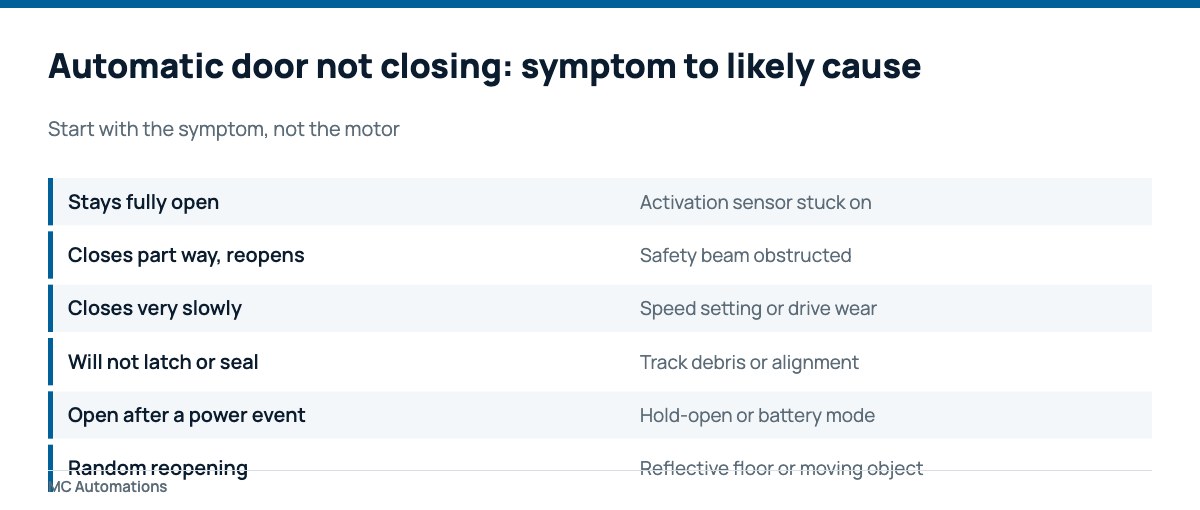
An automatic door not closing is rarely a failed motor. In most call-outs the drive works perfectly and something is telling the door to stay open — a sensor seeing an object, a track holding the leaf, or a mode switch left on after a delivery. Knowing which costs nothing to check and often saves a call-out.
Why an automatic door not closing is usually a sensor
Every powered entrance has two sensor jobs. One tells the door somebody is coming; the other stops it closing on a person still in the opening. An automatic door not closing almost always means one of those two is reporting something.
Activation sensors watch a field in front of the door. Put a display stand, a delivery pallet or an A-frame sign inside that field and the door reads it as a person who never leaves. Safety sensors watch the closing line, and dirt, a web or a knocked bracket produces the same result.
This is why an automatic door not closing often begins after a shop reset or a delivery day rather than after a fault.
The track, the leaf and the weather
On a sliding entrance, grit in the track is the second most common cause. The leaf travels most of the way, meets resistance near the jamb, and the controller backs it off rather than forcing it. That is correct behaviour, but to staff it reads as an automatic door not closing.
Wind matters too. A strong gust against a leaf can load the drive enough for the controller to stop and retry. If the problem only appears in certain weather, that is a clue worth reporting when you log the call.
Settings that look like a fault
Most operators have a mode switch: automatic, partial open, exit only, hold open and locked. Hold open catches people out. Staff set it for a delivery, nobody sets it back, and the next morning it is logged as an automatic door not closing.
Hold-open timers are separate. A long timer is not a fault, it is a preference somebody chose. A door standing open for ten seconds after the last person walks through is a timer, not a failure.
What you should never adjust
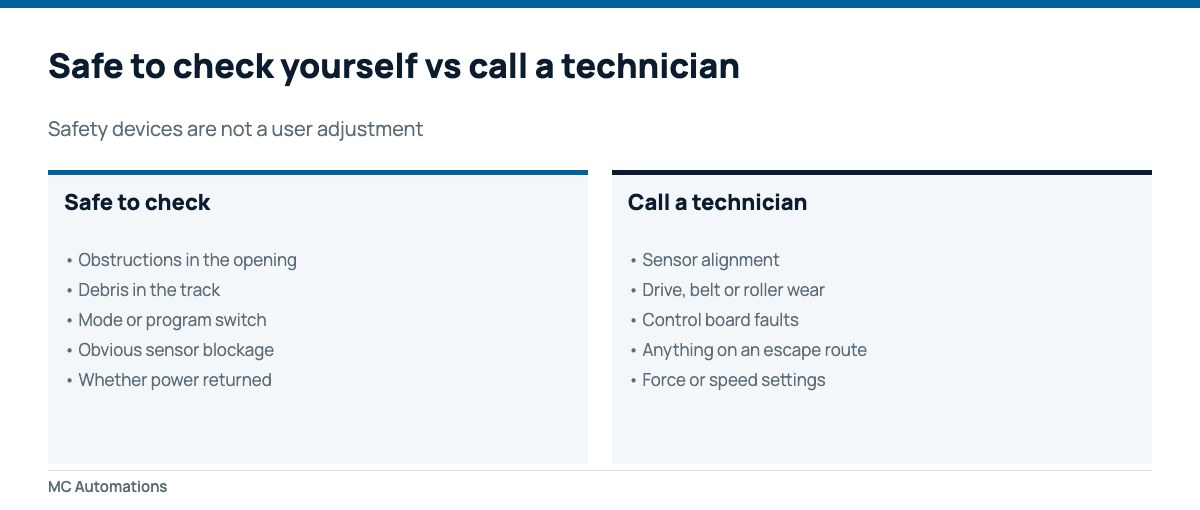
Force, speed and safety sensor alignment are not user settings. They are what stop a door injuring somebody, and on an escape route the closing behaviour is governed. Requirements for powered pedestrian doors in South Africa are published through SABS.
If an automatic door not closing turns out to be a safety device doing its job, the answer is to test and reset it properly, not to reduce its sensitivity until the door closes again. That is how a nuisance becomes an incident.
When it is genuinely mechanical
Sometimes it is the hardware. Worn rollers, a stretched belt, a failing floor guide or a drive that has lost torque all present as an automatic door not closing, or closing badly. These need parts, and we hold spares for our own operators in Johannesburg — see automatic door spare parts.
We service other manufacturers’ equipment as well as our own, so a mixed estate does not need three contractors. Automatic door repairs covers what a breakdown visit includes.
Reading the pattern before you call
The single most useful thing a facilities team can record is when the fault happens. An automatic door not closing every time is a different problem from one that fails twice a day, and the second is far harder to diagnose on a single visit if nobody wrote down the pattern.
Constant faults are usually physical: an obstruction, a track, a failed device. Intermittent faults are usually environmental. Sunlight moving across a sensor field through the afternoon, a delivery bay door opening and changing air pressure, or an extractor fan starting on a timer will all produce an automatic door not closing at the same time each day.
Weather-linked faults are their own category. Rain on a sensor face scatters infrared, wind loads a leaf, and a wet floor reflects a beam that a dry floor does not. If a door misbehaves only in bad weather, that is diagnostic information rather than a nuisance.
What the controller is actually doing
Modern operators do not force a leaf. When the drive meets more resistance than expected it stops, reverses slightly and retries, and after a set number of attempts it holds the door open and waits. To staff that reads as an automatic door not closing; to the controller it is a safety routine completing correctly.
This matters because the instinct is to increase force until the door closes. That converts a controlled machine into an uncontrolled one, and it removes the only warning you were going to get that something mechanical is failing. The resistance was information.
Some controllers log these events. Where they do, a technician can read how long the fault has been developing, which is usually longer than anyone realised.
Security and what to do overnight
An automatic door not closing at the end of trade is a security problem before it is a maintenance one. The first question is whether the opening can be physically secured by other means: a shutter, a secondary door, or a guard.
Where it cannot, say so when you log the call, because it changes the priority. A door that will not close in a warehouse at midday is a Monday job. The same fault on a shopfront at closing time is not.
Avoid the temptation to disable the operator and manually push the leaf shut unless you know the door is designed to be moved that way. Some units are damaged by being forced, and on an escape route the manual behaviour is part of the fire strategy rather than a convenience.
Why it often starts after something else changed
An automatic door not closing rarely begins on its own. Something changed: a new floor finish that reflects, a repositioned display, a delivery that knocked a bracket, a cleaning contractor using a different product on the sensor faces, or a shopfit that moved the till queue into the detection field.
When we ask what changed recently, the answer is often treated as irrelevant because it was not about the door. It usually is about the door. A polished floor installed in June explains a door that started misbehaving in June far better than coincidence does.
Escape routes change the urgency
On an escape route the door has defined behaviour under alarm and under power loss, and an automatic door not closing may mean a compartment line is no longer being held. That is a different order of problem from an inconvenient entrance.
Requirements for powered pedestrian doors in South Africa are published through SABS, and safety devices are tested against the requirement stated for the building. If the affected door is on an escape route, say so when you report it.
What a technician will do on arrival
A competent visit starts by watching the door rather than opening the housing. The technician triggers the activation sensor, observes a full cycle, obstructs the closing line deliberately to confirm the safety device responds, and checks the track and guides by hand.
Only then does the cover come off. Belt tension, roller condition, floor guide wear and the control board are inspected, the settings are read rather than assumed, and the findings are written down so the next visit has a baseline.
If the cause of an automatic door not closing turns out to be a worn part, the question becomes availability. We hold common wear items for our own operators in Johannesburg and fit parts for other manufacturers’ equipment, which is usually the difference between a same-visit fix and a week of propping the door open.
Preventing it rather than fixing it
Most causes of an automatic door not closing are preventable by housekeeping rather than engineering. A monthly walk that clears the opening, sweeps the track and wipes the sensor faces removes the majority of nuisance call-outs before anyone notices them.
The second prevention is discipline about the mode switch. If staff need the door held open for deliveries, agree who sets it and who sets it back, and write it on the door. An automatic door not closing because somebody forgot is the cheapest fault to eliminate and the most frequently repeated.
The third is shopfitting awareness. Every time a display is moved, a sign is added or a floor is refinished near the entrance, somebody should watch one full door cycle afterwards. Thirty seconds then saves a call-out later.
What to include when you log the call
A useful report shortens the visit and often changes what the technician brings. Say which door, what the symptom is in plain terms, whether it is constant or intermittent, what time of day it happens, what you have already checked, and whether the building can be secured.
Add anything that changed recently, even if it seems unrelated. New flooring, a shopfit, a delivery that clipped the frame or a cleaning contract change have all turned out to be the cause of an automatic door not closing.
Finally, say whether the door is on an escape route. That single sentence changes both the urgency and what has to be tested before the door is signed off as working.
Cost of leaving it
An automatic door not closing is rarely just an inconvenience. In an air-conditioned building it is a measurable energy loss every hour it stands open, and in a retail environment it is a security exposure for as long as the shop is unattended.
There is a slower cost as well. A door held open by a fault is a door whose safety devices are not being exercised, so the next problem is discovered later than it should be. Deferring an automatic door not closing tends to widen the eventual repair rather than postpone it.
Dust and weather are the third factor. A leaf parked open lets grit into a track that was designed to be swept occasionally, not filled continuously, and that accelerates the wear that caused the fault in the first place.
Automatic door not closing, answered
Why is my automatic door not closing all the way?
Usually something in the closing line, or grit in the track. The controller stops rather than forcing the leaf, which is the safe response.
Can I switch it off overnight?
You can, but if the door is on an escape route its closing and release behaviour is part of the building strategy. Check before making it a habit.
Does load shedding cause this?
It can. Some operators return to a default or hold-open state after power is restored. See automatic doors and load shedding.
The sensor light is on constantly. What does that mean?
Generally that it is detecting something. Clear the field, then look for dirt, a knocked bracket or a reflective surface.
Is this an emergency?
If the building cannot be secured, yes. Say so when you log it, because it changes the response.
Do you repair brands you did not install?
Yes. We service all major automatic door brands alongside our own.
Automatic door not closing checklist
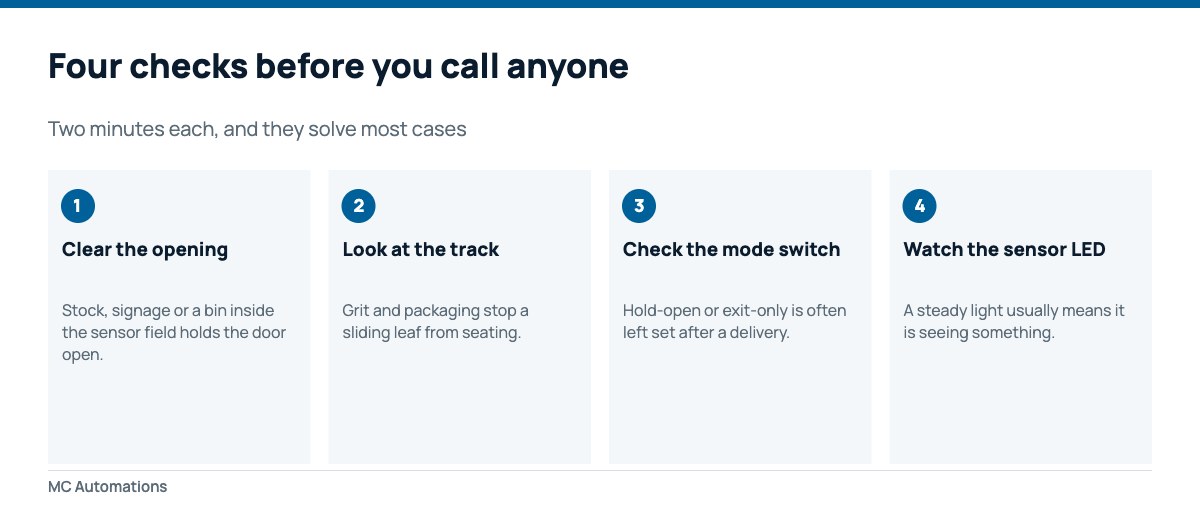
Work through these before logging a call. Each is free, and each rules out a common cause of an automatic door not closing.
- Clear the opening. Stock, bins and signage in the sensor field are the most common cause of an automatic door not closing.
- Sweep the track. Grit stops the leaf seating, which the controller reads as resistance.
- Check the mode switch. Hold open and exit only both look like an automatic door not closing to staff.
- Look at the sensor faces. Dirt, webs and stickers all produce a false detection.
- Note weather and timing. If it only happens in wind or after an outage, say so when reporting.
- Do not touch force or safety settings. Those are set for safety and, on escape routes, governed.
If an automatic door not closing survives all six checks, it is a service call rather than a setting. Tell us the building, the door and what you have tried — automatic door servicing explains what a visit covers, or request a quote.
Automatic door not closing: quick answers
- An automatic door not closing at all is usually a held activation signal. Check the hold-open switch, then the presence sensor: a beam latched by a display stand or a trolley bay holds the leaf open indefinitely.
- An automatic door not closing fully points at the floor guide or the track. Grit, a bent guide block or a belt stretched past its adjustment range all leave a gap at the jamb.
- An automatic door not closing at the right speed is a controller setting, not a fault. Closing speed and latch check drift after a power event and are reset on site in minutes.
- An automatic door not closing is a safety problem on a fire escape route or a secured entrance. Isolate the operator and secure the opening manually until it has been repaired.
- Most cases of an automatic door not closing are fixed on the first visit because we hold belts, rollers, guides, sensors and controllers locally rather than importing them per job.
Still stuck? Send the opening size and a photograph to MC Automations and we will tell you what we would do.
