
Office park automatic doors for landlords and managing agents: who owns which entrance, the access states a working week needs, the morning peak that sizes the lobby, standardising across an estate, and why maintenance recovery changes the contract.
Door Automation Explained: Types, Safety and Cost Drivers
Door automation is the difference between a doorway people have to handle and one that simply lets them through. On a busy entrance it removes a bottleneck; in a clinic it removes a contact point; in a cold store it removes the time the door spends open. This guide covers what door automation involves on a commercial building in South Africa, which doors suit it, and what decides the price.
What door automation means here
We use the term for pedestrian entrances: sliding, swing, telescopic, revolving and hermetic doors that people walk through. In South African search results the phrase is often mixed up with driveway gates and garage doors. Those are a different trade with different equipment and different safety rules, and we do not do them. Everything below is about the doors in and around a building that people use on foot.
The operator is the part most people picture, but it is the sensor arrangement and the commissioning that decide whether the entrance is pleasant or irritating to use. A well-specified system disappears into the building; a poorly set one gets propped open within a month.
Which doors suit automation
Almost any sound pedestrian door can be automated, but each type solves a different problem.
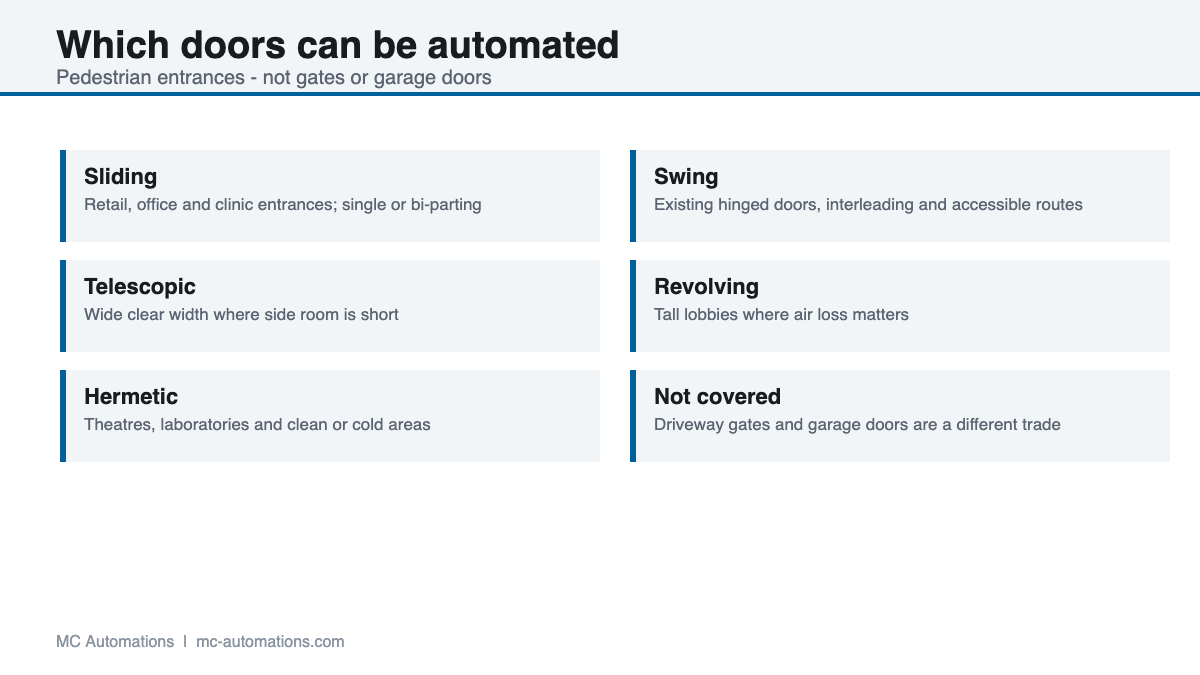
Sliding entrances handle the bulk of retail, office and clinic traffic. Swing operators are the usual answer for door automation on an existing hinged leaf, which makes them the retrofit choice and the accessibility choice. Telescopic leaves buy clear width where there is little side room. Revolving entrances keep conditioned air in a tall lobby. Hermetic doors seal as they close, which is why they appear in theatres, laboratories and cold-side openings.
If the leaf itself is failing, automation is the wrong first spend. A door that drags, binds or has tired hinges will fight the operator, and the operator will win for a while and then fail. We say so at survey rather than afterwards.
How the right system is chosen
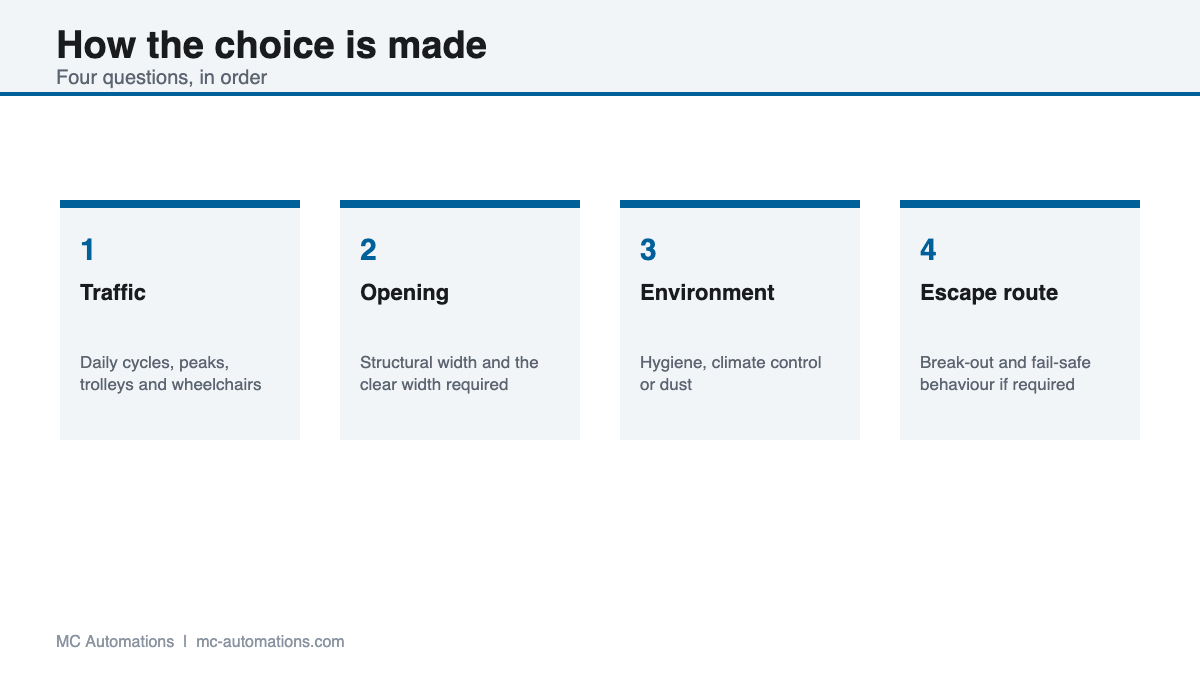
Four questions settle most specifications, and they are asked in this order: what traffic does the opening carry, what clear width does the building actually need, what is the environment doing, and is this an escape route? Door automation on a fire escape route is governed by break-out and fail-safe behaviour, not by preference, so that answer changes the hardware before anything else is priced.
Traffic is the one most often guessed. A shopping centre entrance can pass more cycles in a month than an office door does in a year, and that difference decides the operator size, the service interval and eventually the lifespan of the drive. Counting people for an hour at the busiest time is worth more than an estimate.
Safety is the part people underestimate
An automated leaf moves through space that people stand in, so the safety arrangement is not an accessory. Activation sensors see somebody approaching. Presence sensors see somebody who has stopped in the opening: a child looking at something, a wheelchair being turned, a trolley half through. Both are needed, and on every quotation we list them individually instead of hiding them inside a package price.
Force, speed and sensor coverage are set on site during commissioning, against the relevant South African standards published by the SABS. Obstruction behaviour is tested with an object rather than read off a controller screen. If you have an existing automated entrance and nobody has tested that since it was installed, it is worth booking a service visit to confirm it still reverses as it should.
What door automation costs depend on

There is no single price, and any supplier quoting one without measuring is guessing. Leaf weight and width come first, because they decide the operator. Leaf count comes next, then the sensor arrangement, then anything to do with power backup and locking, then the state of the site itself. Our cost guide works through those drivers in detail.
Two things are worth budgeting for that buyers often leave out. The first is making good around the opening once the old frame is removed. The second is the service interval, which is an operating cost rather than a capital one and is what keeps the entrance out of the repair cycle.
Retrofit or new entrance
Retrofitting door automation to an existing doorway keeps the structural opening, often the frame, and sometimes the leaves. It is the cheaper and faster route where the structure is sound. A new entrance gives free choice of clear width and system, and it is the honest answer when the header cannot carry an operator, the opening is out of square or the leaves are past saving.
There is a third case: an entrance that is already automated but running on an obsolete controller. That is modernisation, where the header stays and the working parts are renewed. It is usually better value than replacement, and we will tell you when that is what you are looking at. Our post on automating an existing door covers the retrofit decision in more depth, and the sliding door automation kit article explains what is inside the header.
Living with an automated entrance
Door automation is not fit-and-forget. Belts stretch, rollers wear, floor guides fill with grit and sensors drift out of aim. None of that is dramatic, and all of it is cheap to correct on a planned visit and expensive to correct after a failure on a Saturday morning. Service intervals should follow the cycle count rather than the calendar.
Power interruptions deserve a decision rather than a shrug. Battery backup, fail-safe or fail-secure behaviour and manual release are specified before the order, because each one changes what is fitted inside the header. Staff should be shown the manual release on handover, and shown it again when the people who were there at handover have moved on.
Door automation by sector
The same equipment is specified differently depending on what the building does, and the differences are worth knowing before you compare quotations.
Retail. Footfall is uneven: long quiet periods and sharp peaks at opening, lunchtime and close. Door automation here is sized for the peak, not the average, and the hold-open time is set so a queue does not trigger repeated cycling. Trolleys and prams make presence sensing across the threshold essential rather than optional.
Healthcare. Hands-free entry is the point. Clinics and hospitals also need entrances that behave predictably for people moving slowly, on crutches or in wheelchairs, which usually means slower closing speeds and longer hold-open times than a retail entrance would use. Where infection control matters, hermetic doors seal as they close.
Cold storage and food. Every second the opening stands open costs energy and risks condensation. Door automation is specified for fast, reliable cycling with seals that suit washdown, and the control arrangement usually ties into the building rather than standing alone.
Offices and reception. Access control drives the specification more than traffic does. Readers, interlocks and free-exit devices are integrated at the header, and the entrance must still release correctly in an emergency.
Education and public buildings. These entrances take rough use and heavy traffic in short bursts. Robust hardware and a realistic service interval matter more than a refined specification, and the manual release has to be something any staff member can operate.
Airports and transport. Traffic arrives in waves set by arrivals and departures rather than spread across the day, so door automation here is specified for the surge rather than the daily average. Luggage and trolleys mean the presence field matters more than on a retail doorway, and landside areas mixing public access with controlled zones bring access control into the specification from the start. Pedestrian entrances only, as everywhere.
Common mistakes when buying door automation
Four mistakes account for most of the door automation we are called out to fix, and none of them are the equipment’s fault.
- Buying on the total only. Two quotations for the same doorway can differ by a third because one has specified presence sensing and an operator matched to the leaf, and the other has not.
- Treating the survey as a formality. The measurements are what protect you when the opening turns out to be out of square; door automation priced from a photograph gets corrected on site, usually at your cost.
- Ignoring the escape route question. If the entrance sits on one, the answer changes the hardware. Retrofitting break-out behaviour afterwards is far more expensive than specifying it up front.
- Skipping servicing to save money. A planned visit costs a fraction of an emergency call-out, and almost every failure we attend was visible as wear months earlier.
There is a fifth worth adding: choosing a supplier who does not service what they sell. Door automation is a long-lived installation, and the value of the relationship shows up in year three, not in the week the quotation arrives.
Quick answers
- What it covers: pedestrian sliding, swing, telescopic, revolving and hermetic entrances.
- What it does not cover: driveway gates and garage doors, which are a separate trade.
- Retrofit: most sound hinged or sliding doorways can be automated without rebuilding the opening.
- Safety: activation plus presence sensing, tested with an object at commissioning.
- Escape routes: break-out or fail-safe behaviour is decided before the order.
- Price drivers: leaf weight and width first, then leaf count, sensors, backup and site condition.
- Lead time: quoted separately from the site work so trading sites can plan.
- Warranty: 24 months on the operator; wear parts quoted separately.
- Servicing: interval set from real cycle counts, not a fixed calendar.
- Other suppliers’ doors: we service them, starting with a condition survey.
- Coverage: installed and serviced across South Africa from Johannesburg.
- Where to start: opening size, a photograph and an idea of daily traffic.
A short glossary
Quotations use these terms as though everyone knows them, so here they are in plain language.
- Operator. The drive unit that moves the leaf. In door automation it is the component that dictates what weight and width the entrance can carry.
- Leaf. The moving panel itself, whether glass, aluminium or timber.
- Clear passage width. The gap people actually walk through when the door is fully open, which is always less than the structural opening.
- Activation sensor. Detects approach and starts the cycle.
- Presence sensor. Detects somebody stationary in the opening and holds the door.
- Hold-open time. How long the entrance stays open after the last detection.
- Break-out. The ability to push the leaves open by hand in an emergency, required on many escape routes.
- Fail-safe and fail-secure. Whether the entrance unlocks or stays locked when power is lost.
- Commissioning. Setting speed, force and sensor coverage on site, then recording it.
If a door automation quotation uses none of these terms, it has not been written from a survey. If it uses all of them, you can compare it line by line with anybody else’s.
Frequently asked questions
Does door automation work on an existing door?
Usually, yes. A swing operator can be fitted to a sound hinged leaf in a frame that can carry it. Where the hinges, leaf or frame are tired, we say so before quoting rather than automating a door that is already failing.
Do you automate gates or garage doors?
No. We work on pedestrian entrances only. Gate and garage automation uses different equipment and different safety requirements, and it is better handled by a specialist in that field.
What happens in a power failure?
Whatever was specified: battery backup, fail-safe or fail-secure operation, and manual release. It is a design decision taken before the order, not something added later.
Is door automation worth it on a low-traffic door?
Sometimes. Accessibility, hygiene and climate control justify it even at low cycle counts. Pure convenience on a door nobody struggles with rarely does, and we will say so.
How often should an automated entrance be serviced?
On an interval set from its real cycle count. A centre entrance needs attention far more often than an office door, and setting both to the same schedule wastes money on one and risks failure on the other.
Can you take over a door another company installed?
Yes. The first visit doubles as a condition survey: we record the operator, sensor layout and track condition, then tell you what is serviceable, what is obsolete and what should be replaced before it fails.
Load shedding and the automated entrance
Scheduled outages change the brief for door automation in South Africa, because the interruption is not a rare fault but a routine part of the week. An entrance that behaves well during a single blackout can behave badly when the power drops twice a day, every day, for months.
Three questions settle it, and all three belong in the specification rather than in a conversation after handover. Does the door need to keep working on battery, or only to be safe and releasable? How many cycles, or how many minutes, must that battery actually cover? And what should the door do once the battery is flat: stand open, stay locked, or release to a manual push?
Repeated daily outages raise something a single-outage design never surfaces. Batteries need time on charge between stages, and a schedule that cuts the power again before the charge has finished will shorten the working backup over time. Say out loud at specification stage what the entrance must still do at the end of a bad week, not only what it does at the end of the first outage.
Where the doorway sits on an escape route, behaviour on power loss stops being a preference. It is set by the building’s fire strategy, and it should be confirmed with the fire consultant or the local authority before the operator is ordered, because it changes what is fitted inside the header.
How to compare door automation quotes
Two quotations for the same doorway can differ by a wide margin and both be honest, because they are rarely quoting the same scope. Reading them line by line is more useful than reading the totals.
- Is the operator named? A model number lets you check the cycle rating, the leaf weight it carries and whether spares are available. “Automatic sliding door operator” tells you nothing you can verify later.
- What is included, and what is by others? Glass, framing, the electrical supply to the header and any access control are commonly excluded. An excluded item is not a saving; it is a cost that arrives later.
- Are the sensors specified separately? Activation and safety sensors do different jobs. A quote that mentions only one has either left something out or is leaning on the operator’s built-in detection alone.
- Is commissioning included? Setting opening and closing forces, hold-open times and sensor aim is the difference between an entrance people like and one they resent. It is work, and it should appear as work.
- How long is the warranty, and what does it cover? Ours runs twenty-four months. Compare like for like: a longer number covering fewer parts is not the better deal.
- Is a service interval proposed? An interval set from the real cycle count says the supplier has thought about your entrance. Silence usually means the first service visit will be a surprise.
If a quotation is hard to compare, ask for it to be broken out. A supplier who cannot separate the operator, the sensors, the installation and the commissioning is describing a price rather than a scope.
Getting a quotation
Send the opening size, a photograph of the doorway and an idea of daily traffic, and we will tell you which system fits and what the work involves. If your doorway does not need door automation at all, that answer is free too. Request a quote or call 010 412 0062.
What actually happens in one opening cycle
Most descriptions of door automation stop at “a sensor sees you and the door opens”. What happens between those two events is where the quality of a system shows, and it is worth understanding because almost every complaint about an automated entrance is a complaint about one stage of this cycle.
- Detection. An activation sensor above the opening registers approach and sends a signal to the controller. It is a signal, not a command — the controller decides what to do with it.
- Acceleration. The leaf does not jump to full speed. It ramps up, because starting a heavy panel abruptly loads the belt, the carriages and the gearbox every single cycle.
- Travel. The fastest part of the movement, and the part people notice. A door that feels slow is usually a door whose travel speed was set down for a reason — trolleys, wheelchairs, a doorway where people stop.
- Braking. The controller slows the leaf before it reaches the open position rather than letting it arrive and stop. Door automation that bangs at the end of its travel is either mis-set or has lost its commissioning.
- Hold open. A programmed pause. Too short and people get caught; too long and the building loses conditioned air all day. This single setting causes more dissatisfaction than any component.
- Closing. The same profile in reverse, slower, with presence sensing watching the opening throughout. If anything is detected the cycle reverses immediately.
Every one of those stages is adjustable, and door automation that has been properly commissioned has them set against the traffic the doorway actually carries rather than left on factory defaults. That is the difference between an entrance that disappears into the building and one that irritates everybody who uses it.
What sits inside the header
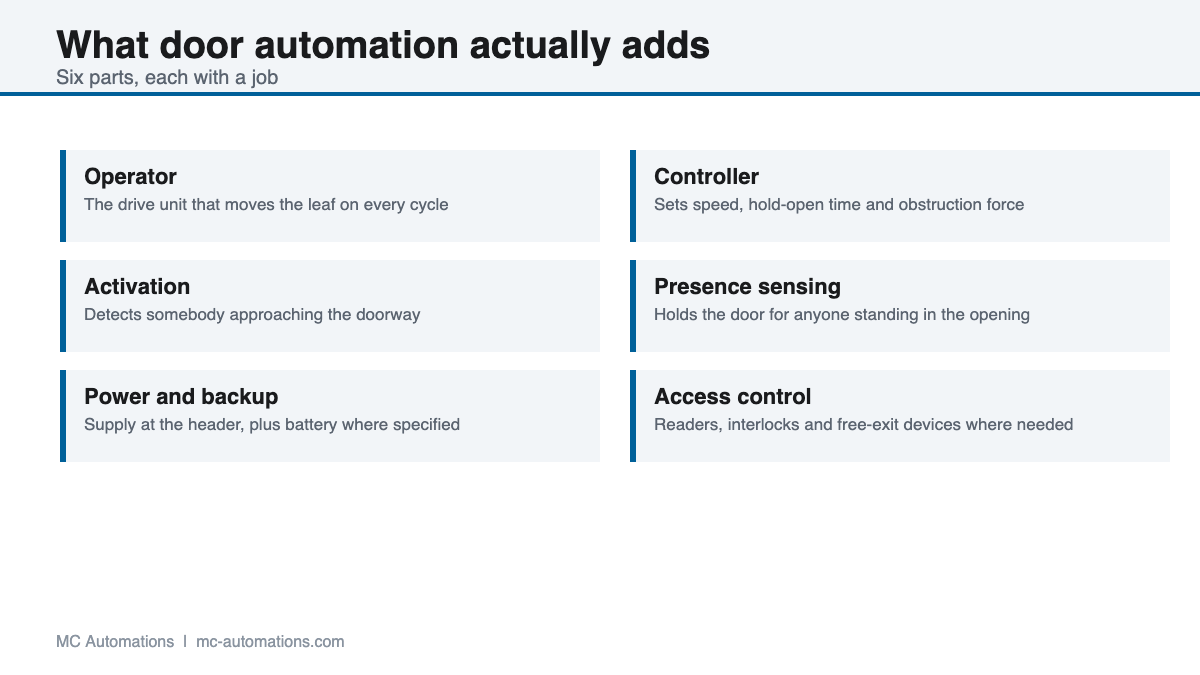
A door automation system is not a motor. It is a set of parts that have to work together, and knowing what they are makes a quotation far easier to read.
- Operator. The drive unit — motor and gearbox — that moves the leaf. On a slide that is the MC-125; on a swing, the MCW-100.
- Controller. The logic. It takes sensor inputs, decides the cycle, and holds every setting. It is also what any access control system talks to.
- Drive belt and pulleys. How motor rotation becomes leaf travel on a sliding entrance. A wear item, replaced on service rather than after failure.
- Carriages, hangers and track. What the leaf hangs from and runs on. Most mechanical faults in door automation live here rather than in the motor.
- Floor guide. Cheap, routinely neglected, and the reason a leaf starts swinging at the bottom and wearing the carriages above it.
- Activation sensor. Sees approach, opens the door.
- Presence or safety sensor. Sees somebody standing in the opening and stops the door closing on them. Not the same device and not optional.
- Power supply and backup. What the entrance does during an interruption is decided here, before the order rather than during an outage.
When a quotation lists only an operator, it is not a quotation for door automation — it is a quotation for one component of it.
Why alignment matters more than motor power
The most common misdiagnosis on an automated entrance is a motor blamed for a mechanical problem.
A sliding leaf should move freely by hand with the power off. If it drags, binds, or needs a shove to get going, the operator is compensating for that resistance on every cycle of every day. The controller frequently reads it as an obstruction and reverses, which presents as a sensor fault and is not one. Meanwhile the belt, carriages and gearbox wear at a rate nobody has budgeted for.
This is why a competent door automation installation proves the mechanics before relying on the drive. Track clear and true, carriages sound, floor guide intact, leaf level, threshold drained and flat. Only then does the operator get asked to move anything.
It is also why “the motor is failing” is a conclusion rather than a starting point. A door that has become heavy or slow is usually a doorway that has changed — hinges settled, flooring replaced, grit in the track, a frame that has moved — against an operator still set for the doorway it was commissioned against.
Door automation and access control, briefly
Door automation and access control are separate systems that have to agree with each other.
A reader, keypad or intercom does not open a door. It makes a decision and passes a signal to the controller, which runs the cycle described above. That boundary — what cable runs between them, what contact type the operator expects, who pulls it — is where projects stall, and it is far cheaper to settle at first fix than after the ceiling is closed.
What the entrance does on power loss and on fire alarm is the other half of that conversation, and it belongs to the people who own the life-safety and security risks rather than to us. Our access control page covers the detail.
Sliding door systems, entrance automation, door operators: the words people use
Buyers arrive at door automation through half a dozen different phrases, and they usually mean the same handful of things. It is worth setting them side by side.
- Sliding door systems. The complete sliding entrance — panels, track, carriages, operator and sensors. A single sliding door system has one moving panel running alongside a fixed one; a bi-parting sliding door system has two opening away from the centre. Both are covered on our automatic sliding doors page.
- Entrance automation. The same work described from the building’s side rather than the product’s. Where a specification says entrance automation, it usually means door automation plus the sensing and access control around it.
- Door operators. The drive units themselves — sliding door operators and swing door operators. The operator is one component; the entrance is the system.
- Automated glass doors. A description of the leaf rather than the mechanism. Glass, aluminium framing, operator and sensors are specified together, not bought separately.
- Commercial door automation. Door automation specified for the traffic a business actually carries, rather than domestic-duty equipment asked to do commercial work.
- Automatic sliding door mechanism. The cycle described further up this page: detection, acceleration, travel, braking, hold open, closing.
The same applies on the service side. Door operator repairs, sliding door system repairs and automatic door repairs describe the same attendance; what changes is whether the fault turns out to be in the drive, the mechanics or the sensing. We attend all three on any major brand — see repairs and servicing.
Door automation sensors and motion sensors for sliding doors are the same components discussed on our sensors guide: one type detects approach, the other watches the opening.
Geographically the phrasing shifts too. Door automation Johannesburg is where our same-day call-outs apply, from Laser Park in Roodepoort. Door automation Gauteng extends that across the province. Door automation South Africa means installed and serviced nationwide, on a scheduled basis outside Gauteng — we would rather write that down than quote a response time we cannot honour.
In short
Door automation at a glance
- Door automation here means pedestrian entrances only — sliding, swing, telescopic, revolving and hermetic. Not gates, not garage doors.
- The operator gets the attention, but the sensor arrangement and the commissioning decide whether the entrance is pleasant to use.
- Backup behaviour on power loss is a specification decision taken before the order, not an accessory added afterwards.
- Service intervals should follow the real cycle count rather than the calendar.
- Every opening is quoted against a site measure, not a catalogue price. Send the sizes, a photograph and your daily traffic to start.
