
Office park automatic doors for landlords and managing agents: who owns which entrance, the access states a working week needs, the morning peak that sizes the lobby, standardising across an estate, and why maintenance recovery changes the contract.
Sliding Door Automation Kit: The Seven Components
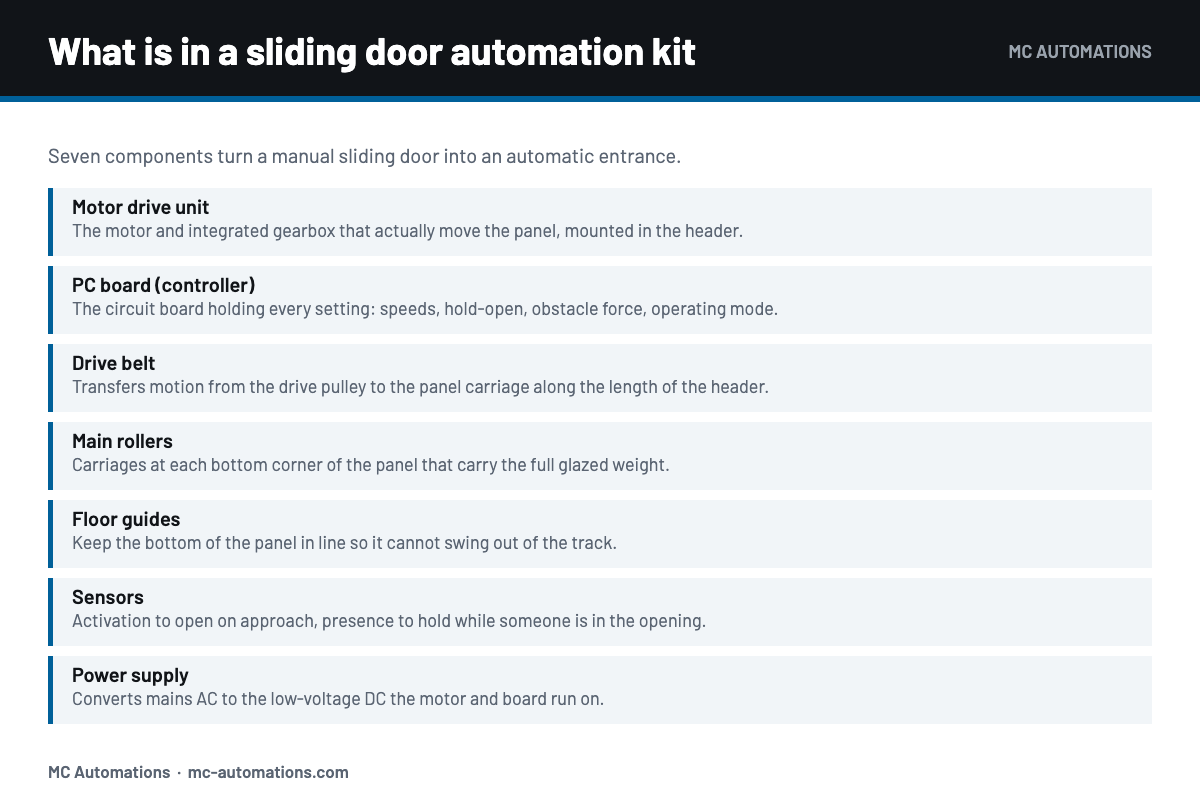
Sliding door automation kit is the set of components that turns a manual sliding door into a powered entrance. There are seven of them, they each do one job, and knowing which is which turns a vague fault into a specific one.
This guide walks through the motor drive unit, the PC board, the belt, the main rollers, the floor guides, the sensors and the power supply, what each does, and how each one fails.
The motor drive unit
The drive unit is the motor and its integrated gearbox, mounted inside the header above the opening.
Its job is simple: turn a pulley. Everything else in the sliding door automation kit exists to translate that rotation into a panel that moves safely.
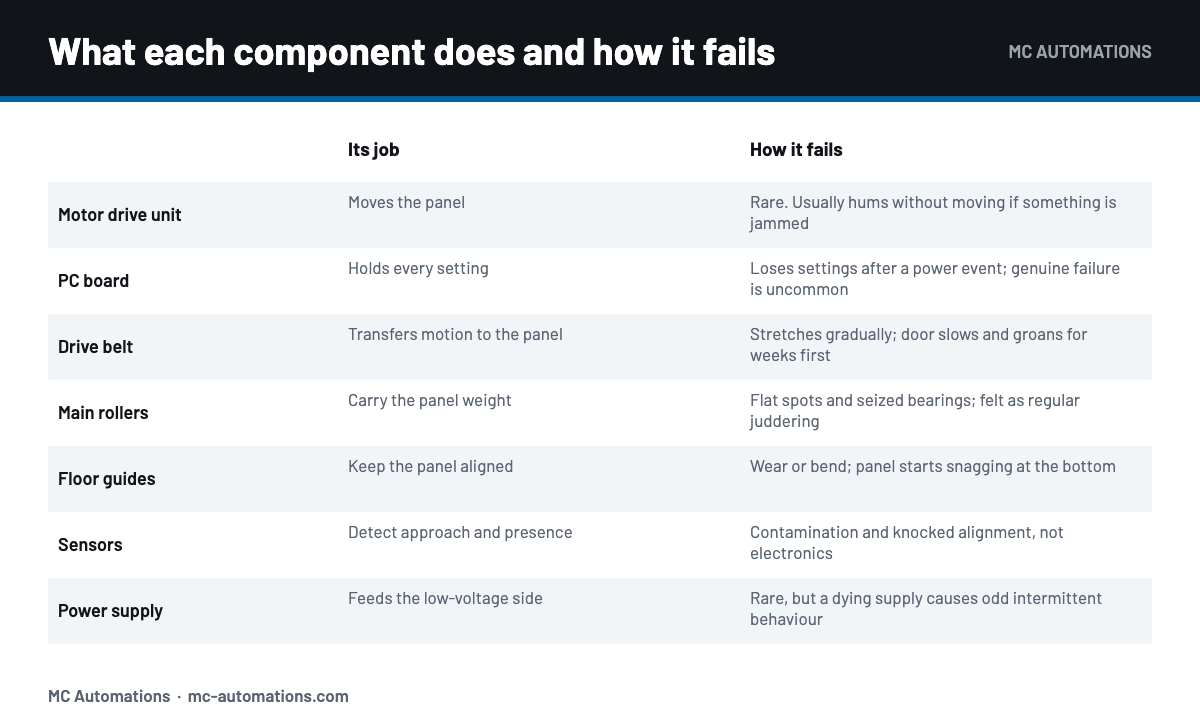
Genuine motor failure is rare. What people usually report as a failed motor is a unit humming without moving, and that is almost always something jammed in the track or a belt that has stopped gripping.
On our own operators the drive unit is a DC brushless motor with an integrated gearbox. Full figures are on the automatic sliding door operator page.
The PC board
The PC board, or controller, is where the entrance actually lives.
Opening speed, closing speed, hold-open time, obstacle detection force and the operating mode are all values held on this board. Two identical doors behaving completely differently are usually two boards set differently, not two different products.
Boards do fail, but far more often they lose their settings after a power event or a dirty supply. That is why so many faults reported after load shedding turn out to be a reset rather than a repair.
Most boards also show an LED pattern or fault code that names the failing part, which is the first thing a technician looks at.
The drive belt
The belt runs the length of the header and transfers motion from the drive pulley to the panel carriage.
It is a wearing part and it stretches gradually rather than snapping. That gradual stretch is why a door becomes slower and noisier over weeks, and that noise is the single most useful early warning any sliding entrance gives you.
Acting on it is far cheaper than waiting, because a belt replaced on a planned visit costs a fraction of one replaced during trading hours.
The main rollers
The main rollers are the carriages at each bottom corner of the panel, and they carry the entire glazed weight through every cycle of the door’s life.
They are the most common mechanical failure in any sliding door automation kit. Flat spots develop when a wheel has been dragged rather than rolling, and you feel them as a regular bump as the panel travels.
Most carriages also carry a height adjuster, which squares the panel to the frame. A door catching at one end is often adjustment rather than wear, and that is worth trying before ordering parts.
The floor guides
Floor guides keep the bottom of the panel in line so it cannot swing out of the track.
They are the smallest and cheapest part in the kit and the one most reliably ignored, usually until the panel starts snagging or scraping at the bottom.
They are also where grit does its work, which is why vacuuming the track protects the guides as much as the rollers.
The sensors
Two sensors, two different jobs, and they fail in opposite directions.
Activation looks outward at the approach and opens the door. Presence looks down into the threshold and refuses to let the door close on somebody standing there.
A failed activation sensor gives you a door that will not open. A confused presence sensor gives you a door that will not close. See how automatic door sensors work.
These are the first components in any sliding door automation kit to complain, and contamination rather than electronics is nearly always the reason.
The power supply
The supply converts mains AC into the low-voltage DC that the motor and board run on.
Outright failure is uncommon, but a supply on its way out causes exactly the kind of intermittent behaviour that is hardest to diagnose: a door that works all morning and misbehaves in the afternoon.
Where a battery backup is fitted it sits alongside the supply, and a dead backup is invisible until the power actually goes. That is one of the things a service should be testing.
How they work together
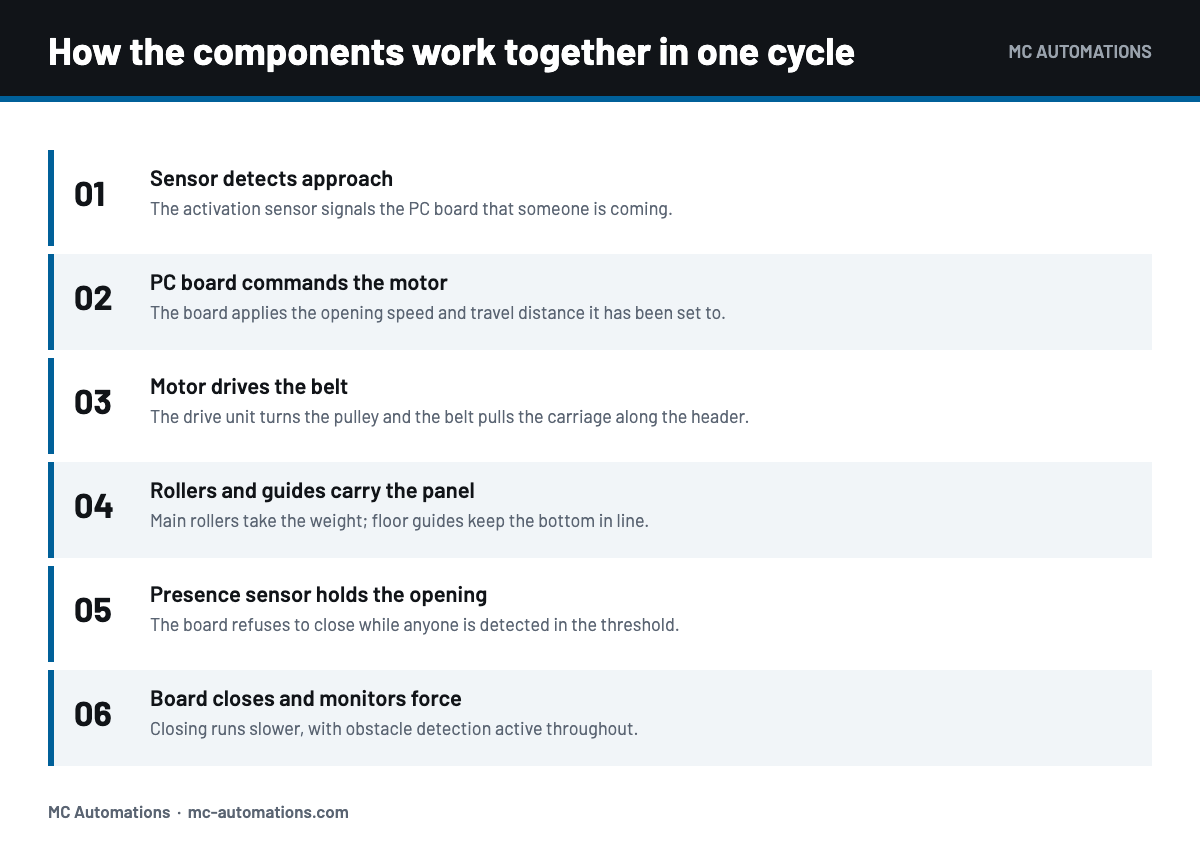
One cycle uses every component in sequence: sensor detects, board decides, motor drives, belt transfers, rollers carry, guides align, presence holds, board closes under force monitoring.
That sequence is also the diagnostic order. Whichever step the door gets to before it stops tells you which component to look at.
Before automating an existing door
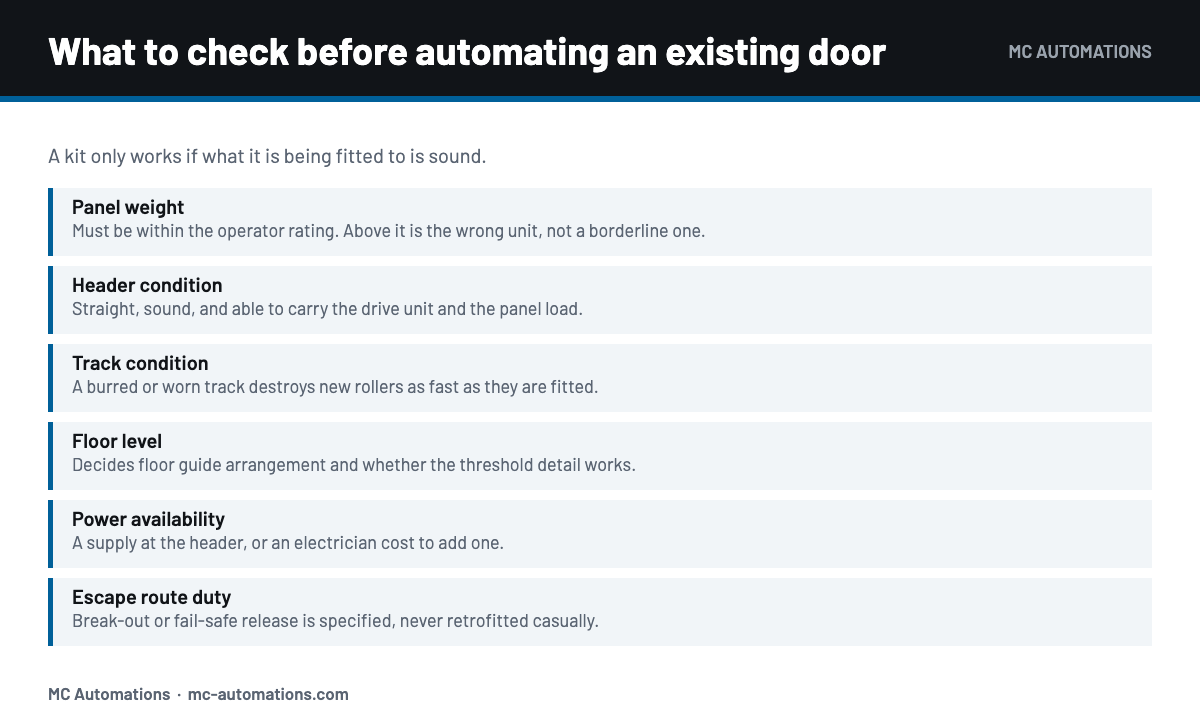
Panel weight first, because it must be within the operator rating. Above that limit it is the wrong unit rather than a borderline one.
Then header and track condition. A burred or worn track will destroy new rollers as fast as they are fitted, and fitting a kit to a bad track is spending money on a symptom.
Then power at the header, floor level for the guides, and whether the opening forms part of a fire escape route.
See automating an existing door for the wider process.
Kit or complete entrance

Where the header, track and panels are sound, automating what is there is usually cheaper and faster, and it puts the money into the parts that actually wear.
Where the track is damaged or the framing has moved, a complete entrance is the honest answer. See automatic door modernisation.
Parts and support
Belts, roller carriages, floor guides, sensors, controllers and power supplies are the parts any sliding door automation kit ever needs, and we hold them locally because our operators are imported and assembled at our Johannesburg facility.
See automatic door spare parts, or request a quote. Call 010 412 0062, Monday to Thursday 08:00 to 16:30 and Friday 08:00 to 14:00.
For a component-by-component view of the door itself rather than the automation, see parts of an automatic door. For published national standards, SABS, the South African Bureau of Standards is the reference body in South Africa.
Sliding door automation kit: quick reference
Motor drive unit. The part of a sliding door automation kit people blame first and that fails last.
PC board. Holds every setting. After a power cut this is usually a reset rather than a fault.
Drive belt. Stretches slowly. The groaning it causes is the best early warning a sliding door automation kit gives you.
Main rollers. Carry the whole panel weight and wear fastest of the mechanical parts.
Floor guides. Cheapest item in the sliding door automation kit and the one most often ignored.
Sensors. First to complain, and contamination rather than electronics is nearly always why.
Power supply. Rarely fails outright, but causes intermittent faults when it is on its way out.
Diagnosing a fault. Work along the cycle in order. Whichever step the door reaches before stopping names the component.
Before buying a sliding door automation kit, confirm panel weight, header condition, track condition and power at the header.
Servicing a sliding door automation kit
The service items map straight onto the component list: track and rollers, belt tension, floor guides, sensor cleaning and walk-test, obstacle force on the board, and the battery backup where fitted.
Interval follows traffic rather than the calendar. Quarterly at retail footfall, twice a year at a quiet office entrance, and shorter again in butcheries, forecourts and cold rooms.
Between services, the single highest-value task anyone on site can do is vacuum the bottom track. Grit attacks the rollers and the floor guides simultaneously, and it is doing that damage on every cycle.
Keep dated records. A service history is what lets you argue wear against defect if a warranty question arises.
Why component knowledge saves money
A caller who says the door is groaning and slow gets a belt on the van. A caller who says the door is dead gets a technician checking supply and mode switch first.
A caller who says it judders gets rollers. One who says it will not close gets a presence sensor cleaned rather than a controller replaced.
That is the practical value of knowing what is in a sliding door automation kit. It is not so you can repair it yourself, it is so the right part arrives on the first visit instead of the second.
Choosing a sliding door automation kit
A sliding door automation kit is specified from the panel it has to move, not from the opening it sits in.
Start with panel weight and panel width, because every other figure in a sliding door automation kit specification is conditional on those two.
Then look at the adjustment range on the board. A sliding door automation kit with a narrow speed range cannot serve both a quiet reception and a busy retail entrance, and that flexibility is what lets one product family cover a whole estate.
Then ask where the spare parts are held. A sliding door automation kit is only as good as the belt you can get for it in a hurry.
Then confirm what the entrance does on power failure, and whether the opening is on a fire escape route. No sliding door automation kit removes the requirement for an opening to be passable without power.
Finally, be honest about the environment. A sliding door automation kit in a butchery or a forecourt will need its sensors cleaned far more often than the same kit in an office reception.
What a sliding door automation kit does not include
Worth stating, because it is where unexpected cost appears.
The electrical supply to the header is usually not part of a sliding door automation kit. If no supply exists there, that is an electrician cost.
The panels and track themselves are generally not included when you are automating an existing door, which is the whole point of doing it that way.
Break-out panels or a fail-safe release for escape routes are specified separately, and access control integration is its own item again.
Ask what is excluded rather than assuming. It is the single most common source of a revised quotation.
What a sliding door automation kit does not include
It is as useful to be clear about the boundaries of a sliding door automation kit as about its contents, because the gap between the two is where budgets go wrong.
The leaves and the glass are not part of it. A sliding door automation kit drives leaves; it does not supply them, and where the existing glass is not safety glass it has to be replaced — the standard we work to is 6.38 mm clear laminated safety glass. The frame and any structural work to the opening sit outside it too, as does the electrical supply to the head of the door. On a retrofit those three items are frequently the larger part of the cost.
Access control is a separate system that a sliding door automation kit integrates with rather than contains. The operator takes a release signal from a reader, a keypad or a building system; the credentials, the readers and the software belong to that system. Similarly, a battery backup is an option rather than a default, and on any entrance that has to keep working through load shedding it should be specified deliberately.
One thing that is never part of it: we do not supply, fit, retrofit or service door closers. Where an existing leaf has a closer on it, that device comes off — a sliding door automation kit controls both the opening and the closing, and a closer working against it is a fault rather than a safeguard.
Specifying a sliding door automation kit for the opening you have
Four numbers settle which sliding door automation kit applies: the clear opening width, the leaf weight, the configuration, and the cycles the entrance will actually do.
The MC-125 covers sliding entrances from 1450 mm to 5000 mm of clear opening with leaves to 150 kg, in single, bi-parting or telescopic configurations. Side room decides which of those three you get: a single leaf needs wall to park against equal to the clear opening plus an overlap, bi-parting halves that requirement and opens in half the time, and telescopic clears more opening from less wall by stacking two leaves per side. All three use the same drive; what changes is the track, the carriages and the belt run.
Duty is the number nobody sends. A sliding door automation kit on a retail entrance doing six hundred people an hour is a different specification from the same opening on an office corridor, even though the drawings are identical. Both the MC-125 and the MCW-100 are tested to one million operating cycles, which is a comparison figure rather than a service life — what determines how long a sliding door automation kit lasts is how much headroom it has over the daily load, and whether it is maintained.
Sliding door automation kit, answered
What is in a sliding door automation kit?
A motor drive unit, a PC board, a drive belt, main rollers, floor guides, activation and presence sensors, and a power supply. Those seven parts turn a manual sliding door into an automatic entrance.
What does the PC board do?
It holds every setting the entrance runs on: opening and closing speed, hold-open time, obstacle detection force and operating mode. Most post-power-cut faults are a board that has lost its settings rather than a failed board.
What does the drive belt do?
It transfers motion from the motor pulley to the panel carriage. It stretches gradually, which is why a door gets slower and noisier for weeks before it stops.
What are the main rollers?
The carriages at each bottom corner of the panel. They carry the entire glazed weight through every cycle, and flat spots or seized bearings are the most common mechanical failure.
What do floor guides do?
They keep the bottom of the panel in line so it cannot swing out of the track. Small and cheap, and usually ignored until the panel starts snagging.
What power supply does a sliding door automation kit need?
Mains AC at the header, converted to low-voltage DC for the motor and board. If no supply exists at the header, adding one is an electrician cost to budget separately.
Can any sliding door be automated?
No. Panel weight must be within the operator rating, and the header and track must be sound. Condition decides it rather than age.
Is a sliding door automation kit cheaper than a new automatic door?
Usually, where the existing header, track and panels are sound, because the money goes into the moving parts rather than the whole entrance.
Which part of a sliding door automation kit fails first?
The sensors, and almost always through contamination rather than electronics. Rollers and the belt follow, and both are accelerated by grit in the track.
Do you supply and fit automation to an existing door?
Yes. Send a photograph of the opening, the panel size and weight if known, and we will tell you whether automating it is viable.
In short
Sliding door automation kit at a glance
- Sliding door automation kit are quoted against the opening we measured, not a catalogue price.
